
 Continue with onX Maps
 Sign in with Facebook






Voie Rébuffat-Baquet

5.10- YDS 6a French 18 Ewbanks VI+ UIAA 18 ZA E1 5a British
 Avg: 3.9 from 74
votes
Avg: 3.9 from 74
votes
Routes in Aiguille du Midi
|
|
Ballade pour Aurelia T 5.12a 7a+ 25 VIII+ 25 E5 6a |

|
Contamine T 5.11c/d 7a 24 VIII 25 E4 6a |
|
|
Ma Dalton T 5.12c 7b+ 27 IX- 27 E6 6b |
|
|
Monsieur de Mesmaeker T 5.12b 7b 26 VIII+ 26 E5 6b |
|
|
Super Dupont T 5.11d 7a 24 VIII 25 E5 6a |
|
|
Voie Kohlmann T 5.10+ 6b+ 21 VII+ 20 E3 5b |
|
|
Voie Mazeaud T 5.11c 6c+ 24 VIII- 24 E4 6a |
|
|
Voie Rébuffat-Baquet T 5.10- 6a 18 VI+ 18 E1 5a |
| Type: | Trad, Alpine, 700 ft (212 m), 11 pitches, Grade II |
| GPS: | 45.87865, 6.88754 |
| FA: | G. Rébuffat and M. Baquet (1956) |
| Page Views: | 23,162 total · 141/month |
| Shared By: | Seleucus on Jun 18, 2012 · Updates |
| Admins: | Bogdan Petre, David Riley, Luc-514 |


Description
The Voie Rébuffat-Baquet is a truly beautiful line in a fantastic setting. The route is rather well equipped for a trad route there are oftentimes pitons in the most difficult sections and most of the belays are equipped for rappel. With the proximity of both the Aiguille de Midi telepherique and the Cosmiques refuge, it has become possible to do this climb with fairly minimal commitment for climbers who would otherwise avoid the long approaches and committing routes of the Chamonix Aiguilles.
That being said, this is a route at high altitude with highly variable weather. Be prepared! Fatigue can quickly slow a party who are unused to climbing at altitude and snow or ice on the route can render otherwise simple pitches very difficult. Furthermore, the weather can change at any moment and rappelling the route in bad conditions can become very difficult.
At the top route-finding can be problematic and there are many different variations. I have included the beta for just one of these variants.

The grades I listed should be taken with a healthy dose of skepticism. Almost every guidebook I own lists a different grade for each pitch of the route and translating these grades from the French scale to the YDS adds an additional element of uncertainty.
Pitch 1 (5.8/5.9): Go straight up and obvious crack/dihedral, pull through a vertical section (5.9), continue on up the dihedral. Next move left along a horizontal crack and go up the face (thin moves) and move under the roof. There are two belays one under the roof and the other at the left edge of the roof. The one on the left is the most commonly used (and recommended) and makes it easier for the belayer to see the climber on the 2nd pitch.
Pitch 2 (5.10): Typically considered the crux pitch. Move up the s-shapped crack and curve left to a belay. Pitches 2 and 3 can be linked if crowds allow. If linking pitches, don't clip the intermediate belay anchor and instead place a cam above the belay in the crack to minimize rope drag. The rope should follow a relatively straight line.
Pitch 3 (5.10): Move up and to the right following the obvious weakness. Make a tenuous move left to a big jug with a pin, and climb up a crack (on the left) and a flake (on the right) until you reach the belay at the top of a comfortable stance at the top of a column.

Pitch 4 (5.8): Move down and to the left. From here move up to a protruding flake. Move behind the flake or go outside of it to gain a left slanting ramp. Climb the crack on the ramp to an excellent belay ledge (great for a picnic!). This pitch can easily be linked with Pitch 5 using long slings.

Pitch 5 (5.9): From the belay ledge go right and continue up the ramp. Make awkward moves across a slab and go up the crack system to the left. Belay at the top. This pitch can easily be linked with Pitch 4 using long slings.
Pitch 6 (5.8): Move up a wide crack (5.8). Here the route splits, going straight up is 5.10 (parallel finger cracks), moving to the right and arcing back following good holds and cracks is much easier 5.4/5.5 (as shown on the topo).
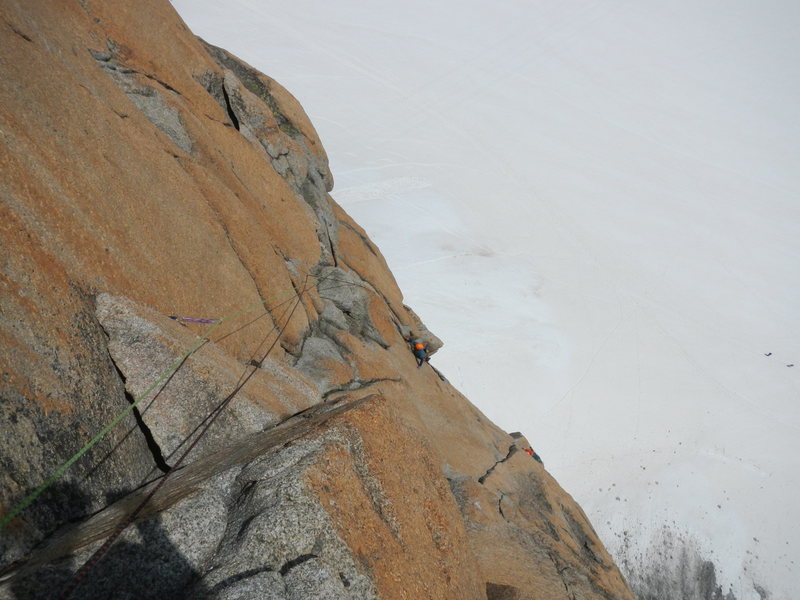
Pitch 7 (5.9): From the belay move horizontally left on large ledges for about 4 meters. From here move up easy holds (5.7) until you reach a dihedral with a crack in it. The crack has some pitons and stuck nuts. Pull through this crack (5.9) and follow (grovel up) an extremely awkward gully (can be wet from snowmelt). When this ends follow cracks to the left and belay at the top.
Pitch 8 (5.2?): An easy linking pitch. Move down and left then go up a few meteres to a belay. This can be linked with pitch nine but beware of rope drag.
Optional: Here you can continue traversing to the left to finish up the spectacular Desmaison corner (6c+), highly recommended! Despite the crux being a thin finger crack, it's protected by 9 pitons and a fixed nut, which means you only need cams from 0.5-3 to protect it.
Pitch 9 (5.5): Follow easy holds up a gently sloping gully. The belay is on the right of the gully.
Pitch 10 (5.8): Follow the gully until the end (unless it is full of snow in which case you can follow the ridge on the right) then move up a crack system on the left to a belay on a good ledge.

Pitch 11 (5.10+ or 5.8 A0): From the belay move left onto the face and make thin moves (well protected by bolts) until you reach easier climbing on the arête before moving completely onto the right side of the arête. Continue with easy moves to the summit.

- More information: chamgranit-topos.com/cham_n…
- Translation from french by Aanoud Petermann
Photos


13 Comments