
 Continue with onX Maps
 Sign in with Facebook






Proposal to fix rock grades



|
I’m here to propose a grading system. Yes, that’s right – a new grading system, to supplant the dozen systems already in place. It takes the best of the existing scales, removes the historical garbage, and gives YOU the information you need to onsight that next level route in a glance. I propose the name “Universal Grading System” (UGS), though if users decided to refer to it as the Roe system I wouldn’t be offended. Let’s start by looking at the best features of different existing scales. Here's a conversion chart for reference: 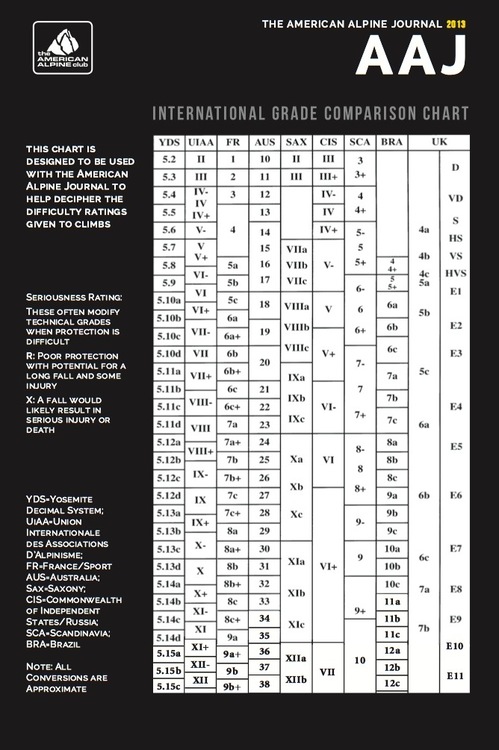 Brittish trad grades: The great part here is that the grades have two dimensions, giving you an idea about the hardest move on the route, and the “overall seriousness” of the route. They certainly have the right idea, but where does it go wrong? I’ll tell you – It misses the mark in two aspects. First, the scales are independent. That is to say, the seriousness grade is a full scale from Difficult to Extremely Severe 11, with a bunch of nonsensical garbage in the middle (D, S, VD, HVS, WTF???). This means that you have to do a conversion in your head (“so it’s 6b E1, which means there’s probably just one or two hard moves”, or the opposite “It’s 7c E6… So I guess it’s mega sustained? Or has terrible gear?”) That leads me two failure two: the serious grade combines the sustain level with the safety level. We’ll have to separate those out. YDS: Mountain project’s favorite. Unfortunately, it has the nonsense of mixing letters, numbers, and +/- or even the absurd “slash grade” 5.10a/b. It also has weird baggage around combining grades “5.11-“ and includes the 100% useless 5th class designation. It does have one thing going for it though – safety ratings. Based off movie ratings, a climb that’s a tad spicier than normal is given a pg13, something that you could hurt yourself on is an R, and a climb with a real possibility of death or disfigurement is an X (very apropos). Alright, with that said, let’s get to the new system. In brief: Ewbanks grades for the hardest move on route, YDS safety ratings, and +/- to indicate sustain in the style of British grades. Now, I know what you’re thinking – Eric, I thought you hated + or – attached to grades? Well you’re right. In order to make it impossible to use them anyway despite it being officially unsupported, I’ve coopted them into reflecting the sustain. Here’s a breakdown: Difficulty: We use the small increments of the Ewbanks scale, but shifted down. Ewbanks includes scrambling grades, but we’re climbers not hill walkers so we don’t care about that. If you look at a conversion chart, you’ll see that French and YDS grades line up after 5.8 or so, and Ewbanks is pretty close. So for the initial swath of conversion, the supported formula has a benchmark at 5.9 / 5b French == 9 in the new scale. To convert other grades, count the number of steps in YDS up or down. This amounts to chopping off the “5” from YDS for grades below 5.10 (unfortunately French grades get a bit messed up, oh well). For grades above 5.10, here are some conversions: 5.10d == 6b == 13 ; 5.11c == 6c+ == 16 ; 5.12c == 7b+ == 20 ; 5.13d == 8b == 25 ; 5.15a == 9a+ == 30. Sustain: Ok, that’s the hardest move on the route. What about sustain? We use the following: --, -, <no modifier>, +, ++. Note, the distribution of climbs within each designation isn’t uniform, it’s normal. Ie, a bell curve. Roughly, I’m imagining the spread to be 10%, 25%, 30%, 25%, 10%. That means that “—“ is reserved for one move wonders. ++ is only used for fully sustained endurofests, where every move is within ~2 grades of the max. Single “-“ grades have maybe a couple boulder problems at the grade, or a 5m stretch of hard climbing. No modifier means that there are multiple distinct hard parts within ~2 grades of the max, or a section up to 10m or so. Single “+” grades refer to stout climbs with a lot of hard climbing, separated by excellent rests or sections of easier climbing. Finally, Safety. While it initially sounds appealing to break the safety rating into choss and runout components, doing so would lead to unwieldy, long grades. Instead we combine them. Due to a lack of appealing alternatives, we stick to the YDS convention of PG13, R, X. I also support different locales using an “X” system if it makes sense for the area, as long as it is made clear in the guidebook: X, XX, XXX. PG13 indicates mild runouts or loose scree on route. R indicates runouts which are likely to lead to injury, or lots of large, likely to topple blocks which may injure either the climber or belayer. X involves “no fall” zones, or unprotectable sections with a serious risk of death or severe injury. In the YDS tradition, safety ratings take into account the difficulty of climbing – runout 5+ on a 13- climb doesn’t warrant a PG13, for example. It is expected that climbers turn to route descriptions for detailed info about the specific reasoning for a grade. Alright, now for some examples. I’ve converted the grades of a few climbs I’m familiar with.
Alright, there you go. I’m giving this great idea away free of charge for the world to use. I expect MP to add a conversion option immediately, and expect new guidebooks to take up the charge posthaste. |
|
|
 |
|
|
Yes, thank you for restating the first link in the post ;) |
|
|
Eric Roe wrote: Yes, thank you for restating the first link in the post ;) Linking was too subtle. |
|
|
Plus we can make rating scale for you by correlating your ratings of current routes with what others have said so that what you see for rating will be based upon what people like you have said about other routes. Think of it like Netflix recommendations for climbing. |
|
|
Eric: Excellent notion! A few thoughts: |
|
|
Pg13 is absolutely necessary. Think of it as R- with humor. |
|
|
Nick Goldsmith wrote: Pg13 is absolutely necessary. Think of it as R- with humor. Do you mean the "13" after the PG is necessary, or do you mean there should be both a "PG"grade and a "PG-13" Grade? |
|
|
Can Duck Tape fix it? |
|
|
Robert Hall wrote: If you know where those abbreviations came from, you'll understand why there is a PG-13. |
|
|
My understanding, because I don't climb hard, is that many of the very hardest climbs are really long sequences of less hard moves. Pro climbers and elite climbers will never go for rating the hardest move of a climb; they want bigger numbers. |
|
|
Viva La difference. Enjoy the variations and stylistic differences when you go to new areas. |
|
|
Absolutely not. Too logical and simple. Please take that as a complement. But, no: The more confusing and unclear the system, the better. Part of the charm if you will. This is why I love YDS and British systems, and despise the Ewbank scale (though the fact the Ewbank scale changes depending on whether one is in South Africa or Australia is a plus). Furthermore, vague and confusing grades allow for you to feel terrible - or great - about your climbing performance at any given time depending on your psychology and they provide endless fodder for (usually) good-natured arguments on the car rides to/from crags. |
|
|
I can’t tell if the post itself is facetious or just the wording. Then a Roman numeral for the grade. For example 17V16AIV Is a 5.11c route: 17 Has a 5.11b crux: V16 Has G (plenty of easy to place) protection: A Is grade IV / all day route: IV The biggest problems are that the numbers are similar but not the same as the aussy scale and V scale. |
|
|
I say revel in the absurdity of the various grading systems. Celebrate the inconsistencies from area to area, route to route. Laugh at the nonsense of it all. Understand that grades have nothing to do with climbing and everything to do with competition and ego. A consistent grading system would be boring as hell. |
|
|
I like the diversity and history of the various rating systems. Ego and number chasing are the least of my interest. What I and many others like about good ratings is it allows you to pick climbs that are an appropriate challenge for you to repoint or flash or cruise. |
|
|
I say rate everything, including boulders, sport, trad and alpine, either 4th Class or Hard Very Severe and leave it at that. |
|
|
Robert hall. Both. PG You need to pay attention . PG13 you should know your being messed with. Parental guidance is suggested but the parents are way more experienced in a Hendrick's way than any of the cool kids. Think of it as the 9+ of protection grades. |
|
|
Lol. Love the caffeine-based posting. Can tell you put lots of effort into it and I learned a thing or two. |
|
|
???? I couldn't understand at ALL after only one beer. I think I need a few more. I imagine that's how the UK system works - several pints in the pub and it makes perfect sense. As for safety, to paraphrase Lovelace or somebody, it's all PG until you fall. |
|
|
I knew something would come out of this Covid 19 thing. Didn't say it was good, but it's something. |


