
 Continue with onX Maps
 Sign in with Facebook






Routes in Savandurga Hill


|
Beladingalu T 5.9+ 5c 17 VI 17 E1 5a PG13 |
|
|
Cloud Nine S 5.5 4b 13 IV+ 11 MS 4a PG13 |
|
|
Deepavali T 5.7+ 5a 15 V+ 13 MVS 4b X |
| Type: | Trad, 900 ft (273 m), 8 pitches, Grade III |
| GPS: | 12.91917, 77.29473 |
| FA: | Charu Sharma, Rohan Kanhai, and Mandip Singh Soin |
| Page Views: | 4,037 total · 34/month |
| Shared By: | T T Niranjan on Jan 2, 2017 |
| Admins: | Gokul G, Sandeep Bhagyawant, Gunkswest |


Description

Named after the "Festival of Lights", Deepavali was the first technical route on Savandurga, climbed in 1984 after multiple previous attempts. Over the last three decades multiple parties have climbed the route/face, usually through variants that differ from the original line by a few feet to a few hundred feet. As a result today there are about half a dozen known variants (see references at the end). Some variants have almost no part of the climb in common.
I suppose the local climbing community will eventually evolve a consensus on whether to call all of them variants of Deepavali Route, or club all variants/routes under something like "Deepavali Wall, Savandurga" and give each route its own name. In this page I only describe the variant I climbed with Samiran Kolhe on 30 Dec 2016, primarily to inform future climbers from going astray. We ended up on the final pitches (Pitch 8) in a purely exploratory way.
There are simply too many ways of getting to the top and while most variants are run out, some are extremely run out. No single move described in the variant in this topo is harder than 5.10a/F6a or thereabouts but this is a poorly protected, committing route. Apart from climbing endurance, you need to have good tolerance to the sun/heat as this is a south facing route.
Approach: Follow a strong trail behind the first temple (unmistakable; ask for Veerabhadraswamy Temple if in doubt) past the little temple/place of worship with some carved stones strewn around, into the woods. From there a faint trail that turns into bushwhacking and boulders to get to the start of the climb. ~45 mins.

The route:
P1:
Start along the right side crack or go up the face/slab directly above the tree. Both options lack protection options for about 20 or 30m, 5.6/5.7 slab. After that you can place a cam on the right side crack after which the angle eases and you can set up a belay about 10 meters higher, takes in two solid cams, or further on 20 meters, along a ledge leading to a tree.

From there, turn left to P2.
P2 can be done inside the wide horizontal crack (if you are thin/small enough to crawl through it), or 5-10 feet below it as we did it, or 10-20 feet below it, as the Sohan and Poonacha variant does, to bushes/tree around the corner of the large flake.

P1 and P2 can perhaps be combined with a 70m rope; in line of sight and audible range, I think.
P3 The best pitch in my view; steep and spicy, no protection for the first ~8 meters, after which there is a sturdy chockstone to lasso. Continue straight up; possible to place two more cams until you hit a decent sized tree. Delectable climb, ends at the tree anchor. It is the best belay station in the entire route; you can sit comfortably on the tree, in the shade and enjoy views while belaying the second. Length: 30m. Grade: 5.7+


P4:
Continue under the roof/crack rightward and outward, following the crack system till it merges into a ledge right below a headwall. P4 is rather short (~15-20m?), nevertheless it probably has to be done as a pitch of its own to avoid the rope getting into the crack and also because the leader will be completely out of sight/hearing and rope signals will also be difficult. You can still try merging P3 and P4, now that we have clarity on where it ends.

P5:
Starts as an exposed, delicate traverse to the right. You lose about 10 or more meters elevation over a 30-40 metre pitch: traverse turns into a down-climb along a thin, barely there crack on the face. Barely any protection possible at the P5 station; ask your follower not to fall!

P6
continues up the obvious diagonal crack, upwards. Set up a pitch at a modest sized tree; possible to place a large cam. Protection is in general very hard, given the shallowness of the crack

P7:
continue up the crack system till the next cactus tree. Sketchy belay; possible to place one moderately good cam as backup. Looks feasible to merge P6 and P7; in line of sight and hearing.

**P8 is heady, neat Vodka!
~5.7 (5a), 70m long, is a slab/face climb right of the standard exit gully marked by the dotted lines "3" and "4" in the TOJ topo. Starts on the sketchy cactus tree and cam belay station, continue up the crack system for about 10 odd meters before you feel comfortable stepping on to the face on the right, that's about 4-5 feet higher. This transition is the crux; I felt this exposed move with little protection was more like 5.7+, 5b. Once on the face, just continue to plough on for a total of ~70m from the previous station. It offers nil protection in the last 50m and has massive rope drag as the angle eases in the upper half (about 5.6). There is a decent place to plant both feet just behind the tuft of grass from where you body belay the follower.
This pitch, we believe, adds about 50m of high quality slab/face climb to the existing variants.
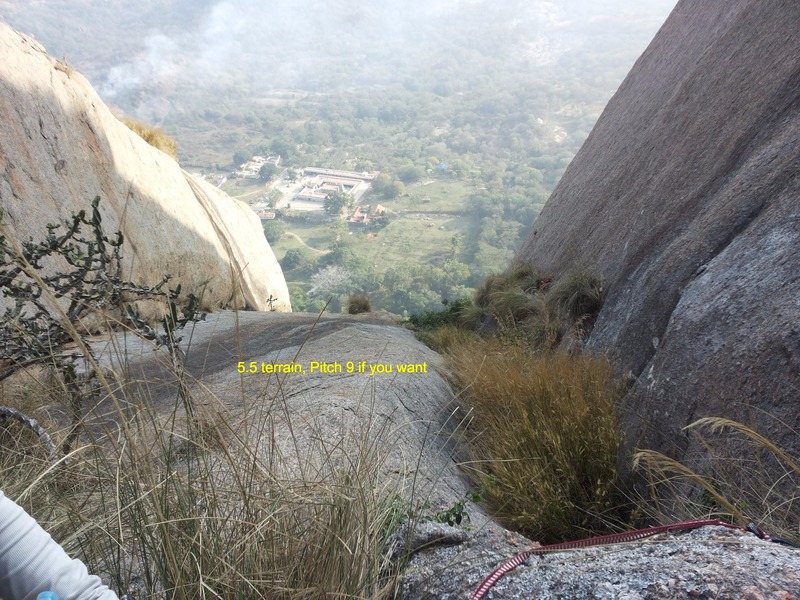
From there on the angle eases sharply, leaving about 30 meters more of 5.4/5.5 terrain to the boulder field and exit hike; you could do it as Pitch 9 or go unroped. If you have led P8, you will want to unrope and just run up P9 in relief!
Trivia:Here's
? a gripping account of Praveen/Keerthi's team rescue of five stranded teens. This rescue, to my mind, represents the highest form of mountain-craft/ethos.

Additional notes/references
Trad gear, full rack.
The obvious tradeoff holds: carry too much weight and slow down, or go light and fast, run out; what is safer for you depends on you.
Other variants of the route have been climbed in as few as 4-5 pitches (70m rope). We preferred to stay within hearing distance of each other and kept pitches short; 8 pitches with 60m rope.
Anchors are generally poor; at most one somewhat good placement to back up a small tree/cactus plant. Note that these plants/trees are living creatures; what used to be sturdy trees years ago may be non-existent today and vice versa. Their strength depends on their age and the season you climb in.
Don't forget sun protection; you are in the tropical sun the whole day. We would have preferred to make an alpine start like the old-timers did, but that would mean wearing a headlamp and attracting attention of the whole township/guards/dogs below (see the warning below).
WARNING: This lies in restricted forest area, off limits . The entire Deepavali route/face is in plain sight and earshot of the town/temple below (much like Eiger North Face is from Grindelwald/Kleine Scheidegg). Another reason why you should keep your pitches short and stay relatively quiet.
This access issue adds a "psychological" dimension to the overall hardness/commitment of the route; when I was not worrying about the route, I was worrying whether my car would still be there, or whether the cops would be waiting for me there.
References:
1. BCI Climbing Guide to Bangalore 2016 (Sohan Pavuluri).
2. TOJ: (see the area page for high resol. pictures).
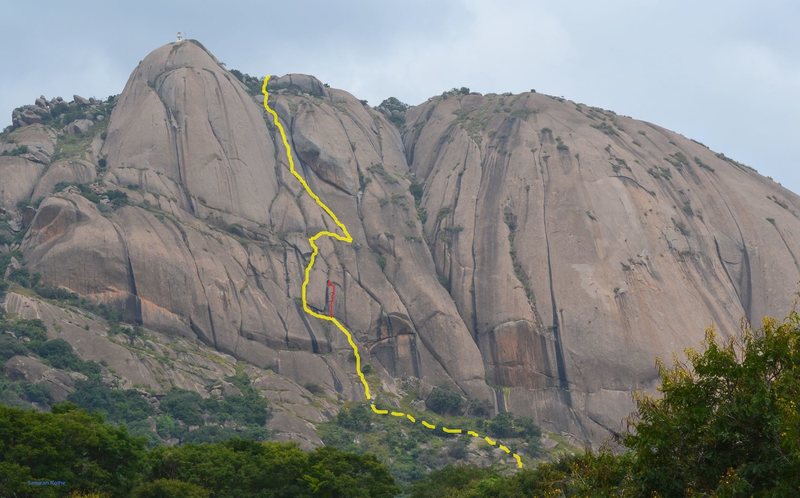
During our earlier attempt of another variant of Deepavali, we found sections of the climb (shown in red) much harder than described in the topo. Samiran Kolhe who led it felt it was at least 6b+/5.10c whereas the BCI/TOJ rate it at 5.7-5.8. Therefore for the above ascent we decided to leave all topos/info behind and climb unencumbered by prior info.


2 Comments