
 Continue with onX Maps
 Sign in with Facebook






New and experienced climbers over 50 #38



|
fossilwrote: Okay. I was wondering if it was an injury or something like that. Cat rescue sounds like fun
I think if I could find a suitable winter partner, I could make it work. But I already have had trouble finding suitable and reliable summer partners. My main climbing partner is my bf, and I try to prioritize climbing with him because I like him a lot! Then I need "filler" partners for the days when he's not interested, which are often days when it's a bit too hot or cold. I found a couple of potential partners in the neighborhood, but they never worked out well for different reasons. Interesting to find how many people are doing TRS. I like the teamwork involved in climbing. But it's true that with scheduling and personality conflicts, it can be difficult to find partners when you need them. I'll probably do more TRS in the future. It has been frustrating trying to find suitable (and available) partners in the area.
No, I don't really understand that. Do you mean this is something that you do during TRS? Could you expand on what you mean by "my mental side will always speak louder than my physical side in any internal dialog"? Here some pics from the last couple days of climbing with Tim (an excellent climbing partner, but sadly he lives rather far away!). He has passed the thin crux of Laurel in the photo. An impressive lead.  I managed to lure Tim onto Southern Pillar with promises of awesome fun and easy climbing, though I did properly warn him that P2 was runout.  PS Edit to add video link to the Pixies song in case people don't notice the link above: |
|
|
TRS...top rope solo... Curious what you kids are using for gear. My rig is just a micro (or nano) traxion on a locker on my belay/rappel loop on my harness. Not a great photo of it...:  (Switzerland at Haldenstein last fall) I've added a neck lanyard but really don't care for it. I add another traxion to the neck lanyard situation but I find its too clunky or finicky and usually just go without. Sometimes I add my backpack to the rope at the bottom to add a little tension to the rope which seems to make the traxion slide up a bit easier. Anyhow...what's your system? Cheers! |
|
|
Brian in SLCwrote: Mini traxion, petzl locking oval, 8th” (tiny) shock cord girth hitched through biner hole in mini traxion, just enough weight at end of rope for smooth feeding. Thousands of pitches climbed. For me, simple is the best option. |
|
|
Two micros, elastic necklace to keep ‘em separated. A fixed draw with a screw link for one, the other goes to the belay loop. All on a harness specifically dedicated to TRSing. |
|
|
Spoc (primary), Nano, avant lanyard, and one of those little avant anti-cross load thingies. Vastly prefer climbing with other humans though. |
|
|
Lori, you should consider getting a bunch of roundish rocks and building yourself a course in your back yard. It's the old pretend game where the ground is lava and if you fall off the rocks you die. Mostly bury the rocks so that if you do fall off you only go a couple inches. Then just hop, hop, hop, hop, hop, hop, until you are tired. I think it is better for balance than playing on some short little slackline. I've never really considered TRS as a viable climbing experience. I guess part of that is that with our circle of friends made from years at Stoney Point, that there is almost always someone willing to go climbing for the day. I've known all of theses people for so many years that I would never question their ability to belay. And for me, comradeship is a huge part of what makes climbing special. |
|
|
Lori Milaswrote: Both. I’m enjoying cracks !
Travel everywhere you can, while you can! |
|
|
Brian in SLCwrote: I haven't done this very recently, so we're talking years ago, but I still have the gear: Petzl Microcender, PETZL Micro Traxion,PETZL OK Screw-Lock Carabiner, PETZL Oval Screw-Link, cord to keep one elevated (I forget the details so I'd definitely have to practice it before using it). I attached the two devices to the two separate ends of the rope coming down off the anchor, and put in back up knots periodically. That means multiple redundancies. I have a friend who fell on a TRS setup on a line with just one device, no knots. It held on a couple falls, but then it didn't. He fell about 20-25 feet. After a long struggle, he wound up with an above the knee amputation. I think that TRS can be very safe, but I would never do it without a backup. I know people who don't, however. Go figure. |
|
|
Jan Mcwrote: Do you mean you can find someone now, or back in the day? So I'm not very good socially (putting it mildly). I find it hard to understand how you all found such a large circle of friends that you could find a partner as needed. Instruction manual, please. |
|
|
Jan Mcwrote: This is me. I find that I really climb mostly for the social aspect. I love climbing and moving over rock and having to control my mental state while on lead and the VERY LIMITED "Zen" state it brings me to but when it comes down to it, it is all about the social aspect. I have TRS'd in the past with a TAZ Lov2 device and a microtraxion but only when practicing aid climbing as aid climbing is sooooo boring for the belayer! |
|
|
apogeewrote: I went through a period where if I didn't have a plan I wouldn't even call anyone. I just went TRSing, often using LRS of an easier route to get to the anchors. Now I find that I just climb on my home wall. |
|
|
My friends are way up at the top of the list of the best things in life. They are not a hardship. Lead and belay climbing is definitely a pleasure. It’s fairly free and fluid providing a safety net and means for others to enjoy the activity. Solo is too scary. Rope solo too gear intensive (for me). |
|
|
philip bonewrote: Very much agree with Philip on this, though fully appreciate that others prioritize things differently. |
|
|
dragonswrote: I really feel your pain, dragons. This is a real problem, and I have never found a solution. Our local climbing forums are filled with posts of people looking for partners. That may be why I was so interested in the history of climbing here because it sounded like an extended group of friends of similar capabilities met here every weekend and paired off to go climb. When I look at the FA’s here in the 70s, it’s the same group of climbers who obviously knew each other. I assume it was that way in camp 4, and probably in the Gunks. That no longer exists today. When I showed up here at intersection rock, which is where climbers commonly meet, it was instantly obvious that young mostly male climbers were not going to want to pair up with me. I have had scrappy looking climbers approach me saying “hey we should climb together “… but nooo, we should not climb together! Safety seems to be a relative term here and there are so many accidents and injuries. I do wonder whether if I were climbing in another place it would be this fraught with danger – – maybe sport climbing areas would go easier.(?) For a while I climbed in Northern California with various meet up groups, REI had some climbing outings, another Sierra group had scheduled climbing days and I did them all. I don’t know why I didn’t love them. For one as a newbie, I might be in a group of really advanced climbers and just feel like I was holding them up. Also, they were all really young. I don’t know if there’s a solution. My solution is not an option for most people. I just had to weigh my age, diabetes, capabilities, or lack there of, and make some decisions. I had just sold my house up in Rocklin and set aside a little piece of that to afford some ongoing climbing. I thought a lot about the natural mentorship that seemed to happen among Yosemite climbers and probably here in Joshua Tree too where an older more experienced climber would take someone under his wing and teach him the ropes (literally). I really wanted something like that as part of my own experience. I got really lucky. I hope you find some good partners and potential new friends. |
|
|
dragonswrote: I meet a ton of people at the gyms who all want to try outdoor climbing. The main thing is to get them single pitch climbs first. Not pushing limits and that they are very competent belays. A very good belayer can learn whatever they need to to transition to outdoor then trad/cracks. Being able to feed rope properly and Feeling the protection points are key, I think? Protection points meaning body position of the climber then learn how gear holds. There are many climbers capable of partnering on outdoor climbs.
|
|
|
Lori Milaswrote: BITD, there were far fewer places where people climbed---and far fewer people climbing, so much easier to meet up with folks of similar experience level and stoke, as well as more opportunities to meet and get to know older ( though not always older!!!) mentors. From my understanding ( others on here with direct experience can correct me), for folks in the LA area it was Stoney Point, then Hidden Valley CG itself, which drew folks from a wider area. Eventually, many migrated up to Camp 4---a larger group ( though then not so large) and from all-over. Similar areas existed across the country. Also, at least into the '70s, formal climbing clubs, offering training, mentoring, and a potential partner pool, were much more prevalent and influential---though often also too 'conservative' and restrictive. Even despite those negatives, however, they still served a valuable function. While some such groups are still around and active, over time, for a variety of reasons, many disappeared ( the Sierra Club, for example, stopped formally sponsoring climbing due to liability concerns). Today, there is maybe an 'embarrassment of riches'---many more climbers, many more places to climb---both outdoors and, of course, indoors, also many different 'styles' of climbing have their groups of dedicated devotees. But, in practice, these circumstances seem to have 'diluted' the actual 'community'---people are so spread out now, so that it has become more difficult to just 'show up' somewhere and find partners ( with some exceptions), and especially to find mentorship opportunities ( especially for trad climbing). And, yes, even harder to do for those of us no longer in 'the full bloom of youth', since, realistically, there are far fewer of us. No doubt this situation is even more difficult for 'late bloomers'. |
|
|
There are numerous threads on MP about TRSing and the various systems that people use. Likewise, I can't imagine why anyone would use such a system without some level of redundancy- but then, there are a lot of things people do that don't make any sense to me. I've found that two micro traxions (rigged essentially following Petzl's suggestion, except using a second micro traxion instead of the microcender and an elastic 'necklace' instead of the 'Torse') has worked very well for me- it takes a little adjusting to get the system right, but it moves very smoothly and I've never experienced a failure of any part of the system. I suppose it does take a bit of gear (LRS is way worse, and not appealing for that reason), but it's not very noticeable, and certainly no more gear than leading a route with a belayer. As to whether TR'ing is the 'purest form of climbing', I'll leave that up to the MP peanut gallery to discuss. I just know it's been a great way to get a lot of climbing in. 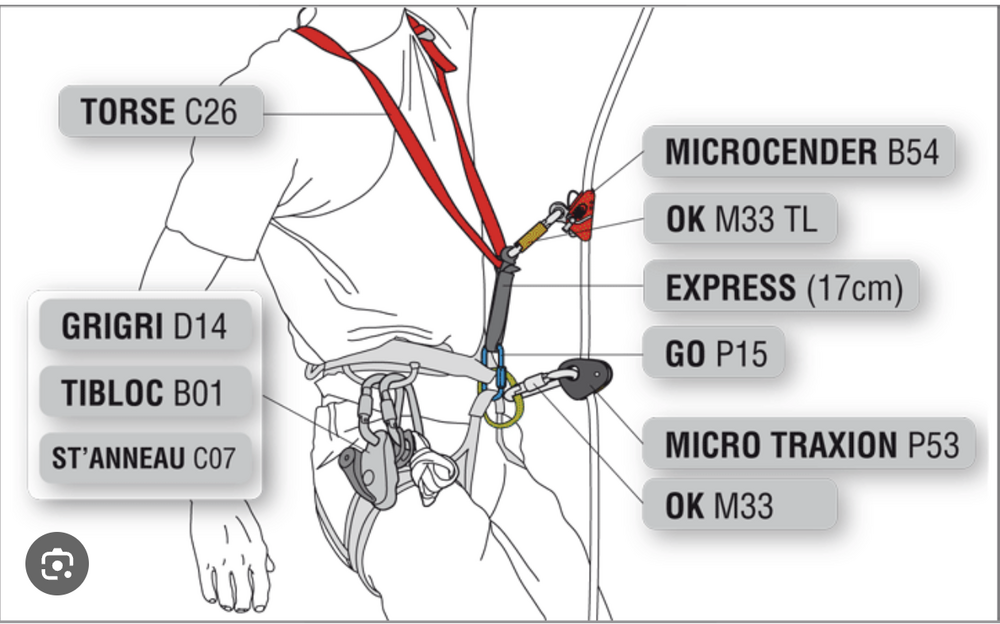 |
|
|
apogeewrote: For me, a single mini trax has always been safe and secure. I’ve tried various redundant systems and found them cumbersome in practice. I view top roping with a single device similarly to belaying or rapping with a single device. My risk tolerance may be different too. For at least a decade, using a single mini trax was the norm for top roping and currently climbers belay their partner using a single mini or micro trax or gri gri. I can’t rationally understand what forces occur during top roping that create a situation that requires redundancy when a single device is sufficient in belaying or rapping. I’m happy that you found a system that works for you. |
|
|
I wonder if this is also a part of the isolation so many of us felt following the 60s. I took for granted that my large circle of friends would always be there, our music, hangouts and brother/sisterhood would remain forever. In hindsight, I was stupid. How could we have stayed the same as we jetted off to different colleges, got married, etc. But I was just flat out lonely and bewildered even as I got married, had kids etc. I felt like a stranger in a strange land until recently. And we really hadn’t crafted ways to stay connected except the occasional class reunion, etc.. Likewise, the climbing brotherhoods also eventually scattered far and wide. I think it was Russ who took such exception to using the description “virtual campfire“ for this thread, but the friendships made here and the opportunity to kabitz about climbing and life have filled a deep empty spot. We found a workaround. So no, we won’t likely ever get to converge at hidden Valley campground routinely ever again. But through the ingenuity of technology, we have found ways to connect. |
|
|
Dragons, Re training for runouts… I am reminded of something Whillans said.. “Never write anything down because you will wind up regretting it.” But, I will try to clarify some more… The internal dialog I speak of is not me talking to myself, but rather a thought process going on silently in my head. The rational side of me would talk me out of doing many things if I only listened to it, so I dig deeper to listen to the strong silent type that lies below in the physical realm that does not argue its case unless called upon. For instance, your climb Laurel is only a 50 footer, so that rational side would be telling me to take enough pro to cover any possibility, where the physical side would tell me (if I key in and actually listen) that 2 to 3 pieces is plenty. You could actually put this in play easily (since you have been repeating Easy Keyhole and other climbs) by taking less gear every time you go thereby forcing yourself to run the rope on ground you are familiar with. Upthread you said “I'm scared to lead this pitch. I would like to. It's pretty run out, though the holds seem good.” That is your rational side telling you to be scared because it is runout, meanwhile your physical side is saying I would like to try it and that the holds are good, so it is a matter of who are you going to let win the argument. I think most of us have a rational side interested in self preservation, maybe mine tries to speak louder than most because I so frequently choose to ignore it. None of this is an issue with toprope solo because the rational accepts that the safety net is in place and will sit back and let the physical do its thing with no argument. I do not toprope solo due to lack of partners, I do it to stay solid, since I do zero cross training a certain amount of mileage is what keeps me in shape. For trs I use a single minitrax clipped to my belay loop on a static line weighted by three quarts of water on the bottom end. For those who might be saying “what no backup?” I tend to view the device as a backup to my climbing, so in my mind I am backed up, just not in the way that most think of it. Crazy, yes I know but I’ve been doing it that way for 25 years. If I thought that I was going to take multiple falls I would double up, particularly if it is overhanging and swinging falls are a possibility. More on mindset… Lori says… ” When I showed up here at intersection rock, which is where climbers commonly meet, it was instantly obvious that young mostly male climbers were not going to want to pair up with me.” That is her rational side telling her she is not worthy. She then adds… “I have had scrappy looking climbers approach me saying “hey we should climb together “… but nooo, we should not climb together! Safety seems to be a relative term here and there are so many accidents and injuries. I do wonder whether if I were climbing in another place it would be this fraught with danger – – maybe sport climbing areas would go easier.(?)” Again, rational side judging by appearance rather than a true assessment of talent. Then this… “For a while I climbed in Northern California with various meet up groups, REI had some climbing outings, another Sierra group had scheduled climbing days and I did them all. I don’t know why I didn’t love them.” Here I would say the physical spoke up and said you need more than this. Large groups are inherently conducive to not getting much climbing in, and your body figured that out. Phillip, Lead rope soloing is gear intensive, toprope not so much. For trs I carry shoes, chalk bag, harness, one each rope capture and rappel device, a couple of slings and biners, rope and 3 quarts of water. So you see, not gear intensive at all. Li hu added this… "Outdoor Solo doesn’t sound very safe?" I would say gym climbing doesn’t sound very safe, since that’s where John Long received his worst climbing injury, but that would just be my rational side speaking. Completely unrelated... Did you all hear about the landslide up in Tracy Arm in SE Alaska about a week ago? A big chunk of mountain fell right where the South Sawyer glacier meets the salt water, creating a huge wave that swept down the inlet stripping away vegetation as it went. It happened very early in the morning so thankfully no tour boats were in the inlet. Here's a few pics that I lifted from the USGS...  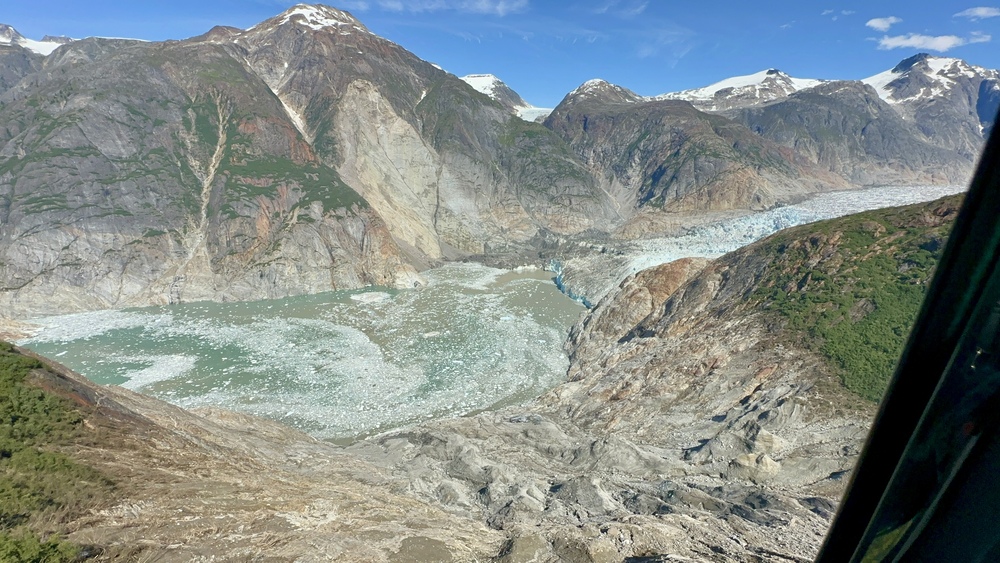 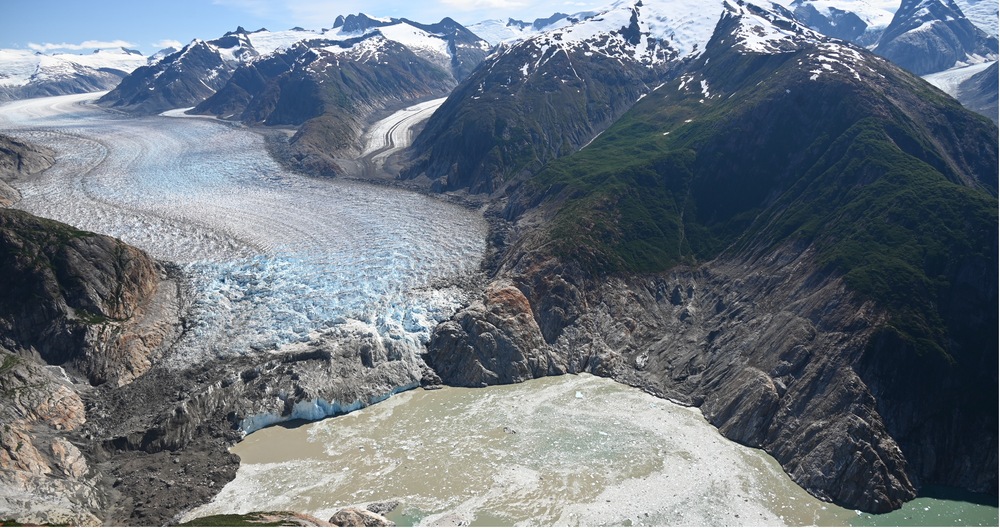 Just in case you are having a hard time grasping the magnitude, everything below the red line was devegetated by the wave. 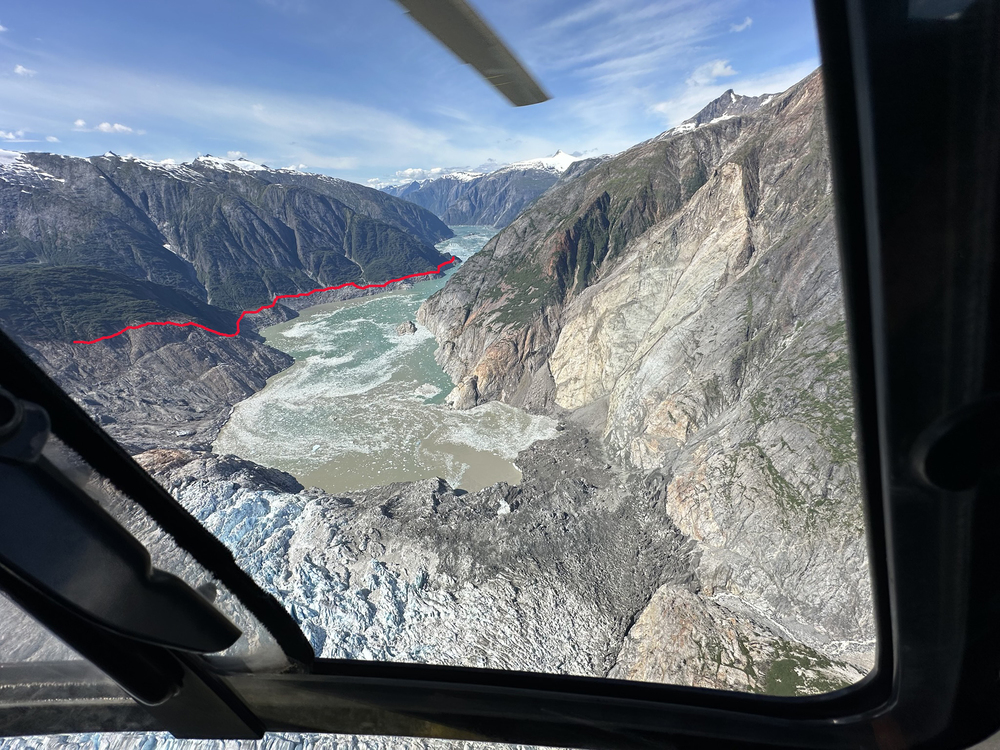 Maybe it goes without saying, but I'll say it anyway, since I recently pointed it out to a young friend of mine who uses mtn proj more than I do... If you click on the picture you get a larger version. |


