
 Continue with onX Maps
 Sign in with Facebook






Bioavailable Proteins - Post a day


|
|
Eric Marxwrote: I’d average 2 headaches a week with 2 days a month completely lost where I couldn’t get out of bed. I’m now at about 2 manageable headaches a month. I’m an academic so I hate making claims without citation, but fiber is correlated with lower rates of cancer, lower blood pressure, lower heart disease, it triggers the feeling of satiety, and as mentioned above with the gut fauna is likely do do other things, some of which we don’t know the exact mechanism yet. For one resource, Dr Lustig’s talk is an incredible resource. He sensationalizes a couple of things (e.g where we talks about glycolaldehyde and acetaldehyde and lumps them with formaldehyde to stress the “poison” claim, which isn’t *false* but sensational and misleading a bit) but no where else will you find an accessible and comprehensive explanation of why sugar is bad, what exactly it does in your body, and how to mitigate the effects. Details on fiber at 1:14:00. |
|
|
Eric Marxwrote: Great breakdown Eric - really appreciate it. But I think we need to know the results of committing to something like this. Can you share a few additional details? If I recall you are the guy who was benching 300, deadlifting 400, and climbing 5.12+. So are you genetically predisposed to be an athlete? Is your diet "success" just confounding data?
2. What are you results? Climbing/strength 3. Injuries? 4. How does your stomach handle that protein load? 5. How much alcohol, beer, mj do you use? |


|
I find those saturated fat and cholesterol panic to be unconvincing, coz overconsumption of fat and refined carb are highly correlated with other more obviously dietary risk factors (e.g. high sodium, food additives and preservatives) and bad living habits. If you follow the standard cholesterol guidelines, you can't eat more than 1 egg per day, which is fucking bullshit. Vegan/vegetarian diet can work but it's way too much hassle for me since I can't hire a nutritionist and I have a 9-6 job. I found to get enough protein and minerals for my weight (175-180 lb), I need at least 3/4 pound of meat/fish+some eggs and diary products. I just work my meal planning off this estimate and add vegetables/carbs/whole grains to get enough calories, fiber and other micro. Cut as much processed food/refined sugar from diet as possible. No coffee nor alcohol drinking as well :) So far it's been working and pretty easy to follow. If I diet more aggressively I might have better body composition but just doesn't worth it (joy of cooking and eating/mental health/etc.) |
|
|
What are your goals? 91g of protein is totally sufficient for most people and even at levels for mass building for some. If you're big enough and training hard enough to effectively use 180g of protein per day then you're in the wrong forum. BodyBuilders.com is nextdoor. Protein isn't gonna kill you today, but it's hard on your kidneys and if you consume more than you use, you're literally just pissing it away. Debatable and arguable but, I always used this document when I was building mass and lifting heavy. I also came to the realization, for me, that being in the 1200 club was not complimentary to climbing. |
|
|
grug gwrote: Thank you, Spope, I'll check that video later when I'm home. Thanks Grug, I have to laugh, I can't tell if you're trolling with those insane lift numbers or where you got them from but I don't lift more than 50lb dumbbells as a part of my antagonist training, with no desire to push harder than that. Just heavy enough(for me) to stay balanced. I hate to shamelessly plug my youtube channel, Headpoint Handbook, but I throw in tidbits of this stuff into videos. I'm currently producing a longer form video of a nemesis route of mine which gets the piddly grade of 12c, and going into my training, rehab, diet, injuries, effects, etc. I am NOT a naturally good, coordinated, or genetically predisposed athlete. I do put on and maintain muscle easier than the average person, which may be my only advantage. I have a genetic blood disorder which results in low hemoglobin(thalassemia minor) I'm 5'9", no ape index, and 185 pounds. 1. During intense training cycles, 7 days a week. I'm not saying I won't go smash a bunch of tacos with my wife on a friday night, every few weeks, but because my diet is squared away 95% of the time, I can afford these days. Imagine eating a piss poor diet and then eating a single healthy meal, you wouldn't notice any difference. The more you fuel yourself with proper nutrition, the more you feel the immediate effects of not doing that, so you start to not want to "cheat." It's truly an example of the average person not knowing how bad they feel until they feel good. Or a dehydrated person not realizing how dehydrated they are. I'll get my daily protein intake as low as 100, depending on training, but never lower, and I start to feel it when I do. Achiness/tendonitis/fatigue. 2. Being as blunt as possible, I can usually single sesh V9 outdoors, I can do your average V8 in a few attempts, if not flash. I don't spend much time bouldering or projecting boulders outside of the moonboard, but I'm sure I can climb harder than that. I have climbed multiple mid 13s on rope but mainly focus on sub-limit dangerous headpointing. I've been climbing for 15 years and my level of success is almost pitiful compared to similar athletes vs. how hard I've tried to progress. These developments only took place after a total diet overhaul. 3. I spent 6 years of my climbing career as a "varied, plant-based diet" eater between 22-28ish years old. I had very slowly declining health, chronic and consistent injuries, multiple complete pulley tears, torn labrum, torn TFCC, persistent tendinitis, a literal revolving door, and I always blamed my injuries on my aging and my weight. This wasn't true, it was simply a lack of proper nutrition and recovery for my level of training. I was plateaud for a very long time. It took about 2 years of properly fueling my body(between 28-30) to recover and I honestly feel like I wasted most of my 20s. I turn 33 next month and feel stronger healthier, completely, totally uninjured, barring my frayed shoulder labrum, which is leftover from my plant-based days. I have no shortage of energy to work, train, and tend to my house and family. 4. The protein load is no issue. Like mentioned, something like a palm-sized piece of steak is so nutrient dense and easy to digest that it causes no issues. Barring medical exception, your body is designed for eating that. If you haven't in a while you may need to repopulate the gut bacteria. Am I eating a 150g protein 100g fat 16 oz ribeye? Hell no, try eating a 2-serving size piece of steak for dinner tonight(and only that!) and tell me how your stomach feels. Most people eat meats with a pile of other shit and then blame the meat. 5. No drugs at all, I could count on one hand how many drinks I have a year. Very occasionally I'll smash a whole bottle of my favorite red wine. Probably after I send the route mentioned above. I plan to go long-form on all my ideas on this stuff on my channel, so again not to be shameless, but consider checking it out. |
|
|
Just skimmed this thread and I think the only "data" source was a youtube video, from the reported "academic". Just a reminder that anyone can make up any wild claim and post it on on MP or youtube ... if there's a worse place to get scientific information, I'm not aware of one. I don't care much about diet and I have no idea if any of the above claims are right or wrong, but it would be refreshing if the increasingly trendy "must eat red meat"/ bio-availability zealotry was accompanied by peer reviewed literature (maybe it does exist?) instead of anecdotal evidence and the usual rah rah medical establishment rah rah mainstream media. |
|
|
Jon.Rwrote: Okay ... feel free to ignore the thread if you need some links to prove something. I don't think that is the intent here - it MP not an academic journal. Honestly anyone can find a cited source to support anything they want. Remember in the 70s when eggs were considered bad for you? |
|
|
I'll say as the "academic" that I'm capable of doing a lit review but I'm not doing all that work for a forum post. Peer reviewed is one thing, but you'll mostly find case studies, which have the attendant issues. Clinical studies will often be too narrowly focused and there aren't many, there are even fewer longitudinal studies, and population studies are informative but rarely conclusive or personally applicable. Why is nutrition research so muddy? Same reason as education (my field)... it's wildly complex, difficult to design and execute (ethical) clinical studies that actually have applicability to real situations, and even harder to maintain participant compliance over a meaningful period of time. Which is a lot of the reason why I stress personal choices--you have to find what works for you.. You can often get there faster by informed choices from the literature, that which exists. |
|
|
I think the red meat paleo diet is a fad, and a dangerous one. That's not how human evolved, and it's not how our teath, stomach, and gut are configured. Is everybody just ignoring the clear evidence of increased cancer risk from eating meat? To say nothing of the ethical concerns and environmental effects of meat consumption. I agree that obtaining enough protein as a vegetarian or "seldom eats meat" person is a challenge, but it's a challenge I think we should embrace. |
|
|
The fact is that people can thrive on many different types of diets, with the exception of "highly processed" as that leads to over consumption of highly palatable but low in nutrition foods. I think the obsession with high amounts of protein is a silly one, but rarely is it detrimental to health, just your bank account. There is no evidence that I know of that higher than normal protein aids in accelerated muscle recovery. Recently, some dude ran the Colorado Trail in like 7 days, on a low carb diet. The next year his buddy ran it a little faster with a high carb diet -- which one had a better nutrition strategy? Who knows? Probably neither. The Appalachian Trail FKT was set before by a famously very vegan athlete, then broke by a famously not vegan athlete. To think you have to exceptionally modify your diet for climbing a big wall just doesn't reason out to me. Isn't Honnolove mostly a vegetarian? It seems more of a "pack your fears" kinda thing when it comes to food -- and to an extent: supplements (but glad the large dose of creatione helps with the headaches tho). As they say, only control what you can, but accept what you cannot (or maybe I just say that). But again, it's mostly harmless to the person partaking. If you like meat cereal, eat meat cereal. (or learn some cooking skills and enjoy your food as a holistic thing). |
|
|
Below is an example of what I eat in a day. The overall macros are at the top. I’m currently bulking from 155 to 165. Gaining weight has always been a challenge for me, and if I eat 2900 calories that’s about maintaining levels for me. I track calories periodically since I think people are very bad at estimating their own intake, and I enjoy numbers. I am 5’11, male, pescatarian, climb 5.12-, age 31, started climbing 3 years ago.
Disclaimer: I don’t eat Mac and cheese that often, this day just happened to have a lot of cheese in it. If I ate that every day I would worry perhaps, but I don’t.  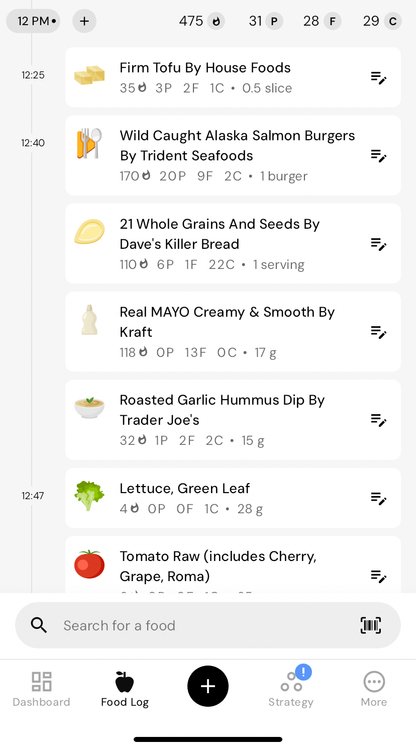 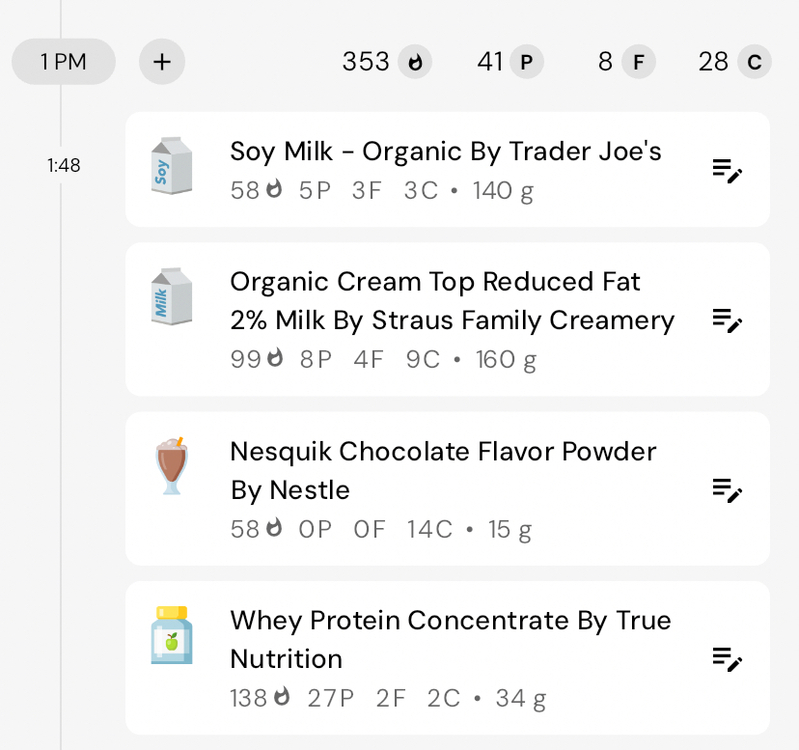 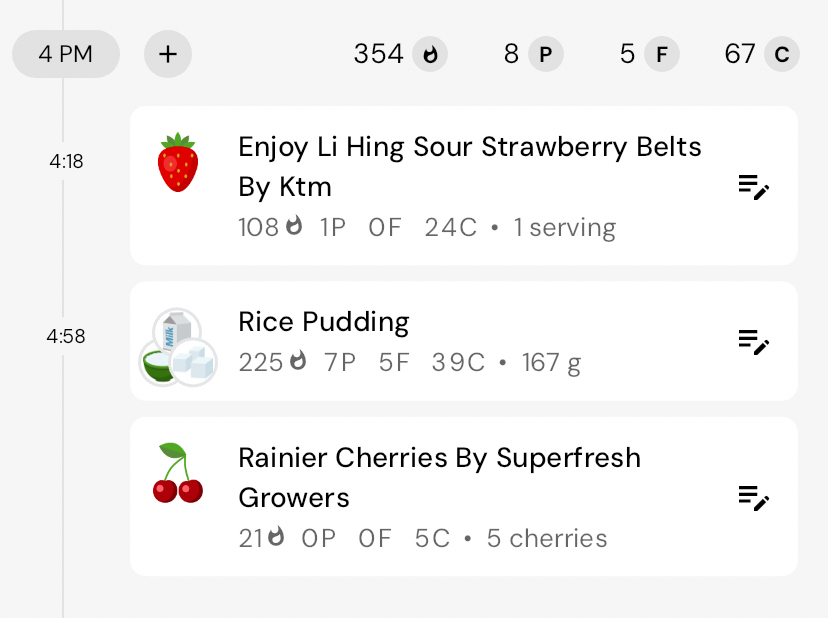 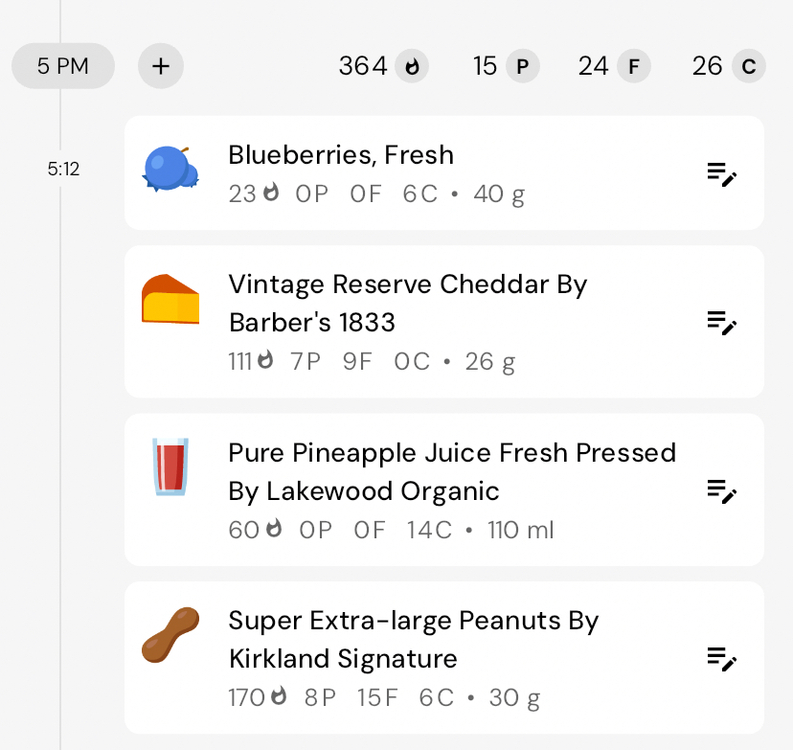 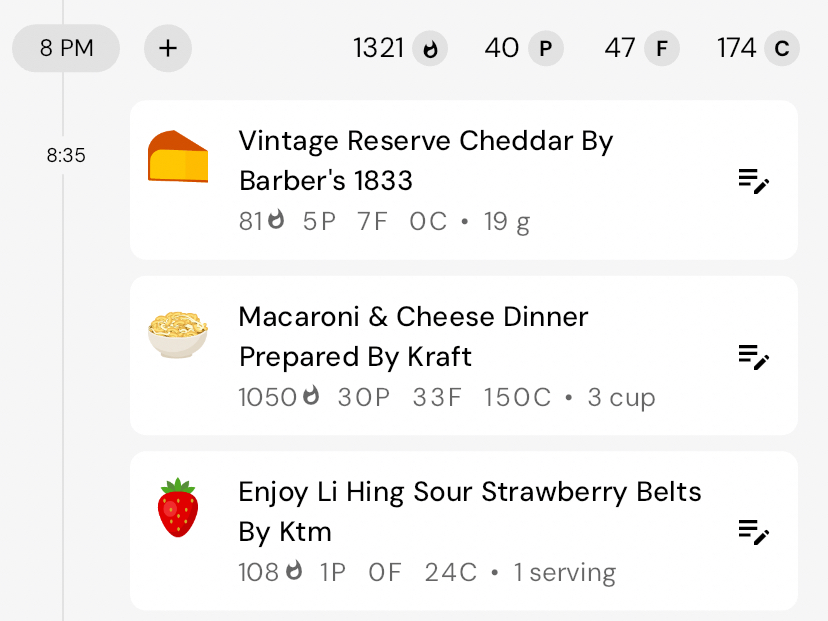 |
|
|
Interesting thread, and it seems the OPs intent is more along the lines of "how to get more protein" than just "how do I optimize my diet for X activity", but I would be interested in what kind of performance people are getting from their corresponding diets (as grug alludes to above). If people are just sharing what they eat in order to consume enough protein, that's one thing. It would be illuminating to know what people are able to do with their diet given the food they eat. |
|
|
Long Rangerwrote: This is a good discussion. It's also worth mentioning the wild degree of variability among people. Different people tolerate different diets...differently. Self experimentation and finding what works for you is key. If that experimentation pushed you to one extreme or the other (or in a reasonable balanced middle), that is well and good. It's irritating though when someone finds what works for them personally and preaches that as the only way. For me personally I've found a high (ish) fat/protein, low (ish) carb, but not full keto, works pretty well. I also have some annoying FODMAP issues that take most legumes and some grains off the menu. Based on on this I end up eating a lot of meat and eggs. I'd have a really hard time going vegetarian based on this. But I know plenty of folks who need a lot more carbs than I do, and function well vegetarian. Individual variability. The intended application (sport performance) is also relevant. Eric Marx's high protein and bioavailability schtick is pretty well supported within the bodybuilding realm (by both the science and the bro science) if your goal is the build big strong muscles. Is that really needed though by the typical rock climber? Debatable. Depends on their goals, and the individual variability. Eric's lifting and climbing perspective may indicate a different diet than Long Ranger's ultrarunning and climbing perspective. With all this variability, we should be very skeptical of anyone espousing the one true way. Eric's got some great points and his approach works well for certain people in certain applications. It seems to be working well for him, which is great. His suggestions and information are also relevant to OPs original query, and OP would likely benefit from at least some experimentation with those ideas. But observations suggest that this is not the only way to be a successful athlete or a healthy human, so we need to stop short of claiming that this diet (or any other diet) is the One True Way. |
|
|
Recent research has found that polyphenol oxidase (PPO) inhibits the absorption of polyphenols. PPO is found in a lot of fruit like bananas which are relatively high in PPO. So if you add bananas.to shakes with blueberries the polyphenols in the blueberries will be largely neutralized. |
|
|
Eric Marxwrote: Thanks! I really thought I remembered a thread from years ago that you stated those numbers. Guess not. 3. This is fascinating - I (like many climbers) have persistent annoying injuries as well. I would love to commit to heavier protein diet and see some of that reduce. I also think I drink too much (~3-5 drinks a week, usually on the weekends. |
|
|
There was another guy that had a similar vibe, thinking maybe it was Eric Carlos? The numbers weren't completely wild for someone actively training if he was talking 1 round max, but definitely out of the ordinary for average climber guy |
|
|
Frazerwrote: It looks like you are sticking to a veggie/pescatarian focused routine- which I do as well, given that I'm capable of caring about my health and other things. I also am on a budget so I'm always looking for responsible, quality AND economical nutrition. Whole foods above any dogma. Some things I eat regularly to add protein- Split pea soup- you can find the Amy's Organic on sale for $2/can. I usually eat 2 cans in a serving, 380cal and 24g protein. Plus a whole grain bread for another few grams of protein. Super easy lunch. Lazy man's canned tuna salad - you can find line caught Wild Planet at Costco. Sometimes for as low as $2.25/can on sale. 1 can with some veganaise, sriracha, TJs green goddess seasoning is like 250cal and 33g of protein. I add some brown rice cakes for another few grams of protein. Another easy lunch (add a side salad)/snack. My go to breakfast is 1/2cup of Bob's Red Mill steel cut oats (8g protein) and 2+ tbsp of nut butter (8+ g protein), a banana, 1/2cup of Oatly (3g protein) and 1/4cup salted hazelnuts (4g protein). Whole meal is less than $5 if you shop around. We cook with Banza pasta at least once a week- usually fresh kale pesto from greens and herbs from our garden. Banza is chickpea based and is about 20-25g of protein per serving depending on how American you portion is. It's good cold as pasta salad. Good with red sauce. Good with just some olive oil and raw veg. We rotate out dinner protein- tofu, tempeh, pumfu (pumpkin based tofu- so tasty, kinda $$), Costco salmon patties, fresh PNW salmon or steelhead, the occasional Beyond burger. This is a pretty good variety of protein sources (soy, pumpkin, chickpea, pea, 2 or more types of fish) plus some probiotics from the tempeh. My wife (who is a practicing nutritionist (CNS) with her MS in nutrition) doesn't do wheat for gut health (check out leaky gut), but I sometimes eat seitan and she regularly eats eggs, so we each have 6-7 protein sources we rotate through. I try and stay away from soy protein isolate because there's a good amount of recent research about some negative impacts of regular consumption. This is about as optimized we can manage given our current resources. We prioritize the quality of the ingredients as much as our budget allows- shop at the local co-op from local farms, nearly 100% organic, grow as much as we can in Seattle's sometimes short growing season which is about half of our produce for 4-5 months/yr. More each year as I get better at gardening. In an ideal world it would only be fish caught by the local fisheries, no canned fish or Costco salmon patties, just locally fresh or cured fish. But we just can't afford $20/lb+ several days a week. |
|
|
interesting thread. i really like eggs, but damn you have to eat a pile of them to get much protein. add to that the cholesterol, unless you just go whites, but then you lose almost half the protein. and i love pasta. one of my favorite things in life is to eat an entire lasagna, drink a bottle of wine, and watch a mafia movie. man, i wish the foods i love most were a bit more healthy. sure, i love a good salad, don't get me wrong. they are never filling for me though, i just get tired of chewing. |
|
|
slimwrote: Figure out if that's a real issue. I eat a half dozen+ or so a day, in addition to all sorts of other animal/"red" meat proteins a day, and my yearly bloodwork hasn't popped any concern, at 46 years old. |
|
|
Jonathan Walker wrote: I believe you you, but there are a whole lot more that are doing better with, regardless of whether or not you want to admit it |


