
 Continue with onX Maps
 Sign in with Facebook






What’s a 5.10+


|
|
I understand the definitions below if it said 5.10a+ or 5.10d+ but 5.10+ ??? 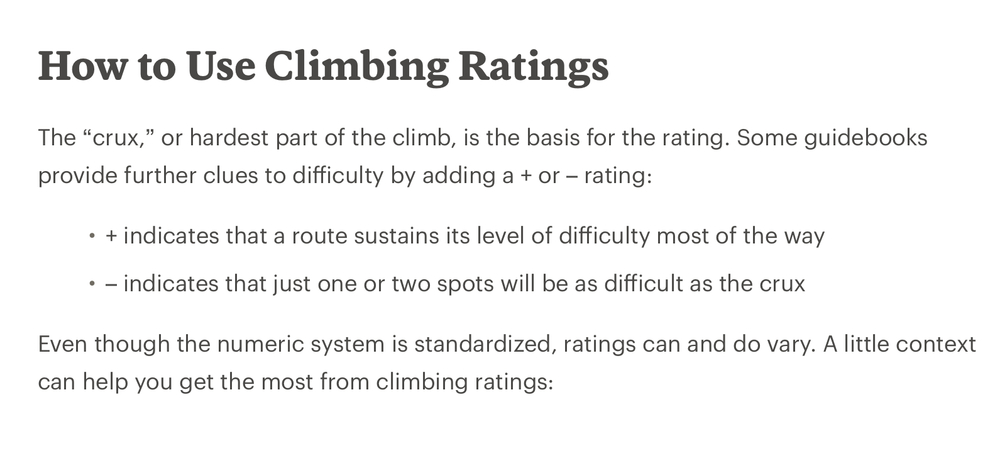 |
|
|
My understanding is that 10+ is 10c an 10d and 10- is 10a and 10b |


|
I don't know where you got that definition from, but it isn't one that I've seen before and doubt that it is often used or understood that way. In a number of areas letter 'sub grades' are used for sport climbs, while + and - are used for trad routes---but that is far from a consistent usage. Like most things involving grading, it is probably pretty random, but generally, and obviously, it means a climb at the harder end of 5.10---or that it is solid 11, but for various possible reasons whoever rated it won't acknowledge the true difficulty. |
|
|
Grades ascend as follows; 5.2 5.3 5.4 “Low fifth class” Fourth class 5.5 5.6 Classic mountaineering 5.4 5.7 5.8 5.9 5.8+ 5.10a 5.10b 5.9+ 5.10- 5.11a 5.10 5.10c 5.9+ (again) 5.10 5.10d 5.11- 5.10+ 5.11b 5.11c 5.10+ (again) 5.11+ 5.12a 5.11d 5.12- 5.12+ |
|
|
Alan Rubinwrote: From REI.com |
|
|
Ben Podborskiwrote: So 5.8+ is harder then 5.9??? This is very confusing |
|
|
simply put 5.10+ means that it's on the upper end of the scale for that grade (in this case 5.10). it's a rating system that i used to rather dislike as someone climbing a route, but have warmed up to significantly as someone establishing a route. |
|
|
REI is wrong, that’s not what plus and minus means. Plus means harder end of the grade and minus means lower end of the grade. If something is more sustained it may be more likely to fall in the upper end of the grade, but it doesn’t mean it will get a plus. A sustained 5.10 that is a little easy for the grade would get 10- and a cruxy 5.10 that is at the higher end of the grade would get 10+. |
|
|
Ben Gwrote: Not surprising!!! REI is far from the best source for accurate climbing information. Presuming that you are serious and not trolling, as you should be able to tell from Ben P.'s 'chart', grades are often highly subjective and, in general, anything graded with a +, should be considered to be very 'suspicious' (4th class, even more so). |
|
|
Alan Rubinwrote: Alan, I am surprised you have not seen that grading system. it’s been in use for a very long time, in exactly the way he describes. It’s not that often used these days, as you say, but it used to be much more common as an alternative to letter grades. I was in fact surprised a couple of years ago when I was on the east coast and met a friend at CRG Hadley - that is the grading system they were using there. Edited to say: were you responding to Adam R’s post just before your’s or another one? I’m refering to Adam Rs definition. |
|
|
Ben Gwrote: Hahah sorry man! Is 5.8+ harder than 5.9? Is 5.9+ harder than 5.11a? Yes and no. Also, my post is a bit of a joke. You might recall that the NorAm grade system is the traditional Yosemite Decimal System (YDS), which is very old and strange, and better explained by others. However, specifically in this context, it is important to recall that 5.9 was considered the most difficult grade of free climbing possible for decades, and so for a long time if someone was physically able to climb something without resorting to aid, then it was graded 5.9. The same thing with 5.8! Was it really really hard but maybe not be theoretical hardest climb? “We’ll just call it 5.8… uh… 5.8+!” The effect of this is that some difficult climbs done by strong folks in the 60s were labeled 5.9+ (or whatever), but have been (or should be…?) graded differently in “modern” grades, infamously up to the mid 11s! So yeah, a running joke is that 5.8+ is often harder than modern 5.9, or even some 5.10 climbs. Edit: also my experience with +/- grades is that they shorthand higher and lower within a single numbered grade, not referring to sustained climbing (or lack thereof). So, yeah, I disagree with REI generally, but it sounds like this is a regional difference. |
|
|
Bryanwrote: 10a & 10b are at the lower end of 10 |
|
|
Bryanwrote: Shocking. |
|
|
"Never trust a 5.9 plus, nor an 11d |
|
|
phylp phylpwrote: Hi Phylp, Of course, I've heard of and used various interpretations of the +/- system ( including the, now defunct one at Hadley),but it is the 'REI definition' of the system as posted by OP---that + automatically means more sustained, that is new to me. |
|
|
Alan Rubinwrote: Ah of course. I thought you were responding to adam not the OP. |
|
|
Ben Gwrote: Curious where that "how to use" came from as I've never heard that idea. The old way of 10-,10,10+ morphed into 10a,10b,10c,10d with the advent of sport climbing. 3 subdivisions or 4 take your pick. |
|
|
I thought the + was to indicate the sandbag level? |
|
|
10- is 5.8 or 5.9 10+ is way too hard for you |
|
|
Ben Podborskiwrote: right here goes "5.8 offwidth, FA 1964"
|
|
|
5.10+/- means sustained or not sustained 5.10+ means 5.10c/d, 5.10- means 5.10a/b 5.10+ means 5.11-, 5.10- means 5.9 All of the above is true. None of the above is true. |


