Continue with onX Maps
 Sign in with Facebook






Does overhanging 5.6 exist?


|
|
Not Not MP Adminwrote: All I am saying is if you cant make a steep 5.6 in the gym, how would you expect one to naturally occur in the wild? |
|
|
Princess Puppy Lovrwrote: Chimneys. Overhanging, jug-fest chimneys. |


|
Princess Puppy Lovrwrote: You can. But they don’t CALL it a 5.6 because they need people to feel good about themselves. |
|
|
Princess Puppy Lovrwrote: Ahhh. Valid counterpoint…except you can grade a route anything… |
|
|
Ricky Harlinewrote: Yeah, chimneying/stemming with huge footholds could be easily be 5.6. Is there a gym anywhere with a double overhanging dihedral? |
|
|
Austin Donisanwrote: I was referring to my route in particular, not gym climbing.
Surely the definition of overhanging is when you're doing moves with your feet closer to the wall than your hips thus loading your hands more and your feet less? |
|
|
The gym I used to climb at had a bunch of overhanging 5.6s over time. I didn't mention it because it's a gym. It's artificial. They climbs were on a wall slightly overhanging from top to bottom with jugs all the way up it. It was common to have 5.6 and 5.7 on it. Gyms like overhanging climbs because they wear people out quickly so they have more turnover and can have more people in without it getting crowded. And people are less likely to get hurt on an overhanging fall because they don't hit anything. The only walls less than vertical there were the kids/beginners walls. |
|
|
As someone mentioned earlier, the second route put up in the Gunks—Gargoyle, is net overhanging and 5.6 ( or is it 5.5?). it’s neighbor, the aptly named Overhanging Overhang is the same. Both, however, are at Skytop, so effectively off limits for most climbers, so are unknown to the younger generations. I, too, didn’t consider gyms in responding to this question, but most of the gyms that I climb at also have consistently overhanging climbs rated 5.6. |
|
|
Ricky Harlinewrote: Your feet aren’t closer to the wall than your hips when you slab climb? My feet are usually literally touching the wall.
|
|
|
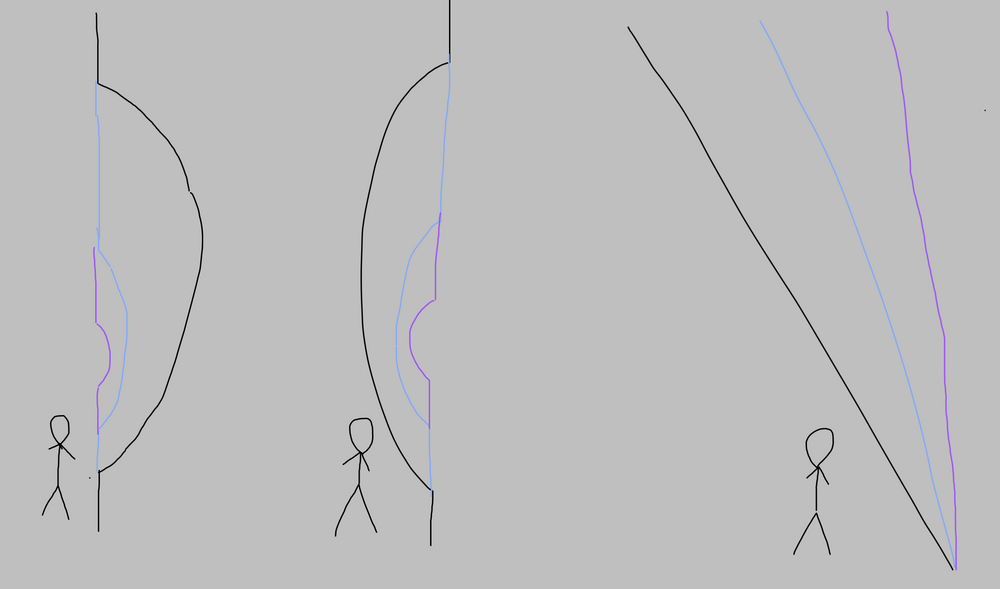
Not Not MP Adminwrote: This is silly as hell, but defining an overhang mathematically is actually fairly convoluted depending on how large a section needs to be to count as an overhang (related to the Coastline Paradox). The question is: how big does a 'section' need to be to count as an overhang, and how are you measuring the 'overhanging-ness'? All of the black walls below would, I imagine, constitute an 'overhang' for most people, but what about the others?  |
|
|
MattHwrote: I agree, there is some ambiguity regarding what is considered a “section” as it would vary based on so many factors. I think overall you’re making it far too complicated. I would say all your examples have overhanging sections. I would only call the last diagram an overhanging route. The other first diagram would be categorized as having an overhanging section and the middle I would describe as having a bulge or a few steep moves. Personally, subjectively, I would not categorize the middle diagram as overhanging. Again, when talking about routes as a whole, I don’t think it’s too complicated. When referring to sections there is some ambiguity for sure though. |
|
|
The Chimney at Crow Hill gets nice and pumpy on some overhanging moves (for a 5.6) https://www.mountainproject.com/route/105907634/the-chimney It's a roof, yes, but a big one -Coyote Rain at Longstack, NH. Best pitch of 5.6 in NH! https://www.mountainproject.com/route/107722696/coyote-rain |
|
|
Drederekwrote: Ummmmm. No |
|
|
Not Not MP Adminwrote: Is your nose over your toes and your hips over your heels? If your nose is much further back from your toes and your hips much further back from your heels on slab you will fall backwards. This is the position you are in when doing overhanging moves. I don't understand the significant difference between the angle of the rock and the position of the body. The rock mandates the position of the body; they are necessarily linked. The body positioning seems to have a slight advantage to me even, as there are some moves on some routes I can think of where looking at it you wouldn't think it's overhanging and dropping a plumb line on any section of the climb you would not find an overhang, but certain sections climb overhanging just because of where the handholds and footholds are. There's a stellar 10- finger crack at my crag that will demonstrate this concept perfectly if you would like to climb such a confounding route-- hit me up and we can be confused about it together. |
|
|
I'm pretty sure there are overhanging 5.6 patina jug hauls at Red Rocks except they're rated 5 9. |
|
|
Jim Twrote: https://www.mountainproject.com/route/105751342/west-overhang |
|
|
Jake907wrote: Let's keep it civil, Jake. |
|
|
Sam Chalkleywrote: This is the climb I thought of when I saw the thread title; I forgot it was 5.7. |
|
|
Ricky Harlinewrote: Calm down Rickstar. Your initial post specifically mentioned hips, there was no mention of noses. Additionally, there are many situations where my body position on overhung climbs/moves is exactly how you are describing your slab positioning. It doesn’t necessarily have to change on overhanging routes, most routes will almost always be harder the further away from the wall your ass is. When your center of gravity is not in line (I.e. ass away from the wall) the climb will be harder more often than not, regardless of angle. Idk even know how we are having this argument though, the rock determines whether something is overhung, not your body position lol |
|
|
I like to picture all you guys arguing at the base of a climb about whether or not it is considered “overhung.” One dude is air thrusting his hips towards and away from the rock exclaiming, “look at my hips, it’s clearly overhung!” Then some other dude is rubbing his nose on the rock saying it’s slab, and then there’s some dude drawing a picture in the dirt depicting a right angle (vertical route), but then some dude looking at the picture from the other side says, “no it’s clearly a roof, and not overhung.” And then puppy love shows up with his protractor, and starts a lesson in trigonometry that nobody listens to. |