
 Continue with onX Maps
 Sign in with Facebook






Rappelling without extension


|
|
Serge S wrote: 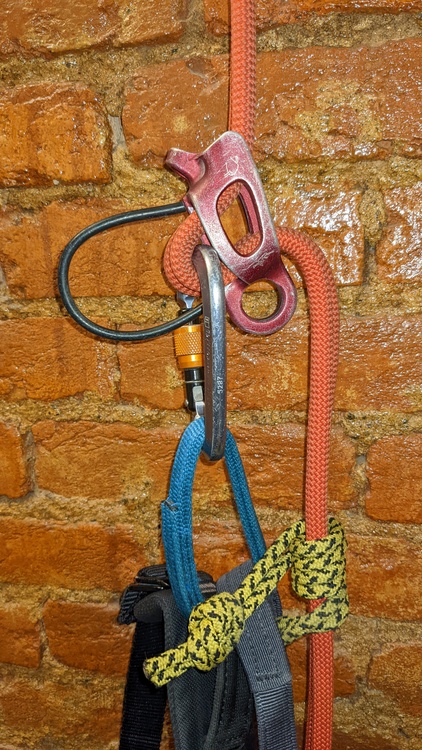 Here's another variant with a simple soft shackle. It seems a little sketchy, but I'm excited to try it out. I could do an Ashley's stopper knot for extra security, instead of the overhand.. |
|
|
After playing with a variant of Eric's method, it's better than I thought. It can cover a good range of rope diameters (e.g. 8-10.5), both single- and double-strand. And you don't have to retie knots every time. To make it work well, you need: Obviously, one has to weight-test the 3rd hand with the full range of rope diameters one expects to use. Less obviously, it is important to tension the prusik loop with about 1 body weight before testing - otherwise the double fishmerman will gradually tighten with use and ruin your tuning. This means you have to untie a fully-tightened double fisherman every time you want to adjust the loop length, which for me took 5-10 tries. Definitely not for everyone. The effect that makes this work for smaller rope diameters is somewhat sketchy. It turns out that when the friction hitch just begins to touch the ATC, you still have about 1/2" to 3/4" margin of error before the friction hitch gets pressed hard enough against the device to stop working. I.e. there is a 1/2" - 3/4" prusik loop length range where the top of the friction hitch appears to be touching the ATC but is still tight enough around the rope to work. So, for the smaller end of the rope diameter range, you have to "break the rules". To an outside observer the friction hitch will appear non-functional, and you may have to explain "actually it's stil ok, I've tested it". But if you always rappel on the same diameter ropes, this is not a problem. Or, if you're ok using a non-locker for the prusik, a small one of those will avoid letting the prusik touch the device for the entire range of rope diameters.  EDIT: after using this a few times, I realized the very short prusik makes it hard to get started off a ledge. I suspect this applies to OP's method as well. |
|
|
I am old and have been doing it with the rappel device on my belay loop and the autoblock on my leg loop for decades. I have many hundreds of hours of rout development , up under roofs, trundling etc. never gone upside down when I did not want to while rappeling. I tried extending my rappel device several times but don't feel that I have as much control when doing weird traverses and strange swings. Not talking breaking power as we know extending enhances that but steering control does not seem as good to me. sticking with my system because it works and i don't have to pass an AMGA test.. |
|
|
Not read through all this so it may have been stated, but: If you want a non-extended rappel with the safety of a third hand (w/o the drawbacks of attaching via the leg loop) just use an alpine up |
|
|
I don't see any real drawbacks to how I have my rig attached to my leg loop. |
|
|
3rd hand above the ATC. |

|
A V wrote: The 3rd hand back-up is a "brake hand" back-up. It is not there to protect you from incorrectly threading your rappel device. Please stay attached to the masterpoint by your preferred method of tether (rope, pas, purcell, sling, etc.) until you check your rappel device. |
|
|
I have in fact been saved once leaning back to rappel and not in my rappel device. Auto block on leg loop saved me. |
|
|
Serge S wrote: That’s a hand pincher waiting to happen. Ouch! |
|
|
Nick Goldsmith wrote: Apparently there have been some weird situations where much of the weight transferred to the third on the leg loop. Unsure of how big of a problem this is, and it doesn't seem to happen often. I think rappelling systems as taught by the AMGA and like minded institutions basically assume people are idiots and teach accordingly. Tbf I do think that should be their working assumption but I also think that means that there's lots of opportunity for practices that are safe but run counter to what these orgs teach. |
|
|
Apparently I don't have those issues with my setup. Thousands of hours in use in all kinds of conditions with no serious mishaps. |
|
|
Nick Goldsmith wrote: And I don't think you ever will encounter a problem. That doesn't mean that the extended rappel shouldn't be the default taught to the masses, however. |
|
|
Not sure if it has been mentioned yet... another huge advantage of an extended rappel is the ability to quickly clip the ear to the belay loop if you need to ascend the rappel rope. I've had this happen to me once or twice when I have rapped past a station. |
|
|
I’ve witnessed the leg loop back up get minded by the atc before, rendering it ineffective. Luckily the climber ended up slowing down and stopping on a slab to work it out, but if you’re going to bother with one at all, I personally don’t think the leg loop is the best spot. It surprisingly easy to get the legs high enough to close the gap if you’re lowering by a roof or edge, etc. Not to say there aren’t combinations of carabiners, prusik lengths, and descenders that will work fine; but I think the hesitation of the leg loop method is valid. |
|
|
I don't recommend my system for anyone other than myself. i have my lengths dialed and it works very well. I did experiment again last summer while doing some developing with the amga approved system and did not feel that I had as much steering control on a long weird traversing rappel as I have with my normal system. Post limits suck. cant help it if the author had a crappy system. I have lots of time up under roofs deliberately upside down hands free working a wire brush, pry bar, drill, epoxy and all that fun stuff you get to do in humid climates with lots of vegetation.. I don't recommend my system for anyone else but I have it dialed. |
|
|
This is what the 2014 AMGA SPI Manual has to say about rigging the backup off the leg loop.  So... while it is IN the book... it also has a full page of dangers and stating that in 3/4 of the tests the author did flipping upside down, the friction hitch failed to catch. That's not an endorsement. |
|
|
Did the OP specify also not wanting the backup on extension? b/c a shunt on extension, above the rap device, would allow for rap device directly on belay loop...and have the added benefit of weight training by carrying a small brick ;) (but for real, I was taught this as I started out and I still like it, just not willing to carry a shunt around with me). Understand I'm not adding much to the convo but sorta curious what the real hazards are of running the shunt in this manner... |
|
|
Desert Rock Sports wrote: Lol! Really fellas, just get one of those newfangled ABDs, no back up needed! |
|
|
Mark Pilate wrote: Aren't we all doing that!? |

|
As one of the coauthors of the AMGA SPI textbook (with Jason Martin) and the one who did the flipping upside down testing with the leg loop backup, I think the important thing, from an instructor's standpoint, is to be able to teach the pros and cons of both methods effectively. For a more secure backup, it's important to extend the rappel device, so that even if you go unconscious and flip upside down, the autoblock will still engage. That being said, the autoblock method I use most often is simply off my leg loop. But it's important to customize the rigging (some leg loop buckles are easily defeated with a slight pull). I use the smallest locking carabiner available and rig the autoblock with a 3 ft 9 inch section of 6 mm nylon cord (tied with a double fisherman's). But there are many other options (like the hollowblock). It's important to dial in your system based on your harness. The 2014 AMGA Manual is a bit outdated. For a more updated chapter on rappelling safeguards and backups, check out Rock Climbing: The Art of Safe Ascent (2021) or How To Rock Climb, 6th Edition (2022) which I coauthored with John Long. |


