
 Continue with onX Maps
 Sign in with Facebook






How many people leave the racking biner on the sling?


|
Buck Riowrote: if you are racking gear on a sling and runners on a harness, you aren't racking like the person mentioned (ie with the runners already clipped to the cams). i agree with you though, i pretty much always rack with gear on a sling, quickdraws on harness on gear sling side (don't tangle as easily as tripled runners), and tripled runners on harness on opposite side. |
|
|
So four pages of this. My question is ,which shoe do you put on first , the right or left? |
|
|
Definitely the left |
|
|
Alex Fletcherwrote: Hum, then you probably are not pushing grades, because once you understand the weight impact of putting the left shoe on first, I can promise you you will definitely change your practice. |
|
|
Putting the right shoe on first is aid. Cause it means you're "starting off on the right foot." |
|
|
The shoes it is the left but now the socks, I change them up every now and again. Don' want them getting used to any kind of a pattern. |

|
At the top of a pitch, I like to make a chain of biners with all of the loose racking biners I've collected from each piece that was placed. I keep one end of this chain clipped to a gear loop, and I clip the other end of this chain to a loop on my left shoe. Then I take off my left shoe, clip the same biner to a loop on my right shoe, and take off that shoe too. To put my shoes back on, I reverse this process. So, I put on the right shoe before the left. |
|
|
/thread |
|
|
Question: Why rack sport draws for trad at all? Seriously, why not just use alpines for everything that needs any amount of extension? |
|
|
The whole point of a sport quickdraw is that they are easier to clip. Try climbing Trad near your physical limit and you’ll realize that floppy alpine draws are more difficult to clip. Not to mention the times the carabiner flips upside down and you’ve got to fix it first while already cruxing. |
|
|
Alex Fletcherwrote: Fair enough... I guess I was thinking primarily about onsighting something below limit That being said though does is a non-entended alpine with three loops really that floppy? |
|
|
Short answer, yes. The difference is noticeable for sure. |
|
|
Alex Fletcherwrote: If you used a "trad" draw, not an alpine draw or a quick draw, you would still get the benefit of a captured biner without the stiffness of a quickdraw. Both of the "trad" draws on the left are floppy open slings with a rubber keeper on them to capture the biner. Very easy to clip, even when pumped. Compare that to some sport draws below, which are extremely stiff and have a tendency to make cams walk. 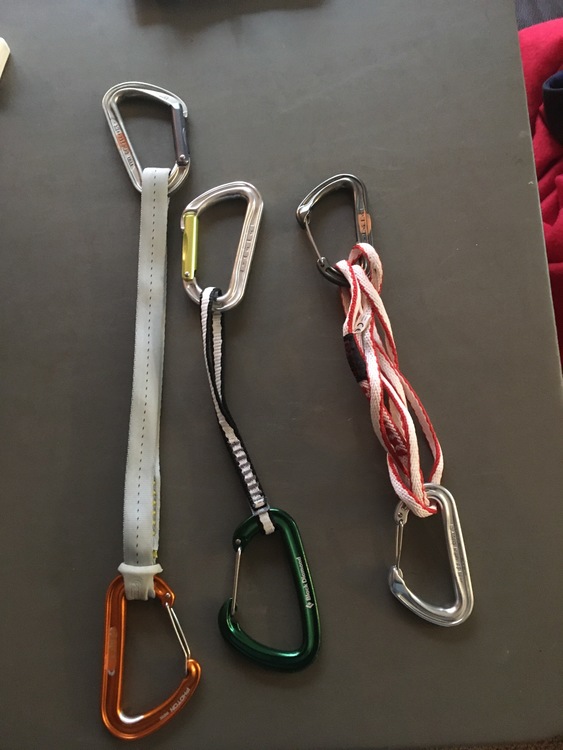 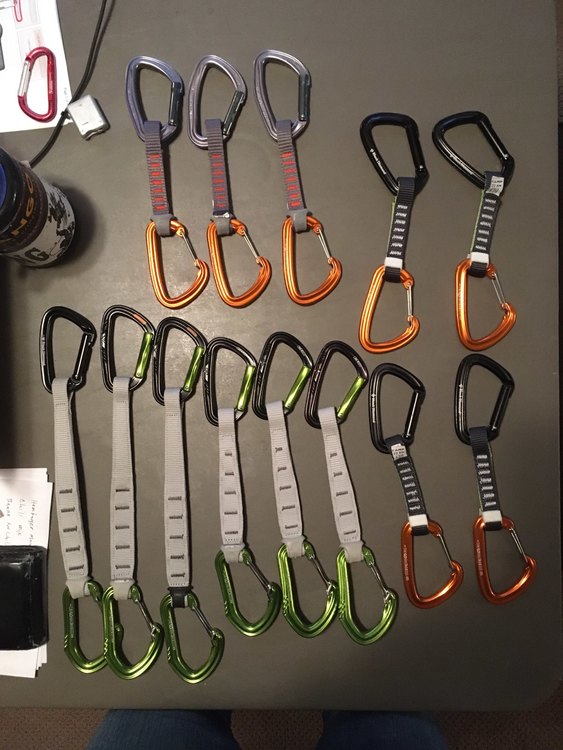 |
|
|
I can't remember the original question anymore, but here are my thoughts: for most Yosemite climbs:
|
|
|
I've tried having several on a racking krab and I can't stand it. Too much messing around unhooking them and too much risk of dropping them all or accidentally unhooking one when the sling gets hung up on the gate. I'm not that fussed about the weight saved and anyway, I frequently clip cams direct to the rope on the short (or opened out double) sling saving a draw for later. In a stress position I just find it much nicer to grab the cam I need, plug it in, clip and go. |
|
|
Rodriguez Donaldwrote: I only rack two cams to a carabiner, from micro up to green camalot size. On my rack, I save 7 carabiners this way. The handling is exactly the same as the way you handle a biner full of nuts. With sizes below purple Camalot, the pair of cams on a biner are in nearby but not identical sizes. In the purple and green Camalot sizes, I have a BD Camalot and a Totem of the same size, but of course the Totem head widths are markedly narrower. Having combinations immediately at hand gives the same advantage you have with a rack of nuts when the placements are tricky. I've never had any "messing around" unhooking them, and in 40 years or so I've never dropped one, so none of your issues have been mine. |
|
|
Dave K wrote: Thanks for posting this. |
|
|
Dave, admittedly I've not been climbing for decades, so my knowledge is quite limited... but are there any examples of these multiple fatalities, under reasonable conditions? The scenarios in the video seem wildly improbable...and nigh impossible. provided you've half a noggin and check your gear as you rack it for the first pitch. |
|
|
Christian Heschwrote: I don't know that I would say "wildly impropable". Depends on a lot of things - how you handle/store your gear, circumstances of the trip etc. Seems to me a "plausible" scenario. As you say, checking your gear etc.... however I feel like this could easily go unnoticed. Depending on context (e.g. large group, super stocked, lots of gear changing hands etc). Weirder things have happened. |
|
|
Christian, I can't remember if they were fatalities or not, but there definitely have been accidents from misuse of those rubber keepers. It boggles my mind too how anyone could mess that up. |


