
 Continue with onX Maps
 Sign in with Facebook






Bolting scary run out sport routes


|
|
ROCKMAN2 wrote: https://www.mountainproject.com/route/105892195/spank-the-monkey - this is one of the most spectacular single pitches of 5.12 climbing in Oregon. The bolting is largely part of what makes it an unforgettable experience on lead, especially onsight. Dreamin' and Heinous Cling (full) are also great examples of quality run-out 512's. Oh God! Here we go with the "bolting is art" delusion, bolting is not art it's an activity, like trail building. Know the difference! And, two of your three examples are trad routes, we are talking about SPORT climbing. Know the difference!  |

|
ROCKMAN2 wrote: https://www.mountainproject.com/route/105892195/spank-the-monkey - this is one of the most spectacular single pitches of 5.12 climbing in Oregon. The bolting is largely part of what makes it an unforgettable experience on lead, especially onsight. Dreamin' and Heinous Cling (full) are also great examples of quality run-out 512's. It's a 12a. It has 6 bolts in 80 feet of climbing. The linked description contains: https://www.mountainproject.com/route/105722566/grain-surgery - another example of an awesome run-out. An example of a trad route with a bolt or two for pro - it's not a sport route which is what's being discussed in the thread. https://www.mountainproject.com/route/105721828/walk-on-the-wild-side - awesome route with spartan bolting and a great onsight experience. Again, a trad route that has some bolts for pro; not a sport route. |
|
|
If you manufacture a significant risk for others to take that you didn't - because you learned the moves and placed the bolts from a TR - you're nothing but an asshole. |
|
|
Or. |

|
Greg Miller wrote: #OkBoomer |
|
|
jessie briggs wrote: It’s nice to have a little bit of everything. Rap bolted routes that can put you on a ledge or feature is pretty stupid. New River Gorge bolting is fun but sometimes rumney clip ups are all I want to climb. Places such as Joshua Tree often have mentally challenging run outs which can be rewarding, although when it’s a low quality “sport” route and it’s poorly bolted it’s pretty dumb. I like to climb everything and mix it up often. When I’m sick of one style I climb the other. Keep it fresh and fun. The new is a good example, I regularly “sport” climb there with a single rack to supplement the bolts. Obviously on slabs or limestone or whatever you can’t always find gear, but I don’t hesitate to bring some gear, probably because I’m a huge weenie. Whatever, I don’t need another broken ankle because of some big winger. I look at it as I’m taking responsibility for myself, I’d never complain about the bolting, be aware of what you’re getting into. |
|
|
Adam Beach wrote: Totally. There seems to be an obvious divide here about the purpose of and "rules for" rap bolted routes (most seem to agree a ground-up or boltless climb is a different beast than a rap bolted route). It really comes down to your expectations. Some feel that the rock is a shared resource, that every route belongs to each even potential climber equally, so sport routes should be made "safe" for all to enjoy. This implies climbers feel entitled to expect the FA party will take steps to ensure their safety via plenty of bolts, so they outsource their responsibility to the FA party. treating the FA party like they would the owner of a climbing gym. If they see a route that appears dangerous, they call that route a mistake and complain about it. In general, these people usually started in a gym, don't see much value in being scared or in danger, often don't climb trad, and see climbing as a safe way to get outside and stay in shape. |
|
|
The day Jim Titt, or any other quality bolt manufacturer decides they will rid the world of runouts, and offer their products for free, I'll place a bolt every 4 feet no matter what. Until that day, developers will do literally anything they want, becasue it's their money, their time, and their effort. Anyone who has never put the money or effort into establishing a new sport route, OR paid out of their own pocket to buy bolts to hand over to a friendly developer to use, then you dont have a reasonable platform to argue from. And no, donating to a bolt fund is not the same. The vast majority of those bolts are used to rebolt existing routes, or are selectively sold to friends of those who control that fund (ask climb2core about that. It's certainly not an unbiased, social democratic organization he's running in the Red). This is not the same as buying bolts at full price and giving them to a developer to use with no strings attached. If you've done that, then you can make a case for placing bolts every x number of feet like a gym wall. |
|
|
Dave K wrote: Clarifying that historical context a bit - sport climbing started in the US at Smith Rock (Watt's Tots) with rap bolting because there was no other way to protect the routes. It wasn't about convenience, it wasn't about not having to find a way down, it wasn't about less adventure - it was all about pragmatic practicality. The spacing of the bolts at Smith - many people call it scary - was a result of the prevailing ethics of the time; that even with bolts placed on rap, the idea was to only place as many as needed to keep the route relatively safe. At least safe enough where one could concentrate on the moves (which were at the limit of difficulty then - recall that 5.13 didn't exist yet*) and not worry too much about the inevitable fall when working the route. Sport routes are developed in such a way to encourage participation, i.e. repeat attempts without the burden of specialized gear or serious risks, or even the inconvenience of finding a way down. Of course risk is subjective to some extent, but deliberately making a route "scary" by creating actual ground fall risk is at odds with the definition of sport climbing. Sport climbs should be designed to encourage as many as possible to make the attempt and enjoy the experience. Pretty much agree except for the parts about wanting to make it more inclusive. Climbers' egos really don't care about that. |
|
|
bryans wrote: Nonsense. The entire point of sport routes is to be relatively safe. If a sport route has a dangerous fall, then it's a botched bolting job. By definition a sport route can't be R or, especially, X. And no, I didn't start in a gym - they didn't exist until after I had been climbing for about 20 years - with over 100K' of trad leads in the past 45 years. Now about the only trad gear I place is in areas where the ethic is to not place a bolt if there's a crack or if there's a spot between bolts to reduce the run. And I rarely climb in the gym. |
|
|
Marc801 C wrote: with over 100K' of trad leads in the past 45 years. Is this a typo?! If not...kudos on some serious commitment. over 2000 pitches a year for 40 years!! |
|
|
Mike Brady wrote: I just assumed that was feet of vert... Lol |
|
|
Dave K wrote: It's all semantics. When is a bolted route not really a sport climb? lol |
|
|
So, to recap: 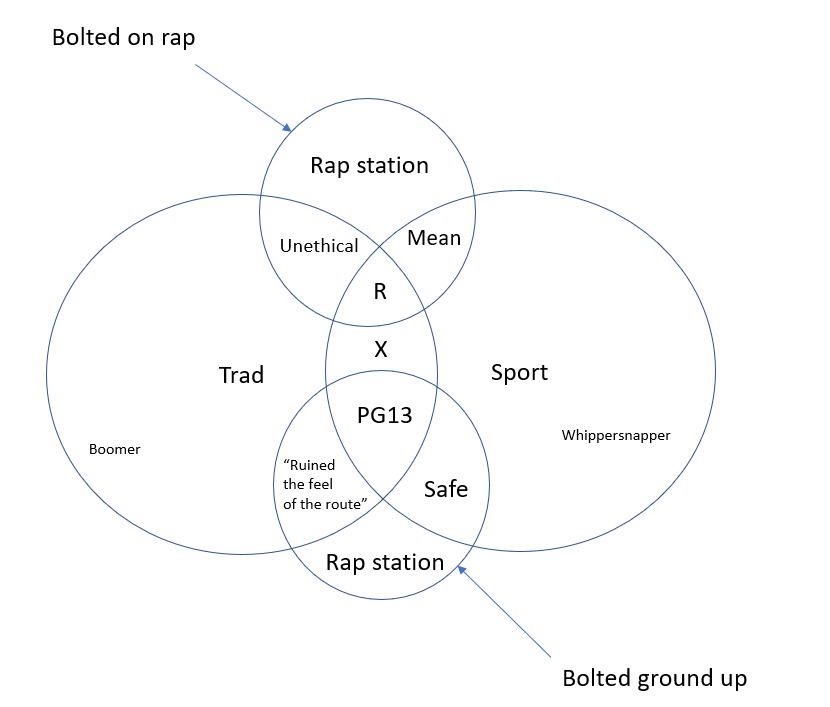 |
|
|
Greg Miller wrote: Lol, kid. Tradition in Eldo, for example, is Jules Verne - lead ground up - or the many deteriorating aid routes - climbed free back when there were pitons every 3 feet and slowly normalized over the years into an X route. That's trad climbing. Headpointing is far more recent and it's not trad climbing. If they'd just make it crystal clear that the route is actually a TR that might get lead someday, as was the FA, that would also be better - but what really happens is some fucking wanker is making decisions about how bold something should be without personally demonstrating they have the capacity to take on that boldness themselves and the route very often gets passed off in the guidebook and community as some sort of trad climbing test piece - the TR details conveniently left out. Because they lack the necessary judgement and experience for their contrived creation as a ground-up onsite experience, the danger is often over-the-top and not found anywhere else in the trad universe for the grade. |
|
|
Marc801 C wrote: Nonsense. The entire point of sport routes is to be relatively safe. If a sport route has a dangerous fall, then it's a botched bolting job. By definition a sport route can't be R or, especially, X. And no, I didn't start in a gym - they didn't exist until after I had been climbing for about 20 years - with over 100K' of trad leads in the past 45 years. Now about the only trad gear I place is in areas where the ethic is to not place a bolt if there's a crack or if there's a spot between bolts to reduce the run. And I rarely climb in the gym. Marc, I'm not looking to argue, but in 45 years how many routes have you put up, trad, sport or in between? I've put up 30 or so (mainly mixed routes with both bolts and gear) and my goal is to place only enough bolts that I would have my good friend try for the onsight, or I would try it in a year after the beta is forgotten, and not be worried about my safety. So in practice I try to create "safe" routes if they have rap bolts. I only have one pure sport route to my name - basalt usually has at least intermittent cracks, and I religiously will not bolt them - and the comments treat it like a safe route. https://www.mountainproject.com/route/107324388/vicious However, you can't take all the danger out of sport climbing, unless you put a bolt every 3 feet, and that I would find unacceptable. I bet you would, too. if a 5-11a climber gets ambitious and hops on a 5-12a climb and blows the 2nd or 3rd clip with rope out they will probably get hurt on that fall. But that does't mean the 12a is dangerous or needs another bolt. It means that climber made a mistake in trying that route. |
|
|
Spaggett, Gotcha! wrote: So, to recap: I should of just posted this as the OP. Way less wordy. Nice work on the diagram btw! |
|
|
Bill Schick wrote: Lol. IMHO, I wouldn't describe it as restful, leisure, or easy. |
|
|
Jon Hillis wrote: Exactly. |
|
|
bryans wrote: That's exactly what I mean about sport routes being relatively safe. And in answer to your question, perhaps 5 trad routes, but none are in any guidebooks. It was more like "someone must have climbed this before", esp. the 2 at Seneca since the Army swarmed all over that rock in the 50's-60's. However, you can't take all the danger out of sport climbing, unless you put a bolt every 3 feet, and that I would find unacceptable. I bet you would, too. if a 5-11a climber gets ambitious and hops on a 5-12a climb and blows the 2nd or 3rd clip with rope out they will probably get hurt on that fall. But that does't mean the 12a is dangerous or needs another bolt. It means that climber made a mistake in trying that route. Fully agree with that, too. Climbing outside is dangerous. I'd rather assume sport climbing is not relatively safe, and instead stay aware that every time I go above my gear, there is danger and so I must perform and stay focused. That kinda goes without saying. I was at the city of rocks last August and almost every route we did had ledge or deck potential, at some point, with or without bringing gear to supplement the bolts. But it was my choice to climb those routes instead of going to a pure modern sport crag where the danger could at least be mimimized. Those routes at the City don't need more bolts, even if they could be safer with more bolts. City of Rocks is kind of an outlier in many ways, that being one of them. A lot has to do with when the route was established, and a lot of those routes need to be viewed more as a trad route with some bolts for pro, not sport routes. |


