
 Continue with onX Maps
 Sign in with Facebook






Quick Field Analysis: How Much Force Does a Top Rope Fall Produce?
|
|
Background
Earlier this week Rock and Ice published an article involving forces in a TR fall (1). They claimed they were able to reach forces as high as 7kN in their analysis. I did some testing on TR falls a few years back (2), but lieu of the article, I decided to revisit the topic once more.  Equipment Measurements were taken with a 3000lbf load cell with a conditioner scanning at 520 Hz. The load cell was properly calibrated, and its accuracy was verified against three other load cells. Results Series One – 160 lbs climber, 180 lbs belayer, no twists in rope at anchor - Fall 1 - 525.7 lbf / 2.33 kN - Fall 2 - 515.6 lbf / 2.29 kN - Fall 3 - 465 lbf / 2.07 kN Series Two—160 lbs climber, 180 lbs belayer, two twists in rope at anchor - Fall 1 - 462.8 lbf / 2.06 kN - Fall 2 - 421.6 lbf / 1.88 kN - Fall 3 - 426.8 lbf / 1.90 kN Series Three—180 lbs climber, 160 lbs belayer, no twists in rope at anchor - Fall 1 - 555.6 lbf / 2.47 kN - Fall 2 - 570.3 lbf / 2.54 kN - Fall 3 - 600.1 lbf / 2.67 kN In the spirit of trying to replicate the results R&I got, both my partner and I climbed to the top of the route, pulled out two huge handfuls of slack (about 6-7’), and jumped off to simulate an inattentive belayer. The results were: 160 lbs climber, 180 lbs belayer - 766.3 lbf / 3.41 kN 180 lbs climber, 160 lbs belayer - 728.7 lbf / 3.24 kN For fun, here is a graph showing the 766.3 lbf / 3.41 mentioned immediately above: 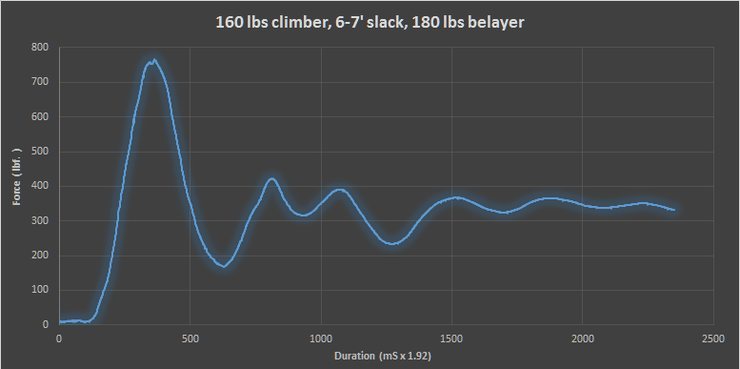 While I do not have a video of series one and two, I have a video of series three: youtu.be/f_hRE9isHx4 |
|
|
I think if you reach 7kn your belayer was asleep... |
|
|
were they using a tired gym rope on a much shorter route with an autolock device? |
|
|
That's super interesting thanks for doing this! |
|
|
Climbers are nerds, and I love it. Nice work. Seems like there might be some KN sandbagging going on at R&I. |


|
Hmm...R&I device calibration issues? |
|
|
rgold wrote:Hmm...R&I device calibration issues? Both tests had roughly the same fall factor (R&I 0.11, 20kN 0.14). The main difference was that R&I used an almost totally static belay with a 200lb climber, and 20 kN had a 160 lb climber and a 180 lb climber alternating falling and belaying. With these conditions, you would expect higher numbers from the R&I tests, but nearly double is surprising. I tried to track down the author to ask. The article says it was written by Tyler Stableford. I looked him up on Facebook. There is one Tyler Stableford on FB, he is listed as living in CO, and listed as working for R&I. However, when I asked him about it he said he did not write the article and does not work for R&I anymore, so who knows. I might try to email R&I directly and ask. It seems really unlikely anchoring the belayer down would double the impact force. On the smaller falls, I was barely even lifted off the ground. We are talking a foot, if that. Yet, even R&I's "standard" TR falls were just under double mine—3.5kN on average. One thought might be that they are using an analog dyno, which I know can produce inaccurate results on dynamic loads, but that's just a guess since they dident comment on their equipment usage. |
|
|
Worth noting that the R&I article was originally posted online in 2013. They just recycled it, which they seem to do pretty regularly... |
|
|
Your numbers seem much more reasonable than R&I. |
|
|
Nice study. |
|
|
climber patwrote: Here is a link to Geir Hundel's experiments geir.com/mythbuster.html Latest archive: GEIR HUNDAL the climbing mythbusters I think you're actually citing this, though? The theoretical fall factor |
|
|
you should try this with a static rope. That'd be an interesting comparison. |
|
|
Petzl claims 5.5kn impact force for a FF0.3 for their semistatic 10mm. (Presumably 80Kg, but I didn’t dig into the details) 7Kn at the anchor (so around 4Kn at the climber) sounds reasonable for a top rope fall with a lot of slack on a semistatic, probably with the belay device anchored. It would be interesting to see some tests confirm that, but I hope no one’s regularly leaving a big loop of slack hanging while they’re top roping on a semistatic, because that seems like it would hurt. |
|
|
Who climbs with a semi static rope? Maybe R&I tested with a steel cable. |
|
|
Some gyms and lots of “high ropes course”/summer camps/etc use semistatics for top ropes. As long as there isn’t an insane amount of slack in the system it’s not a safety concern on top rope— the FF0.3 impact force petzl tested would be difficult to achieve without decking. ETA: It’s much less work to give a birthday belay with a semistatic, so if most of your clients aren’t regular climbers it makes sense, if everyone belaying is closely monitored/not a hooligan. The only scenario where impact forces exceed what you’d see in a typical lead fall would be if a belayer just straight up stopped taking in slack when the climber was two thirds of the way up and the climber jumped from the top of the wall. |
|
|
Eli Wwrote: I have led and fallen on the Petzl semi static ropes many times. Used to avoid rope stretching falls into talus. No top rope load on one could be a problem. |
|
|
Yeah, I’m not signing up to test it, but my assumption is that even on lead, the belayer getting yanked up into the first bolt absorbs enough energy that a semistatic probably won’t kill ya even if it breaks a couple ribs. OSHA says a peak force of 8.9Kn for 2ms is acceptable for fall arrest systems, which seems like it would be challenging, even with a semistatic, to achieve in a climbing context without belaying of an anchor. |


