|
|
CBW Warner
·
Sep 23, 2013
·
Unknown Hometown
· Joined Nov 2010
· Points: 30
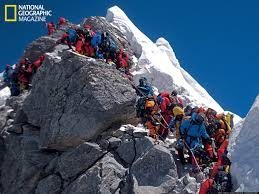
An estimated 23 climbers died in the Karakorum this year. 4 of these were good friends and 3 had 20+ years of Himalayan experience. While it is a stretch to blame those deaths on global warming and the resultant weather and climate changes, the Himalaya is definitely becoming more "objectively" dangerous (rock fall, more avalanches, more crevasses). Add in the # of people on the normal routes of Everest, Manaslu, etc and the subjective risks keep multiplying. The conundrum, is that if you leave the normal routes where the people are trying to kill you, you'll up the objective hazards (I was forced to retreat on two new routes on 8000 meter peaks due to good weather: the heat released boulders that had been frozen in place for thousands of years, and wet snow avalanches scoured the couliors and poured over rock bands.) Why is Denali 80 feet shorter? The snowy top melted away.
Everest may be the perfect place to witness these two factors: the Lhotse Face was a bowling alley two seasons ago, and 500+ reached the summit. At some point in the future we will see a rock fall that takes out dozens as they climb that face.
The good news: if you do a meta survey of the Accidents in North American Mountains, you'll find that the top four reasons people die while climbing is due to HUMAN ERROR. So if you are skilled, conservative and always learning, you can live to be a has been.
The bad news: if you want to be a mountaineer, the best days are behind us.
I am going sport climbing today.
|
|
|
Simon Thompson
·
Sep 23, 2013
·
New Paltz, NY
· Joined Apr 2011
· Points: 895
CBW wrote:you'll find that the top four reasons people die while climbing is due to HUMAN ERROR. So if you are skilled, conservative and always learning, you can live to be a has been. You hit the nail on the head. I just returned from a climbing trip and witnessed a rescue and/or body recovery in every national park climbing area I visited. In almost every case, the accident was completely avoidable and could be attributed to poor decision-making and lack of honest evaluation of one's own skills.
|
|
|
Buff Johnson
·
Sep 23, 2013
·
Unknown Hometown
· Joined Dec 2005
· Points: 1,145
1. Is the percentage of climbers dying or getting injured from climbing rising?
As a percentage, no. More people are outdoors enjoying these activities. With advances in equipment and ease of access, it's just a reality.
Although, Vallone brings up some great parallels with the "pro" but not pro skiers, and the increased visibility of accidents.
2. If so, why?
3. Are we as a community ok with that?
Nobody is "ok" with accidents
4. If not, how do we change it?
First, you can't fix stupid. No matter the effort into education or equipment, people do stupid shit and will continue to do stupid shit.
Second, shit happens. The mountains are never 100% safe.
Third, aside from my first and second points, everything else (95+% of every accident) is an avoidable one that had a basis in human-based decision making. Ignorance, complacency, bias, arrogance..what can you do? Not a damn thing, except educate yourself and take care of your partner(s) and vice versa.
Otherwise, free expression and risk acceptance are the name of the game; people are responsible for themselves.
|
|
|
doligo
·
Sep 23, 2013
·
Unknown Hometown
· Joined Sep 2008
· Points: 264
Dustin B wrote:Get an AAC membership if you don't already have one. Their 'accidents' book that comes free when you join. Plus you get a copy of the AAJ - don't know what trip reports the OP is reading, but the cutting edge ascents described in them I rarely want to attempt. Take for example, Kyle Dempster and Bruce Normand's FA on Mt. Edgar - both of them have said that they never want to climb that mountain again. When it's hard and desperate, there are usually no film crews. You get a better perspective by reading written accounts from places like Alpinist or AAJ, not from the ReelRock Tour.
|
|
|
Greg D
·
Sep 23, 2013
·
Here
· Joined Apr 2006
· Points: 908
Buff summed it up pretty well.
This question gets asked every year, though. So, I don't think this year is unique. I think the op's awareness has grown and media coverage is greater. As a percentage of the growing numbers I don't think there has been any change. I don't have stats to back it.
Climate change, oh my. The term global warming had to be replaced because the predictions didn't happen. Well, it turns out the climate has always been changing including in all recoreded and non recorded history. But, the media needed a new catch phrase. Yes, we are seeing changes. But, the climate has always been changing. I have the weather channel on right now. There is a special on climate change. Makes for great tv.
Someone above mentioned Mills Glacier. It is larger and more stable than it was in the 90's. It was so warm up there people were climbing in shorts.
|
|
|
Insert name
·
Sep 23, 2013
·
Harts Location
· Joined Dec 2011
· Points: 59
Jeff Thilking wrote:Nice write up. I blame Reel Rock Film Tour, GoPro, and Red Bull. To blame anyone but yourself or to not make anyone take responsibility for their own actions is stupid. You are doing something dangerous and pushing limits (personal or more) will likely end up with you in the injured or dead at some point.
Next thing we know it will be: Spoons make people fat, Guns shoot people & Climbing routes throw people to their death.
Another example: I have been cycling for about 15 years & went downhill riding for the first time this weekend. Half of the people riding should not have been riding any downhill trails without expecting to get hurt, people were crashing 5 feet of the lift before they even got to trails.
So the problem isn't just climbing it is anything that people wish they had the "nuts" to do and society has given people this instant gratification issue and that makes a dangerous combo.
|
|
|
Martin le Roux
·
Sep 23, 2013
·
Superior, CO
· Joined Jul 2003
· Points: 422
Chris Kalman wrote:Is the percentage of climbers dying or getting injured from climbing rising? Short and unhelpful answer: No-one really knows.
1. There's no reliable mechanism for reporting climbing accidents. ANAM's a good publication, but they rely on voluntary submissions. Many accidents go unreported.
2. No-one keeps an accurate count of climbers or climber-days. There are some statistics such as national park visits or outdoor gear purchases that can be used as rough benchmarks, but they rarely distinguish between climbers and non-climbers.
3. The term "climber" isn't well defined. What about people who never venture outside climbing gyms? Ski-mountaineers? Hikers who get into trouble on mildly technical terrain?
4. It's human nature to see patterns or trends when sometimes you're just looking at random noise. Climbing deaths or serious injuries are rare events; it's hard to tell the difference between a trend and a small number of unlucky accidents.
This isn't meant to imply that accident reporting isn't a worthwhile exercise. There's lots to learn from these reports; it's just that anecdotal evidence isn't a good basis for statistical analysis.
|
|
|
Mark Pilate
·
Sep 23, 2013
·
MN
· Joined Jun 2013
· Points: 25
Pretty much agree with Buff’s assessment above.
Except for expanding on item 3 a bit. While the good angel on my right shoulder wishes nobody any harm and I actively and routinely assist other climbers in need (such as all my insightful, always on topic, and very useful posts on this website), the bad angel on my left shoulder whispers, “you gotta weed out the weak and stupid somehow” and I’m OK with it.
Basically it is carrying the “can’t fix stupid” 5th fundamental law of nature to its logical conclusion. Do what you can to help educate and assist, but its gonna happen regardless.
Just yesterday, a girl had apparently collapsed and cut herself as she fell. I happened to be 50 feet away when someone started yelling for a doctor. Long story short, she was just supremely hung-over. The good angel made me stay with her, treat her, call her Mom for her, escort her out, etc etc. The bad angel makes me talk smack on the internet about such people. Does this make me Bipolar?
Edit: This post does not address the smaller % of unavoidable, "legit" accidents of just being out there, "can happen to anybody" type incidents
|
|
|
William Sonoma
·
Sep 23, 2013
·
Unknown Hometown
· Joined Dec 2012
· Points: 3,550
Mark Pilate wrote/asked: Does this make me Bipolar?
Im sure you werent truly asking Mark but you made me think. that makes you the opitomy of human. the modern human mind (maybe mind period?) is bipolar naturally, the aristolian logic (= black and white, not grey like life) we're induced with (a2+b2=c2, better/worse, good/bad) is a big part of this.
we all have a sinner and a saint within us. we all see the positive and negative (potential or part of the WHOLE potential). the difference between us all is what we choose to do, commit to.
|
|
|
Jon Weekley
·
Sep 23, 2013
·
Denver, CO
· Joined May 2010
· Points: 70
As you can see by the current Accidents report (2013), There has NOT been a significant increase in fatalities in North America, since the early 80's.
|
|
|
William Sonoma
·
Sep 23, 2013
·
Unknown Hometown
· Joined Dec 2012
· Points: 3,550
thanks locker. im sure youve picked up how to spell alot of words correctly over the last 80+ years of your life...
theres not more deaths, just more media attention (media = facebook, forums, news sites, climbing sites, etc). ALOT more info is being taken in/shared these days.
|
|
|
Jim Titt
·
Sep 23, 2013
·
Germany
· Joined Nov 2009
· Points: 490
Chris Kalman wrote: Is the percentage of climbers dying or getting injured from climbing rising? Well, don´t know about the USA but Germany,the country with the largest Alpine Club and painfully exact accident statistics reporting gives the lowest number of deaths ever in real terms and 1/13th of the accident rate since 1952 for their membership of around 1,000,000 in 2012. The weather in 2012 was particularly favourable (it was bad!) but the year-on statistics show climbing/alpinism/mountain activities in general are becoming steadily safer.
|
|
|
Chris Kalman
·
Sep 23, 2013
·
Unknown Hometown
· Joined Mar 2011
· Points: 726
Thanks everyone for your thoughts, especially to those who showed some of the data on accident totals past and present. It is interesting to see that in fact it seems that participation has increased, but accidents have decreased in the U.S. since 1980. I didn't expect to see that! I think this information precludes the value of my third and fourth questions, and the thoughts I had about them.
|
|
|
hikingdrew
·
Sep 23, 2013
·
Los Angeles, CA
· Joined Jul 2013
· Points: 38
I'm going to risk appearing a bit pedantic by posting about stats on a climbing site, but I often get asked questions about climbing safety and stats.
When you're counting something (like climbing accidents,) for it to be a 'statistically significant' change, the increase or decrease has to be at least the square root of the count. So if there were 100 accidents one year, the next year would have to have more than at least 110 (or less than 90) accidents for you to think it significant. For smaller numbers, it still applies; so 10 one year and up to 13 next year may not be significant, even though it's a 30% increase.
This isn't a hard and fast rule either, a way to think of it is to say that increasing from 100 to 110 may be just statistical fluctuation, but 100 to 120 is probably not due to just chance.
|
|
|
bearbreeder
·
Sep 23, 2013
·
Unknown Hometown
· Joined Mar 2009
· Points: 3,065
i suspect that many of the accidents that dont involve fatalities or SAR never show up in the ANAM, especially if people can self-evacuate from the crag
there are accidents in squamish all the time, but generally youll rarely see em in the ANAM
remember that, as far as i know, there is no required reporting for "accidents", which itself needs definition
what i have noticed is quite a bit of sketchy activity by some climbers, often those who are new
lack of basic anchor knowledge, crap belaying techniques, lack of multi experience, learning off the intrawebs, no rap safety, etc ...
the bluffs in climbing season is home to all the shenanigans ... youll see it all along with people doing approaches in high heel boots, little kids playing at the base under trad climbers, etc ...
of course youll see the inverse ... newbies screaming at other people about how UNSAFE UNSAFE UNSAFE they are for nothing, like not using 4 lockers and an equalette for a TR anchor ... which is just as bad because its crying wolf when theres real safety issues
;)
|
|
|
Mark Pilate
·
Sep 23, 2013
·
MN
· Joined Jun 2013
· Points: 25
Always cracks me up when someone questions the real world value of a forum discussion....
|
|
|
vincent L.
·
Sep 23, 2013
·
Redwood City
· Joined Jan 2005
· Points: 560
Loud and clear D. Buffum ....
The OP pretty much acknowledges as much in his last post . It's still a worthwhile and interesting discussion IMO .
|
|
|
vincent L.
·
Sep 23, 2013
·
Redwood City
· Joined Jan 2005
· Points: 560
Well first I would argue that it is worthwhile to the OP , as he had one viewpoint and has since changed his opinion based on the input and data of others .
Secondly it is worthwhile to me to learn what other climbers think or don't think the reasons are behind climbing accidents .
|
|
|
Buff Johnson
·
Sep 23, 2013
·
Unknown Hometown
· Joined Dec 2005
· Points: 1,145
somali pirates on obamacare, that's why
|

 Continue with onX Maps
 Sign in with Facebook