Home - Destinations - People - Partners - Forum - Photos - What's New
 ADVANCED
The Crestones
Show routes:
Select route...
Crestone Needle North Buttress 
Crestone Peak / North Pillar 
Crestone Traverse 
Ellingwood Ledges 
Kit Carson / The Prow 
Northwest Couloir 

Ellingwood Ledges 

5.7

   
2 people found this page useful

FA: Albert Ellingwood, 1925.
Type: Trad, Alpine
Consensus: 5.7 [details]
Length:  Grade III
Views: 7,295 page views

Submitted By: Ben Mottinger on Jan 1, 2001


Add Photo  Add Comment 

You and this route  |  Other Opinions (50)
Your todo list:
Your stars:
Your rating: -none- [change]
Your ticklist: [add new tick]
 Printer Friendly View

Profile shot of the Needle. Storms brewing.


Description 

Got up at 4:30am to get a good start on the climb. We hiked up to the upper S. Colony Lake and then waited for a little light to start climbing. The standard route ascends a 3rd class slab up to a ramp on the Needles' East face, then starts the 4th class arete. There is also a direct start, which adds two pitches of 5.6 climbing up to the 3rd class ramp. We ended up doing the direct direct start which started on the N side of the arete and added 6 pitches of 5.5/5.6 climbing up to the arete. Once we got to the 4th class section, progress was faster, but we still stayed roped up which made it slow going. The headwall section is the crux, which we did in 4 pitches. The climbing here was really nice, and the last, crux pitch was 150 feet of 5.7 up a nice crack. There was another group in front of us already on the standard 5.7 crack, so I took one to the right, which angled up and right for a bit, then went straight up to the belay. It was about the same grade 5.7ish and offered nice hand and finger jams with cobbled conglomerate rock for extra hands and feet. From here, it was about 200ft. of 3rd class to the summit. Key beta for the climb. We did 10 technical pitches (although easy) take time nonetheless. Plan on using a WHOLE day for this climb. You start at first light to make it off the mtn. before thunderstorms in the afternoon. Since we did it in Sep. the storm factor was less, but still present. Even so, we didn't make it back to camp until about 4pm. Take plenty of water, extra food and clothing, and definitely first aid gear.


Protection 

Hexes, tri-cams, cams from #0.5-#4 Friends, mid-large stoppers, many runners in the 24 inch length. Twin ropes are useful.


Photos of Ellingwood Ledges Slideshow Add Photo
Sun on the headwall of the needle.

BETA PHOTO: Sun on the headwall of the needle.


BETA PHOTO
Carol, about halfway up Ellingwood Ledges.  August 26, 2000

Carol, about halfway up Ellingwood Ledges. August...

Taken low on the route where the direct and normal starts merge.  Above George's head is the "Red Tower" - most parties rope up for the pitch that goes just left of it.

Taken low on the route where the direct and normal...

4th class climbing above the Red Tower.  The complex final Headwall is visible high above.

4th class climbing above the Red Tower. The compl...

Fun climbing below the final crux headwall.

Fun climbing below the final crux headwall.

The start of the first headwall pitch.

The start of the first headwall pitch.

Another angle on the start of the first headwall pitch.

Another angle on the start of the first headwall p...

On the final 3rd class pitch, only 100 feet below the summit.  This is a very exposed pitch, but the rock is excellent.

On the final 3rd class pitch, only 100 feet below ...

Sunrise on the one of the namesake ledges.

Sunrise on the one of the namesake ledges.

1st ledges after simul-climbing past the Direct. Note the mackerel sky!  Photo of Josh Hobgood.

1st ledges after simul-climbing past the Direct. N...

Early on the aręte - Photo of Greg & Marcello.

Early on the aręte - Photo of Greg & Marcello.

First hard headwall pitch.

BETA PHOTO: First hard headwall pitch.

Josh Hobgood following the first hard headwall pitch.

Josh Hobgood following the first hard headwall pit...

Marcello leading the 2nd hard pitch, near the crux.

BETA PHOTO: Marcello leading the 2nd hard pitch, near the crux...

Mike Schillaci on the arete, 1990.

Mike Schillaci on the arete, 1990.

A friendly Marmot poses a few feet below the summit of Crestone Needle in the early morning.  Humbolt Peak is silhouetted in the background.

A friendly Marmot poses a few feet below the summi...

Jolly Max on the early morning approach.

Jolly Max on the early morning approach.

Max crawling up the early 3rd class.

Max crawling up the early 3rd class.

Looks good.

Looks good.

SUMMIT!

SUMMIT!

Don't step on the flowers.

Don't step on the flowers.

Looking down at the 5.7 crux.

Looking down at the 5.7 crux.

Ellingwood Arete...and me thinking 'I should have been at the base of the climb about an hour ago....'

Ellingwood Arete...and me thinking 'I should have ...

Fun in the Winter, too.<br />March, 1975

Fun in the Winter, too.
March, 1975


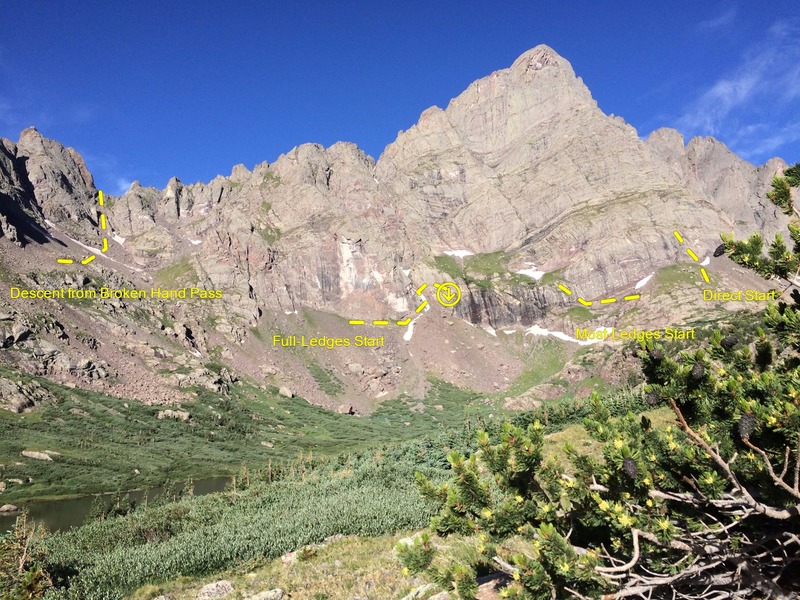
Looking up the Ellingwood Ledges from the valley below.

Looking up the Ellingwood Ledges from the valley b...

Ellingwood Ledges as seen from the summit of Humboldt.

Ellingwood Ledges as seen from the summit of Humbo...

Ellingwood Ledges as seen from near the end of the 4WD road.

Ellingwood Ledges as seen from near the end of the...

Starting up the easy 3rd class at the beginning of the route.

Starting up the easy 3rd class at the beginning of...

Looking up the technical headwall pitches higher up on the route.

BETA PHOTO: Looking up the technical headwall pitches higher u...

Me on one of the belay ledge immediately after the crux pitch.

Me on one of the belay ledge immediately after the...

Needle, summit pitches (courtesy of Top Rope Hero and SummitPost.org).

Needle, summit pitches (courtesy of Top Rope Hero ...

The Crestone Needle and Peak massif. Photo by Anna Thomas.

BETA PHOTO: The Crestone Needle and Peak massif. Photo by Anna...


Comments on Ellingwood Ledges Add Comment
Show which comments
Comments displayed oldest to newestSkip Ahead to the Most Recent Dated Sep 16, 2009
By Ben Mottinger
Founding Father
Jan 1, 2001

My younger bro has a very nice TR for this climb that is much more fun to read than my bland description. Check it out here:

http://www.geocities.com/slabmonger/CrestoneNeedleTR.html

By Anonymous Coward
Jan 1, 2001

This is a variation on the Ellingwood Ledges this climb starts from the town of Estes Park, drive US 34 for 28 miles to I-25 south. Once on I-25 drive south for 160 miles, take the CO-96 west for 60 miles to the town of Westcliffe, from Westcliffe go 4.6 mi S. on 69 then 5.6 mi on 119 to 120. Follow this road till it becomes a 4WD road, its a rough road, but I managed to do it in my Chevy Blazer in 4HI for the 4 miles, it took me about 45 minutes to drive the road as its not really that rough of a 4WD road. Hike to South Colony Lakes. Get up on the Arete, either the direct start or the ledges. We did the ledges. Once the ledges are over thats where we put on all of our technical gear. We simul-climbed the route until we reached the 5th class sections, there were about three pitches of techincal climbing. The crux was technical with a lot of exposure, to quote my partner Cab "The needle is sick dude"Once we got to the top we hiked back down to the bottom via the standard S. coulior route. The downclimb is not as tricky as all the descriptions I read stated, just make sure you take the second coulior and youll be all set. Enjoy this climb and camp out at the S. Colony Lakes, as this is one of the most magical and beautiful settings; abudant with wildflowers, wildlife, majestic peaks, and unparalled vistas. Joe E.

By Steve Levin
From: Boulder, CO
Jan 1, 2001

A classic combo continues from the Needle summit to the Peak summit (the "Needle-to-Peak Traverse") over lower 5th-class terrain, exposed in places, one short exposed downclimbing section may warrant a rope- be careful! Not a good place to be caught in an electrical storm. This traverse is one of the best (and hardest) between two 14ers in the State (also- in the southern Crestones, the Blanca to Little Bear traverse is longer and more committing, very exposed in places, and completely wild!). Having a camp in S. Colony may be a disadvantage for the needle-to-peak, as you will need to head back over the pass at upper Cottonwood (above the lake) to get back to your camp; although if you camp in Cottonwood its still a long day. For those of you into ADVENTURE BOULDERING, there is big-time untapped potential in the central Crestones, in S. Colony drainage, upper Willow creek, upper Spanish Creek, and many other areas. The boulders are conglomerate erratics, some as high as 40, usually 4-star stone with level landings (early season i.e. into mid-July may be wet and/or snowy). Some of these boulders would be famous if they were stuck out in the foothills of the Front Range. There is also a lot of potential for bolted sport climbing in the central Crestones, but you didn't hear it from me! Years ago Westword magazine had a cover photo of upper Willow; a very experienced alpine rock climber friend of mine saw it and was convinced it was Glacier Gorge.

By Matt White
Nov 19, 2001

Some advice for improving your chances for having a good time on Ellingwood Ledges:

1. If you camp at Upper South Colony Lake, you can reach the base of the route in just a few minutes from your tent.

Like S.L. says above, you can boulder yourself silly in the upper South Colony drainage. Just watch out for marmot s**t on the holds. A few of the boulders overhang on every side and therefore have marmot-proof summits. These make nice hiding places for your food while you're on the Needle.

2. Wear a helmet. I've never seen so much falling rock! I almost got creamed at least three times.

3. Bring mostly old-school pro - hexes, tricams, and nuts. Leave the big (#2.5 and up) Camalots at home. One each #0.5 - #2 Camalots might be worth the weight. The #0.5 is nice for the crux pitch.

4. Simulclimb whenever possible. A running belay with 2-3 pieces of pro between the leader and second is a safe way to climb 80% of this route. My buddy and I belayed every pitch, and it took us 6 hours from the tent to the summit. Light and fast we were not. Bad, bad alpinists!

5. Memorize the topo. The two crux pitches of the climb have several variations each. Study the topo so you can plan ahead and avoid routefinding problems.

6. Be careful on the downclimb. My partner and I had never been on the peak before, and we were lucky to get down without getting lost. A rain or hailstorm would make the downclimb suicidal. If you get rained on during the downclimb off the upper part of the Needle, it might be best to pull on your raingear and wait it out.

This is a great, satisfying route. Its mostly very easy, but make sure you can safely lead 5.7 cracks before you go. Keep one eye on the weather and the other eye looking out for hurtling boulders with your name on them.

Have fun. Take lots of film. Matt White. mwhite@mines.edu

By Matt White
Feb 27, 2002

Does anyone know if this route has been climbed in full winter conditions?

By Sean O'Dell
Apr 26, 2002

In response to Matt W. - for what its worth, I have a friend who worked for several years at Mtn. Chalet in Colorado Springs who told me of a guy he knew there who had climbed Ellingwood Ledges several times in full on winter conditions as training for big time alpine stuff in Alaska, etc. I know its just a "friend of a friend" story, but at least it SOUNDS like its been done.

By Mark Robbins
Jul 29, 2002

Well, after reading the comments here, and both Roach's & Dawson's guide descriptions, I was still confused. So after having done the climb yesterday I thought I would add my two bits and muddy the waters further.

Drove to the end of the 4WD, which left us with 1.5 hours hiking to what I believe was the base of the direct start. The crux of the approach is surmounting the large band of rock- aka apron- which blocks the base of the ridge. We climbed this on the right, slightly to the right of the aręte, which I believe is the direct start. Follow the main trail to the upper lake, branching off and traversing around the south side of the upper S. Colony lake where the trail starts to head up Humbolt. Hike up steep grass to the base of the apron and traverse right to the apex of a scree field below a large open book (12,500ft- see 'Direct Start' waypoint). Easy 5th class moves get you into the book up to where a light colored horizontal dike intersects the book (120ft). At this point we exited up and to the left via an awkward 5.5 move and ended up on the grass above the apron- I believe the actual direct start continues up the book. Once on the grass we traversed left, and then meandered up 3rd/4th class grassy ledges, sometimes following the ledges, sometimes climbing directly up easy, knobby conglomerate. We continued in this manner until we reached the base of the headwall (13,500ft- see 'Headwall' waypoint). Look for an obvious R facing dihedral at the base of the headwall, to the left of the aręte proper. We climbed the headwall in three 60m pitches.

P1: Climb the L facing corner which is about 20 feet to the right of the dihedral. First over blocks, then stem out of a small chimney (5.6) to a nice hand crack in the corner. After 50ft in the corner, continue on easy ground to a broad dirt path/ledge with a pin in the crack above and belay- 180ft.

P2: Move left 15 feet (exposed), then head up a R facing corner system (5.6), again with easy terrain for the last half of the pitch- 180ft. Belay at blocks in a grassy area below the final steep section, even with and just to the right of the base of the huge notch in the top of the peak which is obvious from the hike in. The notch has a large chimney exiting the back.

P3: Rather than climbing left into the notch & chimney, climb up and to the right over blocks to enter a R facing corner system with a nice hand & finger crack with several old pins. The crux is the steep section of the corner about 30ft up (5.7). As the climbing eases off, continue up and belay where the chimney exits from the notch to your left- 180ft.

After P3, scramble up a 4th class gully for 200ft to the summit ridge, then 50ft north to the summit.

Descent: About where the gully from Ellingwood hits the ridge, there is a couloir going down the opposite side. This is not the couloir heading directly down from the summit, but the second one to the south. Many cairns mark the descent down the couloir, and eventually you will exit left and traverse through towers to Broken Hand Pass, from whence a well marked trail leads down to the lower S. Colony lake.

By Anonymous Coward
Aug 7, 2002

As of August 2002, can anyone offer a little insight into the condition of the 4x4 road leading up to the parking lot for the Crestone/South Colony Group. Thanks.

By George Bell
From: Boulder, CO
Aug 7, 2002

A buddy of mine who climbed it last month reports: "The road in sucks big time." I doubt it is getting any easier with time. Without a pack, I think you could easily jog up the road faster than most 4x4s grind up it.

By richard magill
Aug 7, 2002

The road in is one of the worst roads I've been on in Colorado. However, after hiking all the way up the road, I was shocked to see a VW bug at the top. Anything is possible.

By Casey Bernal
From: Wheat Ridge, CO
Aug 7, 2002

I was up there a few years back and the road was bad and getting worse with traffic. On this road you need EITHER a small vehicle with tight turning radius or lots of ground clearance. This is one of the most beautiful places in Colorado.

casey

By George Bell
From: Boulder, CO
Aug 12, 2002

I climbed the route last Saturday (my second time) and it really is a fantastic route. We did the direct start this time which I would recommend. The GPS coordinates below we found to be accurate.

Both times I have gotten confused and off-route just below the base of the final headwall. The area leading up to this is very easy and grassy, but you then run into a steep mini-headwall. You may think this is "the headwall" but this is incorrect. There is now a fixed piece in this section with a purple sling (vertical to overhanging here), if you go up past this piece it is probably at least 5.8. If you go up about 20' left of this piece, you can climb steeply up the mini-headwall at about 5.6 or so, this is what I have done twice now. However, if you are smart like the team below us, you will simply traverse right (north) 50 feet or so, bypassing the mini-headwall completely, and reaching the base of the real headwall with no big problems. It is a fun pitch to climb the mini-headwall but it will slow you down and confuse you into thinking you just did the first headwall pitch.

We also had enough time and good weather left to continue with the traverse to Crestone Peak. Highly recommended!!

By Chris R
Aug 20, 2002

Did this classic on 8-19-2002 with perfect weather....here is some added beta.

Survey the route the day prior to climbing it from somewhere on the Humboldt trail. The Ledges route runs almost directly up the Arete before you. To do the direct start, look for a large, right-facing dihedral at a high point on the lower cliff band. The direct start runs at about 5.6 for two pitches. Scramble up and right from the top of the dihedral until you can traverse right along the face. See the below descripion for the rest....The alternative is a non-technical (but exposed) walk up. To find this, look at the far left side of the lower cliffs for an obvious grassy ramp ascending from right to left that cuts through the black cliff face. It looks very narrow but is generally secure. Walking up this band will deposit you on a steep grassy slope. Walk up and to the right on this slope to the lowest of three deep, parallel cuts that ascend left to right. The walk up this loose ramp will place you on the grassy ledges that bisect the face of the Needle. Traverse to the right across these ledges, following the path of least resistance. Eventually the traverse will reach a dead end where the ledge abruptly drops off. A good start to the route is about 40' to the left of this drop-off. Begin 4th class scrambling here, trending slightly left. A few hundred feet above is a giant horn; climb to the left of this feature. Continue upwards as the climbing gets more technical and more exposed. There are a few exposed 5-easy moves upon which some may want to rope up. There are many paths upwards, few of which exceed 5.2 in difficulty. Choose whatever looks most exciting! Reach a mini-headwall with a slice left of center--going around the right side of this feature provides the easiest ascent. Eventually, find yourself at a comfortable ledge beneath a headwall. Albert Ellingwood's original route followed a crack in a large, lower angle, right-facing corner which trends slightly to the right. A 60m rope and about 40ft of simul-climbing can breeze through this 5.2 pitch. Set the belay at a large ledge next to a set of boulders--above and slightly right should be a right-facing dihedral that starts about 30ft. up, past a couple of small, easy bulges. This pristine corner is the crux of the route--the Head Crack. The climbing is aesthetic and fun 5.7 stemming. Climb out of this 100ft. corner and run it out, aiming to the right of an obvious gully--you have to stretch a 60m rope to reach the good belay under a roof. Breeze up on easy but loose climbing up the gully and enjoy the superb view from the summit.

By George Bell
From: Boulder, CO
Aug 20, 2002

Good info Chris, but the finish you describe does not sound to me like the Head Crack. What you describe sounds more like the normal finish these days (it has several fixed pitons and a fixed wire, right?). I have never heard anyone describe the Head Crack as "aesthetic 5.7 stemming". I believe the actual Head Crack lies about 100' left of the aesthetic 5.7 stemming corner . Although I've not done it, I hear the Head Crack is an awkward and physical chimney and a #4 Camalot is recommended if you go that way.

By Ron Olsen
From: Boulder, CO
Aug 20, 2002

My partner and I did the route on 8/17/02. The best beta for the final technical section is in Mark Robbins' comments above; the guidebooks (Roach, Dawson, Green, Roper and Steck's 50 Classic Climbs) are very inaccurate. Roach and Green have copied their Ellingwood route descriptions almost verbatim from Roper and Steck; I wonder if any of them has actually climbed the route? We did P1 and P2 exactly as described in Robbins' comments above. P1 was about 180', and P2 took the entire 60m rope to get to the grassy area with blocks; I could have belayed 30' lower on a small ledge with a fixed pin. As George Bell surmises, P3 in Robbins' comments (and the final technical pitch in Chris R's comments) is not the Head Crack. To get to the Head Crack, you go around a corner to the left and up a low-angled ramp to a belay anchor with two old fixed pins on the right wall. There is another fixed pin about 15' up and right from the belay that protects the 5.7 crux move. Do not climb the ugly chimney at the back of the ramp! Instead, climb up and right, clip the pin, make a delicate stem right, work up into a right-angling wide crack, and clip a second pin. Continue 15' up to a ledge. Do not go left on this ledge to the ugly chimney; there is no protection and some hard climbing to surmount this obstacle. I saw a tattered back-off sling in this chimney. Instead, climb the short headwall to the right, clipping another fixed pin. Gain a large ledge and continue up on easy ground to a belay just short of the top. An easy scramble up a 4th-class gully leads to a cairn at the top of the southeast ridge. A short walk north gets you to the true summit. The guidebooks' comments about "stemming the wide crack" on the Head Crack pitch are completely inaccurate, unless you do the ugly runout chimney described above, which to me seemed clearly off-route. Done the way I described, the Head Crack pitch does not need any large pro, and the entire climb can be done with nothing larger than a #2 Camalot.

By Chris R
Aug 20, 2002

Ok, my bad on the beta, the finsh I described above is not the original "Head Crack". George Bell has the info. correct in his comment--the actual Head Crack starts about 100' up and left of the corner I thought was it. That said, I compared notes with some guys who have done the route the original way and followed the Head Crack, and came away with the impression that my finish up the corner was a heck of a lot more fun. Don't take my word for it, though--get up there and check it out for yourself. I'm still riding high from topping out that line.......

By Peter Franzen
Administrator
From: Portland, OR
Sep 7, 2002

Did this route on September 7, 2002 in truly specacular conditions. I'm not sure I can add much to the good beta already provided, but here are some random comments:

The road to the trailhead is horrible. I did it at night (!) in a stock Nissan Pathfinder and although we made it up, there was a constant fear of flat tires and bottoming out on rocks. Make sure you have a 4WD-Low gear or some sections may be impossible.

We started at the lower lake at around 4:30, and waited until dawn to do the direct start. Being the speed deamons we are, we decided to simul-climg the ds- probably not a good idea. There is little pro, and what there is seems to be pretty spread out which made the simul-climbing really sketchy.

We only climbed 2 pitches at the top of the route. I highly recommend skirting around to the right of the "mini-headwall" that lies at the top of the 4th class arete. Using a 50m rope we were able to do 2 comforable pitches and then scramble the last 60m or so to the summit. We did move the belay at the top of the first pitch to the ledge system about 40ft to the left and about 25 feet up.

Round trip took us about 7 hours. We made the summit at 10:00am, and the descent seemed to go on forever. Great route overall!

By Jake
Sep 8, 2002

As Franzen said, simulclimbing the direct was a tad sketchy, but if you do decide to rope up, it is only nessesary for the first 100 meters. The rest is pretty cruiser. Many fixed pins/pitons. The road in SUCKS and it might just be faster to hike in.The descent is, well, horrible.The route makes up for it however.

By YDPL8S
May 16, 2003
rating: 5.7

I happen to know that it was climbed in the "dead of winter" by John Rosholt and Bob Dickerson sometime in the late 70s. They both got a little bit of frostbite from the adventure. Had some harrowing stories of frozen mitten on rock handholds (although the stories get more harrowing as the years go by!) I have a summit shot, from their ascent, looking towards the Blanca massif hanging in my office. I personally have done the route 3 times, first time on the 4th of July 1976 Bicentennial. I think the most important thing I can impart is to get off the top before the afternoon lightning storms start to hit. I've seen rivers of hail washing down the gullies. Believe it or not I drove a '69 Datsun all the way to the top of the road! When I got back to Gunnison, my toe-in on the car was out 2 1/2 inches and my tires were ruined. I'm an old fart and don't climb any more but I like reading all stories from you young bucks. This is a great route, I always 3rd classed the bottom section until the last two pitches (although I had a run-in once with some Texas Sierra club members that admonished me for being "off route"!). Keep up the good work, keeps me interested in life before kids and job and achey old bones.

Scott M.

By David Conlin
Jul 23, 2003

2nd time up the arete on 7/20/03. I worked in this basin for an entire summer (1998) and drove the road many times. It is definitely in declining shape, but any 4x4 SUV/truck in stock condition, driven wisely can make it. I've seen a minivan at the top, by which I was amazed.

I did the headwall in only two pitches (stretching a 60 m rope all the way for each). You can avoid the first technical pitch (which I did accidentally) by climbing 4th class terrain to the right of the arete. The next two pitches were made for 60 m ropes. Each 60 m progression lands you squarely on a *phat* belay ledge. Both times I climbed the right facing dihedral to the right of the head crack proper and this is recommended (although I haven't climbed the head crack itself). Beautiful 5.7 climbing (though my partner/girlfriend who is about a 5.7/5.8 climber downrated it to 5.6!!!).

I agree, bring old-school pro. Lighter, sufficient, more fun. The crux is easily protected by pitons, anyway. Heck, might as well solo it.

I have been thoroughly lost both times on the descent. There are extraneous cairns (ducks) everywhere. Be careful and double check your descent line by climbing out on viewpoints and picking your line. Also, it has hailed on me both times I climbed this, right as I topped out (noon last time and I don't remember what time it was in '98).

This is more of an alpine/mountaineering route than any rock climb I've done in Colorado. Do it.

By YDPL8S
Aug 7, 2003
rating: 5.7

I wrote the previous commment about the winter ascent. I have to admit I have been confused by some of the descriptions of the route. I just posted my beta photo as best I could. I 3rd classed up to this point on the "ledges" and then belayed the 1st pitch to a little coffin shaped indent just before the big ledge so that the rope drag was minimized. Scrambled up and set up the next belay for the final pitch. As I recall it, the crux was a small roof that was on lower angle rock and a number 8 or 9 hex (yes, this was before Friends) protected right at your chest. You pulled the roof and then stepped right on to some wonderful 5.5 low angle slabs to the top, looking at the lake between your legs! Great Stuff. Does any of this make sense?

Scott M.

By Anonymous Coward
Aug 9, 2003

Just returned - 8/9/03 Couple comments some might find helpful, in addition to the above.

1) I rented a SUV. 80 bucks for the 1 day that I needed it - less than the price of 2 lift tickets. No brainer, IMO. Saved us a lot of time, energy and stress.

2) Printed Mark Robbins' description, and added in G. Bell's comments. "Ellingwood Express" was the result. No direct start, cut right at the "mini" (?) headwall and 3rd class up, then 2 60m pitches. Worked well. The original "choss-width" last pitch was unapealing to me. The picture in 50 Classics and the area topo map in Dawson were my other info.

3) The approach described in Dawson is worth noting. Take a right over the fat log just before crossing the river to the upper parking lot, and head past all the camping to find a trail leading to the lake. Walking though the gate and up that road adds maybe a 1/2 mile or so plus a lot of people. I did the shorter up, then the latter down. I'll avoid the gated road in the future.

A fun route in yet another spectacular place in Colorado that I hadn't even seen before. Thanks to all for the above beta.

By Tyson S Arp
Sep 9, 2003

The trail that's shown on the USGS topo which avoids the last part of the old mining road is posted as being closed (I was just there on 9/3/03). I believe this is the trail mentioned in the previous post--unless there is another trail that I'm unaware of.

By Brian Espe
From: Fort Collins, CO
Aug 1, 2005
rating: 5.7

I did this route on 7/30/05 exactly as Mark Robbins described it. It is one of the best, it not THE BEST climb I've done to date. I took a look at the "true head crack", best decided to climb the one Mark Robbins describes to the right instead because it look much more fun. Stellar!!!

By Ben
Aug 23, 2005
rating: 5.7+

Gear Alert

Just from reading all the beta on this site, I was able to stay on the route the whole time. Here's what we found: Heading almost straight up from the red tower, you reach a small bulge with an old piton at about eye level. Our first pitch went over the bulge with one 5.7+ move, and then angled up to the left at about 5.4 to a nice ledge below the obvious headwall chimney/crack. This next pitch was hard! about 55 meters of SOLID 5.7 at roughly 13,700 ft. with a pack. The pitch is broken into 3 sections. about 45 feet in the steep corner will bring you to a nice rest below a few chimney moves. If you're good with your feet you can keep it at 5.7 but if you arm it it'll feel like 5.9. The moves (3 or so) in the chimney are protectable with an old piton that's hammered into dirt and a variety of backup possibilities. Once you grab your way up a few big nobs (I laybacked the knobby flake at the top of the chimney) to pull out of the short chimney, it's relatively easy (5.5 or so) to the end of the pitch at a big cozy ledge. For the next pitch we moved the belay up and headed up the obvious finger crack that angles right just a few feet right of what I imagine is the original route. This offered some airy and scary but protectable moves (felt like at least 5.7 with 35 lbs. on my back) for the first 40-50 feet before heading up around the corner to the left on slightly easier rock. The rest is a short scramble directly up the obvious gully above. The last move is a little harder than 4th class so be carefull, It's Crestone conglomerate and you never know what might pull off!

I don't lead any harder than 5.8 on gear and this is how I felt on the route. Although mostly 4th class there's still 2000 ft. to be gained and it can be tiring! Remember, these reports are highly subjective. Prepare for a challange and if it comes you'll be ready. If it doesn't, good for you...you're strong...go climb the Casual Route.

By kirkadirka
From: Golden
May 22, 2006

Does anyone know how early in the year the trailhead for this area can be accessed? Would a late May climb be considered much more difficult of an approach? Not sure how much snow they've had out there this year.

By Michael McKinnon
From: Golden, CO
Jul 17, 2006

I did this route yesterday and here is my beta FWIWs.

We slept at lower S. Colony Lake and bivied where they standard route connects back to the lake. And, yes, the road is horrible:).

We started at 6am and hiked straight across to the base of the climb from the lower lake. We climbed the entire route up to the headwall free. The only move of any consequence was the one 5.7 move over a bulge with the pin in it that Ben mentioned. We only roped up for 2 pitches total and they were the final headwall pitches, and they went exactly as described by the other posters. We had a 70M rope and I ran both pitches the to the very end of the rope. This left us with one final pitch of low class 4 for about 100 ft to the top.

There are a lot pins in the first headwall pitch as the OP suggests. They are all really old ring pins that are being over run by moss and it looks like the ring pin will break. We hit the top at 10am - 4 hours total from Lake to Peak.

The descent can be scary and hard if you get off route. You descend down the gully off of alternately loose rock and solid conglomerate. Continue down the gully until you can break left (looking down the mt). You can also spot the path from the top of the peak and use that as guidance. We got back to the packs at 12 noon.

All in all, great route. If you feel comfortable making 5.6 and the occasional 5.7 move without gear or rope, this route can go really fast. If you need to rope up for the entire thing, then give yourself a full day.

By Joe Leonhard
From: Denver, CO
Aug 24, 2006

Fun climb, but be ready for sore feet from standing on knobs all day.

By Tyson S Arp
Feb 6, 2007

Not sure why I didn't post this earlier, but here's a link to a trip report and some photos from Team Arp's ascent of Ellingwood Ledges.

By Jeff Deutsch
May 11, 2007

Anyone know the current conditions for this route? I'd like to climb it in early June, but I know Colorado got a ton of snow this year. I don't mind the occasional bit of snow and ice in a crack, but I'd like to be able to do the entire route in rock shoes and protect it with rock gear. Possible?

From what I've read about the 4WD road, my car stands no chance. So we were going to hike in and basecamp somewhere. Recommendations for a nice place to camp?

Thanks!

By Ron Olsen
From: Boulder, CO
May 11, 2007

Jeff,

Here is a photo posted on www.14ers.com; it was taken from the summit of Mt. Humboldt on Sunday, May 6th. Crestone Needle is on the left; the Ellingwood Ledges route goes up the bulging buttress that's just in the sun. Still lots of snow up there.


There is a good campsite at Upper South Colony Lake, elevation 12050', about a 1.5-hour hike from the trailhead at the end of the 4WD road. Of course, the hike will be a lot longer if your vehicle can't make it that far.

I think early June is pushing it for a snow-free ascent. The descent down the South Couloir can be tricky, with route-finding, downclimbing and some loose rock. Also, there is likely to be some snow on the loose descent below Broken Hand Pass. Not something I'd want to attempt in marginal conditions. Personally, I'd wait and do the route in July or August.

By Jeff Deutsch
May 12, 2007

Thanks Ron! Yeah, I figured early June was out of the question. It is possible that I'll be back in Colorado in August, so maybe I'll get another shot at the climb.

By jhump
Jun 14, 2007

I would like to go up there this weekend 6-16, 6-17. Any idea on the conditions? Last report from early May with picture above shows loads of snow. Any idea how much conditions have improved?

Also, should I expect snow on backside scrambling descent even if no snow is seen on the climb from below? I have been up there years ago-midsummer, so I am familiar with the terrain. I was thinking approach shoes and light axe would suffice.

Thanks,
Jeremy

By Ryan Kane
From: Denver
Jul 7, 2008

gotta admit, not extremely impressed with this route. lots of exposed 3rd/4th class leads to 2 pitches of rock and a cool summit but the authors of "50 Classics" must have never been to Eldo or Lumpy.

Here's my TR from 7/6/08
http://14ers.com/php14ers/tripreport.php?trip=4604&cpgm=trip>>>>>

By YDPL8S
Jul 8, 2008
rating: 5.7

I don't know Ryan, it's an alpine route, not a rock route. As far as scenery and location, it can't be beat. Camping at South Colony lakes and bouldering in the alpine flora with those huge faces surrounding you makes it one of the most magical places I know of. Sure, the rock climbing is not 5.severe, (but I can assure you if you want to, there are routes up that thing that will blow the hardest man away), but climbing up the last two pitches looking at S. Colony lakes between your legs and then topping off and trying to find your way off before the lightning and hail epic you, is the quintessential mountain experience. I think it definitely deserves to be in the 50 Classic Climbs!

By Tom Hanson
From: Castle Rock, CO
Jul 8, 2008

Did this route about 20 years ago.
When we got back down to S Colony Lake, we were offered a ride back to the trailhead in an Army Chinook helicopter (a search had taken place earlier while we were on the peak, for an injured climber, who was located).
The helicopter ride made for a full adventure.

By Ryan Kane
From: Denver
Jul 9, 2008

I understand its an alpine route and I totally agree the sights and surroundings make it memorable. I'm just saying I expected more out of a "classic."

The only other "classic" in Colorado is the Diamond. I did that last summer with the same partner so maybe my standards of a classic (2000 feet of vertical, beautiful, solid granite) were already inflated.

By Ryan Kane
From: Denver
Jul 9, 2008

I don't want people's first impression to be mine, let it get lost at the bottom of the page so no one is discouraged from trying this route. Do it yourself and form your own opinions, it is a good climb.

By YDPL8S
Jul 9, 2008
rating: 5.7

Cool Ryan, you're right, they're apples and oranges. Like the Black Wall on Evans and Wham Ridge on Vestal, both classic, but two completely different experiences.

By Joe Brannan
Jul 14, 2008
rating: 5.7

Climbed this two days ago (7-12-08) using the direct start and a 54 meter rope. Found the first pitch of the direct to be 5.4 due to a traverse to get into the open book at the start the pitch. The rest of the first pitch is simple low angle crack with some loose rock on a wide belay ledge. The second pitch was a bit tougher with a 5.6 traverse to get back on route after climbing left to avoid a steeper manky section of the crack. After that, easy fun and solid 5.4 crack to another huge belay ledge. Finally, 150' of 4th class gets you out into the open area where the walk up route meets the arete.

We 3rd classed the section between the direct start and the headwall difficulties. Stay left as you approach the red tower to stay on 3rd class ledges then head back right and start climbing right on the arete above the red tower which provides a few 5.4 moves. You can stay out left here and keep it at 5.2. As stated above, the first headwall pitch can be avoided to the right with a stiff 4th class traverse and then solid 4th class climbing.

For the first of the two headwall pitches, we opted for the 5.5 right-facing corner to the right of the obvious 5.9 chimney. The 54 meter rope was just enough to get to a boulder to sling for the anchor. Good pro on this pitch. Several old pins, a shady bolt plate, and many good hex/tricam placements.

After moving our anchor up 20' to a bomber belay ledge, we climbed the 5.7 crack. Really good protection, especially around the crux (#1 Camalot) move which is a small roof. Stemming out to the left was how I found my way up it. A pin is just above the crux. The remaining 50 feet of climbing is fun 5.6 crack. Just as you reach a ledge there is a good pro for an anchor, only needed 45 meters of rope here. Remaining terrain is stiff 3rd class up a wide gully.

This route was a blast! Medium hexes and tricams were very useful. Dont need anything bigger than #2 Camalot. Took us 4.5 hours with the direct start and I have been leading trad for less than a year. Pretty straightforward.

By geoffe077
Jul 19, 2008

Does any one have any beta for the traverse to bag Crestone Peak after summiting the Needle? Am I correct that the descent is about halfway between the two peaks? Doing this traverse, would you summit Crestone Peak and then backtrack to the same descent as for the Needle?

By Joe Brannan
Jul 21, 2008
rating: 5.7

We continued with the traverse after our 7-12-08 climb. Rap The Needle and then follow the fairly obvious class 3 traversing terrain to a notch next to a large tower (crux of the traverse route, aside from the rappel, is getting into the notch). Follow the gully down west away from the ridge line to the base of the tower and then stay low on easy ledges and gullies to around 13,300' in the red couloir of Crestone Peak. Use the Red Couloir to finish Crestone. Descend the Red Couloir and return over broken hand pass (or descend the North Couloir which is loose and potentially icy to the Bears playground then down gullies back to S Colony Lakes).

The traverse stays very low, avoiding the difficulties of the upper ridge. If you find yourself in class 5 terrain your off route. Here is a tr from a trip I did which has good beta for the traverse in the opposite direction, Peak to Needle.

http://www.14ers.com/php14ers/tripreport.php?trip=3397&parmp>>>>>

and my tr from the 7-12-08 climb with the traverse Needle to Peak

http://www.14ers.com/php14ers/tripreport.php?trip=4690&parmp>>>>>

By Lordsokol
From: Boulder, CO
Aug 4, 2008
rating: 5.6

I free soloed this route yesterday morning. Started from the jeep (end of road - South Colony trailhead) at 3:45am. I did the direct start and the "head on" finish up high. I watched the sunrise from below the upper headwall while I ate my power gel breakfast. I reached the summit by 6:30am. (1 hour and 20 minutes from lake to summit - such are the advantages of not burdening yourself with a bunch of gear) Got back to the car by 9:15am. I hung around on the summit for a while taking pictures of a friendly marmot. The route was very dry, and the rock was solid all the way up. This is definitely a classic!

P.S. I found a hanger with a bailer biner on it. If it turns out to be convenient I can return it to whomever claims it. Otherwise I call it Karma... I've lost plenty of stuff in the mountains in the past! :-)

By Pete J. Lardy
From: Colorado Springs
Apr 4, 2009

CRESTONE TRAVERSE: very fun, but better from Crestone Peak to Crestone Needle. A better finish!

By Lee Frazer
From: Durango, CO
Jun 24, 2009

Does this also go by Ellingwood Arete? If so, this must be Crestone Needle, no?

By Gregg Russo
From: Aurora, CO
Aug 19, 2009
rating: 5.7

Onsight solo the direct variation 08/18/09. Hiked in to S side of upper SC lake from lowest parking (2x2). 2hrs to lower SC lake then maybe 1hr more to find place to sleep at base of talus just below direct start. Hike to lower lake only 1hr more than driving (7-8 miles total to USCLake). Tent and all the grass in shade covered in layer of ice at 6:30am at USC Lake (overslept 2 1/2 hrs). Best to solo as if leading, follow pro possibilities to avoid most of loose stuff elsewhere. Even with methodical free solo footwork and no ropes to tangle, etc. I somehow managed to knock off several rocks and even though I was first on the route there were rocks whizzing by me occasionally. Cruxes would not be easy to reverse with pack. Started about 8am on top at 10am. It is a slog going all the way back to upper lake for pack and then out to the car but you can oversleep and still get on the route 1st if you bivi at the upper lake. Unique and funkadelic cobbles but if this is a 4 star route then how many does Fairview get? Royal Arches? Exum?...Slesse, Stuart ?

By Top Rope Hero
From: Denver/Aspen
Aug 25, 2009
rating: 5.8

OK. Either I'm the man, and the 5.9 pitch was soft (which is why I'm grading at 5.8), or I'm the super-wuss and think the initial, supposedly easy pitch was Mr. Death.

Scrambled all the way up to the headwall in two teams of two. Raterman and the Bry Guy took some fun-looking, wavy, less-than-vertical crack+knoby face off to the right, while the Miller and I took what seemed to be the flagrantly obvious chimney/crack/dihedral right in front of our faces, there at the very base of the headwall proper.

Now…I was told the sequence was Pitch 1: 5.5/5.6 Pitch 2: 5.7 (crux) Pitch 3: 5.4ish/scramble to the top. AND I had heard there was a "serious" 5.9 pitch somewhere on the headwall, be careful. (Here's a long-shot beta photo: http://www.summitpost.org/image/469275/157166/headwall.html)

Just to be sure, we DID absolutely find the obvious, right dihedral-ly 5.7 as the second pitch above some small, grassy ledges. Sent it. But it sure wasn’t the crux of the day.

An experienced party came along, just before we tackled that 5.7, had followed Bryan’s and Raterman’s line up. Said that I had just lead the storied 5.9 pitch. But then there’s my issue: Either the first pitch was a soft 5.9 (It DID have some exciting, in-your-face bulges you had to negotiate, pack on your back, but nothing to cry about) and I should be the hero, or else I got suckered into the mightiest mightiest sandbag on the planet and should consider taking up something more sane like crochet or perhaps full-contact dominoes.

I was in approach shoes the entire day, and the crack was ice station zebra, so maybe I was in no place to judge. Either way, good times, good times....

By YDPL8S
Aug 25, 2009
rating: 5.7

Toprope, I copied your picture off of your summitpost site. If you don't mind, I am posting it here but will remove it if you wish.

I have drawn on a line in orange that reflects the dihedral that I have always used to climb this thing the 3 times I have done it. If this is the mythical 5.9 variation it would make more sense to me as it always seemed more difficult than the 5.7 crux pitch up above. Maybe George Bell could chime in on this as he seems to be quite the expert on a lot of these alpine routes. I always chalked up the difficulty to the fact that I did it twice in big boots and once in kletter shoes.

Thanks, Scott Mossman

By John Korfmacher
From: Fort Collins, CO
Sep 8, 2009

Climbed this route in excellent conditions on 9/5/09 with S. Costello...a dusting of snow made the footing on some of the shaded bits kinda tricky. The direct start probably doesn't add much time to the route and you can choose between 5.5 roped climbing and a lengthy but enjoyable 4th-class scramble up the ledges and steps.

Do not trifle with the weather--if you haven't reached the base of the climb by sunrise you are going to experience a waking nightmare in the rain on the standard-route descent. We needed about four hours from base to summit, and that was cutting it pretty close.

We climbed the last two pitches per Mark Robbins' description above and found good jams and stemming and solid pro. Think of Ellingwood as a fine mountaineering experience with a fun moderate rock climb at the top. The fact that this route appears in the 50 Crowded despite having only two or three technical pitches speaks volumes about its quality. Great exposure and position and a very aesthetic line in an absolutely beautiful place.

By Hoag
Sep 15, 2009

The final pitch of the needle presents two options: 1) on the far right is the standard crux route and is a confirmed 5.7 pitch. 2) on climber's left there is a crack that goes up a right-facing dihedral that looks like it might be the 5.7 standard pitch but it isn't. This pitch is more like a 5.9. After 5 pitches at altitude, that 5.9 isn't as easy as one might think. It's really fun though and I recommend it to anyone feels they are capable.

Overall, Crestone Needle was the most intriguing and spectacular climb I've ever been on. It is a classic, and I can't wait to go it again.

By YDPL8S
Sep 16, 2009
rating: 5.7

Thanks a lot Hoag, that clears up a lot and makes me feel better. I've done the "5.9" dihedral (shown as orange line in above photo) all 3 times I've done that thing. The first time I did it was on the 4th of July on the Bicentenial in 1976 with Jim Nigro, famed Gunnison hardman. We did it in big mountaineering boots (Galibier's) and thought to ourselves that the difficulty of that supposed 5.7 pitch was due to the altitude and our big boots (there was a pin up there, so we thought we were on route).

It is a really fun pitch, but with a 150 foot rope (yes, that's what we used in those days), the belayer had to unclip from the anchors and simulclimb the 1st 10 or 20 feet until the leader reached a little alcove he could belay in.