
 Continue with onX Maps
 Sign in with Facebook






Altimeter confusion


|
|
I am trying to figure out exactly how pressure and temperature differences affect the altimeter, and I believe I have the following information correct:
High pressure system Altimeter is lower than true elevation I am higher than the altimeter reading
Low pressure system Altimeter is higher than true elevation I am lower than the altimeter reading
Hot temperature Altimeter is lower than true elevation I am higher than altimeter reading
Cold temperature Altimeter is higher than true elevation I am lower than the altimeter reading
I also believe that hot air = low pressure, and cold air = high pressure.
So why the contradiction? With hot air, I am higher than my altimeter reading, but with low pressure I am lower than my altimeter reading. With cold air I am lower than my altimeter reading, and with high pressure I am higher than my altimeter reading. But hot air = low pressure, and cold air = high pressure.
What am I missing?
Thanks! |
|
|
Maybe I am not understanding your question, but most altimeters only measure barometric pressure. Temperature does not directly affect the altimeter reading other than its effect on barometric pressure. |
|
|
Pressure decreases as you go higher in elevation barometer measures pressure low pressure indicates a storm high pressure indicates clear skies [ Better Weather) altitude can be measured by pressure if your elevation drops on your altimeter (using barometric pressure ) low pressure is moving in ( stormy ) elevation rising = high pressure ( clearing weather ) im always setting my elevation ( sunto altimeter) to my known position on the map
be safe out there |
|
|
Once you get this straight you can work on does the moon go around the earth in the same direction the earth spins or the opposite! |


|
As it relates to barometric pressure warmer air is less dense and rises, creating lower pressure, while cooler air is denser and sinks, leading to higher pressure. So you have it backwards. There is an old saying. If during the night the camp goes up, you go down. If during the night the camp goes down, you go up. |
|
|
This is all very interesting, but altimeters that rely solely on barometric pressure are fast going the way of paper maps and leather hob-nail boots, at least when it comes to backcountry users. Nowadays most consumer devices use GPS elevation sensors and digital elevation models, either exclusively or in combination with barometric sensors. My Garmin wristwatch has a barometric sensor, but it automatically applies continuous elevation corrections based on GPS readings, offsetting barometric drift due to variations in air temperature and sea-level pressure. Even if the GPS is turned off, the watch has a motion detector and it's smart enough to recognize that if the watch isn't being moved then any gradual drift in ambient pressure is due to changes in the weather, not changes in actual elevation. Allan's comment about the campsite going down at night doesn't apply to this kind of device. If you're still curious about the vagaries of barometric altimeters, try searching for "pressure altitude" and "density altitude". There are hundreds of articles on these topics, mostly directed at airline pilots. You might also want to read up on Boyle's law. |
|
|
Thank you all for your feedback! I'm basing my assumptions on the following statements I found online:
https://airplaneacademy.com/why-and-how-much-temperature-affects-altimeter-readings/ Cold air is denser so the same amount of air pressure fits into less volume, and I am below the altimeter reading. I think I understand this concept.
https://aviation.stackexchange.com/questions/16898/if-left-stationary-at-a-spcific-height-would-altimeter-change-the-displayed-va Therefore, with this statement, in a high pressure system, I am above the altimeter reading. From what I’ve seen online, air pressure and density are positively correlated, which totally makes sense to me. (High pressure = denser air so I am below the altimeter reading.) Yet the statements above seem to be inversely correlated, and this is where my confusion is coming from. Therefore, I still must be missing something – or something I’ve seen online that I’ve taken to be true is actually wrong?
|
|
|
alpinist 47wrote: You have this backwards: If you are stationary, and the elevation drops on your altimeter, that means that HIGH pressure is moving in (clearing weather.) If you are stationary, and the elevation rises on your altimeter, that means that LOW pressure is moving in (stormy weather.) |
|
|
Elle Wwrote: You get points for trying, but in general, it is safer to assume all information, particularly physical "explanations" on the internet are wrong, even from official-sounding sites. I would suggest instead a popular meteorology textbook, such as Ahrens. About the temperature effect, is it large? Maybe it is due to the mechanical workings of the altimeter. Perhaps the manual to the altimeter would help clear that up, not the internet. |
|
|
Thommens altimeters are temperature compensated. Allen's old saying is correct. If your altimeter shows a mysterious elevation gain, that's not a good sign. Same basic deal. Old pilot's saying: from high to low, or hot to cold, watch out below. So when pressure or temperature go lower, your (uncompensated) altimeter will tell you that you are higher than you are. That can be a problem when flying an aeroplane. Helicopter too, but I have never flown one of those. I still carry a Thommens. It can't spy on me. |
|
|
Kai Larsonwrote: Yup… thank you for pointing that out… im terrible at writing and could not for the life of me proof read my own writing my brain hurts from over thinking it sat gps for sure |
|
|
I usually just listen to the atis and get my new setting |
|
|
Using an altimeter for weather forecasting: If you are stationary, and the elevation drops on your altimeter, that means that HIGH pressure is moving in (clearing weather.) If you are stationary, and the elevation rises on your altimeter, that means that LOW pressure is moving in (stormy weather.) There is an old saying. If during the night the camp goes up, you go down. If during the night the camp goes down, you go up. This is pretty clear. Therefore, if I am using my altimeter to determine elevation: If a high pressure system comes in, I am lower than the true elevation. If a low pressure system comes in, I am higher than the true elevation. I think I have the above correct, because I believe that high pressure is associated with colder temperatures. Using the altimeter to determine elevation: However, I think I’ve read contradictory things about whether I am higher or lower than true elevation in the following circumstances: If the elevation rises on my altimeter, I am ____ than the true elevation. If the elevation decreases on my altimeter, I am ____ the true elevation. Given how confusing it is, I do think the advice to use a GPS altimeter to determine elevation while hiking makes a lot of sense! Clearly stated? However, I would still like to have everything spelled out so clearly that I can’t misunderstand things. So could you please just fill in the all of the following for me? If I am in a stationary position, and not moving at all: If the altimeter reading goes up, it means that I am ___ (higher / lower) than the real elevation. If the altimeter reading goes down, it means that I am ___ (higher / lower) than the real elevation. If it gets colder, my altimeter will read ___ (higher / lower) than the real elevation. If it gets warmer, my altimeter will read ___ (higher / lower than the real elevation. Thanks so much – I really do appreciate everyone who is trying to help me make sense of this! |
|
|
temperature changes way faster than barometric pressure. yes, temperature and pressure are directly propertional, all things equal, but temps change throughout the day by a lot while barometric pressure can remain quite stable. your "real altitude" questions don't make sense. if your baro alt increases and you didn't move, your real altitude is the same, so your measured altitude is above your real altitude... I wouldnt bother thinking like that. if you need an altitude for safety reasons, use GPS. honestly it may be best if you spend some time using all three values on your watch, if possible. baro alt, gps alt, and baro pressure. |
|
|
Okay, let me try. A barometric altimeter is just a device for measuring air pressure. If the altimeter reading goes up, it means that the pressure has dropped. There could be several reasons for this. These are the most important ones.
The last one is what gets people confused. Maybe the following will help (this is from http://ww2010.atmos.uiuc.edu/(Gh)/guides/mtr/fw/prs/prstmp.rxml, with some scribblings of my own). 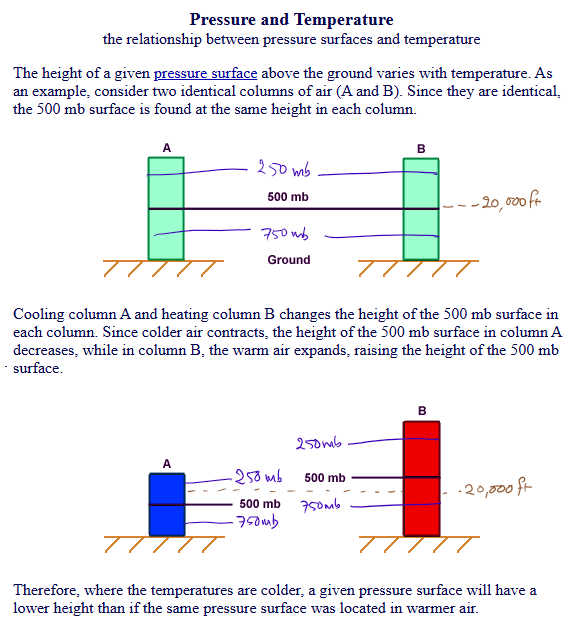 In other words, if you're up at 20,000' (near the summit of Denali or Kilimanjaro), then normally the ambient pressure would be roughly 500mb. However, if it's unusually cold then then 500mb pressure surface will be lower down. Up where you are the pressure will be lower than 500mb, and the altimeter reading will be higher than 20,000'. To give an extreme example, think of a scenario where the air temperature is just a bit warmer than liquid nitrogen (-321°F). Then the entire atmosphere would shrink into a very cold, very dense layer of air down at sea level, and up at 20,000' it would be like the vacuum of outer space. |
|
|
THANK YOU ALL! I think I've got it figure out now. And yes, I realize now that my "real altitude" questions were a bit mixed up - so thanks for pointing that out too. Based on what everyone has said (some copied directly below), as well as books I've been looking at, this is my current understanding:
If I stay in camp and air pressure increases 2/10 of an inch (7 millibars), my altimeter will show a reading 200 feet less. Therefore, if I am out hiking, my readings would be 200 feet too low. Unstable weather – elevation may change by as much as 500 feet, and even if supposedly stable, an elevation change of 100 feet is not uncommon. In camp I’m higher than my altimeter and if hiking I’m higher than my altimeter.
If it gets colder, the air is denser so my altimeter will read higher than the actual elevation. If it gets warmer, my altimeter will read lower than the actual elevation.
If you are stationary, and the elevation drops on your altimeter, that means that HIGH pressure is moving in (clearing weather.) If you are stationary, and the elevation rises on your altimeter, that means that LOW pressure is moving in (stormy weather.) There is an old saying. If during the night the camp goes up, you go down. If during the night the camp goes down, you go up. |
|
|
Elle Wwrote: Still backwards: If it gets colder, the air is denser so my altimeter will read LOWER than the actual elevation. If it gets warmer, my altimeter will read HIGHER than the actual elevation. See Martin le Roux post above. |
|
|
Thank you for correcting me yet again!  I have seen this image (or variations therof) multiple times. I had assumed that the reported altitude was the same as the altimeter reading, which is how I came to the conclusion above (that the altimeter reads higher than the actual elevation in cold air). But this conclusion is obviously wrong if denser cold air makes my altimeter read LOWER than the actual. I think I'm just going to have to memorize it to keep it straight! |
|
|
AI actually helped me with this - the above chart is from a pilot's perspective (altimeter doesn't change, height does). And that's different to a mountaineer's perspective (height doesn't change, altimeter does): The reason you might feel the logic is different for mountaineers vs. pilots is due to fixed points versus moving points. 1. The Mountaineer (Fixed on Terrain) As a mountaineer, you are standing on a fixed physical point (e.g., a mountain pass known to be on a map).
2. The Pilot (Moving through Airspace) A pilot tries to maintain a constant altitude reading on the dial.
Comparison Summary Mountaineer (standing still) Gets Colder Altimeter reads LOWER than the map. Pilot (flying level) Gets Colder Altimeter reads HIGHER than the the actual ground. The mountaineer sees the pressure change at a fixed height; the pilot follows the pressure change to a new height. |
|
|
Thank you all for bearing with me, and helping me out as I tried to figure it all out. I appreciate it very much! |
|
|
I am curious Elle what altimeter you are using? |


