
 Continue with onX Maps
 Sign in with Facebook






New Sleeve Bolts


|
|
SS has a smaller coefficient of friction on the surface/threads vs zinc plating, which may contribute. Besides that there seems to be some sort of relaxation of the Torque after initial installation, perhaps related to the former? I have a theory that the soft stone gives a little over time from the outward pressure on the rock after the initial install, in my observation this happens as quickly as the first 24 hours. Bolts that are retorqued to spec a second time generally fair much better in the long term. Once the initial torque is lost it takes very little force to unscrew the bolt. We’ve had a couple dozen of them completely unscrew out of the wall (hanger and bolt end up on the QuickDraw zipping down the rope) each time it’s happened from the rope jiggle as folks are pulling the rope or on a protection bolt as someone is lowering. I’ve not experienced the same problems when bolting in harder stone.
|
|
|
Thanks... Really good info here. I definitely agree with the theory that the soft rock gives/wears down a bit with time, but never thought that even in the first 24 hours that happens. I typically assumed it mostly happened with loading the hangers, especially off-axis... or poorly cleaned holes... or climbing on wet rock. Since I generally bolt, then climb again at a later date (projecting or redpointing), perhaps I'll start making it a habit to re-torque after the bolts have been sitting for a little while. I have no experience with RRG and am amazed to hear it is softer than (the good) stuff in RR. But it does give me more confidence since RR is just about the worst rock I've placed bolts in and it seems pretty decent. |

|
Josh Janeswrote: In my experience doing a bit of drilling in both RR and RRG...on average RRG rock is softer (under the very thin surface patina) than RR. It is highly variable, like RR, but, on average, notably softer. RR seems to vary by location (Kraft, vs each pull-out of the Calico Tanks, vs each Canyon) substantially, and RRG seems to vary (the most) by proximity to the top of the cliff with many cliffs getting notably softer as you near the top. Not a hard and fast truth for either area...but some trends I have noticed. More on topic, I have tried the 12mm CT sleeve bolts and find they really want to spin even when tightening (compared to 5 piece). In general, I am using 100% glue-ins here, but I do find a use for sleeve bolts as the first bolt of an anchor and a few other one-off uses, but the CT bolts just do not seem like a great option, yet. Perhaps future versions, and perhaps your experimentation with crush rings will help. |
|
|
I know this is a very small sample size, but I've installed ten of these (the 1/2" size) so far in medium density rock, using the 3D-printed compression rings, and with both 3/8" hole and 1/2" hole hangers with zero problems. Here are a few things I've learned/observed:
I have yet to place them in softer rock. And time will tell if they can handle falls/loading and freeze/thaw cycles without loosening. And I've only placed a few... but so far I'm happy with them. That said, personally I consider the 3D-printed compression ring a must. If I get through the entire batch I purchased without issues, and if they continue to produce 1/2"-ers, I'd consider buying them again. |
|
|
Josh Janeswrote: Hi Josh! Thanks for your open-mindedness and desire to innovate, pretty awesome! Sorry for the late response to your inquiries. So the sleeves for all of the Climbing Taiwan’s sleeve bolts are sourced from a few different factories which is why there could be a slight difference in diameter, and in batches. We buy sleeves that are already available, as getting sleeves made requires a high MOQ, min 10,000 pcs. So we have to currently search around first to find suitable sleeves as ones out there can be notably different. The sleeve is actually the most challenging component to nail down. We discontinued the previous ½”-sized 304 sleeve bolt due to inconsistencies and incompatibility with drill bits in that range. To the point, we launched it too soon without testing more scenarios. We found them actually work better with 12.5mm and 12.7mm SDS bits. We did do a bunch of more break tests in different substrates when finding that size sleeve spun in the hole during installation due to lack of engagement (hence faff to tighten down), and results were 30kN and up; (still safe, but not full strength). As you observed,the CTW ½” sleeve bolts had basically the same components as our 12mm sleeve bolt, just the sleeve was a wider. — We would like to get made custom sleeves for ½” holes and sized to accommodate a crush washer. Several manufactures other than Dewalt have such a bolt like fischer , CELO , Hilti , and Hobson Engineering. We definitely want to explore integrating a compression ring to our sleeve bolts. It would primarily take placing an order for custom-sized sleeves. Another thing to join the list of things we’re working on sourcing…reliant on time, money, prioritization… We’re really striving to keep costs for hardware affordable for you guys. Large order quantities have to be placed to factories to break into better pricing or even having a commodity made. In addition, the tariffs, HTS codes, inconsistencies with how custom officers have been charging etc has been making things more expensive and uncertain importing stuff into the States. I’ll elaborate more in another thread post. Cheers! Kevin |
|
|
Kevin Maliczakwrote: Thanks for the response Kevin, and this is what I'd love to see. In the meantime, will more 1/2" bolts be imported to the USA/HowNot2? At $2.90 each for the 304 they were less than half the price of the equivalently sized DeWalt/Powers 5-pieces. The cheapest I've found those has been around $7.50 each and that's if you buy 50... But really, if you eventually were able to produce them with consistent sleeve diameter and with a compression ring ("crush washer" [sic]), and even if that involved a moderate price increase, I think you'd have a bolt that would address many of the complaints people have had (high cost of 5-pieces and install problems with the CT's)... If the rumors I've heard on this site of Fixe closing their doors are true, I would think that would create a hole in the market for sleeve bolts in the US... |
|
|
Well, with 10 out of 10 clean installs, I was optimistic... until today. Installed 5 more, three of which were spinners. So I suddenly went from 100% success rate to 80% and that is definitely not OK with me. I'm pretty disappointed and I really can't figure out exactly why these three - three in a row - did this. I did not have the tools I'd need to try to remove them (funkness and a hook tool)... but next time I get out there I'll try. If I get them out, I'll replace with 5-piece... if I don't, I'll have to bring the power tools. I still have a dozen more of these bolts and now have a lot more apprehension. |
|
|
Josh Janeswrote: Maybe the difference is thread cleanliness. If there's debris on the threads when tightening, the cone will start spinning (hence the blue plastic thread protector on the cone of 5 piece bolts) |
|
|
I’ve been diligent about cleaning these holes and checking threads, though good point and maybe I should 3D print dust caps as well. I think the issue might be hole size. For the first 10 bolts I used an older bit that was at the end of its life. I realized I had switched to a brand new (identical) bit for the last five… and suddenly I get three spinners. Maybe this slightly larger hole wasn’t “grabbing” the sleeve as well? I’m going to switch back to the old worn out bit for the next installs. Edit: On that note, has anyone had luck getting these things out? Assuming I can get stud to unscrew, same technique as with 5-piece (mostly unscrew then tap to disengage cone, unscrew, remove sleeve with hook tool, screw back in with a hanger and funk the cone out)? |
|
|
If the hook tool doesn’t work, I’ve had much more reliable success with ‘grabbing’ the sleeve with a 7/16” tap. Basically I cut threads, usually at a little bit of an angle rather than trying to keep it totally straight and intentionally bind up the tap, then working gently left and right with outward pressure until it comes out ask the way or I can grab it with pliers. This is good 5 peice. Funking the cone works better if you use an attachment that pulls straight out rather than the hanger that pulls at an angle, if power tools are kosher I used an all thread bolt and an impact driver in forward and let it ride up the threads, though if it’s not interference fit you can often just grab it with a hole brush. |
|
|
Before you remove, had good results getting these to tighten by torquing outward on the hanger. This pulls the cone at the bottom into the sleeve. While pulling it in, try to tighten it down more. This has worked well for me. |
|
|
Oliver Dattilowrote: Thanks for the suggestion Oliver. I tried this with each of the three spinners without success. Tried leaning out with a draw clipped to the hanger and my belay loop, and just weighting it in a downwards direction as well. I stopped short of funking to attempt to "set" the cone for fear I'd damage the threads and make them nearly impossible to remove. The good news is I was able to get all three bolts out yesterday. It took some work and it didn't quite go the same as it does with 5-piece bolts: I was mostly unable to separate the cone from the sleeve: Loosening the bolt and giving it a tap would just draw the whole thing deeper into the hole - it was almost as if the sleeve was welded to the cone - but I was able to loosen them enough that with lots of wiggling and pulling with the hook tool, and some gentle funking, I could get the whole bolt out in one piece. I attribute my ability to do this to the hole size and the fact that these bolts were fitting so loosely in the holes. I *also* think this was the reason for the spinners. These holes were drilled with a brand new bit (a closer to true 1/2" hole) and I think there just wasn't enough friction (between the hole and sleeve and/or hole and cone) to get them to start tightening down. Maybe if I had pre-tightened the cone onto the sleeve a bit more? I don't know but I didn't want the ends of the sleeve to catch in the hole too much, scraping the rock away, creating dust/debris in the holes, or worse deforming. I replaced all three of these successfully, using the same holes, with 5-pieces. All is well. Furthermore, I installed three more of the CT sleeve bolts using my old, retired bit: It is so worn down now that drilling takes quite a bit more time and effort, but all three of these bolts went in successfully and tightened right down. My conclusion is that these are way less tolerant to differences in hole size (and amount of pre-tightening of the cone into the sleeve) than 5-pieces. This problem is probably exacerbated by what sounds like significant variations batch-to-batch in actual sleeve diameters. I think I've found what works for this particular batch now (I need to use an old bit that will hopefully get me through my 10 remaining bolts), but I think I'll need to see that CT can iron out some of these inconsistencies, possibly be changed to incorporate a compression ring, and bring back the 1/2" size before I buy more. |
|
|
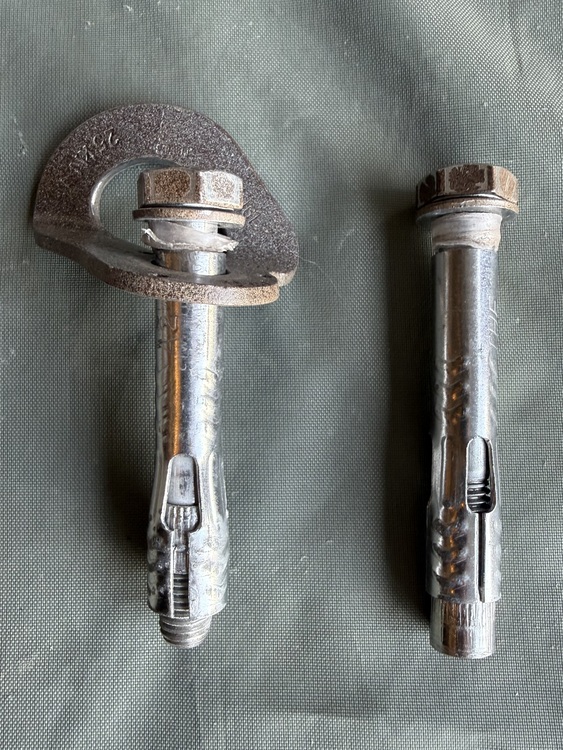 Two of the three bolts I removed. The third is MIA but looked like the one on the right (which might be reusable). The state of the one on the left clearly tells me it is too small for the hole. I undoubtedly tightened it until the cone reached the end of the threads (never reaching proper torque) and then the entire thing just continued spinning. Yet it is a 1/2" bolt placed in a 1/2" hole in reasonably hard rock - kinda amazing it came out of the hole in this condition. Also: disconcerting. If you use these bolts and notice they are fitting loosely, I would definitely check them with calipers before installing them. The one on the right looks fine, but still spun without tightening. All the others that have gone in smoothly would start tightening right away (I could feel resistance ramping up usually with the first or second full turn of the wrench and would achieve proper torque in 5 to 8 full turns). It is no fun to hammer a bolt in and then feel anxiety when turning the wrench really hoping the bolt will start to tighten immediately... The good news is the 3D printed compression rings are clearly working. |
|
|
Josh Janeswrote: That’s too bad. I feel like part of this could be bit choice. I use generic 10mm four cutter bits, and I have not had this problem. It also sounds like the 1/2 inch ones have had a lot more problems than the 12mm or 10mm. Glad you got them out in one piece! |
|
|
I did the hanger trick in combination with wedging a hammers claw under the hex bolt, which in hindsight is what actually worked. Regardless, the one on the left was never gonna tighten. |
|
|
Kevin Maliczakwrote: it's been interesting to watch the evolution of this thread, especially with regard to the concern (for lack of a compression ring)... |


