
 Continue with onX Maps
 Sign in with Facebook






New Sleeve Bolts


|
|
Tal Mwrote: I'm glad to hear you found another fix around for the hanger spinning, thx for sharing for sharing your tip. I don't have any idea where someone in the US could easily buy sleeves and conical nuts for M10 thread that either didn't already come with a stud or tap bolt, esp in small quantities. Also there can be a variance of diameter for readily-available sleeves diff companies make; they're the hardest component to get right. Easist is I can have HN2 hang onto to some extra sleeves+conical nuts for you and others, and toss 'em in with your next order. Can you message me how many you need? Thanks! |
|
|
Anyone else have some experiences with the CT 316 sleeve bolts they'd like to share? I'm thinking of placing an order, but just curious to hear more thoughts. |
|
|
Mitch Musciwrote: I haven't placed a ton but my thoughts: I much prefer their wedge bolts. Probably used over 1000 this year and they work very well. The sleeve bolts work great but they are finicky (imo) to tighten down without the hanger rotating clockwise out of the correct orientation. The configuration of 10 mm hangers (their recommendation) is the culprit in that it sometimes results a tiny gap between the hanger and the rock surface if the sleeve isn't fully imbedded in the hole. There are ways to mitigate hanger rotation, which of course, have already been discussed upthread. Or, you can also use 1/2" or 13mm hangers. This is better for the rotation issue because it allows the hanger to contact the rock surface completely since it's not bound by the sleeve. Just to reiterate: Be sure there is wiggle room between the hanger hole and the sleeve; if the sleeve fits tightly in the hanger hole (don't use 12 mm) the strength will be compromised because it pries on the sleeve rather than the stud. Kevin explains this well in one of his videos. My personal take: I'm still using the sleeve bolts occasionally, but in the hard(ish) rock I've been bolting, I don't find them advantageous over their wedge bolts. |

|
I legitimately just dislike the sleeve bolts after placing roughly 100. I’m not sure if I got a bad batch, but I had probably 20% of them seize the cone to the sleeve when installing, making both installation and removal a nightmare. It got to the point where I rebolted a brand new route I put in with glue ins because so few of the bolts in the route installed smoothly. This is with using a 12mm bit. I’m not sure if the tolerance on them is higher or what but I was sincerely unimpressed. I started wallowing everting hole so the bolt would fit in with minimal hammering and then tightening it from there. Additionally, it seems like I could never get a perfectly flush hanger with them. I’ve never had that issue with standard 5-piece bolts nor wedge bolts. If you’re off even 2-3° from orthogonal it seems like there’s no hope of the hangers sitting flush. (This is with petzl 3/8 hangers) Overall wouldn’t recommend unless you’re working with softer rock where the extra faff is less frustrating |
|
|
I just did 3 routes with them and had 0 problems. 12mm Bosch bit. Brush and blow out the hole 2 to 3 times. Every one tightened down perfectly, no spinners. I will be using these for everything. |
|
|
Anybody wanna report on usage in soft sandstone? |
|
|
I’ve also probably only placed a grand total of 15 of these guys, but I also had problems with the hanger spinning around during tightening. I was using them in gniess that was pretty crumbly and definitely had to clip a PAS to the hanger to keep it straight. To reiterate what others have said, the wedge bolts are super nice while the sleeve anchors need some tweaks before I feel super confident recommending them. |
|
|
I've placed about 20 in greywacke, bullet hard sandstone. I had a couple issues early on but I think I've figured out 2 things that made a difference for me. First is that it seems if the bit is worn down much, the hole is going to be too small to get bolt in without fighting it. I've done a little wallowing and some heavy brushing to compensate for that and will order a new bit if I order more of the sleeve bolts. The other thing that helps is backing the cone off as far as you reasonably can and holding the sleeve while installing to prevent it from engaging prematurely. These 2 tricks have greatly increased my success rate. This may be obvious to others but I'm coming from a background of glue ins. |
|
|
Alright, I bought a couple dozen of these (the last of their 1/2" stock - so slightly larger than the already tight-fitting 12mm) to try out. Reading through the comments here have been helpful. Some things I know (clean holes, fresh bits, etc), but others have suggested keeping the cone screwed on as loosely as possible during installation. So before I start messing things up and learning the hard way:
|
|
|
I’ve been having second thoughts about placing these. I’ve been thinking a lot about why people are having problems with hangers spinning. I wonder if it is the lack of a compression ring (the blue plastic spacer found in 5-piece bolts)? Without it, I’m having a hard time imagining how the bolt head could pull tight against a hanger and pinch it firmly against the rock surface without exceeding torque limits for the bolt. Doesn't there need to be a gap of some sort that allows the bolt head to travel inwards to pinch the hanger between the bolt head and the rock? It seems to me that with a 5-piece, the compression ring is that gap. And it seems to me that with these CT bolts, the sleeve will rest either tightly against the bolt head itself (in the case of a large-hole hanger that sits around the sleeve) or against the bolt hanger (in the case of a small-hole hanger that sits between the sleeve and bolt head). In the case of the former, there is no gap for the bolt head to travel inwards and pinch the hanger against the rock. In the case of the latter, the bolt head can pinch the hanger against the end of the sleeve, but that's it... and that's not very much surface area. This is all predicated on my understanding that when you insert a bolt and begin tightening, the first thing that happens is the cone is drawn into the sleeve and the sleeve begins expanding, and simultaneously the head of the bolt is drawn towards the cone (until it is flush against the hanger/rock surface/sleeve). Once the sleeve is sufficiently expanded, it is locked in place inside the hole, and continued tightening will then only draw the head of the bolt inwards... IF there is somewhere for it to go (like a compression washer compressing)... But if the head is already tight against the end of the sleeve, you'd quickly reach maximum torque without pulling the hanger any tighter against the rock face. So is the presence of a compression ring essential? Maybe I don’t understand correctly how this all works. Or maybe I’m overthinking it. But either way I really don’t want to botch placements or waste bolts experimenting. |

|
The 5-piece are a similar bolt to the Hilti HSL-3-R, which also has a compression sleeve. In the Hilti description of the bolt, one of the Features is: "Collapsing element prevents anchor from spinning in the hole and ensures reliable clamping of the fixture" I am also concerned about clamping, and long-term loosening of the bolts (thermal cycling, repeated whippers, etc). Of course stainless 5-piece are also known to loosen up with heavy use, even with compression sleeves. Anyone with actual engineering know-how want to comment on exactly why both the Hilti and Rawl/Powers/Dewalt bolts have compression sleeves? |
|
|
 "fixture" = hanger "base material" = rock surface |
|
|
Until I have further feedback, I'm not going to place these. Don't get me wrong: I think they're plenty strong in both sheer and tension. I just don't think there is any way to prevent spinning hangers if people weight the bolts - let alone fall on them. Heck, people are having problems preventing spinning hangers just installing them. What I AM going to do is see if I can fabricate my own compression rings to place between the bolt head/washer/hanger assembly and the sleeve. They'd have to be short so there'd be enough threads left to engage with the cone, and they couldn't be used with large-hole hangers because the hanger would rest over the ring and have too much slop, but used in combination with only small-hole (3/8"/10mm) hangers I think that might make these bolts OK. Ugh. Glad I didn't buy too many. |
|
|
PS: If anyone has a couple dozen blue compression rings from 1/2" Powers 5-Piece bolts (maybe from bolt replacements?) they would be willing to send my way I'd be stoked. I already tried them on the CT bolts and they fit. I may trim them down to make sure I still have plenty of thread engagement on the cone. |
|
|
Josh, are you placing these on lead? If not, glue-ins don't have any of the problems concerning you. Just food for thought. |
|
|
Thanks Kris, I use and love glue-ins, but they are not always practical (placing on lead is one situation where this is the case). Meanwhile: 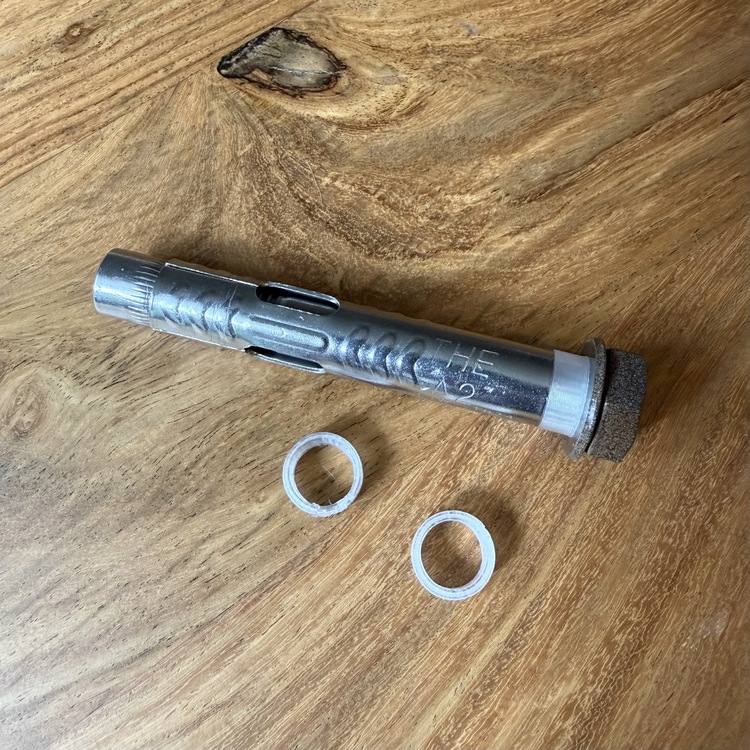 3D printed compression rings for the CT Sleeve Bolts. I feel a lot better about trying them with these! I'll report back... |
|
|
I looked at doing the same, and think you’d need to cut the sleeve down to ensure you get adequate thread engagement on the cone, especially if using a 3/8” hanger. |
|
|
We had great success using the Dynabolt Gold sleeve bolts (no longer available in the US) I only point this out because they do not have a plastic compression ring. They do have slanted diagonal cut outs in the sleeve (perhaps that allows a little bit of of crushing/spring force). Around 2000 of these were placed locally with very few long term problems. For comparison the stainless version of the dewalt SS 5 piece we’ve had substantial problems with spinners, loosening, and bolts completely failing out of the wall due to spinning out of the cone entirely. We never had these problems with the regular plated steel 5 piece. It seems like tweaks are still needed for the CT bolts as well as more testing in different rock types. It would be exciting to have a cheaper option for sleeve bolts, it’s obviously difficult to perfect a good design. The climb tech legacy bolt was a good design but had its own issues which caused them to cease manufacturing, deals 5 SS piece has issues in softer rock. I hope CT continues to perfect, another step would be to make them 1/2” with a 9/16” head, the most common wrench size for future ease of maintenance. |
|
|
Peter Thomaswrote: Yeah. I have adequate thread engagement with a 1/2” hole hanger (which sits over the compression ring), but barely adequate thread engagement with a 3/8” hole hanger (which sits between the compression ring and bolt head). I debated making the compression ring even shorter but that might defeat the purpose. So for now I’m going to test this with 1/2” hole hangers. As long as I can tighten the bolt two full turns once inserted without reaching maximum torque, the cone will be fully threaded. If that goes well I may experiment with 3/8” hole hangers, but I will need to be very careful inserting the bolt and would need to be able to tighten the bolt five full turns for the cone to be fully threaded. Of course a lot of this will depend on the exact size of the hole (how fresh the bit is) and rock type. I think ideally these bolts would come with compression rings and slightly shorter sleeves. Even if that brought the price up 50 cents each it would be worth it. |
|
|
DrRockso RRGwrote: I suspect those spiral cutouts do allow for compression and possibly even a spring action to prevent loosening. Cool
I’ve heard others mention this but have never had one of mine loosen to my knowledge (hundreds placed). But that’s probably because no one climbs my routes 😆 Do you think the issue is the low torque requirements for the SS? Also, are the issues you’ve seen with 1/2” SS, 3/8” SS, or both?
Internationally the 17mm size is probably just as common but I do agree it would be nice to have something more standard in the US. Also, a smaller bolt head is less likely to interfere with hangers/carabiners. I do like the smaller washer on the CT bolts though (over the enormous 5-piece washer). |


