
 Continue with onX Maps
 Sign in with Facebook






What’s the point of the adjust connect on aid ladders?


|
|
I’ve recently gotten into aid climbing and aid lead soloing. I have the Petzl adjust connect and a alfif. When I climb with a parter, I don’t have trouble managing the adjust connect. They never really get tangled. When I aid solo, I use a gri gri plus with a clove hitch to my belay loop for my cache loop. I adjust the clove hitch to add cache. With the grigri and the clove hitch and all of the strands of rope on top of my alfif and adjust connect, it’s a lot of strands of stuff to manage. I’m thinking about ditching the adjust connect for lead soloing.
(2) so you’re connected to your previous piece as you move to the next one. I feel like (1) can be mitigated by just not dropping them and bringing an extra ladder, which I do anyways. And (2) can be mitigated by clipping my rope to the current piece before I move to the next one.
|

|
Have you done any steep aid yet? That's where the Evolv Adjust shine in my opinion. I don't connect my ladders to me except on steep aid for the exact reasons you stated. If I drop a ladder my partner has another I can use (followers just need a static foot loop). Yeah I'll lose a piece, but that's a price I'm willing to pay to move quickly and fuildly up the wall. I'd say you probably don't want to be connected to your previous piece directly; a daisy fall is gonna hurt more than a normal lead fall with the rope catching you. I learned to not clip the rope to the previous piece until I'm on the next one, but that's really just for rope management and the ability to get your ladder off it cleanly. A longer fall is rarely a problem when aiding a clean steep face. Try out just using the alfifi and see how it goes. Aiding with a partner will be much less cluttered, but might as well dial in your system some more before doing your actual objective. |
|
|
I haven’t done anything too steep yet — just barely past vertical. I haven’t “used” the connect adjust, like weighted it, on anything. So I’ll try without it! |
|
|
The Better Way is whatever works best for you. If you can climb without using a connection point to your ladder, and not drop your ladder, well God bless you. I sure can't! |
|
|
Peter, I don’t find them particularly hard to pull the cord though, but I haven’t found a situation where I’d want to weight them when I’m have my alfifi. Like I said, I haven’t done anything seriously overhanging, and I could see how they would be helpful there. But with the alfifi, I never actually adjust them. I just keep them long enough so they’re not inhibiting my reach. |
|
|
OP, the clove "on my belay loop" sounds horrific. Google Brent Barghahn and watch some of his tutorials, I take a 30cm 8mm sling and girth it to the waistband of my harness, in between the gear loops. I tape it so it doesn't move around and so the stitch is at the bottom, as a sort of horizontal gear loop. Drop three biners on each side, pull 20ft of rope from your grigri, and clove to the first biner. repeat on biners 2 and 3, and on the other side if desired. As you climb, just drop cloves as your cache runs out. Brent explains all this much better than I but it works, and keeps you safe. No matter what, LRS is going to involve faff... you just have to learn how to mitigate it as best you can and/or are comfortable with. |
|
|
Harry Honigwrote: Petzl Connect Adjust is a PAS. It uses a bigger rope and is shorter than its two armed sibling, Evolv Adjust, which is designed for aid climbing. It is true that some very confident and experienced wall climbers may elect not to connect to their aiders, but that's not for most climbers and even the capable hands drop their aider from time to time. If you connect at all, wouldn't you want to connect to both aiders? Two Connect Adjusts would get crowded quickly though. It is also true that an Alfifi eliminates the need to weigh and adjust your connection, however, I will not be surprised that once you venture onto some more old school aid routes, you'll find that the arm of Petzl Connect Adjust is too short even at full extension if your aider is connected to it. Maybe you were actually asking about Evolv Adjust? It's not uncommon that folks get the three "Adjusts" mixed up.
Yes, I definitely use my Evolv Adjust for PAS when I aid climbing (e.g. once reaching the anchor) regardless what Petzl says in their user manual. Can't imagine anyone, with it already tied into the harness, does not do that to be honest. |
|
|
Mei pronounced as Maywrote: The new one is "rated" as a PAS, though the old was also used as PAS by many folks anyways. |
|
|
Christian Heschwrote: Sorry for the off topic, but using a clove on a biner connected to your belay loop has been standart practice for solo aid-climbing for years. As a main "device", and as a cache loop... |
|
|
Tee Hwrote: fixed that for ya :) thankfully, people come up with improvements all the time. Maybe at some point BB's method will be improved upon (I hope). |

|
(2) so you’re connected to your previous piece as you move to the next one. Why, oh why, oh why would anyone do this and risk a factor 2 fall???? |
|
|
Mark Hudonwrote: for sure. Clip in your rope, fall on the system that is stretchy not staticey... if that a word or I guess it is cause I'm using it... Do what you want when it comes to worrying about dropping shit, but clipping into a previous piece with a static lanyard when a dynamic is right next to you is kinda a no no. Let the dynamic system do the work. |
|
|
Ok! Some updates: first of all, I have the evolv adjust, and that’s what I was referring to. Not the pas thing. So that’s my bad for writing the wrong name. I was practicing some lead aid solo multi pitch by splitting a 50 foot crack into two pitches. The crack was vertical the whole way so I had to make a downward facing anchor and an upward facing anchor in the middle to clean the first pitch and climb the second pitch. On my first try at this a week and a half ago, it took me two hours from start to finish. Yesterday, without the evolv adjust, I took me one hour. It was ridiculous how much less clutter there was. Super awesome. Christian, my cashe loop method isn’t so bad for aid climbing. I use BB’s method for free climbing, and I really like it in that context, but I don’t think it makes as much sense for aiding. First of all, it’s not as neccesary that I am able to pay our cashe with one hand, since it’s aid. Second, BB’s multiple clove loops would be a lot more stuff to get tangled on my ladders, as opposed to a single loop. And finally, having a locking carabiner in my belay loop is a better backup than a non-locket on a sling girthed around my waste belt. If the sling is too far to the side (between the gear loops, for example), you would probably break your spine falling on it. Having the back up on your belay loop is better all else equal. And yes, I know it’s very unlikely that my gri gri disapears and I’m fully falling on the clove, but if you have that mindset, then you might as well just use a micro trax for your cashe loop. Mark, the evolv adjust is dynamic, not static. Yes, it’s still a factor 2, and it’s still going to suck, but if you are using the evolv adjust, and you fall off your newest piece while on if your ladders is still connected to your previous piece, you are going to fall onto the evolv adjust. That’s just what’s going to happen. If anything, not wanting to fall on the evolv adjust is an argument for not using them at all. |
|
|
IMO you're not missing anything as you've found out. On easy/moderate terrain Chris Mac adamantly suggested not clipping etriers to daisies or PAS's a long time ago to reduce the mess and move quicker and he was right. I haven't aid climbed in years but I do recall whipping and finding myself 30' lower still tightly clutching my etrier in my hand. Obviously if your soloing keep a spare in your bag is probably a good idea. As far as LRS backups go, BB's method and equipment seems very specific to his typical use case of hard repointing single pitch climbs where easy drops and not retying backups is mandatory. Your use case may be different and require a different solution (which you seems to have discovered). Much like I you I used a single long cache loop (figure 8 on a bight clipped to a locker on a girth hitched short sling through tie in points). It worked for me and definitely reduced the amount of clutter. Maybe the joy of LRS and more so big wall LRS is that there's no single "correct" method and you gotta figure out what works for you. |
|
|
Harry Honigwrote: Haha.. thought so! Sorry to be blunt, but IMHO you might want to revisit your aiding methodology if you think factor-2-fall on your lanyard is "just what’s going to happen". The right aiding sequence should prevent that. |
|
|
Harry Honigwrote: Harry, I suggest reading the Evolv manual again. You should not be falling onto it. While it may be made of dynamic material it has too little of it to be dynamic in practice. A climbing rope is dynamic as well, but taking a FF2 on two feet of material is gonna be bad; there's just not enough stretch available to adequately dissipate the force. If you choose to use the Evolv Adjust for aiding you should be unclipping it from the previous piece as soon as you establish yourself on your next piece. The belay loop should be no higher than 30cm above the lower piece. |
|
|
People are taking daisy falls all the time doing hard aid, no ones died yet. Quite frankly, I've heard quite a few stories of people getting saved from very long falls from their daisies catching them. Daisies are optional but as you start to get into harder aid, roofs and traverses they become very useful. Managing the cluster fuck is all part of aid, solo aid especially, might as well learn to manage the cluster fuck on easy terrain than on hard aid. Most serious users replace the rope in the adjust with 7mm nylon for easier release under load though people use all sorts, I'm currently using pur line. you can use some 3mm cord and a Bull hitch to help release it under load. 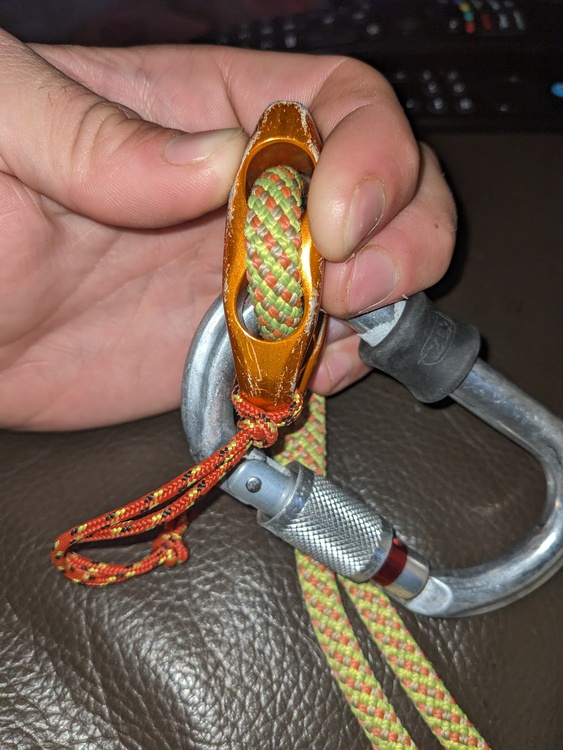 |
|
|
Adam Flemingwrote: So I shouldn’t have said that a factor 2 fall is just what’s going to happen if you fall off of your current piece. What I meant was that when you move your alfifi from your current piece to your next one, there is a window where you will fall onto your evolv adjust if your current piece blows. It won’t be a factor 2, it’ll only be factor 1 or maybe a little higher, since your previous piece will be just a little bit underneath your waist. But if you place a hook above you and it passes the bounce test, but when you sit on it it blows, you will fall onto your previous piece via evolv adjust, unless there’s something I’m missing. When I clip my alfifi to my next piece, the first things I do are clip my rope to the previous piece and un clip my ladder from the previous piece, but there is a window where I will fall on the evolv adjust of my previous piece. Unless you ditch them! |
|
|
I actually use 8ish mil static which allows for better bounce testing, good technique makes daisy falls unlikely. Lots of respect for Skot, but I also dont use the alfifi. |
|
|
Hey Brandon, I messaged you on Facebook messenger. Had some questions about some anchors. Have a look, thanks. |
|
|
I don't know how people do it nowadays, but in the ancient past, some of us stepped DOWN onto the new, higher, sketchy (maybe)bodyweight (that's kinda the whole point) piece, not UP. That would be with or without daisy chain(s). Then probably a bounce. How vigorous the bounce is depends on how good previous placements were, and how good the prospective next one might be. And other aspects of where you are, mentally and physically, at the moment. |


