
 Continue with onX Maps
 Sign in with Facebook






You are responsible for your partner's knot: controversial?


|
|
I get the feeling that a lot of folks are arguing just for the sake of argument... |
|
|
 |


|
I agree that the responsibility issue has been beaten to death. Positions have been laid out. Take your pick. Here's a related thought. No matter how you've messed up your knot, a barrel-knot backup will make it secure enough for any fall. It has become conventional wisdom that a figure-eight doesn't need a backup knot, and I'm sure that's true for a properly tied figure-eight. But tying a backup knot means that whatever you did and your partner missed, the knot isn't going to fail catastrophically. I also suspect that the extra step of tying a backup will expose errors already made in tying, since you have to look at what you've done while tying the backup. So maybe the advice to skip the backup for figure-eights is right in principle but wrong in practice. |
|
|
rgoldwrote: YES! |
|
|
rgoldwrote: Long ago I had a partner that applied this idea to the logical extreme. To tie in he would make a simple overhand, push the working end through the overhand to make a loop (not follow through, just push the end through) and then tie a barrel-knot. I have tried to research this knot a few times and could never find a name for it or any example of anyone else using it. The best I can describe it is a poacher's knot with an overhand that prevents the loop from fully cinching. I was young and he was a mentor, so I just went with it. He assured me it was fine - for him. I used the standard eight follow through. He was a great partner and, aside from this quirk, very safe. It was interesting, since essentially the backup knot was the knot! |
|
|
D Kwrote: Don't remember what it was called at the time but I've certainly seen this illustrated as a standard method of tying in to a swami - albeit several decades ago. It was in an American publication; not Basic Rockcraft, but possibly an early Chouinard catalogue. Pretty sure that a US climber whom I met in Yosemite in the late 1970s was using it. |
|
|
Matthew Bellwrote: Each person is obligated to check each others knot, harness, rappel setup when possible. Only the person who tied the knot, put on the harness, or clipped into the rappel is responsible for doing so do correctly. That responsibility is morally, ethically, and financially I’ve been at anchors and had people ignore me when I tell them their setup is wrong. Fortunately it only resulted in one minor accident. I watched a guy with a canyoneering background rig a biner block with wrong sized binders I told him so and that the block would fail. He ignored me. Rapped. The bock slipped through and he fell Luckily it was only the last 10 feet just a strained ankle was the result The guy who fell was pissed I didn’t do more to stop him. I had told him to fuck off while I helped carry him back to the trailhead. |
|
|
D Kwrote: Chouinard recommended this long ago as a tie-in knot. It s basically a double fisherman's loop (or maybe a 1.5 fisherman's loop?). Stong and secure, but a bitch to untie after loading, so never caught on. In fact, the Chouinard knot corresponds to neutralizing the most dangerous figure-eight failure with a barrel backup. I think the most dangerous failure looks like this   which looks like this when snugged up 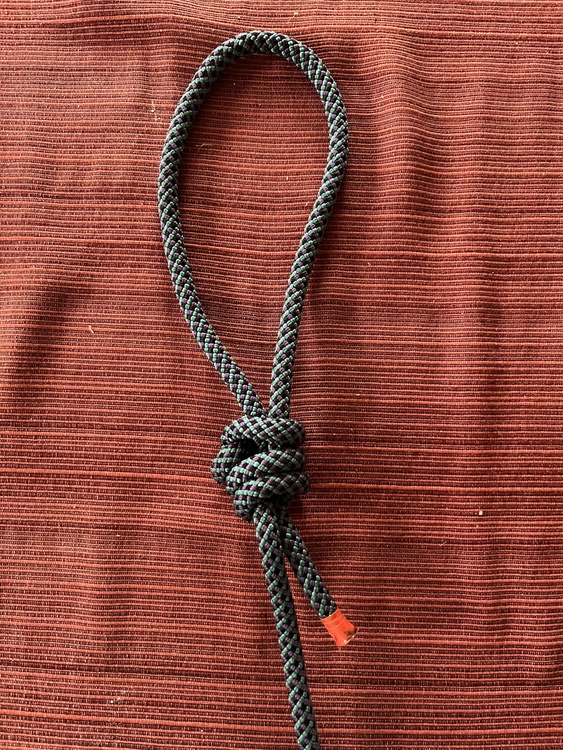 It is very hard to imagine that anyone who even started tying the backup wouldn't notice they had only just started the eight, but even if they are that oblivious, their knot will be ok. The problem remains---I think it was always the main problem---of distractedly not tying a knot at all. At the very least, that's what partners should be watching for. |
|
|
For newer climbers, since I don't think it was mentioned: Don't ever hand any gear to somebody while they are tying in. Wait and watch them finish, then hand it to them. Apply the same rule for yourself. Once you start tying in, do not stop—ignore anybody trying to hand you something. Even ignore any questions, or say just a minute let me finish my knot. Most, if not all, of the accidents were not because somebody tied their knot incorrectly, it's because they started and did not finish...and their partner didn't check. |
|
|
David Burridgewrote: https://en.m.wikipedia.org/wiki/Swiss_cheese_model The more layers of cheese the better |
|
|
David Burridgewrote: I think this is the most important partner responsibility, which is not to distract a person who is tying in, and even to intervene if someone else is causing distraction. |
|
|
rgoldwrote: I must...resist...whacking dead horse..... And I fail. rgold, I'm with you about 96% of the time, but notsomuch on this one. How about just tie an appropriate knot properly in the first place? Teaching 'back up knots' to beginners just instills the idea that a knot (even properly tied) can pull through and fail, which obviously isn't true. I'm thinking it's better to teach beginners the importance of focusing on this simple task until properly completed, and doing system checks is a better approach. |
|
|
Ok, I will take responsibility for knots. Should any of your knots fail, beginner or expert, turn them into to me and I will replace it with a perfectly good knot. |
|
|
apogeewrote: Since everything in climbing should be redundant, surely that principle would apply to the most important knot! Ok, that was a troll. But I think the occasional discussion about the basics is useful, even if the conversation has many tangents. They are a good reminder that anyone can make a fatal mistake, and there are simple practices that can mitigate these mistakes. |
|
|
apogeewrote: Wow, 96%, you agree with me more than I agree with myself. Teaching backup knots won't instill the idea that a knot (even properly tied) can pull through and fail if we explain that the backup is to guard against a mistied knot pulling through and failing, something we can emphasize is not possible with a properly tied knot. That said, it seems to me that someone who thinks knots might fail would be inclined to be more attentive to properly tying and dressing them, and so that gnawing fear might be a good thing. And nothing about recommending backup knots prevents us from teaching the importance of focusing on this simple task until it is properly completed. And yet, I'd agree with you if it were an ideal world, but from what I'm reading and hearing, it seems that more and more people are mis-tying knots, partner checks may not always be happening, or the checkers are sometimes missing flaws. Add to this certain situations where there may not be a partner available to check. (eg belayer needs urgent bathroom break). Climbers in general are fond of promoting redundancy as a way to mitigate the effects of uncertainty, and that's where I see tying a backup knot coming in. It isn't overly complicated or time-consuming. It turns almost all bad knots into at least adequate ones if the person tying them makes a mistake, and it draws attention to the knot in a way that I think will often lead to flaw detection. |
|
|
I have a bit of a vested interest in this conversation as one of my climbing partners uses a bowline that he partially retraces to secure it and it is extremely difficult to tell if he has tied it correctly. So, I just ask him if his knot is correct. Most of the time I use a double bowline with a barrel knot to secure. Easy to check and hard to F’ up. Only a slight variation to what I learned as a youth.  |
|
|
Mark Pilatewrote: With my broken femur, will you lead all the scary pitches for me? |
|
|
I have been checking all aspects of all partners systems all the time for forty years. Some are new climbers, some are way better than me. Nobody complains. I do this because I am literally tied to them. My mistake is theirs and their mistake is mine. In all that time I have caught errors plenty. It happens. If anybody gets bent about it then they don't get my call or callback. Attitude about reasonable safety precautions is a good filter. When climbing with people better than you it is easy to get intimidated to ask a question or hold up the show for a moment. I don't suffer from this problem. They don't either. We are all still here. Go get wild, but do it with a solid anchor and place plenty of gear. use a helmet when it makes sense. Use two ropes around sharp edge rocks. Use locking crabs on key pieces like a crux where you stand a decent chance of falling. Close to the ground on short routes place more gear. Way up on a smooth wall you can run it out a bit more. Watch your leg behind the rope which can flip you in a fall. Don't sit below other climbers above. Remind yourself that you are rock climbing and that it is at least somewhat dangerous. When your rope is old and beat get a new one. A fat 10.5 makes me feel better. Carry the weight. Your body will adapt to whatever you put it through. All this thought is a steady under current to the fun and joy you are having on the surface. One shouldn't interfere with the other. |
|
|
. wrote: I feel like this is trolling (?) On the off chance it’s not I’ll point out that it was probably fine unless you mean the device was clipped into the girth hitch itself. Though it is another point in favor of partner checks. |
|
|
bokel mokek wrote: Ok, to those who think there are no ”bots” on MP and that it’s all a “myth” —go climb with bokel and report back. |


