
 Continue with onX Maps
 Sign in with Facebook






Rope Soloing Ice


|
|
keohan68 wrote:I just got a Soloist, and will begin TR soloing ... Rope doesn't feed through the Soloist when you use it for TR solo. You have to pull it through. So there WILL BE SLACK. So DO NOT use a static rope. |
|
|
keohan68 wrote:I just got a Soloist, and will begin TR soloing as soon as my climbing partner (who has been using the Soloists for years) comes up to educate me. I'm going to back up with a shunt or Mini Traxion. My intent is to keep from abusing my rope with the teeth. So my questions are 1. any rope damage from grigri or traxion? 2. Does anyone use static rope? As I can get Edelweiss Canyon Static 9.6mm Rope cheap.I will be doing laps at a close by area to train. The teeth on the microtraxions are not as severe as the teeth on Tibloc's or most ascenders that I am familiar with. That said, they will wear your rope more than a non-toothed device. |
|
|
I use a Yates rocker. By far the best single TR solo device out there. Cams very efficiently, even on frozen ropes, uncams with a simple unloading of the unit, slips up the rope with absolutely no fuss. Clip it on and forget it. I take a no-fall policy ANYTIME I climb ice. It's not worth the risk, too many things to go wrong on ice in a fall... |
|
|
To re-iterate what was already said but was proposed in the first post, do NOT use the Silent Partner in the wintertime as the manual itself states that the camming device can freeze and cause the system to fail. Otherwise it is a great device for both leading and top-rope soloing rock in more moderate temps. I've used it a lot for sport-climbing as well as took the thing up Cannon for the exposed "crux" of the Whitney Gilman in NH and felt pretty comfortable with it. There is a small learning curve to get used to the backup loops and all the extra "work" involved with self-belay on lead. |
|
|
I know this post has been up for a bit but...Recently I was looking for a good TR device. My buddy used the ushba and that worked well. Too bad they stopped making them. I went on the forum and someone turned me onto the uascend. grandwallequipment.ca/produ… |
|
|
There is tons of information here: |
|
|
Use the Petzl ascender and the Min-Traxion and you won't have to dick around tying safety knots every 10 ft like I use to do using the GriGri - and - best of all - the method above leaves BOTH hands FREE to climb with - making it possible to climb harder grades than when your dicking around having to stop and tie knots every few feet. |
|
|
Resurrecting this thread because I think I’ve got some useful info to share. I used two micro/nano tractions on two different rope strands, and they worked fine in dry conditions. However, when climbing wet ice, the devices became completely useless after a short time - you could freely slide them up and down. I kind of expected this, so I just free-soloed to the top. The picture explains why: the teeth on the devices were completely covered in ice, which obviously doesn’t grab a rope very well. I had to warm the devices with my hands to melt the ice and make them usable again. On a related note, I noticed a Grigri slips a lot on icy/wet ropes when rappelling. An ATC, on the other hand, doesn’t seem to have nearly as much trouble. 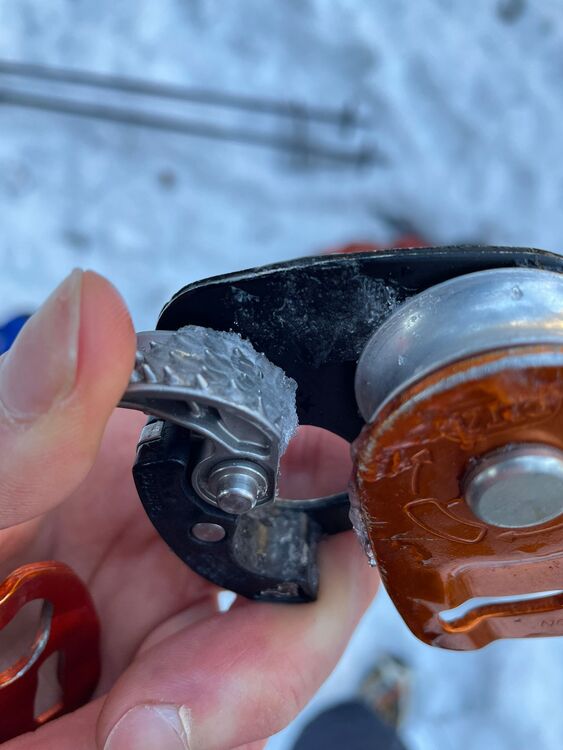 |
|
|
I use a Camp Lift as my primary device off my belay loop then use a microtraxion below it. I used to do micro on top and grigri as a second but the feed was kinda clunky so I swapped. Overall works fairly well as long as you weight your rope at the bottom. Otherwise you need to mind/feed the devices to get fully tight. |
|
|
Philippe Wagnerwrote: FWIW, this is why I use two devices on one strand... Haven't seen this issue happen to both devices at one time... one kinda clears the way for the other... |
|
|
Philippe Wagnerwrote: Thanks for posting this. It's very important for ice TRSers to understand that on iced up ropes, MTs and Spocs can fail, because they will clog with ice. In the same way that a Grigri can become uncontrollable on icy ropes as it clogs with ice. Using two is a very bad idea. The Ushba Basic was the original ice TRS device because it works on iced up ropes. Its successor, the CAMP Lift, theoretically should work as well (I don't have experience using one on icy ropes so I don't want to say that with certainty; I have used the Ushba for 20 years though). The Ushba always must be above the MT and always must by held upright by a tether. And use a rope with a good dry treatment. I still use the MT as a backup to my Ushba for ice climbing but if the climb is really wet and the ropes have a high likelihood of icing up, I'll add backup knots as a third redundancy: I rig two TR strands, MT on one, Ushba on the other. Then I clove a free biner to the MT's strand a few times as I ascend. This way, even if both my Ushba and MT fail, the MT will jam up against the cloved carabiner and arrest my fall. It is extremely important not to clove the backup carabiner to the Ushba/Lift strand because it very well could chop the rope when it jams up against it. Even on dead vertical ice, I've never been in position where I can't find stances to tie a few of these backup knots. TRSing ice is awesome, but make sure you know your systems and have them dialed before you do. |
|
|
Hey folks. I've rope soloed countless pitches on ice, lead and TRS. I can confirm that the MT can clog with ice. For this reason, I use a Lift, as suggested. In contrast to what's posted above, I've found a Grigri works just fine, rappelling and as a LRS device. Any snow/ice in there just melts under pressure when rappelling. I find it no different from rappelling with a wet rope. It's also interesting to use a Grigri for normal partnered roped climbing, using, for example, a lightweight 60 or 70 meter rope and a tag line. It has poisitives and negatives, like all systems. But, relevant to this post, the grigri works just fine with ice and snow. The TazLov also works well as a TRS device with wet and icy ropes. |
|
|
Bruno Schullwrote: How is rapping on the Taz when wet? I had my fixed line get muddy once when doing route development in what turned into inclement weather, and the Taz had two modes: going down the rope slowly, or going down the rope very very fast. I could not stop and lock off and I could not rappel slowly. It was awful and very scary. |
|
|
Ricky Harlinewrote: This is exactly what I have experienced multiple times with a Grigri on a wet frozen rope while rappelling on a fixed TRS line. And it's why I cautioned about this particular use. The Grigri gets clogged with ice and if you are close to the end of the rope, controlling the pace of the rappel becomes very very hard. You have to inch down otherwise the rope will shoot through the GG at frightening speed. I'm not saying one shouldn't use a GG while ice TRSing; but I am saying extra caution should be taken with wet or frozen ropes. |
|
|
@ Ricky and Mike, I get what you are saying, and I've certainy heard that from others. I think it's highly dependent on rope type and diameter, temperature, water content, and so on. I've used a Grigri with a Beal Joker Golden Dry (9.1) for LRS on ice (maybe 20 pitches) and the Taz Lov with a Petzl Peformance Static (10 mm) for TRS on ice (maybe 50 pitches) with no rappel control issues. I think you do have to be somewhat more aware of the "friction point" when the device begins to slide, but I've never felt it was unsafe or out of control. My goto for TRS on ice is Taz Lov as primary and Lift as secondary. I use a full body industrial harness because I like the solidity and the feeling of being held upright. It's bomber and the mental aspect counts for a lot when soling. The biggest danger becomes getting hit by falling ice, or if the whole rig collapses, and you can mitigate that pretty well by choosing the right climbs. My goto for TRS on rock is Taz Lov as primary and Petzl ASAP as secondary because you don't have to engage/disengage the Lift to transiton from climbing to descending. I've used the ASAP on ice, and it never malfunctioned, but I can't fully trust inertial systems for winter climbing becasue of the possibilty of water and ice freezing the mechanism. So that's me. I'm always on the lookout for improvements, however, so I appreciate the discussion. |
|
|
Taz Lov primary with a Lift secondary does sound like a great combo. Possibly better than my Ushba + MT combo since I'm guessing a Taz can deal with icy ropes better than a MT. Fully agree with the rope playing a huge part in how a Taz or GG rappels with icy/muddy ropes. The times I've had issues with rappelling on a GG on icy ropes, it usually has been with older ropes whose dry treatment ain't what it used to be. (I almost always use old ropes for TRS since they've usually lost some elasticity and I don't like the idea of buying a dedicated TRS static when I got so many old ropes lying around.) |
|
|
Yeah, (rope) soloing ice is awesome because it eliminates the part where you get cold hands and feet while belaying. I guess under the conditions I was climbing in (running water + very cold temperatures), probably every device with moving parts can freeze up and malfunction. Nevertheless some of the suggestions made by other people (Ushba, Lift) seem to work better on icy ropes than a MT and I might give them a try. I don’t really want to have to tie backup knots and I also wasn’t able to tie a one handed backup knot on a stiff frozen rope and with the weight pulling it down. As far as Grigris are concerned: the way my GG slipped when rappelling I won’t use it on icy ropes anymore. Seems like an accident waiting to happen. |
|
|
Rope soloing ice is the only time I like to stack the rope in a backpack |
|
|
tried it with jumars in the 80s . they slid right back down the rope. Now I free solo when I don't have a partner wich limits how hard I get to train but it also allowes me a lot of freedom to just cover lots of ground. |
|
|
Bruno Schullwrote: |


