|
|
Kyle O
·
Jan 11, 2025
·
Unknown Hometown
· Joined Dec 2019
· Points: 4,492
My understanding is that a YDS grade comes from the single hardest move on a route. For example, if a route is mostly 5.6 climbing but there is one 5.10a move, than the route should be rated 5.10a. But there is nothing telling a climber how sustained a route is. I've wondered: would an added sustainment grading be beneficial? Many appreciate the "danger" ratings of PG13, R, or X additions to a routes grade, but I've always toyed with an idea I call the "S-rating," S for sustainment. The S-rating could be something such as S1-S4 where: S1 = a one section crux, S2 = a two section crux, S3 = three section crux, S4 = four or more sections of moves at the stated YDS rating. Thoughts?
|
|
|
Daniel Kay
·
Jan 11, 2025
·
Longmont, CO
· Joined Sep 2014
· Points: 152
We fought a war of independence to get away from the British way of doing things.
|
|
|
Ian Bales
·
Jan 11, 2025
·
Salt Lake City, UT
· Joined Apr 2017
· Points: 206
My understanding is that a YDS grade comes from the single hardest move on a route
That's an incorrect understanding, the YDS grade comes from the difficulty of the route as a whole. Single moves get boulder grades for obvious reasons.
|
|
|
Trevr Taylr
·
Jan 11, 2025
·
Rent-n, WA
· Joined Sep 2024
· Points: 50
There are crags with YDS grades that are only so high because of their sustained nature, i.e., the Actual Cave.
|
|
|
Kyle O
·
Jan 11, 2025
·
Unknown Hometown
· Joined Dec 2019
· Points: 4,492
Ian Baleswrote:That's an incorrect understanding, the YDS grade comes from the difficulty of the route as a whole. Single moves get boulder grades for obvious reasons. This, though, creates its own problems. If most of a route is say 5.6 but there is one move of 5.11a does it make sense to call it 5.9? Maybe we should add a V rating then? In any case I think a sustainment rating and a hardest move rating should both be used.
|
|
|
Kyle O
·
Jan 11, 2025
·
Unknown Hometown
· Joined Dec 2019
· Points: 4,492
Trevr Taylrwrote:There are crags with YDS grades that are only so high because of their sustained nature, i.e., the Actual Cave. Would a “hardest move” rating with an added sustainment rating not describe this route better though?
|
|
|
jbak x
·
Jan 11, 2025
·
tucson, az
· Joined Jan 2006
· Points: 5,039
No. The system works fine as is. And has for a LONG time.
|
|
|
apogee
·
Jan 11, 2025
·
Unknown Hometown
· Joined Nov 2009
· Points: 0
jbak xwrote:No. The system works fine as is. And has for a LONG time. And it’s the TDS, dammit.
|
|
|
Michael B
·
Jan 11, 2025
·
The IE
· Joined Oct 2023
· Points: 216
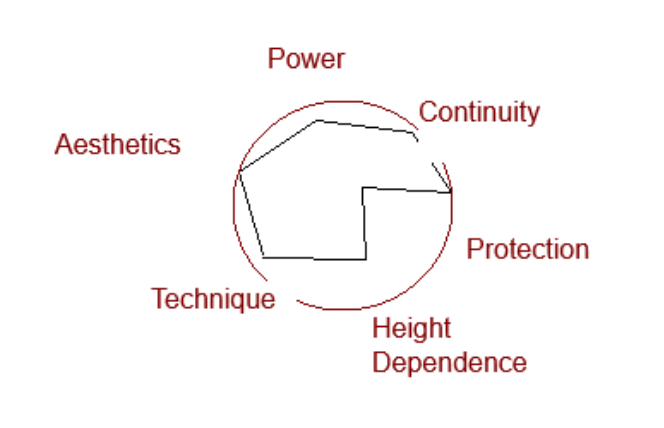
Ian Baleswrote:That's an incorrect understanding, the YDS grade comes from the difficulty of the route as a whole. Single moves get boulder grades for obvious reasons. What? Then a climb that's all 5.7 with one 5.12a move is graded, what, 5.10b? So a dude who climbs 5.11b can jump on it and think he can flash it, then hurt himself? I've never heard of the YDS described this way. I've been toying with this idea in my head for an alternate grading scale that uses multiple dimensions instead of a single number. The single number is a failure, full stop. Look at any route with a lot of comments, I see this one often at Mission Gorge: "This feels like 5.(grade minus 1) if you know how to jam (fists/offwidth/basic hands)". Why should experience change the grade of a route? Besides, what does 5.9 tell you? That a climb is similar in difficulty to Open Book? How many climbers have climbed Open Book? That it's harder than 5.8? Sure. A 5.9 in Joshua Tree is harder than a 5.8 in Joshua Tree. Is it harder or easier than a 5.9 in Yosemite? You have to try a few routes or rely on hearsay to find the level you want to work at on your first weekend trip. I've been thinking a multi-point scale that can't be summarized verbally. You wouldn't be able to say "The climb is L1", but the entire grade could be visually shown. Say, 5 points, forming a circle. The rounder the circle, the more "ideal" the boulder. Now instead of looking at a problem and thinking "but is this a slabby V2 or...", you can look at the circle and go "oh, this looks like my style" and the roundness indicates high quality - "oh this isn't just one hard move, I could actually learn stuff on this" or "oh, this is just one hard move. I could break into the grade on this". Points could be things like: Height dependence (low range: tall people disadvantages, high range: short people disadvantaged beyond what is normally expected). Power (low range: easy ladder climbing, high range: very dynamic), Technique (low range: easy ladder climbing, high range: delicate friction climbing), Continuity (low range: extreme difference between crux and rest of climb, high range: difficulty never eases) Right now one problem is obvious: some qualities I want to define a problem by are "good in the center", like height dependence. Some are "good at the extreme", like how some people prefer a climb with mostly sustained difficulty. I'd be curious to hear thoughts on this as I need to pick a capstone project this week (compsci) and I thought a browser extension to allow users to rate routes on MP would be a good idea. Each route would show the circle grade as an average of everyone's ratings or something. 30 second terrible mockup.
|
|
|
Will G
·
Jan 11, 2025
·
San Francisco
· Joined Mar 2020
· Points: 35
Michael Bwrote:I've been toying with this idea in my head for an alternate grading scale that uses multiple dimensions instead of a single number. The single number is a failure, full stop. Look at any route with a lot of comments, I see this one often at Mission Gorge: "This feels like 5.(grade minus 1) if you know how to jam (fists/offwidth/basic hands)". Why should experience change the grade of a route? Besides, what does 5.9 tell you? That a climb is similar in difficulty to Open Book? How many climbers have climbed Open Book? That it's harder than 5.8? Sure. A 5.9 in Joshua Tree is harder than a 5.8 in Joshua Tree. Is it harder or easier than a 5.9 in Yosemite? You have to try a few routes or rely on hearsay to find the level you want to work at on your first weekend trip. I've been thinking a multi-point scale that can't be summarized verbally. You wouldn't be able to say "The climb is L1", but the entire grade could be visually shown. Say, 5 points, forming a circle. The rounder the circle, the more "ideal" the boulder. Now instead of looking at a problem and thinking "but is this a slabby V2 or...", you can look at the circle and go "oh, this looks like my style" and the roundness indicates high quality - "oh this isn't just one hard move, I could actually learn stuff on this" or "oh, this is just one hard move. I could break into the grade on this". Points could be things like: Height dependence (low range: tall people disadvantages, high range: short people disadvantaged beyond what is normally expected). Power (low range: easy ladder climbing, high range: very dynamic), Technique (low range: easy ladder climbing, high range: delicate friction climbing), Continuity (low range: extreme difference between crux and rest of climb, high range: difficulty never eases) Right now one problem is obvious: some qualities I want to define a problem by are "good in the center", like height dependence. Some are "good at the extreme", like how some people prefer a climb with mostly sustained difficulty. I'd be curious to hear thoughts on this as I need to pick a capstone project this week (compsci) and I thought a browser extension to allow users to rate routes on MP would be a good idea. Each route would show the circle grade as an average of everyone's ratings or something. 30 second terrible mockup. Goddamnit. Can we just climb?
|
|
|
M1 H1
·
Jan 11, 2025
·
Boulder
· Joined Dec 2024
· Points: 0
Michael Bwrote: What? Then a climb that's all 5.7 with one 5.12a move is graded, what, 5.10b? So a dude who climbs 5.11b can jump on it and think he can flash it, then hurt himself? I've never heard of the YDS described this way. I've been toying with this idea in my head for an alternate grading scale that uses multiple dimensions instead of a single number. The single number is a failure, full stop. Look at any route with a lot of comments, I see this one often at Mission Gorge: "This feels like 5.(grade minus 1) if you know how to jam (fists/offwidth/basic hands)". Why should experience change the grade of a route? Besides, what does 5.9 tell you? That a climb is similar in difficulty to Open Book? How many climbers have climbed Open Book? That it's harder than 5.8? Sure. A 5.9 in Joshua Tree is harder than a 5.8 in Joshua Tree. Is it harder or easier than a 5.9 in Yosemite? You have to try a few routes or rely on hearsay to find the level you want to work at on your first weekend trip. I've been thinking a multi-point scale that can't be summarized verbally. You wouldn't be able to say "The climb is L1", but the entire grade could be visually shown. Say, 5 points, forming a circle. The rounder the circle, the more "ideal" the boulder. Now instead of looking at a problem and thinking "but is this a slabby V2 or...", you can look at the circle and go "oh, this looks like my style" and the roundness indicates high quality - "oh this isn't just one hard move, I could actually learn stuff on this" or "oh, this is just one hard move. I could break into the grade on this". Points could be things like: Height dependence (low range: tall people disadvantages, high range: short people disadvantaged beyond what is normally expected). Power (low range: easy ladder climbing, high range: very dynamic), Technique (low range: easy ladder climbing, high range: delicate friction climbing), Continuity (low range: extreme difference between crux and rest of climb, high range: difficulty never eases) Right now one problem is obvious: some qualities I want to define a problem by are "good in the center", like height dependence. Some are "good at the extreme", like how some people prefer a climb with mostly sustained difficulty. I'd be curious to hear thoughts on this as I need to pick a capstone project this week (compsci) and I thought a browser extension to allow users to rate routes on MP would be a good idea. Each route would show the circle grade as an average of everyone's ratings or something. 30 second terrible mockup. Im sorry, I wasn’t listening
|
|
|
Eric Craig
·
Jan 11, 2025
·
Santa Cruz
· Joined Sep 2024
· Points: 5
LMAO! Guess what, this discussion has been going on for a half century, that I know of. In it's functional use, it doesn't really fit any set of rules, or, the rules change as the climbing changes. I believe it functions as it should. And functions pretty damn good. I have been entertained here on MP by a couple other related conversations, that show up from time to time. Thank you all. I can use the cheer.
|
|
|
GTS
·
Jan 11, 2025
·
SoCal
· Joined Sep 2008
· Points: 0
Kyle Owrote: This, though, creates its own problems. If most of a route is say 5.6 but there is one move of 5.11a does it make sense to call it 5.9? Maybe we should add a V rating then? In any case I think a sustainment rating and a hardest move rating should both be used. 5.6 with one 5.11a move is a soft 5.11a 5.6 with multiple 5.11a moves is solid 5.11a 5.6 with tons of 5.11a is stiff 5.11a or 5.9+
|
|
|
Ben M
·
Jan 12, 2025
·
Unknown Hometown
· Joined May 2017
· Points: 0
I like your idea of the circle grades and think it could be really excellent way of a guidebook author adding value to their guidebook for the end user. However, I think it's too complex to be widely accepted and adopted by the general climbing community since there's a plethora of data points people could find subjective and argue about in trying to achieve a consensus, and people love a verbal shorthand that doesn't require too much thought. In other ideas, I personally like the idea of keeping the YDS number and letter grades, but utilizing + and - to indicate an especially sustained climb at the grade (+) or a one move wonder at the grade (-). To me this keeps the grading system relatively simple and easy to use as a shorthand, while conveying that additional degreee of sustainedness information that could be helpful for people to know.
|
|
|
Alan Rubin
·
Jan 12, 2025
·
Unknown Hometown
· Joined Apr 2015
· Points: 10
In the late '60s/early '70s, Colorado climber Harvey T. Carter, the original publisher of Climbing Magazine, created a 'multipoint' numerical grading system in an effort to quantify several of the various factors that effect how difficult a climb feels. He called it the Universal Grading System and, I recall that the system had 5 or 6 data points for each grade. He tried it out on his home crags near Aspen. Climbers found it much too complex and it never gained any traction, despite his best efforts to promote it through his magazine. The TDS/YDS, with some modifications along the way, has been around for 70 years, so, while not perfect, seems to have stood the test of time quite well. Besides, it's 'imperfections' have given climbers something to keep themselves busy arguing about for just as long---not a bad thing!!!!
|
|
|
climber pat
·
Jan 12, 2025
·
Las Cruces NM
· Joined Feb 2006
· Points: 301
It used to be, until about 1990, the grade of the climb was the grade of the hardest move. Sport climbing and grade chasing slowly changed the grading to have some non-quantified sustainment component. We used to just say it sustained 5.whatever, now we say 5.whatever+something.
|
|
|
Tony Danza
·
Jan 12, 2025
·
Unknown Hometown
· Joined Feb 2024
· Points: 5
Michael Bwrote: What? Then a climb that's all 5.7 with one 5.12a move is graded, what, 5.10b? So a dude who climbs 5.11b can jump on it and think he can flash it, then hurt himself? I've never heard of the YDS described this way. I've been toying with this idea in my head for an alternate grading scale that uses multiple dimensions instead of a single number. The single number is a failure, full stop. Look at any route with a lot of comments, I see this one often at Mission Gorge: "This feels like 5.(grade minus 1) if you know how to jam (fists/offwidth/basic hands)". Why should experience change the grade of a route? Besides, what does 5.9 tell you? That a climb is similar in difficulty to Open Book? How many climbers have climbed Open Book? That it's harder than 5.8? Sure. A 5.9 in Joshua Tree is harder than a 5.8 in Joshua Tree. Is it harder or easier than a 5.9 in Yosemite? You have to try a few routes or rely on hearsay to find the level you want to work at on your first weekend trip. I've been thinking a multi-point scale that can't be summarized verbally. You wouldn't be able to say "The climb is L1", but the entire grade could be visually shown. Say, 5 points, forming a circle. The rounder the circle, the more "ideal" the boulder. Now instead of looking at a problem and thinking "but is this a slabby V2 or...", you can look at the circle and go "oh, this looks like my style" and the roundness indicates high quality - "oh this isn't just one hard move, I could actually learn stuff on this" or "oh, this is just one hard move. I could break into the grade on this". Points could be things like: Height dependence (low range: tall people disadvantages, high range: short people disadvantaged beyond what is normally expected). Power (low range: easy ladder climbing, high range: very dynamic), Technique (low range: easy ladder climbing, high range: delicate friction climbing), Continuity (low range: extreme difference between crux and rest of climb, high range: difficulty never eases) Right now one problem is obvious: some qualities I want to define a problem by are "good in the center", like height dependence. Some are "good at the extreme", like how some people prefer a climb with mostly sustained difficulty. I'd be curious to hear thoughts on this as I need to pick a capstone project this week (compsci) and I thought a browser extension to allow users to rate routes on MP would be a good idea. Each route would show the circle grade as an average of everyone's ratings or something. 30 second terrible mockup. You (the royal you, but also you) are nitpicking and taking the joy out of climbing with this sort of mentality. You’ll never be able to accurately depict on paper how “difficult” a route is, so stop trying and just enjoy climbing. A grade is a ballpark, there’s no Rosetta Stone stating “if a wall of 78 degrees has handholds every 1.3 meters, it is 5.X but if it has holds every 1.2 meters it’s 5.Y.”
|
|
|
Jay Crew
·
Jan 12, 2025
·
Apple Valley CA,
· Joined Feb 2018
· Points: 9,319
Kyle Owrote: This, though, creates its own problems. If most of a route is say 5.6 but there is one move of 5.11a does it make sense to call it 5.9? Maybe we should add a V rating then? In any case I think a sustainment rating and a hardest move rating should both be used. I put up a V1 5.8 and caught some heat for the rating.... how hard the route is to redpoint determines the grade... that could either be one stopper move or sequence, or a total lack of rests for 90 feet....
|
|
|
JCM
·
Jan 12, 2025
·
Unknown Hometown
· Joined Jun 2008
· Points: 115
climber patwrote:It used to be, until about 1990, the grade of the climb was the grade of the hardest move. Sport climbing and grade chasing slowly changed the grading to have some non-quantified sustainment component. We used to just say it sustained 5.whatever, now we say 5.whatever+something. Jim Bridwell said otherwise in 1973: "Breaking a pitch into individual moves and rating the pitch by the hardest move is nonsense. A hundred foot lieback with no moves over 5.9, but none under 5.8, and with no place to rest, is not a 5.9 pitch!" A copy of the original article: https://www.ukclimbing.com/articles/features/the_innocent_the_ignorant_and_the_insecure-4397
|
|
|
Caleb
·
Jan 12, 2025
·
Ward, CO
· Joined Jun 2013
· Points: 290
Michael Bwrote: What? Then a climb that's all 5.7 with one 5.12a move is graded, what, 5.10b? So a dude who climbs 5.11b can jump on it and think he can flash it, then hurt himself? I've never heard of the YDS described this way. I've been toying with this idea in my head for an alternate grading scale that uses multiple dimensions instead of a single number. The single number is a failure, full stop. Look at any route with a lot of comments, I see this one often at Mission Gorge: "This feels like 5.(grade minus 1) if you know how to jam (fists/offwidth/basic hands)". Why should experience change the grade of a route? Besides, what does 5.9 tell you? That a climb is similar in difficulty to Open Book? How many climbers have climbed Open Book? That it's harder than 5.8? Sure. A 5.9 in Joshua Tree is harder than a 5.8 in Joshua Tree. Is it harder or easier than a 5.9 in Yosemite? You have to try a few routes or rely on hearsay to find the level you want to work at on your first weekend trip. I've been thinking a multi-point scale that can't be summarized verbally. You wouldn't be able to say "The climb is L1", but the entire grade could be visually shown. Say, 5 points, forming a circle. The rounder the circle, the more "ideal" the boulder. Now instead of looking at a problem and thinking "but is this a slabby V2 or...", you can look at the circle and go "oh, this looks like my style" and the roundness indicates high quality - "oh this isn't just one hard move, I could actually learn stuff on this" or "oh, this is just one hard move. I could break into the grade on this". Points could be things like: Height dependence (low range: tall people disadvantages, high range: short people disadvantaged beyond what is normally expected). Power (low range: easy ladder climbing, high range: very dynamic), Technique (low range: easy ladder climbing, high range: delicate friction climbing), Continuity (low range: extreme difference between crux and rest of climb, high range: difficulty never eases) Right now one problem is obvious: some qualities I want to define a problem by are "good in the center", like height dependence. Some are "good at the extreme", like how some people prefer a climb with mostly sustained difficulty. I'd be curious to hear thoughts on this as I need to pick a capstone project this week (compsci) and I thought a browser extension to allow users to rate routes on MP would be a good idea. Each route would show the circle grade as an average of everyone's ratings or something. 30 second terrible mockup. I don’t think something like this will ever replace the YDS. It’s not measuring difficulty so much as quality. With an algorithm behind it like Darth Grader, it could still be a nice addition to online climbing media. It could be tough to get enough data for outdoor rope routes, but I could see it working within a board climbing app where people already provide more feedback or an outdoor bouldering app like Kaya where people are eager to spray. Retroflash and various other home-wall apps already have a crude listing of climb characteristics (ie, pumpy, crimpy, powerful, slopey, etc.) that could be expanded and extrapolated. Ultimately, you will still need a distilled metric. Maybe the percentage of the circle covered by the accumulated value of the characteristics? That would tell you a high or low score, but you would have to look at the diagram for details. Each characteristic could have a score too. So you could see quickly how the total problem scored but also how it scores aesthetically or how reachy it is etc. I like the circle as a multi point Vin Diagram, but it might be simpler to just give each characteristic a 1-10 (or 1-100) scale and do averages. Once again, I don’t think this is a difficulty grade thing. But it could be cool. Certainly worth a school project.
|
|
|
Steve Astar
·
Jan 12, 2025
·
PHX
· Joined Jan 2025
· Points: 0
I propose we install load cells at all bolts and rate routes on the avg whip taken. Boulders can put them in their pads. And those with gear will have to upgrade to Bluetooth compatible pieces.
|

 Continue with onX Maps
 Sign in with Facebook