
 Continue with onX Maps
 Sign in with Facebook






Joining two ropes with a lashing for a rappel


|
|
Ignoring the safety margin/strength issues for the moment- Ben- is this series of hitches in thin dyneema something you can tie at three in the morning, reliably, with frozen hands, racing to get off the mountain before a whiteout hits? I somehow don’t think so. I can tie a Gibbs, full or half, and a flat overhand with my eyes shut and half asleep, wearing thick gloves. |

|
If it's possible to develop a system that can easily join 1 spliced skinny (~6-7mm) to 1 unspliced lead (~9mm) line in a way that you can pull through a chain link in both directions, then that is a value proposition. The join mechanism has to be decently easy to implement - I'm not faffing around with a bunch of hitches and a little dyneema cord. I'm not going to carry 2 rap ropes in addition to a lead rope on a normal day out. I feel like a spliced lead rope introduces too many potential complications, none of which are completely unacceptable but probably are enough to outweigh the small conveniences provided by such a system. My main objections would be (1) I like having flexibility on which lead rope to use, there are many different brands, lengths, etc. (2) Tying into the spliced end as the leader seems annoying especially untying the knot later (3) Making sure the rope is always stacked so the unspliced side is for the leader adds faff (4) Having the leader always tie into the same end reduces rope lifespan (5) You can't cut the spliced side Your system has to make a substantive improvement on the typical 2 rope rappelling workflow without adding much if any overhead before this will see large scale adoption. |
|
|
Ben Zartmanwrote: The foresight here is remarkable. https://sterlingrope.com/6-mm-trc/ https://sterlingrope.com/5-4-mm-v-tx-cord/ https://sterlingrope.com/5-9-mm-powercord/ https://www.petzl.com/US/en/Sport/Ropes/PUR-LINE-6-mm https://www.petzl.com/US/en/Sport/Ropes/RAD-LINE-6-mm https://www.bluewaterropes.com/product/titan-cord-with-hmpe-5mm/ https://www.mammut.com/us/en/products/2010-04070-11221/6-0-glacier-cord-dry |
|
|
@Kyle: I have suggested nothing unsafe: I advocate strongly for redundancy in anchors. But let's do some numbers: the 14mm Dyneema Yates Rabbit Runner is rated to 17kN. If tied into a knot, it's then weaker than the 12kN UIAA factor two fall you cited earlier. I would use it with no hesitation, because the contingency of unthinkable events stacking up to leave me with a factor 2 on one strand of an anchor is so remote that if I'm afraid of that, I may as well stay home. You should use my products responsibly, and use common sense and proper redundancy when building anchors with them. But you should also climb believing that if everythig goes so sideways that you're taking screamers onto a one-strand knotted anchor, it may have been your day to go. @Jonathan: busted. "a dozen" may have been hyperbolic. But you could tie your haulbag loop to the spliced loop of a haul line with a lashing. I use a lashing to secure my swami belt for climbing. You could use a multiple-pass lashing to get a precise length between a pin or bolt and a 'biner. A super-light ledge suspension could be made with them....I'm not saying everyone should climb with bits of dyneema in their pocket, but the uses for a lashing are limited only by the imagination (or lack thereof). @climbing weasel: It's very unlikely most people could make a secure lashing in a storm at 3 am with frozen fingers. But if you had read the thread, you'd know I've said the fiddliness is huge. This is an experimental use case for this sort of thing, and clearly it's not suitable for every situation. More of a "I wonder how light and low-profile I can make a connection between two eyes" with no other considerations that that. @szheng: It's impractical to splice lead ropes. The kernmantle construction doesn't lend itself to splicing. So the best way to use a spliced skinny rope with a fat rope is to pass an end of the fat rope through the eye and tie a bowline or a stopper knot in the fat rope, make sure the knot CAN'T pull through the rings, and use the skinny rope as a tagline to pull down the fat rope after rappelling. @Micah Hoover: See? everyone else is producing skinny ropes too. Dunno why my skinny rope ideas get so much hate. Betcha it won't be long before they jump on my bandwagon and start splicing eyes as well. |
|
|
Ben Zartmanwrote: Can you post a link to the test data that supports this conclusion? I believe it’s incorrect, and the supporting data is in at least one of the sources I already cited in this thread. 17 kN isn't the ultimate strength of the material (it's the strength of the sewn eye), and this blended spectra/nylon doesn't lose nearly as much strength in a knot as pure dyneema. As a result, the knotted strength will be higher than you suggest. |
|
|
Climbing Weaselwrote: Why was this ignored? It’s the least faff way to make the spliced eye resemble a sensible choice.
|
|
|
Kyle Tarrywrote: Yates says their rabbit runner is Dyneema webbing. They have other slings that are blended Nylon/dyneema, but the only ingredient of the rabbit runner is listed as Dyneema. Using your method of suppositional engineering, where if one dyneema product behaves thus we can assume others do as well, my statement must be taken as correct. You haven't actually tested the Yates rabbit runner in the catastrophic failure mode you've finally had to appeal to as a hail-mary pass in your attempt to discredit a product you've never seen, used, or even imagined. I've submitted my product to testing by the UIAA in an ISO-9000 certified lab. I have labelled it accordingly, and if you'd ever seen as much as the packaging, you'd know that I recommend it not be knotted. It can survive a BFK in normal use (non-catastrophic-end-of-the-world scenario), but I recommend something different as best practice. It's one thing to spout numbers and unreliable data from uncalibrated-machine operators: it's another to use real engineering data and experience. I think, until we can test each specific product in each mode in question, in an actual test lab, we're not going to arrive at perfectly reliable numbers. All your test data so far seems to come from unaccredited labs. That's a red flag right there. Can you show me Hownot2's ISO certificate? Moyer's? et al's? Until you can, your engineering numbers are just a guess at best, and this devolves into a pissing match with no winner. @Jared E Climbing Weasel's post was not ignored: I addressed that idea upthread. It would absolutely work, but you'd have to sit there and pass 200 feet (or whatever the line length was) through the eye of the other one. I though the lashing was less faff, but yes, it'd work. |

|
Ben, Can you post a picture of what you mean by securing your swami belt with a lashing? I can’t visualize what that would look like. Thanks. |
|
|
^Don’t do it Ben! |
|
|
I always love when people actually read the Moyer et al paper, we actually have a QR code for it near our accessory cord cutting area, though I doubt strongly anyone has actually used it: 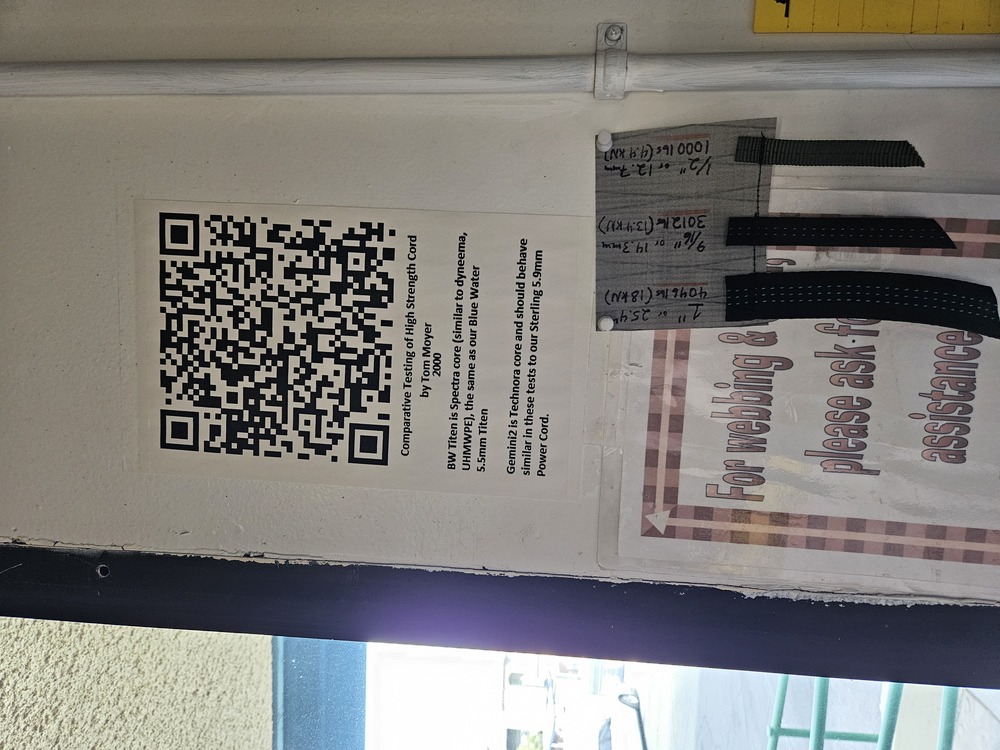 Quad or triple length dyneema sling tied as a normal 3 piece anchor... perfect equalization doesn't happen between all 3 points, but usually, "good" equalization between 2 points does, especially if you pay attention to your loop lengths in a logical way... So thats 2 loops to a knot or 4 single strands to a knot... that is pretty acceptably strong per HowNot2's vids IIRC. Thats with a normal figure 8 or overhand to make the master point loop, BFK would be similar, likely ever so slightly higher strength. |
|
|
In the interest of doing something more productive than bickering with Ben, I put together a table with common anchor rigging configurations, and what strength we should expect from all of them. Sources are listed for each, and detailed at the bottom of the document. All numbers in this table come from the 3rd party sources listed, none of this is my data. 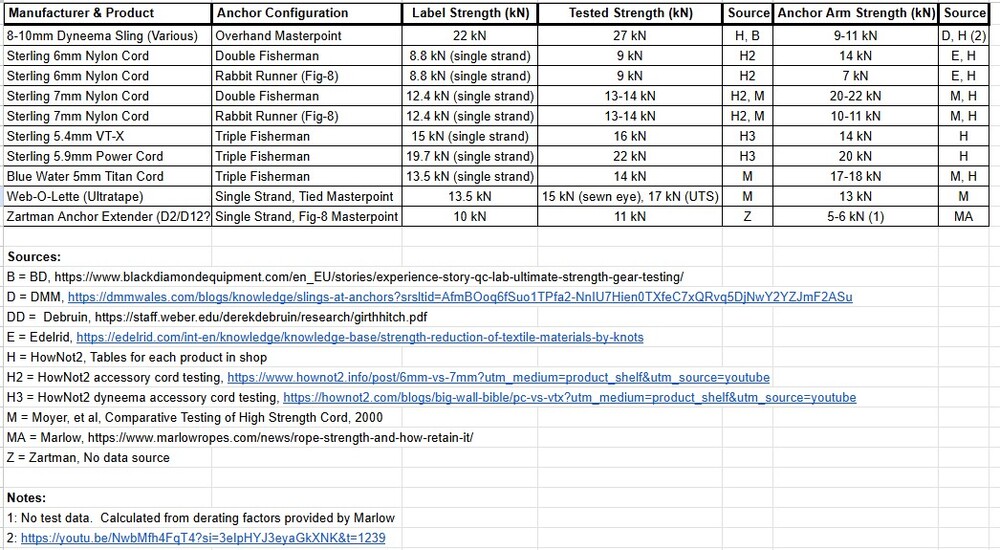 This should be publicly available (read only) at this google docs link: https://docs.google.com/spreadsheets/d/1XfIbfyt08KjvdpXsjIPfoTxVmri1uIlj9aJMpXtgQ4w/edit?usp=sharing If you have additional data, corrections, other anchor configurations, etc., just shoot me a PM with your info or request and I am happy to edit, update, or correct this info. Note: I didn't include girth hitched dyneema slings in this table, because the failure mode of a single leg is often complex slipping behavior, as opposed to strength. That makes mapping it out quite difficult, relative to the other setups. See DeBruin, Camus, Siebert, HN2, and Edelrid for additional information on GH anchor failure dynamics. Hopefully this is useful for someone! Edit: Adding to this, common best practice is to build anchors such that a failure of 1 piece will not result in a system that fails under possible loads. This is tricky to put a finger on, but in general this implies that each individual leg of an anchor should be 8-12 kN strength. For justification of this, see the drop tests by DeBruin, comments by Moyer, and this AAC article on anchors: "Lesson Learned: Avoid building anchors where no single component isn't strong enough to hold any potential load the climbing team could create." "Lesson Learned: If you’re using self-adjusting systems, make sure ALL the components can survive the expected loads AND potential shock loads. Bomber pieces are required." Rigging an anchor out of a material whose strength drops below 8 kN once it is tied in a knot or a hitch would not meet these recommendations. |
|
|
Jonathan Barrettwrote: Not sure the pic posted. I can see it on my screen, but not when I update.... 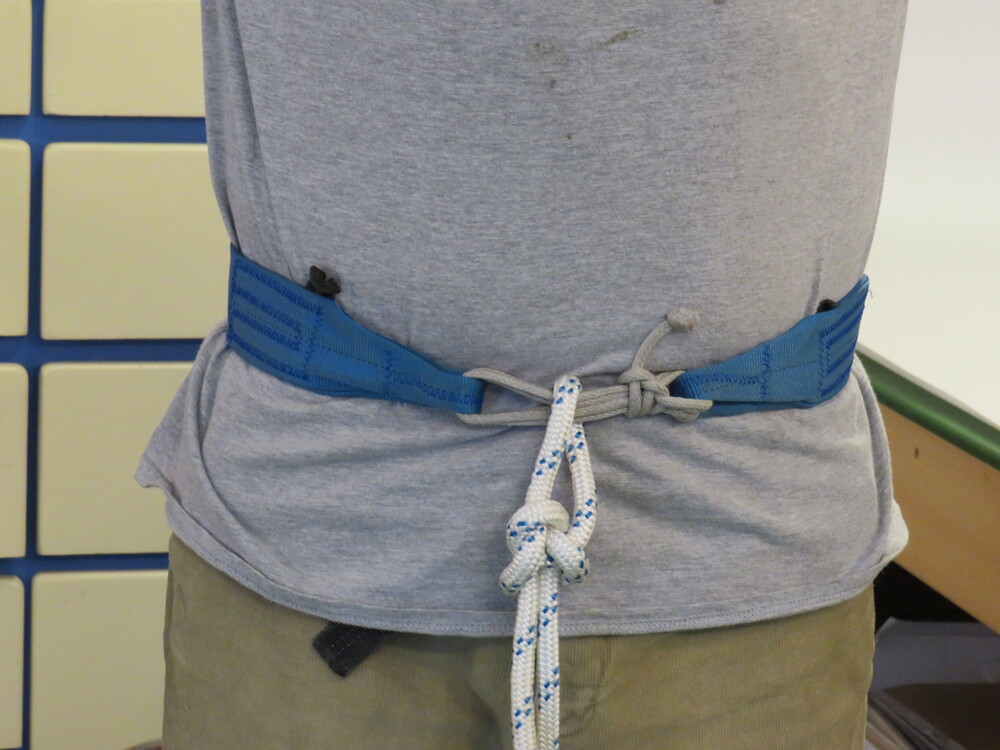 Ah, there it is, the picture of elegance and low-profile-ness. The Knotless Swami! |
|
|
Ben Zartmanwrote: For the uninitiated- exactly what is the point of a swami? I know they’re historical but I didn’t realize they were still in use. |
|
|
Climbing Weaselwrote: Aside from people who get a kick out of anachronistic gear, the only thing they are regularly used for today is sleeping tied in. |
|
|
Climbing Weaselwrote: On a long free route with stance belays, they're far lighter and more comfortable than a harness. In a wide crack or squeeze chimney, they present a lower profile. That's really why I began using one. Finding that the smooth taper of my leg was suddenly spoiled by a leg loop when trying to go thigh-deep into an offwidth, I eliminated the leg loop, and thus elevated my offwidth game. For any kind of climbing where you're not going to be falling a lot, or hangdogging, it's pretty nice. If you climb a lot of easy cruiser long routes with walk-offs, it's ideal. I also use one when sailing offshore as an alternative to the death-trap auto-inflatable lifejacket/harness combos we've discussed up-thread. |
|
|
Hello Ben, On a slightly more serious note, I am genuinely curious as to how you define what a 'knot' is? The title of this topic thread indicates 'no knots', and your swami belt is also claimed to be knot free. Historically and traditionally, a knot has generally been defined to be: A fastening tied by hand which has an intentional geometry that is repeatable - in order to achieve a desired outcome. The term 'knot' broadly captures a range of hand tied fastenings. A knot can be further divided into specific sub-categories according to function: [ ] Fixed eye knots - eg Figure 8 eye knot, Bowlines, etc. [ ] End-to-end joins ('bends') eg, Double Fishermans bend, Sheet bend, Zeppelin bend, etc. [ ] Hitches eg, Prusik hitch, Clove hitch, Munter hitch, etc. All knot book authors have traditionally included all 3 sub-categories in their publications. The sub category of 'hitches' includes: binder hitches, noose hitches, slide and grip hitches, load control hitches. # Example of a load control hitch = Munter hitch # Example of a slide and grip hitch = Prusik hitch # Example of a binder hitch = Constrictor hitch, Clove hitch, etc # Example of a noose hitch = Purcell ... It does appear that you don't regard 'hitches' as being a type of 'knot'. And this might explain why you make claims of "no knots", or "knotless", in your various posts. Given the fact that 'hitches' appear in all knot books, do you believe that the authors are in error? That is, do you believe that authors should not have included 'hitches' in their knot books? |
|
|
Ben Zartmanwrote: Except for those hitches, which is a kind of knot. |
|
|
Mark Gommerswrote: If hairs must be split, yes, you can consider a hitch a type of knot, and a bend as well. But because they have different purposes, professionals in their use tend to be nitpicky about the difference. That you are nitpicky in the other direction is a testament to diversity. In my primary refences (Lever, Toss, Garret-Smith), the difference seems to be highligted rather than downplayed, and they add a further dimension of splices, so that one book (author forgotten) is titled, "Knots, Hitches, and Splices." The knotlessness of which my lashings consist, since technically they do contain "knots," is in the elimination of a giant knot in the primary members. It was probably before your time that swamis were made of 2" webbing, tied about the waist with a water knot. That knot created an awkward bulge in a squeeze chimney which you had to rotate to whichever side of your body was least inconvenient for it. So, the Holy Grail of swami design was to eliminate the Big Knot. I have done so, trading in its place a discreet, low-profile lashing. Fish had something similar, but lacked the Dyneema that really makes it cool. I suppose we could call it the "Lashing Swami," if that's more technically accurate, and we could call my proposed skinny-rope lashing a....."Lashing Between Two Eyes?" I rejoice, though, that the only real objection to my cutting-edge technology is one of semantics. Once you're tried my products in real life, even that objection will melt away in the glory you'll experience knowing that you're rocking the best of the best, and you'll increase exponentially in confidence, ability, and attractiveness. |
|
|
Again: This post is solely directed at Ben:
There is no "hair splitting" here, its simply about getting our definitions in order (language is important, and words have meaning). If you concede that a 'hitch' and a 'bend' are both a type of knot - are you willing to alter the title of this topic post?
I started full time climbing in 1983 (in Australia). My first experience was with a harness improvised from sisal rope in Perth, Western Australia. A year later, I purchased a swami type harness from a climbing shop at Mt Arapiles in Victoria. I used the 'swami' system for 3 years then upgraded to a buckle system. There were no climbing bans at Mt Arapiles in the 1980's and 1990's.
In the early 1980's at Mt Arapiles, the most common method to secure a swami belt was with two or three 360 degree turns of tubular webbing and a tape knot (aka 'ring bend'). You had to suck your belly in and hold your breath while tying the tape knot ('ring bend'). It worked - but was a bit fiddly. None of us at the time considered the 'tape knot' to be a big knot.
No 'real objections' per se - rather, trying to understand your definition of what a knot is - and why you make claims of no knots and knotless systems. As stated, we need to get our definitions in order. Words have meaning, and language is important. Otherwise, we wouldn't be able to engage in a meaningful dialogue if everyone applied their own definitions. If I were in your position, I would not make the claim of "no knots" and/or "knotless". Instead, I would make the claim that I am employing low profile knotting techniques - ie using hitches to unite 2 ends in a secure way. |
|
|
Mike Lindell stopped selling pillows, and he's posting on MP. |


