
 Continue with onX Maps
 Sign in with Facebook






Joining two ropes with a lashing for a rappel


|
|
Andrew Ricewrote: Or even a quick link… |
|
|
@Eli W: the Anchor Extenders are certified to UIAA 102. The Seamless Runners and friction products are certified UIAA 104 @Andrew Rice: You'd need stronger Velcro. Perhaps there's a patent there for you. Or I could splice six-inch eyes and just keep on windin' that Velcro on..... @Kyle: I'm glad you're the judge of responsible business. Here I thought going through the UIAA certification process was responsible enough, but evidently there must be testing by Kyle-approved test labs. I have reams of test data published by the materials manufacturing company that inform me of the properties of the materials I use; I'm not the first or only person to make spliced rope or covered loops. It's a well-established technology, and all the engineering data I use, as well as the UIAA testing, is performed by ISO-9000 certified labs. Your guys may have hydraulic rams to break stuff, but their data is less valuable, since we can't know (without ISO) how or whether their machines are calibrated at all. But all that's aside. You're claiming slippage from a girth hitch, but you (or your fly-by-night shops') testing has been done on uncovered Dyneema slings. A covered Dyneema rope might behave far differently--you'll never know till you actually test, rather than guess. I'm perfectly comfortable recommending a girth hitch because the contingeny of a strand breaking is so impossibly remote without something REALLY stupid being done, that it's like super gluing your pants onto the belt and suspenders. Anything can be pulled on or used wrongly and made to fail, and no one can manufacture something idiot-proof enough for someone not to be able to damage it, so we can only manufacture for a certain range of uses, and hope people will behave responsibly. But I'm beginning to suspect that all this pushback from you comes from a deeper well--no longer merely a discourse on a different sort of gear, I detect an umbrageous undertone. Have I injured you in some way? Do my irrefutable claims of my gear's betterness cause you some personal insecurity or restlessness? What dog do you have in this fight that a new idea threatens you? You're not being forced to buy or use my gear. I'm not being cagey about its construction, use, or certifications. Do self-esteem issues require you to feel like you've won some battle? Let's talk about those for a bit, and maybe you'll feel better. I'm here to listen. |
|
|
This whole two rope idea is silly for climbing-- but I do think his seamless quickdraw design would be great for alpine climbing-- as light (lighter) than an alpine runner, adjustable to two lengths, but with the security of a standard quickdraw (ideally the loop would be a bit tighter to hold the biner better) |
|
|
Ben Zartmanwrote: In that case, issuing the certificate seems like an oversight on the UIAA‘s part, given that you are marketing the product as an anchor I don’t think anyone would advise a 5mm nylon cordelette, but that is equivalent in strength to your offering for the outside legs of the anchor even before accounting for the different knot losses of nylon vs UHMWPE (2 strands of 5kn vs 1 strand of 10kn). |
|
|
Ben Wah, Benhamein, Young Ben,I watched your video! So good to see you old friend, didn't really expect to see you when I clicked on the thread, but was tickled nonetheless. I unfortunately have nothing to add about the subject but wanted to say howdy. :) Carry on! |
|
|
@heyzeus: Amigo! shoot me an email and let's catch up. It's a long time since Hollywood. @MP: thanks for the advice. I'm drifting in those very directions; it's just super time-consuming to set up websites and webstores, especially when I have to have someone to do it for me, since I don't code. Everything is where it currently is as an expedient of necessity, but the plan is to separate the luxury climbing brand, Legendary Climbing Gear, from the sailing brand of Zartman Rigging. I'm a one-man show right now, with help from my computer-savvy wife who doesn't have all day to dedicate to web design. As this gathers steam, I'll definitely move in the directions you've suggested. @Eli W: you can question the UIAA about it if you like, but we tested the pieces to their 102 standard with the spliced eye included in the testing. So the piece, with eyes spliced in, meets UIAA 102. I guess when the doubters start questioning the certification agency, it's because they're run out of ammo. Your quibble about the name is foolish: it's a name, like "rabbit runner," which contains no varmints. I needed a brand name for a specialty accessory cord offering. It bridges the gap between the anchor placements and the masterpoint. It....extends from rock to 'biner. It has a conservatively rated UIAA label. I can't think what more you want. |
|
|
Ben Zartmanwrote: UIAA 102 is a generic test for accessory cord, it doesn't mean something is strong enough to be an anchor. 4mm nylon cords with a 3.2 kN strength rating will also pass UIAA 102; nobody would say they are ok to use as an anchor. 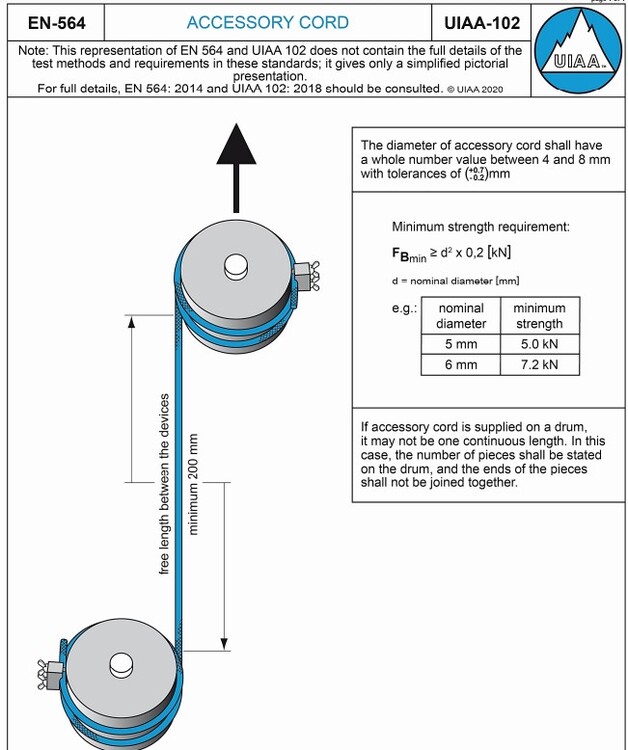
I didn't make up any of the quality measures I mentioned, they are all standard practices across industries where safety is important. There is information about them in a climbing context on the DMM page that I already posted earlier in this thread. Here's similar info from Sterling. There are a bunch of other standard things companies do in addition to this, to make sure product going out the door is safe for people who depend on it. |


|
Eli Wwrote: I agree that 5mm nylon is too skinny for cordelette. However, there are plenty of people who use 7mm for "snake cord" which I imagine is in the same ballpark as this stuff (or even slightly weaker), given the full strength eyes. |
|
|
mbkwrote: Not once you tie a masterpoint knot or hitch in it, because nylon loses minimal strength in a knot but dyneema loses a lot. 7mm nylon accessory cord, rated at ~12 kN, still holds ~11 kN with a fig-8 knot in it (Moyer, HN2). However, dyneema products (with sheaths) like VT-X, Powercord, and Titan cord, all hold ~50% of their rated strength once you tie a knot (Moyer, HN2). So, in an anchor with a typical masterpoint knot, the 7 mm cord is still going to hold 10+ kN per leg, but a dyneema product that breaks at 10 kN without a knot is only going to hold 4-6 kN per leg with the knot.  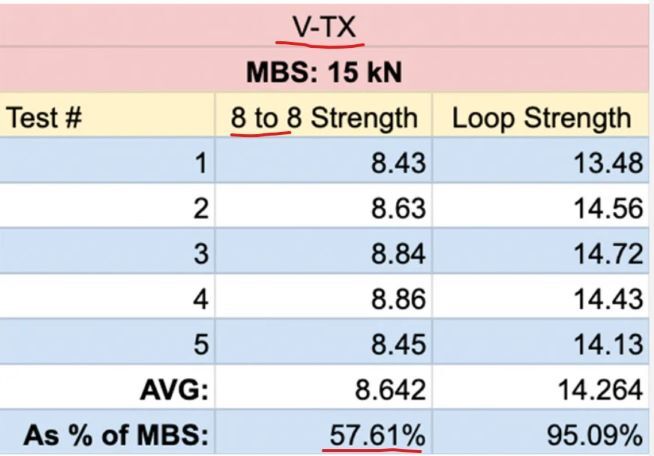 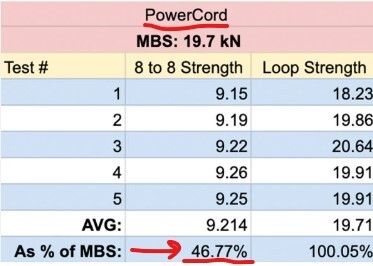 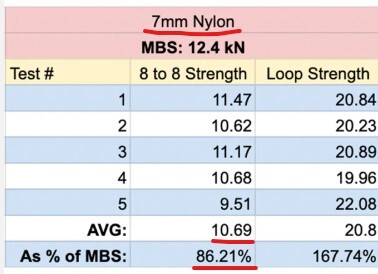 OP repeatedly claims that their product doesn't follow the strength reduction trend of every other dyneema product on the market, but note that Marlow (manufacturer of similar products for splicing) says "Ropes made from HMPE or LCP type material (for example Dyneema or Vectran) should be assumed to retain only 40 percent of their strength when knotted". 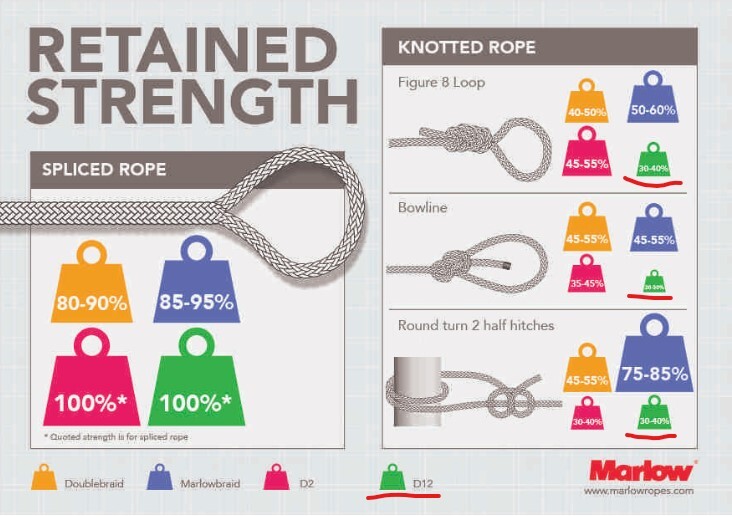 |
|
|
mbkwrote: The full strength eyes don’t matter, the weak point is the 10Kn single strand going into the BFK with this product vs two 7mm (10kN x 2)strands with traditional cordelette or a single 22kN strand with rabbit runner style anchor slings that are actually rated as slings.
|
|
|
Kyle Tarrywrote: You misunderstand the way anchors are built. If you took a single strand of my Anchor Extender and tied a knot in the end instead of the splice, it would indeed lose a great deal of strength. That is why there's a spliced eye, which per the Marlow chart (my rope is D2 from Marlow, incidentally), retains 100% of published strength. If you have two equalized legs, then even with a BFK or girth hitch, you'd have to exceed 80% of the single-strand break load of 10+kN, because you have two legs sharing the load. With a 3-piece anchor, you'd have to get even more rowdy. By the time you achieve that sort of load, you're exceeding the ratings of much of the pro: stoppers, cams, hexes, etc used to build your anchor. And if a knot wigs you out, and you know the pieces are bomber, you need not tie a knot at all: just clip the bight, and you're lost no strength at all. Notice that the different knots, because they put a different bend radius on the line, weaken it differently. Since you're the one worried about it, you could test this specific rope with a BFK. Or you could continue to bluster. That's probably easier. Funny, some time ago when I asked a guide about the strength reduction of a BFK in a Dyneema sling, his answer was the same: with so many parts to the system, it would take a cataclysm to make it fail. If spliced gear gives you the heeby-jeebies, then I urge you to avoid it. Those who have the mental capacity to read the rating tag, understand the engineering of anchors and the limitations of gear, will take these for what they are: a spliced piece of Dyneema cord that breaks at 10+ kN in single strand. Would I build a wall anchor with it in single strand? Of course not--but I'd use it to engage some remote piece of gear as part of my equalized system. I can wrap trees with it, and have two legs, or four, sharing the load. Anchor building requires a bit of skill and common sense. I recommend you learn how to do it sometime. |
|
|
Ben Zartmanwrote: Load sharing doesn't work this reliably, especially with a fixed master point. See Long/Gaines and many others. https://americanalpineclub.org/news/2017/7/31/anchors "Anchors never really equalize. That is to say, they never manage to equally distribute the total load of the climbing team equally to all the components in the anchor, unless there is only one component. Yet, much false confidence and unnecessary time is contributed to achieving the elusive goal of equalization...As a result, anchors that funnel into a masterpoint do not succeed, as intended, in aggregating the strength of the things they are attached to. A strong anchor thus is only as strong as the component that is holding most of the weight most of the time." "However, since equalization never really occurs, one of those pieces will be holding most of the weight most of the time. In that case, a single load that exceeds 6kN could sequentially rip every piece out of the rock, resulting in a catastrophic failure." "Equalization" was a popular topic a few decades ago, before testing determined it wasn't as effective as believed, and anchor best practices were updated accordingly. An important property of an equalized anchor is to protect you from failure of a piece. If the load all goes onto one strand, you want it to be at least as strong as that piece, not ~5 kN.
The manufacturer, Marlow, already did, and I already posted it in the thread. 30-50% strength, consistently for a variety of knots. |
|
|
Ben Zartmanwrote: ….. Or you could continue to bluster. That's probably easier. Ben, I appreciate the technical discussion and I think both you and Kyle should avoid the personal snipes. edit - sorry to include you Kyle! |
|
|
Equalization? That's something that a phrenologist uses, yes? |
|
|
Terry Ewrote: This thread is a classic version of "What do you think of my idea?" followed by a bunch of ad hominem attacks when people actually offer up thoughts that challenge the original poster. |
|
|
Terry Ewrote: I’m not seeing any particularly personal snipes from Kyle. He’s making arguments using data and citing his sources. Let’s not make false equivalencies here. |
|
|
Ben Zartmanwrote: It may just be my limited mental capacity, but it seems like most of the feedback you've solicited hasn't been that splices are untrustworthy. Rather there's a issues with the utility of those splices, the cost/benefit trade of something 2-4x similar products, quality control of your production and the reputation of a manufacturer frustrated and dismissive at the concerns of a market they're seeking to enter. Ben Zartmanwrote: I'm at a loss for words at the suggestion an anchor doesn't need to survive when something goes catastrophically wrong. That's.... exactly when it needs to function. Losing a strand in an anchor to rockfall or gear failing is a very real occurrence. |
|
|
Terry Ewrote: You're right. Please accept my apologies, everyone, and Kyle especially, for anything unpleasant I have said on this thread. Perhaps some of the snipes I was reacting to were the aggregate of this and other concurrent threads, where a good deal of sarcasm and pedantry was directed my way ("he misspelled 'rappel,' does he even know what it is?"). I'm introducing spliced rope technology into a relatively new use mode for it, so a certain amount of hesitation is to be expected. The limitations and cautions relating to the use of the materials are well-documented: I have secured UIAA-certification; been up-front about it, put safety labels on--I don't know what more I can do. And still, one claims that the UIAA must have screwed up; another that their testing is better, another that every anchor should reasonably be expected to survice a cataclysm--how do we even define such a catastrophic event, so that we can engineer for it? I can engineer spliced gear, with the materials available, to hold up to 110 tons, and anywhere in between. But climbing loads and anchor loads are relatively small. If equalizing is now regarded as impossible, then we need stronger cams, stoppers, etc. (Always on brand, I have hexes slung with 8,000lb bl spliced slings. ;), and we need better alternatives to the old-fashioned cordelette-style anchor with a BFK or girth-hitch master point. I personally don't object to the sliding X if confident in the placements, since it's stronger than a BFK, but maybe there's even a better way to equalize that we've yet realized (For swinging leads, I'm happy clove-hitching the lead line, which uses a minimum of gear, but that's for a different application). None of those things are a limitations of the gear, though, but of the technique. @Kyle: Marlow has not tested their rope with a BFK as it is used in making equalized anchors. You insist that they have. They haven't. This is not a personal attack. They simply haven't. Nor, AFIK, with a leg girth-hitched to a 'biner. I would strongly suggest, if a two-piece anchor is dodgy enough that one piece might reasonably pop, there need to be more pieces, or an adjustment of expectations. Lastly, for now, a poll: how many people have had one leg of an equalized anchor cut by rockfall? Does it happen once a year? Twice? There's a point at which catastrophic contingencies become so remote, they're not worth regarding. No amount of helmet will save your head from a rock as big as a TV. Does that mean the helmet is at fault, or that you're willing to climb even with that remote possiblity hanging (as it were) over your head, because it's so infrequent? The purpose of this very drifted thread was to see how folk would react to a minimal but scientifically engineered lashing to join two skinny-rope eyes. Apparently the climbing world isn't ready for that yet, and sees no value in it. That's fine, I didn't expect a chorus of huzzahs, and I appreciate the discussion. I think smaller, lighter gear is inevitably coming, and soon skinny fixing/rapping ropes will be more common than fat ones. But it might take longer than I thought. |
|
|
Ben Zartmanwrote: They have tested a variety of very similar knots, and all of them reduce the strength by roughly the same amount. We can reasonably extrapolate that the results would also apply to a BHK. If you want to argue that a BHK is going to behave significantly differently than every other knot tested, the onus is on you to prove that.
Are you claiming a sliding-x is stronger than a BFK? How do you know that, if we don't have any information about BFK strength?
Go read that AAC article, or any up-to-date text on anchor building. We have clear limits on maximum forces in a factor 2 fall (12 kN UIAA rope test) and clear maximum strength of gear (normal sized cams and nuts are 10-12 kN minimum on the label, and often fail much higher in testing). We simply want our anchor connections to be at least the same strength. All other anchor constructions meet this criteria. Yours doesn't. I have already explained this several times in this discussion, and suggested reasonable minimum strength for each arm of an anchor.
The reason we build redundant anchors is for when the unexpected happens.
You're arguing that your product doesn't need to survive an accident, because accidents are rare? I don't really think there is much point in continuing. Like several other recent threads, you have posted a series of unsafe suggestions, and refused to consider alternative points of view. |
|
|
Ben, Can explain more completely and clearly the scenarios where this system of two skinny, static lines joined with your fixed eye/splice would be employed in climbing?
|


