
 Continue with onX Maps
 Sign in with Facebook






Does being taller make climbing easier? Answering this question with data!


|
|
Go Back to Super Topowrote: Ape Index likely doesn't help. I can't find any direct testing of ape index and elite climbing performance, but if this measure follows other biomechanics principles, then positive ape index is likely an overall wash, or a disadvantage. Longer limbs has been demonstrated as a disadvantage in other strength sports such as powerlifting and gymnastics. This is due to the longer lever arms requiring more pull to create the same power. Add in increased flexion of the joints for any given body position, and you are further disadvantaged by worsened length/tension relationship. |
|
|
David Draperwrote: Climbing and gymnastics/powerlifting require very different body types (short and dense vs. normal, often lean, build) to be successful so that’s an odd comparison in my opinion, though not completely out of left field. Additionally, I would agree with you regarding adding increased flexion, if we were applying this to a fuller range of motion (such as bench press)…..but climbing rarely requires an individual to do a full muscle up without lower body assistance. Think about the challenges of climbing as someone with T-Rex proportioned arms. They would be not be able to climb very well at all, whereas in the powerlifting realm they could still do quite well (given they could get the bar off the rack ) |
|
|
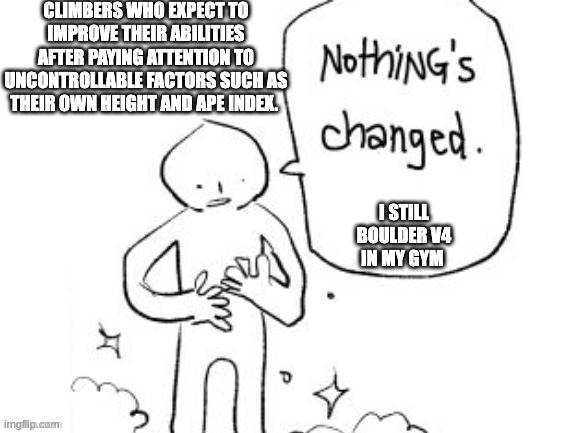 maybe just climb more |

|
Nkane 1wrote: This is unironically a project I’ve been looking at for a while. I stopped following this thread shortly after I made my original comment but if anyone is interested in doing this, feel free to message me - definitely got a few ideas I’ve been putting around |
|
|
 |

|
Adam Rwrote: Maybe that's often overlooked but it still falls into the category of an exception and exceptions don't disprove the general rule. I would be interested in the empirical side of this- what are the sub-research questions that would help answer this as bigger question of "does height matter?" And, what data would help answer these questions? My guess is that the best data would be quasi-experimental, tracking youth climbers over time pre and post growth spurt. I.e., did those w/ the greatest growth spurt increase their sending abilities the most? Indirect methods would probably be useful too in lieu of cohort/longitudintal data. You might have to examine grades sent by height across various levels of difficulty (beginner vs. intermediate vs. advanced/professional). i.e., there might be some height effect as we might expect where being too short or too tall have adverse effects and being the average male height might be advantageous. Maybe more importantly, who has the grant money to fund this line of research |
|
|
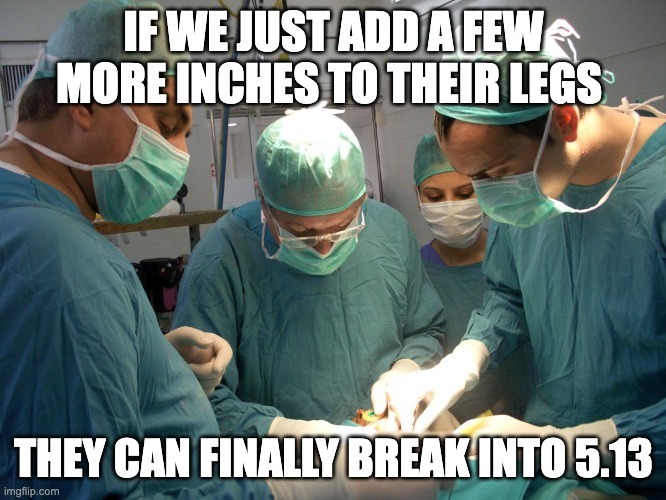
B Ywrote: Hugh Herr literally did this |
|
|
Frank Steinwrote: Did it work?!? |
|
|
David Draperwrote: Interesting assessment, but likely depends upon the climbs? It’s sort of like small handed people can climb tight finger cracks more readily than people with bigger or wider hands. +1 to +2 ape index and height from 5’7” to 6’1” appear to be good height ranges for climbers. Those are relatively average…, average climbers can be argued to be better because that’s where the majority of the population falls and there’s a greater chance of finding better climbers. Climbers aren’t all 6’5” or thereabouts, so the logical conclusion is that it likely doesn’t help to be tall, and the ridiculous argument that climbers whom are shorter are somehow lessor climbers is both insulting to less than average height climbers as well as being simply incorrect. This isn’t the topic, but being lighter than average for your height helps. That’s about the only factor that seems to be common amongst all of the better climbers. |
|
|
Li Huwrote: Or that most people aren’t 6’5” so there are just less people at that height to climb |
|
|
Jason Lwrote: You can sort of do this if you look at longitudinal data concerning comp kids who became elite climbers. There are those who will maintain that height does not matter and will cite prepubescent crushers as evidence of this. But when you look at those kids when they grow up, and the picture is a little different. Ondra sent .14c at 14, but now climbs a full number grade harder. Connor Herson freed the nose at 15, but is now a 5.15 mutant. And, on a personal knowledge level, I remember John Cardwell as a Team Mojo kid who could put down .14-. He’s now climbed several .15s as an adult. |
|
|
Li Huwrote: Yes. He’s a famous MIT engineer in the field of prosthetics. There are many articles and films about him. Post-limited response to SuperTopo: “what does that have to do with height?” |
|
|
Not Not MP Adminwrote: Pretty sure I have the opposite problem, another disadvantage to being 'tall' |
|
|
Frank Steinwrote: Yes and generally people get stronger and better at climber the longer they practice it, no? I just don’t see the direct correlation to height with mentioning youth climbers in the way you did. |
|
|
Go Back to Super Topo wrote: the growth spurt is a way of or opportunity to examining how changes in height within individuals affects performance. previous comparisons were between people of different heights, but these comparisons have their drawbacks as well (e.g., overall strength, finger strength, flexibility/mobility, experience, skill level, etc.). although generally people do get better and stronger over time, within enough data you may able to determine the effect of height on climbing performance by tracking climbers over time and looking at their growth spurts. |
|
|
Adam Rwrote: you might reference small disadvantages but the advantages are there on the whole |
|
|
Jason Lwrote: Are you 'short'? How would you know what it's like to be in a 'tall' persons body? |
|
|
Jason Lwrote: I understand the point given in this context. However, I would be highly skeptical of any reliable data comparing a developing (physically) individual when the primary developments during these times are often not exclusive to height, and arguably more hormonal than anything else. I just fail to see the correlation to height when examining someone climbing 5.14 at age 14 and then climbing 5.15 at age 30. There are just far more factors than height coming into play. |
|
|
Not Not MP Adminwrote: Uhm, this entire discussion is in the context of climbers. |
|
|
Li Huwrote: Your logic regarding not seeing climbers who are 6’5” is flawed just by simple statistics. Of course we don’t see many climbers who are 6’5” and up because there are just less humans that are 6’5”, when compared to your average height of 5’7” to 5’11”. Most people (males specifically) are within that height range, so this is where the majority of climber’s height will be. It has nothing to do with climbers in this context and everything to do with the average heights of males/females….climbers or not. |


