
 Continue with onX Maps
 Sign in with Facebook






Falling on gear, who does it?


|
|
that guy named sebwrote: Same! I'm inherently acrophobic and I climb V5/V6 without much issue- I mean multiple tries, for sure, but usually able to send. Committing to movement above protection (bolts or gear- I'm very confident in the gear I place and have fallen on it with no more fear or apprehension than falling on a bolt) where I'm also experiencing exposure AND a fear of plummeting has definitely held me back. These fears wane with lots of mileage, but never go away fully. I'm pushing 50 now and way less focused on climbing and not really focused at all on progressing anymore, so my motivation to attack my weaknesses has waned quite a bit. I just wanted to comment on this, because it's pertinent to the post, and resonates with me quite strongly. |
|
|
Mark Websterwrote: Can you link to this study? Anecdotally, based on the number of falls I have taken and that I have seen or caught, the number of cams that fail is more like 1% or less. |

|
It depends entirely on the situation. If I am in the alpine, my mindset is do not fall. I have several local routes that I try to routinely go to and take practice falls on gear with various pieces and stances; does wonders for the mental game. I highly recommend Hazel Findley's course Flight School, it was really insightful and helpful for building up a good fall practice. |
|
|
A lot depends on the size of the cam and/or the quality of the rock, but I seriously doubt that a perfectly placed #1 Camalot in good rock would "fail" (i.e. pull or break out under the kinds of forces generated in a typical leader fall) even 1% of the time. Micro cams (and very large cams) are more problematic. On their website, BD says: " The way in which cams fail can be different:
https://www.blackdiamondequipment.com/en_EU/stories/experience-story-qc-lab-big-cams/ |

|
Mark Websterwrote: If a perfectly placed cam failed 30% of the time, BD wouldn't sell many cams and not many people would trad climb. Not many sensible people are going to take a roughly 1/3 chance of failure on any given piece they place. Even from a basic business perspective, do you really think BD would publish a study saying "hey so....our product fails 30% of the time even in ideal conditions"? Prove me wrong and post this supposed "study" because I'm absolutely calling complete bullshit on this claim. Anybody can make up a statistic and it's nonsense like this that will spook people who want to learn trad and improve at it. The rest of what you said is fine, but that first line is utter nonsense. |
|
|
I tend to agree that such a claim sounds specious, yet I'd still be equally skeptical about the 'stats' that any manufacturer makes about the failure rate of their product. That kind of transparency just isn't in the interest of a business model. |
|
|
in 40+ years of climbing I have had .. One #3 Chounard silver soldered micro stopper fail. Short fall turned into a big fall caught by perfectly placed #2 soldered micro wire, Gunks stone. One #0 Purple TCU pulled taking a hang, ripped # 6bd stopper out of a flare and stopped on perfect #13 BD stopper. Monster fall. One .75 Green camalot pulled out of wet mossy crack. big fall, soft deck caught by bolt. Various beaks,hooks and knife blades failed. Never had a major injury climbing. In every instance of gear failing I had been climbing well, getting away with many risky adventures and obviously complacent. Never had a bolt fail. My take away is that if you treat gear like bolts eventually you will get burned. Whether or not you get hurt when it happens depends on Luck and how diligent you are in not putting all your eggs on one piece. |
|
|
Mark Websterwrote: I've heard this same number but I read it was metolius who did this study, I figured it to being down to the harder aluminium they used in their cams. It also reflects the anecdotes I've heard from many people and their metolius cams in low friction rock. |
|
|
 |
|
|
Cosmic Hotdogwrote: Except, possibly, for those who were happily climbing with the existing gear before cams first appeared and way before there was anything other than 'trad' climbing. But yes; their numbers are decreasing! |
|
|
Cory Nwrote: 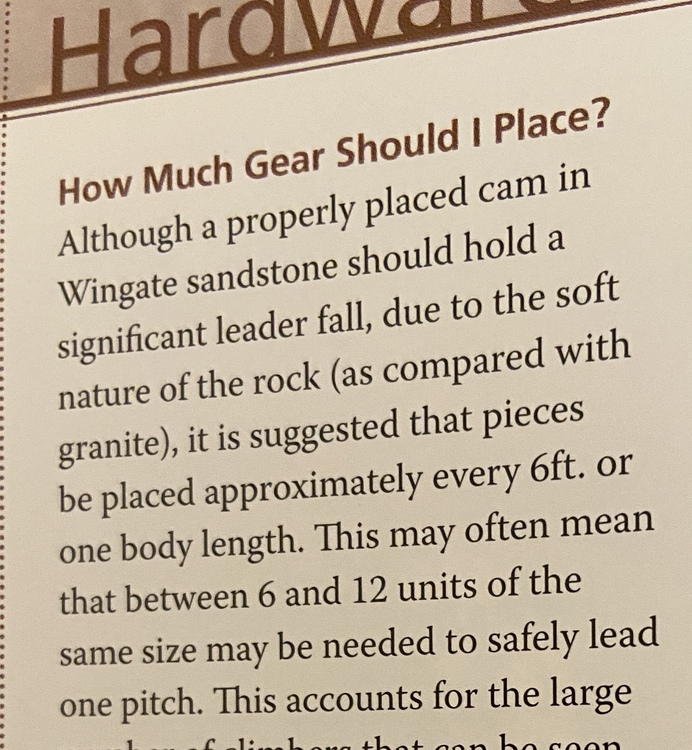 I think your personal experience is great empirical evidence for you to continue on as you always have, but this advice (photo above) is taken from the Bloom guidebook. So somebody must believe the cams are untrustworthy in that rock. |
|
|
Here’s a single data point that has no relevance whatsoever by itself: I once belayed a dude on Air Swedin and caught a real winger onto a 0.3 placed next to the Swedin-Ringle anchor. It held no problem without “skating” or other noticeable wear on the rock. ¯\_(ツ)_/¯ But even after that experience, I still place #2s every body length! |
|
|
Cosmic Hotdogwrote: I hate to be picky - but is that guy's right hand actually a left hand? |
|
|
Metelious or someone with metelious cams absolutely had a test in one of the climbing rags back in the 90s or early 2000s that showed some random failures. I have no clue what percentage it was. |
|
|
phylp phylpwrote: I hope Dr Bloom chimes in here, but this is interpreted by me as the rock is soft and cams can rip. This is not saying the rock is slick and cams can slip. I do place about every body length and respect this as the standard of Indian Creek. Not sure what you are referring to in my post? |
|
|
Nick Goldsmithwrote: I use the trad tag for multi pitches, or big investments of climbing. Ie I would be happy to be the much more experienced multi pitch trad climber up to 5.8. Am I more conservative on gear absolutely, but is it a huge difference no? For example if we met up in camp 4 (probably a bad example since Yosemite "sandbag" but hear me out) thats how I think about it. If we are following or swinging thats closer to my second trad number. Is it perfect? No! Does everyone use it this way? No! But is it a decent enough way to describe my ability as a climber yes and a lot of climbers I know use it similarity. Basically whats the level if I barely know you/ don't want to be working the same two moves all day. For the people I know, I know them so we can find appropriate routes. |
|
|
I took a fairly large winger on a .4 a little ways beneath my feet in a dead vertical granite finger crack this weekend. It was my second attempt of the day, and there’s literally nothing to hit, and it’s granite, so I was more willing to push myself to failure. Like most have said, it’s pretty route dependent. My willingness to fall on a hard climb or pretty much at my limit is a combo of ledge potential/ terrain and stone quality. If either of those things are giving me pause, I’m more willing to hang it and figure out sections. That’s kind of the beauty of projecting hard trad; Taking time to figure out the right gear to leave the best holds open, and on the best stone, or in constrictions. It’s maybe my favorite part of trad climbing. Placing a blind piece like your clipping a bolt. Magnifique! |
|
|
 |
|
|
I fell on a bolt once and it caught my fall |
|
|
Cosmic Hotdogwrote: No memes in the falling on gear thread |


