|
|
Allen Sanderson
·
Apr 17, 2024
·
On the road to perdition
· Joined Jul 2007
· Points: 1,100
Rosemary Tranwrote: On that note...I've hiked Smith Rock multiple times but have only watched climbers doing their thing from a distance and never got close enough to see the starting point. For those who have climbed out there in Central Oregon, what do you think? Approach shoes necessary or nah? I grew up climbing at Smith and wandered all around. These days one will find climbers approaching the crags in everything from approach shoes to sandals. That goes not only for Smith Rock but many climbing areas.
|
|
|
climber pat
·
Apr 17, 2024
·
Las Cruces NM
· Joined Feb 2006
· Points: 301
Approach shoes are a compromise between hiking shoes and climbing shoes doing neither activity well but maybe good enough so that you can do somethings with one pair of shoes.
|
|
|
Tyler Lappetito
·
Apr 17, 2024
·
Unknown Hometown
· Joined Sep 2010
· Points: 0
Considering the durability and quality of Nike products, I’d never use them climbing. Nike is a city brand, not an outdoors brand. Maybe stay in your lane? Doesn’t seem like Nike is hurting for revenue.
|
|
|
Nkane 1
·
Apr 17, 2024
·
East Bay, CA
· Joined Jun 2013
· Points: 475
Rosemary Tranwrote:
On that note...I've hiked Smith Rock multiple times but have only watched climbers doing their thing from a distance and never got close enough to see the starting point. For those who have climbed out there in Central Oregon, what do you think? Approach shoes necessary or nah? Smith Rock is an interesting example: approach shoes are completely unnecessary... unless you're going up over Asterisk Pass or one of the gullies, in which case they're certainly not necessary but are quite nice to have. I see the following use cases for shoes that are optimized for various climbing-adjacent activities, with the characteristics for the different shoes in parentheses--I'll let you decide whether any of these qualify as "approach shoes." As you'll see, many of the features needed for some use cases are in clear tension with others. - Walking from the car to go climbing along a well-maintained, level path (literally anything from flip flops to hiking boots will work)
- Walking from the car to go climbing up a steep, poorly maintained, dusty/sandy path (a shoe with deep lugs for traction in the sand; leather construction to keep sand out of your feet)
- Walking from the car to go climbing where you cross smooth, steep rock slabs with exposure, or involving scrambling up rock up to low 5th class (e.g. Smith rock) (shoe with sticky rubber under the big toe area and a defined edge along with the ability to tighten closure enough for a secure fit, enough sensitivity to feel the rock)
- Walking from the car to go climbing involving off-trail travel through brambly, cactus-y, or poison-oaky terrain (leather shoe, maybe a high-top for protection, heavy and stiff for stomping through brush)
- Walking from climb to climb or boulder to boulder during the course of a climbing day (slip-on, or easy-on-and-off closure system, or the ability to fold down the heel cup)
- Belaying your partner's project at a crag with a bouldery base (enough foot protection to comfortably get yanked around among boulders)
- Descending a multi-pitch climb with a walkoff down a trail (the lightest and most compressible possible shoe; secure clipping point to attach to a harness or pack mandatory)
- Descending a multi-pitch climb with a walkoff down 4th or 5th class terrain (the lightest and most compressible possible shoe that includes sticky rubber and a sufficiently adjustable closure to give both a secure fit and comfort for the walking portions; secure clipping point to attach to a harness or pack mandatory )
- Scrambling: a day in the mountains where you expect to climb 5th class terrain but only bring one pair of shoes (e.g. the Tuolumne Triple) (A shoe with sticky rubber and tight/adjustable fit that also has enough support for long trail miles without a heavy pack)
- Scrambling plus trail running: same as above, but you're running the parts where you're not climbing (e.g. Tuolumne Triple speed attempt) (a trail runner with a sticky rubber edge and closure that can be cranked down for climbing and loosened for running)
- Backpacking to climb: hiking into the mountains with a multiple-day backpacking load, plus your climbing gear, to rock climb in the mountains (e.g. Cirque of the Towers, Mt. Russell). You may be dealing with 4th-5th class terrain while carrying a heavy pack. This shoe is also your descent shoe from the route you climb (sufficiently supportive hiking shoe, also lightweight, with sticky rubber and adjustable closure, foot protection for off-trail travel)
- Approaching a climb involving snow; many climbs in the mountains involve traversing or climbing summer snowfields to reach the base (e.g. incredible hulk) (a sharply defined heel and toe edge for plunge stepping and kicking steps, sufficiently stiff sole to support walking up long steep snow sections or support crampons, heel welt for semi-auto crampons maybe; maybe waterproofing)
- Going to the bar in a mountain town (prominent logo of climbing brand, something that takes on nice patina when scuffed and well-used but not doesn't look too scuffed and well-used)
- Aid climbing. (stiff, especially laterally stiff under the ball of the foot to prevent crushing pressure from aiders; reinforced toe to stave off "aid holes")
Let me know where to send my shipping address for the tester shoes!
|
|
|
Not Not MP Admin
·
Apr 17, 2024
·
The OASIS
· Joined Nov 2018
· Points: 17
Mark Pilatewrote: If you switch to climbing shoes after the approach, you’re using them wrong, lol So I approach the climb in my climbing shoes and climb in my approach shoes?
|
|
|
Mark Pilate
·
Apr 17, 2024
·
MN
· Joined Jun 2013
· Points: 25
Not Not MP Adminwrote: So I approach the climb in my climbing shoes and climb in my approach shoes? Don’t you wear pants over your harness? Seems this’d be natural for you…
|
|
|
Geoff Bindeman
·
Apr 17, 2024
·
Unknown Hometown
· Joined Nov 2007
· Points: 15
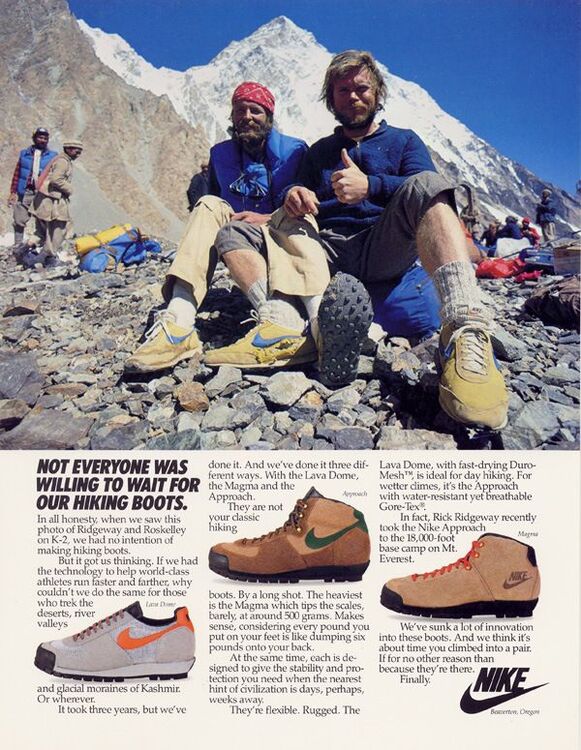
Allen Sandersonwrote:Given the OP works for Nike I thought I would post this advert up from 1981. Nike is the company that started the lightweight hiking shoe revolution. The 1979 American K2 Expedition was the fodder for it. Growing up in Oregon I wore many a pair of the Lava Dome and Approach shoes. They were quite good shoes. This is rad! R&R - OG dirtbags in Nikes! In the real arena! Ha! I do like the look of those Magmas. Kinda has the old Mariacher look/shape. (My first climbing shoes) I would wear a pair of those for approaches. The stealth /low-pro swoosh is key.
A stiff version with a low profile tread for aiders and sticky rubber up front with a wall worthy toe cap to minimize “wall toe” or whatever you want to call it could be a good wall shoe. A softer version with sticky rubbe,r cut more as an approach shoe would be cool too- so have 2 versions. Rosemary?? How much clout you have over there?? Are you arranging a retro-re-release?? Put me on that list!!
|
|
|
Not Not MP Admin
·
Apr 18, 2024
·
The OASIS
· Joined Nov 2018
· Points: 17
Mark Pilatewrote: Don’t you wear pants over your harness? Seems this’d be natural for you… Depends who’s askin’….
|
|
|
Stagg54 Taggart
·
Apr 18, 2024
·
Unknown Hometown
· Joined Dec 2006
· Points: 10
Allen Sandersonwrote:Given the OP works for Nike I thought I would post this advert up from 1981. Nike is the company that started the lightweight hiking shoe revolution. The 1979 American K2 Expedition was the fodder for it. Growing up in Oregon I wore many a pair of the Lava Dome and Approach shoes. They were quite good shoes. That is some awesome marketing copy. I particularly like the last line "because they're there." Nailed it.
|

 Continue with onX Maps
 Sign in with Facebook