
 Continue with onX Maps
 Sign in with Facebook






Three Very Simple Trad Anchors I Don't See Frequently I Wish I Learned Ages Ago


|
|
I'm not claiming these are the best, but they're the best that I've found that work for me, a moderately experienced trad climber who spends too much time thinking about climbing systems like the nerd that I am. 1. 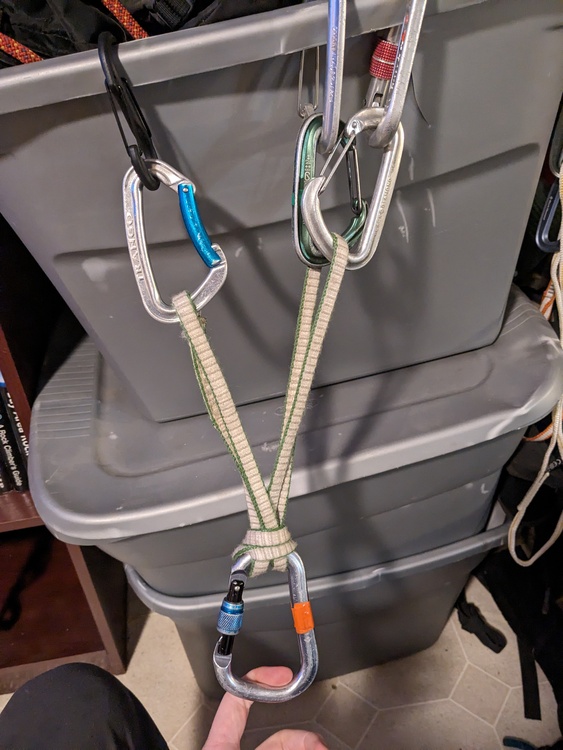 If all the pieces are very near to one another and two are very very close then simply take a single length runner/alpine draw and girth hitch a locker. This is incredibly fast to both build and tear down. Can also work with longer slings when pieces are further apart but that's situation dependent. If you make a sliding/magic X before you girth hitch it then it will increase the friction in the knot and make the locker less likely to slip in case of a piece failure. It's already super good enough unless you have very skinny, slippery slings, but it's an option for the concerned. Or just do the sliding X if you prefer, you do do; I prefer the no extension of the girth hitch method and think that's usually safer, however. 2.  This is great if you have two pieces close to one another and one that is much further away. Clove into your first piece, bunny ears the two pieces, tie an overhand for the masterpoint, you're done in less than a minute easy. You can easily choose what orientation you want the anchor to be in and the clove is still adjustable to fiddle with anchor orientation if necessary. Note that this anchor does not have a shelf. 3.  When the pieces are all somewhat close (that is you don't have one piece several feet away or something) this is my favorite: clove your first piece then clip your second then clove your third. You have two loops of rope now and you can easily move them left and right to figure out the orientation that you want your anchor to be in. Settle on that orientation and tie an overhand. Done. This one is mega fast, easy, versatile, and convenient. I've seen a lot of trad and rope anchors discussed on this site and in the too many books I've read, but these ones don't seem to come up ever. I understand the advantages to many of the other anchors, but I think that these rope anchors might be more attractive to many newer/younger climbers who learned how to build anchors primarily with slings and cord and expect things like masterpoints. Using predominantly these methods of building trad anchors depending on which situation is most appropriate has sped up my multipitch trad significantly and I wish I had learned them much sooner. Many newer trad climbers find rope anchors intimidating and fumble around with clunky and inefficient anchors because it's what their AMGA guide or gym to crag class taught them and I think simple anchors such as these which are quick to both learn and implement in the real world have the opportunity to help many newer and moderately experienced trad leaders. I could discuss little details and situations for ages, but I reckon most people can figure what they need to from here without me winging on for pages. I'd be curious to learn if people use these or similar anchors or know of any names/labels for the rope anchors. I've just learned these things in random conversations with very experienced traddies or niche YouTube videos from smaller channels. I'm sure plenty of people will take issue with something -this is the internet after all- and I'm curious to see what those things will be. Cheers |

|
Ricky, I use bunny ears on two good pieces (if both pieces are beefy cams in good rock), or bunny ears on two and an overhand on a bight on three pieces, in a configuration like your second anchor. I will clip the grigri biner through both of the bunny ear loops and belay from there. the reason i use an overhand instead of a clove on the third piece is for block leading: If I'm going to lead the next pitch, my friend will come up to the belay and just build the exact same rope anchor. all their loops will go through my corresponding loops from behind first and then clip into the biners, so that you can flip the ropes inside the closed biners and my rope is on top again. then i can be put on belay, disassemble my anchor, and be off while my friend is sitting on the same anchor as what i had originally built. with a clove, you'd have to move the clove (cumbersome) or undo the clove (which probably means you don't need it or are risking safety) while the partner cloves into to the backside of the biner. also, you'd need a big biner to accommodate two cloves anyway. so i use an overhand that has just one strand going over the biner. if you're swapping leads at a hanging belay, then sure, clove is way nicer. That's pretty much the only anchor i'll ever use if I have enough rope, a decent stance, and reasonably spaced gear or bolts, which honestly is the vast majority of the time. Ilya PS follow up - with experience, none of the standard anchor configurations will take a long time to rig, so I wouldn't personally argue for speed as the reason to use #2. It's dynamic, you don't need a sling which you may not have, and it's easy to inspect and adjust. It's easy to untie since it's a thick rope. The thing that takes the most time (or should) for new trad leaders is actually assessing and placing the gear itself, and that time will also drop with experience. |
|
|
Eric Craig wrote: Among newer leaders almost none, among moderately experienced traddies it's pretty mixed, among very experienced traddies it's extremely common in my experience at least. |
|
|
ilya fwrote: Really interesting input! Thanks! Love the idea of the grigri running through the bunny ears, I've used that for various things before but hadn't thought of that application. I agree #2 isn't particularly speedy relative to many anchor configurations, but I do think it's speedy for anchor placements where the gear placements are far apart and people commonly use all sorts of slings and cord in a highly complex, cascading anchor that is inefficient in both time and material. I find anchors 1 and 3 to be faster for me and so default towards those ones most of the time. The differences aren't substantial however to be sure-- I could see how just picking one and sticking to it would be super good enough most of the time. |
|
|
Eric Craig wrote: Glad to have you back in the climbing world, Eric. If you're ever near NorCal shoot me a message-- I'd be happy to go climbing with you. Cheers! |
|
|
Eric Craig wrote: Seneca Rocks Mountain Guides teaches clove hitching the rope directly to a carabiner on the shelf or master point (group of four climbers). PAS only for setting up rappel. |

|
Eric Craig wrote: Trad or fixed anchors, first tie in is with the rope. The second is with a PAS or similar. When breaking down, the rope is first. |
|
|
Eric Craig wrote: 99.9% of the time. |
|
|
Eric Craig wrote: Eric…. Go for it! You might be very surprised at how things have changed and how some things have not. Just watching some of the young motivated climbers fly up stuff, that we aid climbed, is really mind blowing. El Cap 2 times in the same day with lunch break in the meadows!!! |
|
|
Strictly in the spirit of overthinking (not to imply that anything is right or wrong).. |
|
|
Serge Swrote: I have to say I disagree with this completely. In fact, I believe the emphasis on load sharing and equalization is a distraction away from what's actually important: make sure you have good pieces. If you have 2 bad pieces for an anchor, the answer is not to equalize them. Instead, you should build your anchor elsewhere. Mandatory load-sharing should be reserved for desperate situations. |
|
|
I tie in with the rope pretty much every time. It’s the fastest and easiest set up by far. Cordelettes and all that is just a simple way to teach new climbers an effective, simple to understand way to build an anchor relatively quickly in most situations. If I’m on a big ledge, I like to extend the rope so I can see over the edge and watch my second if possible. Even if it’s 10ft or more. In that situation, it’s easiest to tie a butterfly a good arms length away and use that as a re-direct for the second rather than have them directed off the anchor. I thought this was common sense and practice for most climbers? I can literally build an anchor with whatever gear, and two lockers most of the time. |
|
|
JaredGwrote: Mostly this but it should not be difficult to realize that a simple adjusted clove hitch and/or a bight loop will distribute loads quite well. |
|
|
None of the above posts matter, get three good pieces in and tie them together with your personal preference. They are all just fine. |
|
|
Nice I've definitely used similar setups to all 3 of these, and I agree that people seem to get stuck on the textbook-style anchors. I think for an experienced climber it's really useful to have a whole bag of tricks to make those belay transitions quickly. I'm a fan of the girth hitch anchor, alpine equalization, and numbers 1 and 3 here. And of course you can build your anchors pretty much however if your gear is good... |
|
|
JaredGwrote: Everything is relative. If the baseline is BFK, I agree additional emphasis on load sharing is a distraction. If the baseline is a connection that will load the pieces one at a time, we have a rare but real possibility that FF2 will rip all 3 pieces. Has the community concluded that this cannot happen ? |
|
|
Tradibanwrote: KISS, climbing 101 |
|
|
Tradibanwrote: KISS, climbing 101 |
|
|
Do #2 & #3 trap the leader at the anchor? i.e. are you forced to swap leads? That could be fine, but it is a limitation. |
|
|
Professor Watermelonwrote: Rope anchors work best when swapping leads, yes. If you plan on swapping leads and your follower chickens out it isn't a big deal, just both PAS into the anchor, then untie and tie into each other's ends. It is certainly a limitation. Building anchors with cord or slings is the go to for guides for a reason. The closer your experience is to that of a guide the more the shenanigans that guides do start to make a lot of sense. Note that rope anchors pretty much always work for the last pitch. |
|
|
After I tried the girth hitch I pretty much use it exclusively now. I've been climbing for a long time and have used the rope, cordelettes, slings, etc. I find the girth hitch with a 48" sling and an HMS locker faster (10 seconds after pro has been placed) and more convenient than anything else for 3 piece anchors, which I build 95% of the time. The HMS locker is a super convenient masterpoint, and easy to clip into and out of, even if someone else is weighting the anchor. You never have to change anything if the next pitch is a rope stretcher. And if I ever need to escape the belay, it's once less thing to think about or take the time to deal with. I always tie in with the rope and a clove hitch. |


