
 Continue with onX Maps
 Sign in with Facebook






Boring climbing minutiae warning-- why do we do the ol clip n' flip?
|
|
I'm writing some basic introductory free pamphlets I'm going to release on climbing and as part of that I've been consuming an obscene amount of introductory content for new climbers. One thing that gets brought up a lot but I can't find a single explanation for is the 'ol clip n' flip wherein you clip a carabiner and then flip it around. There are some obvious reasons why we do this but I want to give the most concise, accurate explanation possible, so I was wondering if others might see something that I don't. To explain this, some pictures:  The above is clearly no good because the gate is oriented towards the rock.  The above is acceptable but no one does this.  The above is clipped and flipped. The advantage is it's now easier to put your cordelette, slings, webbing or whatever into. Also beginning climbers might use the same bolt-side carabiners for TR anchors repeatedly, and having a dedicated bolt-side and soft goods side to the carabiner might help extend the life of soft goods. I top roped extensively outdoors for a year before I started leading and my anchor side biners certainly got pretty chewed up, so this seems like a small niche of people for whom it may be highly relevant to, but might be a topic worth bringing up? So is the reason why everyone does photo 3 and not 2 just a small convenience thing for building anchors? In my experience the why of something sticks, but just telling them what to do doesn't really, so I'd like to have something more to say than "do this just because." Any other points out there for me, MP? Thoughts? |
|
|
The issue with photo 2 is if it is not a fixed pin it will eventually rotate to be like picture one. Secondly do they make carabiners captive like what you have in photo 2? |
|
|
It’s way easier to stabilize and clip one handed on picture 3 when compared to picture 2. With picture 2 you’re basically negating the ergonomic advantages of how gates of carabiners were designed. |
|
|
Princess Puppy Lovrwrote: I just mean for building a TR anchor though. You think photo 3 is more stable than photo 2 and that 2 will likely switch to inverting over time as you climb on it? Am I understanding that right? |


|
If the anchors where you are climbing look like that you should consider adding a ring, mussy, or second link, rapping off of that single link will put a mega twist in your rope, or if you are not rapping why are there links at all, just clip the bolts...either way would remove the faffing around with biners to get optimal orientation... |
|
|
Rope should run easier across the larger diameter end of the carabiner? |
|
|
Ricky Harlinewrote: I wouldn't find that acceptable. Anything sitting on the narrow section has a much better chance of shifting position/hopping and loading the gate. |
|
|
Grant Kleeveswrote: the ol clip n flip holds true regardless of fixed anchor type. I guess I didn't clarify that I mostly mean in the context of setting up anchors with soft goods. Let's say we're setting up a quad which is the new favorite among gumbies (or imagine a pre-euqalized anchor, it doesn't really matter). I'll show two of the options that you mentioned on the same anchor.  No clip n flip. 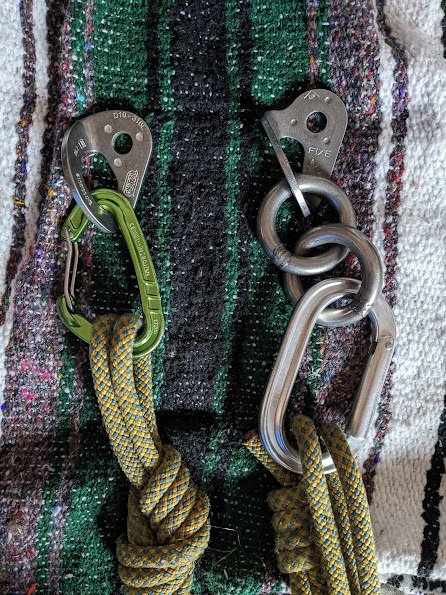 Clipped and flipped.
This does seem like the most compelling answer! I'm curious why the clipped and flipped biners are more stable though? Anyone know? |
|
|
Modified D biners suck for this type of anchor. A standard oval works the best. The problem is nobody uses oval’s anymore so you are stuck trying to make the best out of a bad setup. |
|
|
Ricky Harlinewrote: Spine goes on rock side otherwise gate side will get jacked.  |
|
|
If you are clipping something rigid, like a pin or bolt hanger, best to flip to get the gate opening away from the pin/hanger/etc to avoid twisting the 'biner open. The old time saying was something like: "If your biner opening is not down and out, you will be." |
|
|
|
|
|
Funny story about option 2 on a trad route. Not sure if it’s applicable because it was a locker that I used to extend a piece- dunno how it ended up on my alpine sling but I just kept going. I ended up traversing and as the rope dragged across the screw gate it unlocked the locker, which then somehow opened up the biner. The half-open screw gate kept the biner from closing and my rope was literally hanging from the edge of the nose by the time my follower caught it. I was a good 20 feet runout on both ends and it would have been a disaster had I fallen. So uh…maybe option 2 isn’t that great. But the lesson is probably just don’t use lockers to clip gear. |
|
|
I usually lift the rings/links out of the way and clip directly to the hanger for a TR setup. If the orientation of the bolt, lay of the rock or all the rings and links make any of the connections look funky, I adjust. Rarely have I ever encountered a perfect scenario outside of my garage. |
|
|
Do people really need this much guidance? Surprised nobody has mentioned this but the main reason to do this is because a lot of people use lockers for this and you generally try and load the gate with gravity. If this doesn't immediately occur to you, are you sure you're the best person to be giving guidance on this? |
|
|
The wisdom I've always followed for lockers and links, any kind of screw gate that is unattended for long periods of time, is to flip them so the gates screw down. Cyclic loading has the potential to cause gates to loosen and having them screwing down uses gravity to help resist that. |
|
|
Don Frijoles wrote: I think this is correct and the best explanation in the thread. Thanks. Terry Ewrote: I think this is a good example where not terribly much is said as to why it should be done. that guy named sebwrote: Yes. Have you met gumbies?
That's because this is a discussion predominantly about non lockers. For lockers I am providing the guidance that I stole from Bobby Hutton of "screw down so you don't screw up."
It did immediately occur to me, I was asking a different question. |
|
|
that guy named sebwrote: It’s for the community, man |


