Continue with onX Maps
 Sign in with Facebook






ATC ban


|
|
Princess Puppy Lovrwrote: You don’t need perfect data to make a reasonable assessment of risk. |

|
Colonel Mustardwrote: You jest, but the closest I ever came to throwing somebody out was the guy who top roped a route, somehow anchored himself to the top of the wall, pulled the rope, "threaded it" (wrong, I might add, we double wrapped the top bar), then rappelled. I discovered the issue when I glanced over right as he rapped off one end of the rope, falling about 6 feet. If I had been prepared to point to the specific violations of the facility rules, I would have had the confidence to kick him out. As it was, my conflict averse ass was too concerned about losing my job, so I just asked "what the hell are you thinking?" |

|
K, there are several angles being discussed here, but to me, the pro’s and cons of each device/method is beside the point — as well as pretty established. Don’t care if you use a hip belay, munter, ATC, passive ABD (like a Pilot), or Gri Gri style. They all have their place and I use all in a given year for different climbs and reasons. There’s simply no “one size fits all” in climbing. But how’s this for a legal angle to throw out for discussion. (Im sure there are examples- if so post up.) Gyms of a “co-op” nature where all members are “owners”. Climb or belay however the fuck you want. It’s on you. You’re technically the expert and gym owner. You get hurt, it’s cuz YOU fucked up. Sue your dumbass self not anybody else. What gyms are like this? I’d join. Unfortunately I’m sure some weaselly personal injury lawyer has found a way around it…. |
|
|
Mark Pilatewrote: It doesn’t work that way at a co-op. They are insured in the same way a privately owned gym is. Again, you are not suing the gym for its money, you are suing the insurance company for its big money. And even then you would have to show gross negligence on the part of the gym to win a settlement. Allowing an inferior belay device when “safer” ones are readily available could be a winning argument. |
|
|
Mark Pilatewrote: Generally the person who fucked up is the belayer not the climber who got hurt. |
|
|
climber patwrote: Well, yeah….there’s that. Lol But seriously, the point is that all this need for expensive insurance and lawsuits — is really from wusses not taking responsibility for themselves. I totally support any CLIMBER deciding what belay device their belayer should use, I just hate insurance companies, gyms, and lawyers telling me what belay technique to use. The irony and illogical part being that if I am forced by others to use specific equipment and do things they’re way, then I’m for sure suing their ass if shit goes wrong. They took the responsibility out of my hands and told me to do it their way. It doesn’t make sense to me from a liability/tort standpoint if they are requiring a certain method or piece of equipment, then they are assuming responsibility for that. It seems that by assuming more explicit liability, it negates the slightly better safety odds of requiring ABDs. You can’t fix stupid, and Gumby is gonna find a way to F up no matter what. It would seem to me they are more exposed and “on the hook” liability-wise by trying to play safety overlord. Like Puppy, and Alan R, I’d love to see the math and data behind the decision making. Seems a fool’s errand to try and beat Darwin |
|
|
I've used every belay method under the sun, from the hip belay on. Just to forestall the generic ad hominem attack that such old-school experience fails to live up to the contemporary belayers' hundreds of (mostly trivial) catches, I'll just note that I've caught hundreds of trad falls, including a factor 2 and a factor ~1.8, and done something almost no contemporary climber does any more, which is to practice catching very high fall factor falls with weights. A lot. In short, you are welcome to disagree with my logic, but please do spare me the worn-out trad dad doesn't climb hard crap. That introduction might make it sound as if I'm here to defend the good old ATC. I'm not. Personally, I rarely use one any more myself---my gear of choice for trad is the CT Alpine Up used with half ropes. My gym mandates Grigris, has them installed on all top-ropes, and requires them for lead belays, and I have no problem with it---in fact I think it is a very sensible approach to the realities of the gym environment and demographic. An earlier gym I frequented quite a few years ago had no belay device policy and in fact rented out ATC's to folks who didn't come with their own gadget. I'm not an intervener, and a good thing too, because there would have been days when I would have barely managed to climb, there was so much bad ATC-handling going on. Folks using slack protocols that involved releasing the brake hand completely for a transition, folks belaying with the two strands held parallel above the device, folks with their brake hand so close to the device that getting sucked in was inevitable. On top of that, the gym handed out and some people brought original ATC's whose level of friction was marginal for some of the thinner gym ropes and small light belayers. Mind you, I neither saw nor heard of any dropping incidents serious enough to be newsworthy, but the general atmosphere was one that would have given me high blood pressure and sleepless nights if I was a gym owner. Such observations always cause someone to ask why there aren't a huge number of accidents if so much belay technique is bad. The answer is, I think, that first of all, most falls inside and outside , even if rather long, are pretty trivial to hold, and the belayer mishandling their device is still going to succeed much of the time. A second reason is that the bad practices are usually somewhat momentary lapses and only contribute to a bad outcome if the timing is unfortunate. And a third reason is that bad practices aren't always tested, which is one way in which "experienced" climbers can persist with bad habits without anything ever occurring to cause them to correct. Some people like to argue that it's not the device, its the belayer, This argument suffers from the flaw that if one device gives the belayer either more opportunities to fuck up and/or introduces more serious failure potentials, then it is the device in the sense that the same belayer will be more likely to make a bad mistake with one device rather than with another. This means it's not a question of "fixing stupid," but rather it's a question of reducing the opportunities for stupid to become consequential. We live in a time of unsupported proclamations, and climbers are no different, we hear all the time about practices and behaviors of "most" climbers coming from people with no evidence other than their flawed personal experience filtered through biases already firmly entrenched. I claim no immunity from this failing, and indeed might be accused of it based on the paragraph just above. But in this case, there is some evidence from a 2012 DAV study that a gym owner should be more worried about ATC's than Grigris. https://www.alpenverein.de/chameleon/public/d4ce5dd2-3456-0e69-f1e9-877eee9b6eaa/Climbing-gym-study-2012-english-Panorama-2-13_24301.pdf. Now you might think that the average US gym owner might not ever see this, but in 2017 it was referenced in an article in the Climbing Business Journal with the title "ABD Policy Aims to Prevent Accidents" https://www.climbingbusinessjournal.com/abd-policy-aims-to-prevent-accidents/. The basic idea of the study circumvents the "where are all the accidents" objections by instead trying to classify and then observe dangerous behaviors, so trying to quantify the potential for accidents rather than enumerate the accidents themselves, which as we know are pretty rare no matter what gadget is in use. Frankly, I think there are quite a few things in the report one might want to take issue with, but that isn't really the point. The point is that the Joe Gym Owner looks at  The English translation appeared in Panorama in 2013. The Climbing Business Journal caught on in 2017. The communication between European and American climbing institutions is so spotty that these results can seem like news in the US twenty years after the fact. |
|
|
As always, it is hard to disagree with Rich’s points. It is worth noting that , while we haven’t actually climbed with each other for years, when I first belayed Rich it was with a body belay ( and we were probably tied in with a bowline on a coil—though maybe were using the very avant garde ‘swami belt’ by then!!!). By the last time we roped up, we’d likely advanced to the state-of-the-art sticht plate. We are both still here, both still climbing. We’ve both taken and caught plenty of lead falls over these years. Neither of us has dropped anyone. But, while I understand that gym owners and insurers have a different perspective, it is disappointing to see how narrow-minded certain climbers seem to be about such things. |
|
|
Mark Pilatewrote: What gyms are like this? Most that aren't in the US... |
|
|
Speaking of the all or nothing band wagon, Just anecdotal but … Same here - sort of. The only belay failures I witnessed in which a climber decked, the belayer was using a Gri Gri. Which proves: Something happened, and I happened to be there at the time. |
|
|
Evan LovleyMeyerswrote: I was getting pretty upset because I got one of my 3 kids a pass so we can climb at the gym with guest passes once a month. I am cheap so not willing to pay more than this and will take them outside instead which is cheaper. I called and they said I can bring my kids because I am a member. I guess this is for kids of non-members. It does seem kinda hostile though. For folks who are not familiar with this area, Bellevue is a yuppie city in close proximity to Seattle with no soul so who knows what was going down there because they aren’t doing this in the other two gyms. As for OP concern, is Edgeworks really corporate? I thought it was owned by Todd who is a climber? I gripe about the auto belay removal, but over all, I think Edgeworks in Tacoma is a good gym. If there was another gym within a reasonable distance with auto-belays, I wouldn’t hesitate moving though. I can see being annoyed if one didn’t own an ABD and didn’t want to buy one. That being said, I don’t actually know anyone who doesn’t own an ABD and you would actually only need one between two partners…. |
|
|
Petsfed 00wrote: That’s awesome. Man, that double wrap makes it a PITA to lower the smaller folks. There are gyms that allow far less as well as ones I’ve seen let people tr solo, jug, etc.. |
|
|
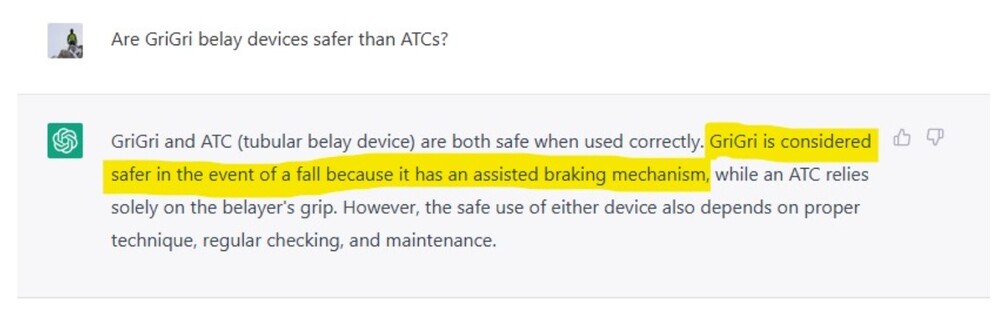
Tom Chingas wrote: Ask ChatGPT if auto-belays are better then humans. I think we can predict the answer.... |
|
|
The problem with not trusting gadgets with multiple moving parts is you have to get rid of all your cams. |
|
|
rgoldwrote: or cars, airplanes, machinery, bicycles, most tools, etc... |
|
|
rgoldwrote: From my perspective as someone who has for many years regularly read about climbing accidents whenever I see them on MP or elsewhere: I *almost* never read or hear about "conventionally inexplicable Grigri failures." I can think of exactly one, and that's the accident you mentioned about Jim Ewing. I've posted something more or less like the foregoing on a number of MP threads--to me it's striking how few GriGri accidents there are where the belayer even claims to have been using the GriGri correctly. I haven't seen my claim be refuted, but I don't mean to suggest there's anything super significant about that--I'm just sharing what I've heard and read about, and for whatever reason it's something I'm at least mildly interested in. I don't have any ax to grind and if I'm mistaken and there are an appreciable number of "inexplicable" Grigri accidents, I'll gladly stand corrected. And of course there have been many Grigri accidents that are "explicable" -- basically some combination of the belayer holding the climber strand of the rope (and not the brake strand) and/or interfering with cam operation and/or high friction situations that may prevent the cam from engaging. For example, this guy seems hellbent on showing how Grigris can fail; I don't have any reason to doubt any of his stuff and think it's useful to appreciate that Grigris may not work when improperly used: https://youtu.be/wz1PTbjQ3pc https://youtu.be/VmZE55W5SHo His failure modes are not "inexplicable" and wouldn't refute a claim that "Girgris don't fail when used according to their instructions." As to the Jim Ewing accident, I don't have a theory. Perhaps it's true that one in some huge number of times, a Grigri may actually fail even when used properly, or perhaps something else was going on. From an article in Climbing, someone suggests the ground anchor interfered with the Grigri, and Ewing said he was going to "try to figure it out," but I never heard anything about it being figured out. I've never heard of any lawsuits involving Grigris--not sure the American legal system is the best way to get to the bottom of the way things work or don't, but such lawsuits might give some interesting info at least. https://www.climbing.com/news/jim-ewings-scary-fall-and-recovery/ |
|
|
I think I've read about more than Ewing's failure over the years but don't have any links to prove it, so maybe or maybe not. As pfwein says, the cause of Jim's accident has never been presented. I'm, not, by the way, trying to make any kind of argument that Grigris are not to be trusted. Everything has failure modes, and sometimes it takes quite a while to learn what they are. If memory serves, Petzl has or used to have two warnings in their instructions about making sure there is no sand, lubricants, or other foreign objects on the rope or device. |
|
|
JaredGwrote: Dunno... but I was at Movement (Portland) the other day and they were teaching a lead class I think, Every one of 'em had a helmet. |
|
|
amariuswrote: Ha! Just use a gigajul and turn off the AB setting! That'll fix 'em! |
|
|
Let’s just cut to the chase for gyms… Helmets, mouth guard, full body harnesses, elbow and knee pads, Covid mask, hand sanitizer dispensers at each climb. Dual belayers on separate ropes (one tied in, one clipped in with steel locker) with two Different ABD’s in case of user error or some as of yet undiscovered issue lurking with a particular device. Throw in a 30 page waiver with medical release by your primary care physician Gotta ensure safety by all means. |