
 Continue with onX Maps
 Sign in with Facebook






When a route calls for double rope raps, what do you do?


|
|
As per the title, I'm curious what most climbers are doing when a route calls for full 50-60m raps:
I've always assumed routes were bolted with the intent to be climbed via #1 or #2 but got by with #4-6 enough that I'd use #3 if none of the other options presented themselves. Now I've got doubles and have to go to the trouble of learning how to climb/belay with them and am wondering why I even bothered getting them - #4-6 still seem like better options |


|
Either option 3 or option 7. Beal escaper (If you are certain the bolts are bomber) |
|
|
Depends on the nature of the overall climb, the nature of the descent, and the risk vs consequence of getting stuck or taking too long. Would be 2,3 or 4, for me, most of the time. |
|
|
7. Make the followers carry a rope/tag line |
|
|
1 or just rap off single bolt if, as in your example, it’s bolted. |
|
|
Decision tree is something like this: If my 70 or 80 definitely won't work, my next question is how many of the raps won't it work on. If it's just short on one rap by 15 feet but sufficient for all others I would consider shenanigans to get past that one rap such as using my beal escaper or setting one end 15 feet longer, single strand rapping with a blocked rappel and attaching a cordalette/slings/etc to the other end to improvise a short pull cord to make up the needed difference. I wouldn't want to do this a bunch because it's annoying but something like doing it once or twice for a route with many rappels outweighs bringing a 2nd rope IMO. If it's between a walk off or a 2nd rope the question is how bad is the walkoff. People's tolerances here vary widely. If the route simply demands two ropes to rap (and a beal escaper isn't appropriate due to terrain or something else), 2nd rope selection depends on how long and remote the route is. If it's a long hike I might consider a 4 or 5 mm full length pull cord. However what I have been doing more lately is bringing my 7.1 mm edelrid dynamic line as a tag line. I like knowing that if the lead line gets jacked or stuck I have another dynamic rope I could climb on in an emergency. I can't recall the last time I brought 2 full size ropes just to use one for rapping. If that's all you own then by all means, but if you have the equipment to avoid the surplus weight it sure is nice and also you can climb a lot faster not having to organize two ropes the whole time. |
|
|
I’m going to be a bit persnickety and say none of the above. mostly because I object to the imprecision of using tag line and “any old rope” interchangeably. As I’m sure you know, tag lines as sold are to my knowledge static lines which can often be jugged but are not meant for leading. |
|
|
I use 60m half ropes for almost everything and never worry about rap lengths. |
|
|
MattH wrote: Yup. Doubles are useful for specific applications but it seems you didn't get them because you really needed them. I wouldn't try to use them just because you own them. You can lead on a single and use one of your new ropes as a tag line. I hate free climbing with a heavy rope hanging off my ass so I usually opt for a super skinny tag line or other shenanigans. It's likely that a rap route calls for double ropes because it was established with them, but in modern times with 70s and 80s there are often other options. Scour MP comments and ticks for beta. |
|
|
From my experience as others said above it depends on the line. First thing I'd do is make sure you can get away with not bringing two ropes. If it can be done/ new rap stations have been established etc. it is definitely worth a touch of shenanigans to not bring two ropes.... again this depends on experience... if you're new to all of this then you should keep it safe and just bring a tag, two ropes or an 80... If it is a single pitch route, I will be lazy and bring an 80. (Those are great for Indian Creek and Devils Tower from my experience). If you're in the alpine or in Red Rocks or pretty much anywhere else that you're attempting a route that has more than a few rappels with double ropes then yep it is probably time to decide what you want to use. My comments below
I have witnessed my partner rig a beal escaper a lot though have not rigged one myself. It's like a little Chinese finger trap method that when you pull your rope you have to tug on the system (a lot) to get the rope to pull. We have gotten the escaper stuck on an alpine climb and it was not the funnest experience to try to retrieve because you don't have another rope handy to re-lead the pitch once the rope is stuck.. Clean rappels seem to be fine or crags. If you use it at a crag you have to belay your partner from the top so that adds a layer. To me the escaper is nice to have in a pinch when in a weird situation but the pulling of it and the probability of it getting stuck has made the escaper less of a favorite to me. Theses are my personal preferences / opinions... I have zero research based evidence and all my opinions come from my experience :) I am also not a guide. Just a stoked climber who likes to get after it on long multi pitch. Enjoy! |
|
|
If I can, I use #1. I like single line rappels so it fits my preference nicely. Otherwise I like using double ropes. The problem there is that I often climb solo and a second rope really weighs you down. Edit: I guess I like #3, too. I just want something fairly light. |
|
|
I read the comments and see if anyone has rapped the route with a 70. Often people will mention something like, "rap 3 nearly reaches with a 70" so if that's the case, I lower the first and reepshnur for the second. Option 10. If other parties are present, fix your rope to the anchor, do a single 70m rap. Once you and your partner are down and have secured your tail end of the rope, yell up and have the other party throw your rope down. (obviously make this plan with them previously) |
|
|
Option 2. I use doubles frequently and like them so this is an easy choice for me |
|
|
Double/twins Single ropes with beal escaper Single ropes and leave gear as necessary |
|
|
Michael Vaill wrote: I got them because I like long/linking pitches and figured this would help me achieve that without massive rope drag (as inevitably occurs on a wandering line even with heavy extension). I just underestimated the question of acclimation - I've had plenty of cases where they'd come in handy, but I'm not keen on jumping right into trying them out on a reasonably challenging climb and don't want to waste a day doing 5.6/7 just to get acquainted, so I keep putting it off. |
|
|
Typically, I just bring a 65m tagline, and climb on a single 60 or 70m. Tags can be a tangled pain in the ass if not careful so I'll usually do additional research for nearby routes that can be rapped with a single. I have no problem rapping off a single bolt if it looks bomber, but that's definitely not ideal. |
|
|
Is there a reason climbing with half ropes wasn't listed as an option? My understanding is that "Half Ropes" and "Doubles/Twins" are different. - With Doubles/Twins you have two skinnier ropes but each could be safely climbed on individually. When you are leading you typically want to alternate which one you clip to gear to eliminate rope drag associated with essentially having two ropes. This is nice of you want to avoid rope drag and/or climb with a party of 3 (you can belay both followers at once on an individual rope). Simul rapping also feels sane. The down side is that doubles/Twins can sometimes be heavier than a single 70m, it also takes a little getting used to wrt alternating which one you clip in, they can get tangled and it can be a pain. - With Half Ropes you have two super thin ropes. You wouldn't safely climb on a single strand. When you are leading you always clip both. The ropes combined prob weigh about the same as a single 60/70 but you can do a full length rap with them now. The down side is that simul-rapping with the things is kind of unnerving (but I'm not sure its unsafe?) My ultimate preference would probably be to use half ropes unless I was in a party of 3 or really wanted to simul rap (although even then I might take halfs). |
|
|
It won't happen often, but I had a nice double rap thing happen on Super Slab at Smith, my first multipitch. 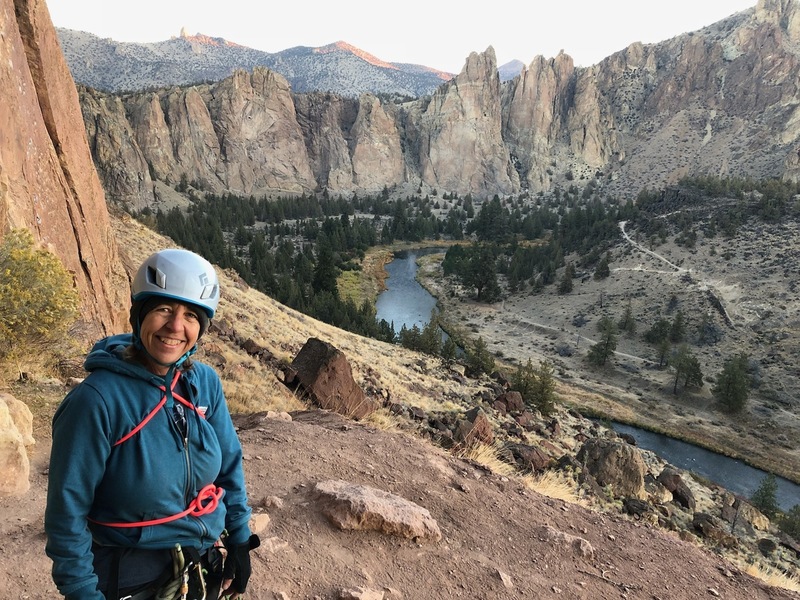 My partner had that second rope tied to me. We never used it, because there was a huge line of people climbing that day. We hiked in starlight to nab spot one in line, lol. We got friendly with the people behind us (actually, she was coaching me from behind the whole time), and the first of their twosome was up top before we were ready to rappel. It was a cooperative thing all the way up. So, up top it was amicably worked out that we'd use our rope, and theirs as the second rope, tied together up top. They keep control of their rope, drop ours, add on their number 2 rope, and so on. Super fun day! The other 2 rope situation was also mutipitch, with the noob (that's me) tied into both ropes. One ahead with the leader, one behind with their trusted second. All I had to do was just unclip and reclip the draws as I got to them. Then tether in and wait. The last was on Theater of Shadows at City of Rocks, which doesn't absolutely require 2 ropes, but doing so sure made it a lot more fun rappeling! The last guy stopped at the second rappel anchor, and did the bottom with one rope, so he could pull without issues. Best, Helen |
|
|
Aaron Wait wrote: Doubles is the same as half ropes. Almost all half ropes on the market are also rated as twin ropes. Double/twins is shorthand for dual certified ropes. With double/twin ropes the leader can choose the technique most appropriate to the climb and skill set. Additionally there are triple certified ropes on the market that can be used as single or half or twin ropes. |
|
|
8. Bring single rope. Call rescue. |
|
|
I’ve done all six at some point or another. It looks like there’s a lot of good info from others so I’ll just add some pull-cord beta, as that’s the method I’ve been using lately. First, there’s no need to bring an 80m (unless your pull cord is 85m). Mine is 65m, so when I’m using it, I only use a 60m lead line. Six-mil cords get tangled very easily. If it’s gonna be tagged, make sure it’s tagged by the leader and pulled up to the belay every pitch. Also ensure the leader takes the top end (i.e. leader of P2 takes end that was on the ground for P1). I think in a lot of cases, it’s easier to have one of the climbers climb with it flaked in a pack. When rappelling, just let it feed out of the pack. Definitely don’t throw it. Have gloves and/or a rope grab for pulling the tag line after rappelling; the slightest bit of friction can make a pull extremely difficult/painful. You can also easily haul a small pack for both climbers’ water, food, jackets. A micro-trax isn't rated down to 6mil but it works if your bag only has one day’s worth of stuff and no one’s life depends on it. When pulling the ropes after rappelling, the micro can be used as a rope grab. This method works well for Grade III/+ length routes. Even tho I haven’t used mine in a while, half ropes (8-8.5-mil range) provide quite a few advantages once you get used to them. If you’re gonna do the rap-off-a-single-bolt method, have one person rap the full rope length down to the two-bolt anchor. Then second rappeller threads the rope and does two raps down to the two-bolt anchor. There’s no need to have both climbers hanging on a single bolt and you’re gonna want someone alive to call for the body recovery. |


