
 Continue with onX Maps
 Sign in with Facebook






Why “Bounce Testing” should be avoided


|
|
Mark Pilatewrote: Mark, can you please just tell us where you sourced that graph?
This is another straw man. I never said that I performed bounce tests in my own climbing, or that I recommended it as standard practice. After 6 pages of skirting it, I don’t think you’re going to provide any data or legitimate science. I’m tapping out, you win. |
|
|
ubuwrote: HowNot2 did some tests with a quad that are interesting, given this context. They pulled some used 6mm cord tied in a quad to failure (proof load at ~100%, the max possible), and then re-pulled the remaining material afterwards: https://www.youtube.com/watch?v=Hfn21EzAHgU&t=709s They did 3 quads, here's a summary of the results: 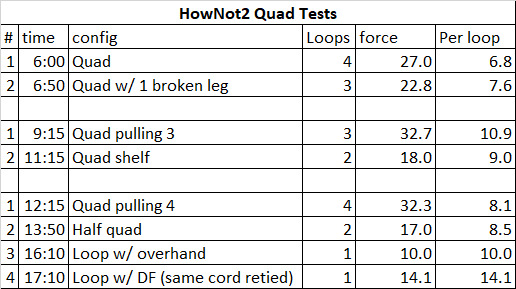 Even after being loaded to full breaking strength, the integrity of the rest of the material is largely unaffected. In 2 of the 3 tests, the strength goes UP after the initial proof load, likely due to failing the weakest point first. In the other it does go down at the second test, but only by ~20% (much less than the strength decrease claims made in this thread). This casts doubt onto the idea that pulling cord/webbing to near it's breaking point results in a significant strength reduction. It provides substance to the counter-claim that if a piece of soft goods holds X force in an initial test, it's quite likely to hold about the same force in another test shortly thereafter. The data from the Tahquitz SAR suggests the same. That material failed under the body weight of 1 rappeller (maybe 1-2 kN, depending on circumstances), and then during 3X subsequent testing it failed between 2.5 and 3.5 kN. Again, there is no evidence from this data that loading the material to near its breaking strength results in any significant strength reduction in subsequent loads. https://rmru.org/2022/09/28/2022-28/ Is it possible that you'd get completely different results from a short duration load like a bounce test? Maybe. However, given multiple consistent datapoints that suggest otherwise, and a lack of a viable explanation for why this would be the case, it would be a really weird conclusion to hitch yourself to. Occam's Razor and all that. |


|
Mark Pilatewrote: Dude........ You're literally explaining the process that we proposed all along, step-by-step, just trying to reword it so it looks like your idea now. You're unbelievable Doesn't matter whether you call it "testing at 2x the static load" or a "bounce". Nobody carries a load cell with them to measure the forces while climbing, and I doubt anybody was talking about taking a factor 1 fall intentionally, so we are left with a common sense bounce. |
|
|
Patrikwrote: Thank you Patrick, you’ve crystallized it and and yes, you are correct. To clarify, I do not disagree with Kyle’s “common sense” reasoning when applicable. On new homogenous materials at the manufacturer. Almost all testing and data easily available to date is from that “ green space” (I added some clarification to my graph below. I already had stated that I made this graph. It’s a pic off my computer and is an attempt to graphically depict an amalgamation of a bunch of related topics and verbiage to reference for this discussion. It is not quantitative, it’s conceptual. The concept is pretty basic…as variables continue to stack up during the Lifetime of any material or specific specimen, the expected predictability of result B given result A widens and is widest at end of life. This is not controversial. New products are very predictable, deteriorated products are not. 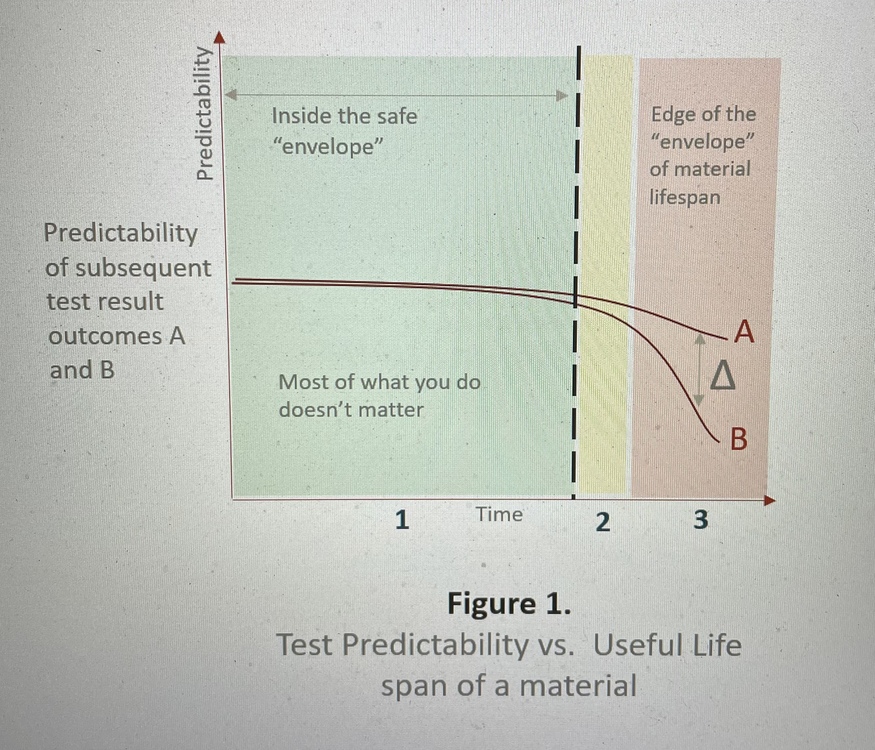 I think I have demonstrated my openness to discuss, have admitted when my logic was flawed and put my money where my mouth is (Big Red is getting a bunch of new slings). It is not possible to respond to Kyle due to shear volume, and he is constantly changing or deleting his posts so as you’re formulating a response, his post is either gone or changed. I do not believe he is here in good faith, but reached a conclusion from the get go and if I posted “the sky is blue” he’d come back with pages of why it’s not. He has questioned my credentials yet revealed none of his own. Not that it is “proof” of anything, but he got impatient that I didn’t respond quick enough last night to him, and it’s because I was preparing for this mornings meeting with DuPont engineers on a test plan. I live this shit daily. I was at the Instron tensile tester on Wednesday. I think anyone who even still gives a crap about any of this should at least know some of Kyle’s qualifications. I’d totally be more deferential myself if he stated his qualifications and experience. OK, back to principle 6 and how this is potentially applicable to tat at a rap station. Textiles are essentially a series of woven together columns of fibers. (Pause to come back…work intervenes) Edit: Ok sorry, got sidetracked again by Kyle’s needless sidetracking of this thread. Let’s cut to the chase and what can climbers easily take away from this: Learn from other industries who live and work this shit daily — Riggers. Due in large part to exactly what I have been saying all along, federal and industry regulations specify that slings that support a shock load should be immediately taken out of service. A proper proof test is a smooth pull to 2x working load. A “bounce” test would immediately render the sling unusable due to its being too unpredictable. Apparently OSHA, ASTM, ASME, and rigging companies base their best practices on junk science and bullshit just like I do. It seems relatively obvious and intuitive that uncalibrated shock loading of degraded and unpredictable old tat would be bad, and that for a last ditch safety proof test, you’d want to test smooth and easy, and then use smooth and easy Not sure why all the pushback on the concepts of new material doesn’t equal old material, and shock load doesn’t equal static load. |
|
|
Now this thread is getting good! Selfies while wearing eye protection is a hard argument to counter. I’m just trying to be funny, not mean. But I’m coming around to see the points that others are making here. A few of you are getting emotional, but I guess that’s what the internet does best. |
|
|
You guys should fight in humber park, the only way we can finally answer this question |
|
|
Ian Lauerwrote: Dude….Not taking credit by any means . Modifying per discussion thread that is all there. Purpose of thread is first show why you don’t need a bounce (back it up and leave good anchor) Second, if for whatever reason you need to, what is safest protocol.
Of course, that’s the point. You’re making it for me again. That is why a larger uncontrolled “bounce” shock is riskier than a smoothly applied known extra load safety factor is better i am not sure I understand what you think my goal is for this thread. I have have adapted as legitimate discussion and points have been made. My original thesis stands. Don’t do uncontrollable shock loads in the field to old materials as a safety “proof test”. It’s not legitimate. What are you arguing and why? |
|
|
Mark Pilatewrote: This is kinda weird/creepy, and it feels like more logical fallacies intended to bolster an argument that isn't supported with data. I know plenty of extremely bright and capable people who don't have education beyond high school, and plenty of engineers who are... not as capable. https://en.wikipedia.org/wiki/Argument_from_authority https://en.wikipedia.org/wiki/Poisoning_the_well "One of the great commandments of science is, 'Mistrust arguments from authority.' ... Too many such arguments have proved too painfully wrong. Authorities must prove their contentions like everybody else." - Carl Sagan Anyway, here's a selfie I took at work today:  Edit: It is hilarious that you've been lecturing me about how none of the data I posted is relevant because it's from textbooks and new material samples in a lab, and then your qualifications are a picture of textbooks and a picture of you in front of a lab tensile tester. |
|
|
Kyle Tarrywrote: In a lab, test fixtures are generally used to ensure a uniform load over the x-section. In the real world, especially with knots and areas of damage - there will be considerable variation - basically from tearing initiated by overloading a smaller piece of the full x-section. In short - you’re both saying things that are both correct and incorrect. This thread is a mess, really - you’re all fired. +1 to Mikey S’s general take - veteran of many sketch alpine descents, I’m sure - bounce testing isn’t going to keep you safe - in fact it’s a waste of time unless you’re a total noob questioning what should be A1 gear and webbing obviously and visually both in good condition and with redundant loops. |
|
|
James Wwrote: Totally agreed! As a result of this, it's likely the strength is going to be less "out there." That's why all this stuff (slings, carabiners, etc.) is rated to WAY higher than real world loads, so you have lots of safety factor for the real world weirdness. I was trying to speak specifically to the question "if I hang from the rap ring (or whatever) and apply a certain load, and it holds, will it hold that load again?" There's no reason to believe that a lower load, applied to the same point in the same orientation, is going to result in failure, when the higher load held. Edit: Ran out of posts.
I'm making no assumption whatsoever about whether or not a bounce test was done. I don't know how anybody would know that (although Mark has claimed he knows...). Edit: Since Mark claims he "never said this," here is his exact quote: "He [Kyle] also erroneously assumes the victims didn’t do a bounce test of the anchor before committing. They didn’t trust just one of their own biners and used 2, but implicitly trusted a single piece of old tat without testing it?... I’d like to know if any of Chelsea’s partners would expect her to blindly trust old tat or did she have a tendency to bounce test." I've always said that we can't be sure what they did (how could we?) and Mark argued with me about that, as though he somehow knows what happened. I'm just talking about the data as a repeated load to breaking strength on used material; in this case, pulling on this material repeatedly doesn't significantly reduce the overall strength, in contrast to claims upthread. |
|
|
Kyle Tarrywrote: With knots, rope burns, twists in the material and far from consistent test loading - you can’t say that and I doubt the data to prove it can exist. It’s what’s called a Rat Hole in my line of work - an unknowable waste of time. Also - you’re citing the accident test data as proof of your point, but also assuming a bounce test was not done - as an arguement for bounce testing. Defective thinking, IMO. |
|
|
I think y'all need to declare stalemate, shake hands and be nice to each other. Another related thing I was thinking about -- don't most belay devices get very "grabby" when it's wet? Perhaps greatly increasing the dynamic load on the anchor? There's an engineering project if I heard of one. A rappelling device that feeds as smoothly as possible even if you slip and such. |
|
|
After all of this Mark, you still haven't provided a single link, DOI number, or verifiable reference (ie. study name, author, and date at a minimum) to any of your sources. Being an engineer, you should know the standards to which referencing source material is required. I realize you are taking much of this from your background experience, which is fine to a degree, but that doesn't circumvent the need to provide verifiable links to referenceable material that backs up your claim.
Everyone already agreed that you should back it up and leave a good anchor, so that's a red herring. You're in circular logic. You've now been completely against bouncing, come around to realizing its fine and proposed your own test which implies load testing(or " bouncing" whatever you want to call it), and then just criticized me and said that you shouldn't shock load an anchor again. If your contribution is to specify that it should be done on a dynamic rope instead of a static sling in order to limit the load applied, that's totally fine, and is exactly what I had proposed all along. Its possible that others suggested using a static sling to do the bounce test, but I couldn't find that suggested by anyone in this thread, so.... |
|
|
jt newgardwrote: I think this actually is an interesting point and believe it was mentioned at one point as being a possible contributor in the accident that spawned this thread. The rappel happened during or after a thunderstorm, so in additional to materials being weakened by being wet, a slip of footing or rope through the rap device may have led to a higher force applied on the anchor than in a controlled rappel. |
|
|
Ian Lauerwrote: Glad we can find common ground on a relevant point! I think tensions ran a bit high in this thread because of the recent accident at Tahquitz. We're all trying to decide the best practices and procedures to follow in the wake of an awful tragedy. My mantra after all this ... back it up !! |
|
|
James Wwrote: The burden is more on you to prove your point. The concept of proof testing is well known and is used daily in industrial settings, for example pressure vessels. If the gear does not fail in an overtest, it will not soon fail at a much easier test, such as a smooth rap. - Keeping in mind that climbing does not have nearly as high a safety factor as OSHA or commercial equipment. The odds of a bounce test weakening webbing just enough so it fails 2 minutes later at a lower load are extremely remote. Far more likely is the odds of saving lives due to the bounce test results as a proof test. You would have to prove the reverse odds for your theory to be useful. It seems unlikely that either initial bounce testing or heavy climber first overtest method has ever clearly resulted in a following failure of webbing under a lessor load, even after thousands of real life tests by climbers. What seems far more likely is the risk of an accidents occurring after old cord was not properly bounce tested. So looking at the pros and cons, even if a bounce test led to a failure one in a million, it will lead to prevention of failure perhaps 100 times more often. Sending the heavier climber down while still backed up is just a slightly less severe overtest than a bounce test while still backed up. It is still a version of proof testing, and if your theory were correct, it could still weaken the anchor enough for it to fail on the second lighter climber. All of this discussion applies only in a case where the climbers are running out of gear to make anchor backups, and the existing anchor passes a good inspection. Such situations are not as rare as we might wish. Keep in mind that lowering and toproping place higher loads on the anchor than a smooth rap, so a bounce test may be less adequate in those cases. However, gear placements fail regularly after working initially. Generally this is because the gear, or the rock, or the loading has shifted. Lead gear may hold a fall, and then later fail on another fall. Webbing may slip off a horn. Some examples of things that do fail: https://law.justia.com/cases/california/court-of-appeal/4th/41/1040.html pro at an anchor may hold some climbers, and then fail for another climber. http://publications.americanalpineclub.org/articles/13197901401 http://publications.americanalpineclub.org/articles/13201213944 http://publications.americanalpineclub.org/articles/13199200902 http://publications.americanalpineclub.org/articles/13201214650 In this case bounce testing did not help, and the old fixed cam failed on rappel. http://publications.americanalpineclub.org/articles/13198403600 http://publications.americanalpineclub.org/articles/13201215609 http://publications.americanalpineclub.org/articles/13200109600 http://publications.americanalpineclub.org/articles/13198502002 http://publications.americanalpineclub.org/articles/13201214031 https://gripped.com/news/anchors-failing-alpine-bring-hammer/ https://gripped.com/news/anchors-failing-alpine-bring-hammer/ http://publications.americanalpineclub.org/articles/13201215567 This was a webbing failure, with no backup and not stated if proper bounce testing occurred. One more interesting video from Hownot2, showing how it's much easier to generate a high force by bouncing at the anchor, than by bouncing on the rope partway down a rappel. Shows how the bounce test is a reasonable amount of overtest compared to the rappel. Table of results at 12:00. https://www.youtube.com/watch?v=nr3YBDnOI8Q Here is a different sort of case for comparison. http://publications.americanalpineclub.org/articles/13197500701 The anchor didn’t fail but the 8mm rope did. First 2 people rapped safely, then the rope broke on the third climber. Possibly a case of a slight additional cumulative damage to the nylon, and the straw that broke the camel’s back. No detailed investigation due to the remote location, so it is not known if the third climber did something more severe than the first two such as bouncing or had a more sharp rappel carabiner. Extrapolating such a case into a hypothetical, take the case of a damaged 8mm rope being rappelled by 1000 people. Clearly the rope will get more and more damaged with each additional rappel, and eventually it will fail. Bounce testing it from the base would not put enough overload to count as a normal bounce test, since it stretches so much. Although several people bouncing on it simultaneous from below would work, that is not often practical. Can such a failure also happen with a sling at an anchor after just passing an overtest? Not likely. A sling doesn’t suddenly lose significant strength. It doesn’t stretch significantly in the same way as a rope. And the sling is not going through an additional sharp bend in a rap device with each rappel. And again, even if it did happen 1 in a million times, the bounce test will save someone 100 times as often. |
|
|
Kyle Tarrywrote: This is definitive proof that you are not here in good faith, but on some kind of “creepy” mission (to re-use your words). You are the one who has repeatedly cited proof positive conclusions from the RMRU data multiple times. However, nowhere will you find what you have now claimed several times that I have said. I have never made definitive conclusions about the data either in this or the accident thread. You are outright lying here and I can’t figure out why. My asking about your credentials is just to clarify where you are coming from. Not any dick measuring contest, and I explicitly stated it was proof of nothing. But if you have such credentials then it is very puzzling the way you are going about this. You would be agreeing with me on all the principles but saying “your conclusion from them is in error because….x” You are not and that is why I questioned from what standpoint are you approaching this —which has the feel more of a personal vendetta
Again, just come out and say “your principles are solid, but…”. All of your rebuttal has been in “the green zone” with smooth pull tests where we ALL agree. And yet your own data keeps aligning with my thesis (not definitive claim). If materials in the green zone (I would not call materials failing in the 20-30kN range, equivalent to tat at the < 4kN range) but it is entirely reasonable to suspect that if smoothly pulled pieces in the green zone differby 20% that one could expect shock loaded pieces in the red zone to differ by 50%. And that is The context — materials in the red zone. To Ian: the problem here is that this requires a synthesis of multiple disciplines, and existing principles and procedures. My stated principles are accepted basic engineering. My extrapolation to tat is just that, an extrapolation based on Good engineering judgment and experience. Not saying I’m definitely right or making a hard high and mighty claim like you seem to think I am. No specific webbing test data of this nature to settle the “argument” exists. We are all out on a limb. But My limb seems pretty solid from known basic principles I am not saying I’m definitely right. Maybe statistical tests in this regime will prove me wrong. And it seems a bit odd of Kyle to be truly “neutral” on the topic of unknown shock load response to deteriorated materials vs smooth controlled test. I would welcome his actual thoughtful opinion on the matter. Not asking for data or sources, etc. I’ll accept his engineering judgment from the sum total of experience. Otherwise it’s kind of a cop out and continuing to post either irrelevant data or data that plays to my thesis is a waste of all our time. (We’ve already wasted it this far, lol)
1. Smooth static is less variable in material response than higher impact shock loading 2. known load is less variable than unknown load So, given the topic is best proof test for sketchy anchor would you still recommend A: unknown, higher impulse, field bounce test from sling B: known weight, careful load test with rope Which would you suppose is statistically safer in “filtering” results ? My theory and concern is not that doing a pretest test horrifically weakens something every time . Pretest is better than no pretest. I’m trying to get to best/safest pretest, and known is better than unknown, and smooth is better than sharp to avoid the rare, but unwanted unfiltered catastrophe of the proof test. Lol: We are all a bunch of frickin idiots, and as James W said, we are all fired. Just got off the phone with someone “who would know”. But…let’s just say it appears that I won the technical debate. And before I post the links and references (I’m waiting for them now myself to back up the conversation I just had) that some have been craving, I want to recoup my losses from the slings I owe Big Red. ….so, who wants to put money where their mouth is? After all, I only know junk science, and am “full of shit” should be a sure bet Edit: look for all of Kyle’s ever evolving flood of replies to suddenly get deleted. —haha he’s changing them right now! Pretty soon he’ll edit them to say he’s agreed all along, or “I never said that” .. now he’s on to new semantics arguments Reference OSHA 1926.251(c)(11) and ASME B30.9-2018 Shock loads prohibited. Riggers must immediately retire web that has been shock loaded. Why? After using, too many variables and it becomes unpredictable. And we’re not talking obvious climber tat around a tree Keep it simple, no need to follow OSHA ASME industrial rigging safety factor guidelines, just follow their logic — Old in Situ tat is extremely unpredictable. Per DuPont engineers who know a thing or two about plastics - “it’s not even the same material, I wouldn’t know what to expect”. They also brought up a concern not listed her, but applicable in many western climbing areas - ozone attack (smog). Will drastically change the characteristics for the worse. Expecting it to give results the manufacturer tested or even to expect it to respond similarly is dangerous. As said, treat like nitroglycerin, Always back up, but if absolutely forced to rely on sketch for some reason.. 1. Test smoothly and carefully with both partners backed up, 2. Heaviest partner raps backed up 3. Last partner removes (big why?) and raps. and use smoothly. Just like hooking it up on an AED — “No shock advised” will be the answer. The point always has been what can guide a best practice for climbers to minimize the bullets in the Russian roulette we are always playing. Hope at least one person gained at least a bit of perspective or useful info (other than ideas for HN2 argue on MP, lol) |
|
|
Old nylon becomes more crystalized as it ages, and the elasticity diminishes. The question of 'to bounce or not to bounce' hinges on at what point does a dynamic force of D reduce the strength of a tat sling of static breaking strength of D+x to some value that is appreciably less than original D+x, even to below D. (Given that the sling is age-weakened to somewhere below 1/4 original strength. ) Or: does a 3 kn dynamic load weaken a ratty 5kn sling 2% or 50%? Where is the break even point? Certainly worth looking at, thanks for the debate, everybody |
|
|
Years ago, I took a fall that ripped through about 1/4 of the waist webbing of a Petzl Jump harness. Prior to this fall, there was some minor fraying at webbing/buckle interface. Seemingly minor. Bought a new Jump, and just put those perplexing thoughts behind me. Some time later, I grabbed some tat at the top of a route, some tat that someone had just lowered off of. I'm grabbing it, so I'm not putting nearly as much weight on it as they did. Aaaand, pooof! A slight jolt, and a cloud of dust formerly known as nylon. I didn't fall, as some other tat that still identified as nylon, held together. Unsettling. But, not terrible. And kind of throws some sand in the face of my theory of always sending the fat hobbit first. I then started to think that tat might not be well characterized as a homogeneous material. The outermost fibers of webbing will have more UV, oxidation and biological/mechanical degradation. This would ostensibly affect the elasticity, ultimate strength, and so forth. I started thinking that this elasticity mismatch between the outer fibers and more robust inner fibers could kind of create an abrupt failure cliff where the outer fibers are bearing load but yield at a lower ultimate strength, at which point the same load, maybe a little more due to dv/dt is then supported by a lesser amount of fiber in the inner part of the webbing, a load that exceeds that, higher, yield strength. Invariably, the thought process is interrupted by beer, and my happy resignation to the fact that I'm not *that* type of mechanical engineer, and thoughts of hobbits, and run-on sentences. I don't know what my point is. |
|
|
Jason ELwrote: Not bad. |


