
 Continue with onX Maps
 Sign in with Facebook






Why “Bounce Testing” should be avoided


|
|
I appreciate the attempt to remove this bounce testing debate away from the main accident thread. I thought that was thoughtful. That could have been me, and that could be my family and/or climbing family reading these threads. Let’s please keep it that way by not asking friends of victims to chime in to prove or disprove your point. Also- I think the initial goal was to scientifically prove that bounce tests are a bad idea. I am not educated, and I may not be the target audience, but I walked into this thread hoping to have solid evidence against bounce testing. I feel, at this point, that I will continue to bounce test. However the term “bounce test” has been loosely identified(2.5-4kn) My bounce tests are not deemed “proper” I can only guess that I only add 50-150 lbs of weight (enter proper term) It’s a lot to take on: to start a thread of this nature. Can you potentially save my life and another life by showing the layman irrefutable data that a specifically defined bounce test on older “but not obviously terrible”tat (I’ve been convinced to be very wary of bounce testing v- threads[thank you, truly]) is a bad idea In a gear conserving situation? Or am I saving my own life and my n+1’s life by conservatively bounce testing with back up in situations that it’s not easy to to choose to leave gear.
|


|
This place really brings out the best in people |
|
|
Tradibanwrote: The time-honored foundational part of that is peer review, I think you know. Ignoring or discrediting valid peer review is unethical and sometimes dangerous, That’s where accusations of professional malpractice come in (a.k.a. trash talk). (just addressing your question) |
|
|
nic houserwrote: Why are you convinced bounce testing on v threads is a bad idea? They generally fail at a minimum of 8kn if built properly and on average above 10kn (google v thread anchor strength and click the first study that pops up). There's no way you're going to get close to that unless you're bouncing on only a static piece of material. You're trying to test the anchor at above normal rappelling forces (max 2.5kn) to make sure that it doesn't catastrophically fail in that range. Meanwhile, you're backed up to a 10Kn ice screw (or 2). I'd rather find out while I'm sitting at the anchor backed up to the screw if i built it wrong than halfway down the rappel, and i think a bounce test achieves that purpose without compromising the strength of the anchor. |
|
|
Shawn Rezendeswrote: I’m convinced to be very wary, I said. I don’t think light bounce testing is out for me on v threads either, but I didn’t explain myself very well, and I’m glad you called me out. I wanted to tip my hat that I was made more aware of the plasticity of ice due to this thread, and I do believe that terrible ice has properties that make it more likely to weaken in a bounce test than half decent nylon. I would have to see the anchor to call it terrible. If it is horrible; then I would hopefully find a better option. I can’t point to data to identify “decent nylon” but it would probably NOT be very faded, brittle, wet, chewed or worn through. Maybe I would know who placed it, I can see all of it, other slings back it up and it has a rated mallion or biner for rapping. And it wouldn’t care if I bounce tested it a titch :) This whole thing has made me think of all the stupid anchors I’ve bailed on and what I could do differently. I was thinking of this terrible snice anchor we bailed off of backed up by a terrible screw in snice. That anchor was in my mind when I posted about being wary of bounce testing v-threads, and I will say this- if there are truly no other options, at all, and I can’t back up; then things are dire and bounce testing won’t help, as it would just increase the load on anchor I’m forced to trust anyway. Whew! I feel for you guys. Hard to defend oneself online, and I didn’t use any specific data to do so(though I never claimed to have any). I will change my approach to bailing, and am open to more data and perception, etc. My apologies as I didn’t contribute anything that hasn’t already been shared. I just challenged for more data and gave my unsolicited two-cents. I do ask that we keep to the original perceived goal here and keep recent victims and their families out of the debates. Thanks again to everyone for their efforts. I will be thinking hard about bounce testing and trusting anchors. I’ll just slither back into the darkness now, please, and Thank you:) |
|
|
I don't "bounce test" v threads because I basically only rap off of naked threads, and I don't want to risk damaging my way-too-expensive Edelrid rap line on a sharp corner of ice. I do, however, weight it with a backup, and maybe shift around a little before removing it, so I definitely test it to some degree. Based on everything I know about v threads, including thorough reading of all the studies online of the topic, I think most of what I need to do to be safe happens well before weighting the anchor (primarily selecting good ice, but also testing it for hollow sound, watching and feeling the screw go in, etc). As noted, studies show threads are reliably strong, especially when you take tat out of the equation. |
|
|
I really wish the fixed tat issue wasn't commingled with ice v-threads. |
|
|
Warning TL;DR Took a bit to figure out which direction to take here. As for my original post, EVERYTHING, each bullet point, is true and factual, and stands – with the exceptions of the “takeaways”, which I’ll get to updating and modifying, along with the thread title something like "How to test...." It’s all basic level mat sci and can be found in any text and I did not really think any of the points listed was controversial. Now context is everything, and how does it apply. I will take the blame for some sloppy terminology and graph confusion (There was nothing “incorrect” about it, but is was confusing the point and duly noted. It was supposed to be material non-specific as the actual curve shape is immaterial to the discussion. The intention was to contrast the difference between any new material and old material (tat) and show how physical properties can change (like UV aged nylon) as listed in the original bullets. If anybody can find an actual one for old tat, I’m interested. The fatigue principles are listed because scatter at end of life failure loads was germane. My context was, and always had been, real world “sketchy” materials for climbers -- old, deteriorated nylon webbing (tat) similar to that recently discussed in the accident at Tahquitz, with a side of ice. My goal with this thread was to generate discussion – Thus “come at me” and invite debate on a vague and little understood safety topic in light of a recent real life accident. Much faulty thinking has been involved on all sides as pointed out by James W and I am guilty of my share as well. However…. Most of the critiques were either out of context, or just plain wrong within the context. Not saying Kyle didn’t have legitimate questions or points, just that most of Kyle’s points that were valid were not in contention at all and lay in the “green space” of zone 1 in my admittedly feeble attempt to graphically show the divergence of test results/predictions over the life of a material and the differences and changes between old and new material. And after a full retro-review of his responses, he did ask the pertinent question, but I lost it in the volume of side issues around it. It did come off as “way snarky” as opposed to others like Big Red who just got to the point and thus that is who I focused responding to. But his critiques never invalidated my assertions and were off base in the context of this thread. For example, water/moisture content is a huge factor in dynamic load response and recovery of nylon based products. His own source for the graph showed almost 50% reduction in fatigue life at just 2.5% moisture. Rope companies advise to retire the rope if you dynamically load it when wet and under some conditions, a 70% degradation can occur (. The other test data showing 5% ish impact was single slow pulls on std web and is well known. Not the same context or applicability of water’s impact on the variability of a subsequent load response after a high wet shock to tat Also, Materials do not recover in real usage life they recover “mostly” in the relative short term response, but their properties decay exponentially (UIAA, MIT/Custer). There are no perpetual motion materials. All materials decay and evolve over their lifespan. It’s why Jim Titt can still sell more bolts. They DON’T last forever. I know Kyle agrees, and will say I’m moving the goalposts but why would we be the arguing in theoretical design space, vs real world failure space (red zone 3) which is the area of interest and where my points are valid. The point I was trying to make is exact opposite of what he thought I was arguing. I was saying NOT to use new material test specimen criteria or comparisons of performance. That leads to errors in judgement. 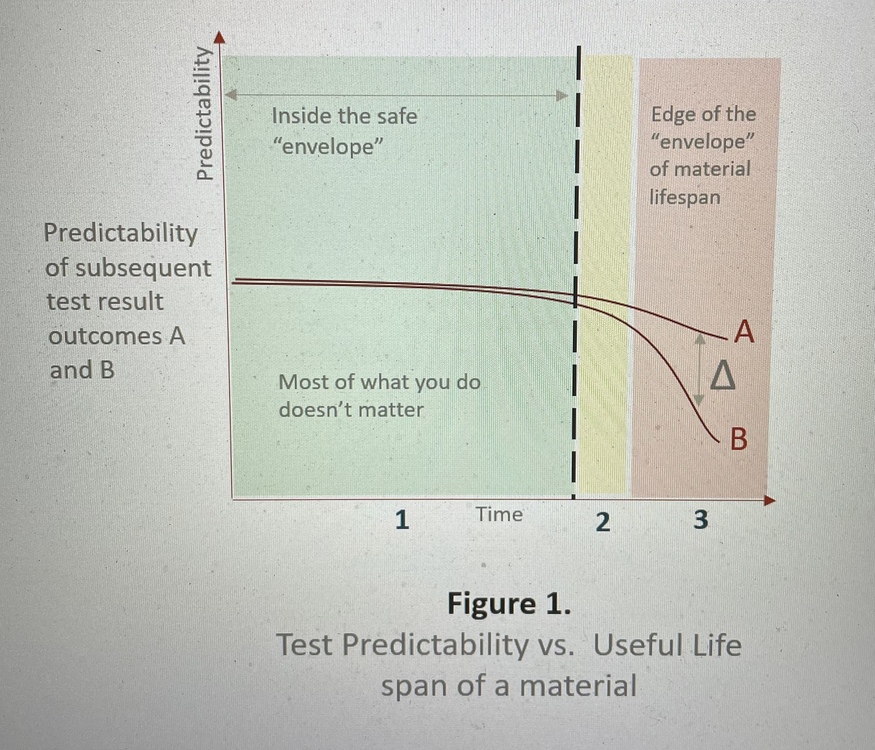 My experience comes from 25 years as a mechanical engineer often with a focus on safety systems for industry, fire, military, and climbing (in spare time). It is difficult to take time to find and cite every paper, book, or report from a career dealing with it. Most of my data, graphs, etc is pulled from original work over the years or constant immersion in it. I don’t pretend to be infallible, and admit when I am wrong. I do not think anyone reasonably thinks I was posting about the importance of stress-strain curves for brand new material uniform test specimens to guide decision making out in the wild. The entire point was exactly the opposite -- to caution about applying that data or thinking to real world, non-uniform, highly variable, degraded materials like tat or thin ice. There is a lot of study and data on the former, not much at all on the latter where it matters to us as climbers. The point is that the cumulative changes the material undergoes through use and wear (many just skipped over or ignored the deterioration issues I listed in the bullets) create large un-predictabilities. By “end of life” preceding complete failure, it is no longer the same material as it started. As far as polymer based textiles go, it’s stiffer and weaker (attempted to show on the graph), and the point is that test A results can vary randomly and widely from subsequent test B results –(newer graph better showing the diversion of results over a material’s lifespan). I used the word fatigue and included the deterioration/wear factors contributing. I probably should have just called it all wear/deterioration, and listed the fatigue issues as a factor. They go hand in hand and this is what I mean about a semantic argument (“but you said “Fatigue” first…) (Continued below). Grab coffee |
|
|
My Thesis is mainly derived from the following established principles from materials testing, shock and catastrophic failure studies both military/government, and civilian/industry, and accelerated aging studies, etc. I did not just pull these from my ass or make them up to support a thread I wanted to post. They are derived from lectures, seminars, journal articles, texts, classes, etc on the subjects through the course of my career. They are pretty established principles and not in contention as far as I am aware. I hope you can appreciate that it is more difficult to chase the specifics down at the drop of a hat after years have passed (example: go try and find the issue of “Polymer Forensic Engineering” that you scanned over coffee at work 4 yrs ago. Its not under my mattress). It is all from “peer reviewed publications” or Ph.D’s lectures /seminars (I’m not a Ph.D), or engineering textbooks. I am not referencing it in realtime from google which makes it more difficult. If any engineer disagrees with any point below, or feels it’s controversial and not sound or established science, I will make a concerted effort to track down the original or other supporting source details/and clarify or modify/correct as needed. Foundation Principles (in addition to my original post which focused more on why old tat was a risky medium)
Thesis: Conducting an uncontrolled “shock load” test to such materials immediately prior to use is statistically riskier and less useful and predictive, than a more controlled, slow load test above intended use. The stack up of variables and non-uniformities in deteriorated materials (tat) or waterfall ice, make pre-use shock loading inadvisable. I am sure of the supporting principles listed above and will basically stake my life on it. As for the derived thesis, I am not 100% sure, as it requires more serious testing and probability analysis to confirm. ANY side of this debate is out on an unconfirmed limb here. I welcome the discussion and that was the point of the original “come at me”. I did not expect wholesale agreement by any means (I’ve been on MP long enough for that) but let’s focus the debate and energies on the areas of unproven contention in the established context either way. There currently exists no specific data available that I am personally aware of other than my own ice pseudo-tests results (below), but given the synthesis of existing proven engineering principles, it stands on surer footing than believing the contrary. It could very well turn out to be a statistical wash, OR someone could have better real world data or statistical analysis to prove my thesis is bunk. To be sure, test and verify before committing, but If there are real world engineering experts who have studied the issue chime in.
New Proposed test Protocol modified out of this discussion A proposed better “pre-use” team test protocol would be: Back up system: Test to 2x the proposed static usage load (avoid high impulse “bounce” that could raise shock loads to 2-4x ) with both partners, then run heaviest team member in a backed up “full use” test, then remove back up and carefully use by last person. Solo test: using rope to dampen the impulse, vs static slings, do a small ~2x bounce on dynamic rope section to verify. (needs refinement). With respect to highly variable and brittle structures like Waterfall ice, minimize any shock load testing. You do not want your test to induce damage you are seeking to identify. You are in uncharted territory. In early March of 2020, I constructed 20 A-threads using 13 cm Petzl aluminum screws. Air temps around 40 F on wet farmed ice. 10 threads got a One person (~200lbs with gear) shock load from about 2-4 inches on 8mm Mammut sewn sling from 2008. I Then rappelled from all threads using the same sewn sling in the thread on a 12yr old Mammut 8.5mm. All held an “operational and careful” rap successfully. At the end of each rap, I bounced around on the end of the rope to try and induce a failure. 2/10 of the pre-shocked threads blew. All others I was unable to get to fail. Totally anecdotal for sure. No scientific or calibrated or statistical controls, just messin around on a warm March Sunday testing a variety of edge of the envelope scenarios. Take it for what it’s worth. (Don’t use 13cm screws for threads in practice) |
|
|
Marc801 Cwrote: Bounce testing on ice seems even more fraught than on tat! |
|
|
Mark Pilatewrote: After 6 pages of stringing us along, you have no data?
Your recommendation, in your thread titled "why bounce testing should be avoided," is... to bounce test?
I already posted testing of the actual sling that failed during the recent Tahquitz accident, which showed consistent (even rising) strength results, despite the fact that you insist the victims MUST have bounce tested it.
The first link shows the impact of water on lab samples that are cycled 10 million times in a lab. The second link shows the measured impact of water on actual climbing slings that are pulled to failure. You've been discarding all of my data from lab samples because you say it doesn't apply outside. You're just cherry picking the data in the first link, but not the second, because it matches your narrative. Edit: I am not suggesting a bounce test regimen. I am just calling out someone masquerading as an expert and posting misinformation. Just back up your anchors people, you're worth it. |
|
|
Huh, after 6 pages I still have no idea why this is getting debated. Never once in my life have I bounced tested an anchor to judge the quality/strength of the webbing/tat/cord and I have done a lot of sketchy rapping. If there is any reason to believe the webbing/tat has been significantly compromised just replace it especially if it is a single piece keeping you alive. Introducing an inadequate and non-conclusive test is absolutely crazy to me vs simple replacement. Talk about over engineering something so simple. |
|
|
Mikey Schaeferwrote: But….MICRO-TEARS!! |
|
|
Reminds me of noobs bounce testing their way up the Stovelegs - and maybe it’s for the better they do bounce test everything until they gain more experience. |
|
|
When I look up "low cycle fatigue" most sources indicate that it is something over 10,000 cycles. I can't believe that fatigue is an issue with climbing gear. The fatigue testing that I have done is always in the millions of cycles. Proof loading is very common in structural engineering and is a well established practice. I've proof loaded many structures and structural components. Please provide a link for the graph so I can understand how it applies. The vertical axis lacks a scale and has variable that needs clarification. The horizontal axis appears to have a non-linear, non-logarithmic scale, no defined variable and no units. There are two variables plotted (A and B) but I have no idea what they are.  |
|
|
Dan Merrickwrote: Mark has limited the scope to old tat. If a sling is good for 5 kN, and we bounce it to 4 kN, that's a pretty high percentage of its breaking strength. Coupled with the supposition that old slings behave somewhat erratically, I don't think the info you found can be assumed to apply here. As for the graph, I look forward to Mark's explanation but I will say, it's pretty obvious that the colored sections and associated 1, 2, 3 are conceptual regimes within the plot, not some random scaling system. Just to be really clear here: I'm glad Mark has had this opportunity for personal growth and development, and hope it can be that for all of us; however, this thread will in no way change what I do or how I act when I go climbing. I'm optimistic that I learned or will learn something, but I don't know what it is. I have been pouring over my memories of past adventures to come up with the sketchiest anchors I've used, or really any time that anchor evaluation took longer than 30 seconds. The sketchiest anchor I remember was luckily found right after lead soloing a pitch, so I kept my lead belay system as a backup. So even with total anchor failure I wouldn't take more risk than I had taken to get there. Of all things to get me, I just don't see it being a judgement error leading to total anchor failure. |
|
|
Dan Merrickwrote: The caveat is that when people bounce test, the magnitude of the proof load is unknown. It seems entirely plausible that under certain conditions a bounce can damage old tat without causing failure, but weakening the material enough to lead to failure upon further (static) loading. Peak load, strain rate, and the resulting flow stress all matter, but are not well controlled in a bounce test. I'm not taking "sides" here, but also don't think the question is as simple as some have suggested up-thread. |
|
|
I kind of think bounce testing just tells you that the anchor did or didn't hold together for *that* instance, and not much more. I don't think real world arrangements follow the cyclic testing plots we'd normally look to in engineering evaluations. |
|
|
Dan Merrickwrote: Low cycle fatigue is not the key issue. It’s variable stress and or shock loading on deteriorated material. Webbing rap anchors don’t see a high frequency of load cycles. Any stress cycles (rap A, rap B) or bounce tests, etc done on new material has trivial differences in the effects and material response. After significant aging, oxidation, wear and abrasion, rope pulls, temperature and moisture cycling, wet loading (lots of bailing and use in the rain),etc weathered tat at close to failure loads max strength is not the same material and has a different and unpredictable response to shock loads. My premise is that Doing such a “pre test” on such material is not a sound practice. The graph is intended to graphically show divergence of expected results -the spread - of any two test outcomes A and B as a material deteriorates and becomes non-uniform and accumulates defects (approaching end of life and failure)
Edit back to Dan on the proof loading: you are right and getting super close to understanding my point. Proof loading is a valid exercise - in the “green regime” in the graph during its useful life. but you’d agree has to be done precisely and way thought through either way. Show me an engineer who would disagree that attempting to construct a valid proof test of a material in the red zone at end of life pending failure (old oxidized, brittle, defect ridden, etc) would be a tall task. Just subjecting random shock loads to such materials is not a proof test. But apparently I’m fucked in the head to many. no polite debate or understanding needed. Edit to Kyle: LOL. That is YOUR data not mine. It is was evidence of YOUR cherry picking. In one breath you said water was insignificant just to argue (you are wrong, it is very significant here and was likely a major factor in a death) and then you cite a source that you evidently didn’t read as your own source said water was significant. So YOU’RE the cherry picker —no backs!! And now apparently you’re the proverbial “ you were for it before you were against it” and now you’re not for Bounce testing either. You’re too much. |
|
|
Kyle Tarrywrote:The claim you're trying to make is that a material will hold a bounce test at some force, and then second later it will fail at a much lower force. That's not logical. If a sling (or v-thread) held 4 kN 30 seconds ago, the odds are quite good that it's going to hold 4 kN again now (or, in the scenario you've put forward, half that). What the heck is the mechanism where a piece of material holds X force, and then 30 seconds later doesn't hold 1/2 X? Why don't you post data that shows the strength of a piece of material going down by 50% in the minute or two between loads?
This is the only issue we non-material-science people are interested in. Skip all the other word-wrangling and focus on this one tiny (but possibly life altering) "fact". We don't care about "plastic deformation", Young's Modulus, or whatever. Just give us solid evidence that item 6. in the "Foundation principles" is true for material that is commonly found on rap anchors. The "common sense" reasoning by Kyle makes a whole lot of sense. However, there are a few cases where science has actually proven "common sense" to be wrong. Is that the case here? |


