
 Continue with onX Maps
 Sign in with Facebook






Watches for climbing?


|
|
Hello, Just wondering about everyone's opinion on watches to track your fitness. Since all my training in the last few years was for Sport climbing, I never felt the need of getting a watch. Now I'm more focused on climbing longer and harder multi pitches and alpine routes and I'm training to become a Mountain Guide so I would like to track how I'm doing aerobically, recovery etc. Questions are: What's your opinion on watches? Which one is your favorite and why: Do I need a fancy one with climbing features? Is buying a used one worth it? HR monitor worth it? I recently purchased an InReach mini 2 and I'm wondering if there's any benefit on sticking to Garmin to connect the two. Thanks in advance guys! Cheers, |

|
I'm a fan of Garmin watches. I've got their Tactix Delta Solar. Like it a lot. Good for navigation. Good for tracking my exercise. Lots of useful widgets. Good battery life. Durable. Only downside is cost. It's not cheap. Do I "need" it? No. Am I glad I have it? Yes. |
|
|
How are you supposed to climb a crack with a big fancy watch on? |
|
|
Michael Abendwrote: On top of this, I would recommend a watch with a strap that will break if it is caught on anything in a fall |
|
|
Michael Abendwrote: I don't wear my watch cragging. It's mostly just for alpine routes. |

|
Wearing a watch while climbing is problematic. You will almost certainly damage it when climbing on rock. I bought a coros vertix 1 for training purposes. It is has all sorts of special software for training, sadly for me they training software is unlocked only by running and I do not run. It also has a few dozen exercise modes for capturing workouts but they end up being just variations on a theme. For example it has a walking, hiking and mountain climbing apps. By default walking is a step counter, hiking is 2D GPS tracker and mountain climbing is a 3D gps tracker (nothing to actually do with climbing). The three modes can be adjusted to be any of the other three. Just lame in my book. It does have about a one month battery charge life which is nice. The alarms and timers are nice. I have confidence that the watch will wake me at 1:00am for the alpine start. The heart rate monitor is so so. I had to shave my wrist to get it to function at all. Fortunately the watch can take input from other wireless monitors and I got a polar H10 strap monitor to get reliable heart rate information. The watch has a O2 meter that is supposed to tell you how your acclimatization is coming along. The O2 meter just barely works. You have to be perfectly still for it to take a reading and it takes several minutes to get that reading. The O2 sensor is completely useless in real life. (Get a finger O2 meter if you want one). The watch has maps which are next too useless. The topo lines auto scale and often just disappear. The geographic map with man-made objects on it is, at best, ok. Most of the watch faces are ungodly ugly, apparently designed for teenage boy. Which is very sad. Coros recently fixed the sleep tracking so what it reports is at least believable. The watch's compass seems to work just fine. The watch has track mode where you load a path into the watch and it will tell you if you get off track. I imagine it works but I don't often hike well known paths so this feature is of little value to me. Apparently runners (distance runners) like and use this feature during events. The watch apparently has performance problems with long track and lots of waypoints. RideWithGPS on your phone is probably a better option. The default displays for each exercise mode seem designed for race day rather than training. Fortunately they can be modified. Overall the watch is designed for running and everything else is an afterthought to gain market share. The running community seems happy enough with it. A better and much cheaper approach is to get the Polar H10 strap and connect it to your phone and use whatever training service you like. Get GaiaGPS for mapping. |
|
|
Michael Abendwrote: I usually keep mine in the zipper pocket of my chalkbag. |
|
|
Andy Eiterwrote: Do you have a phone? Phones go in a pocket and have the same functions. |
|
|
Michael Abendwrote: I don’t have a phone. -Sent from my iPhone The watch battery lasts a week. My phone battery would last a couple two three hours if I had GPS tracking on. |
|
|
Andy Eiterwrote: Get a new phone. Mine lasts almost 2 days with gps on. |
|
|
climber patwrote: But then what would I do with my watch? |
|
|
climber patwrote: Apart from battery life, the trouble with phones is that they don't usually have barometric altimeters, only GPS altimeters. If you try to record a GPS track on a near-vertical rock face you'll inevitably get something wildly inaccurate like this (this is the Yellow Spur in Eldo). According to this track the vertical gain was several thousand feet, not bad for a crag that's maybe 500' high. In this kind of terrain, if you want half-way decent elevation readings you'll need a barometric altimeter, which in practice means a watch, not a phone. 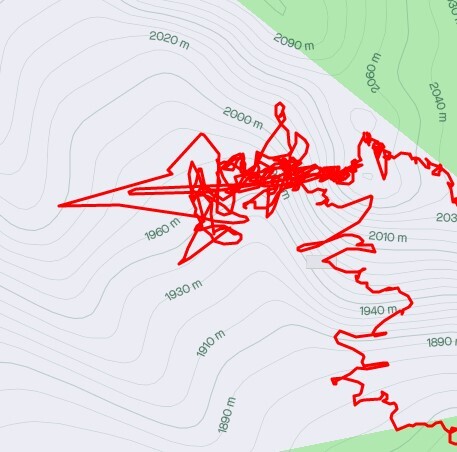 |
|
|
nothing screams "gumby" like climbing with a watch on your wrist. |
|
|
Most of the issues noted above can be addressed by clipping the phone to the back of your harness with the same carabiner your chalk bag is attached to--ideally an HMS locker. |
|
|
suunto ambit3 peak old by current fitness watch standards, but super durable and has yet to fail me. i use it for running, biking, hiking, alpine climbing etc. battery life is also great. |
|
|
Why would you want to track your fitness? |
|
|
Aaron Kwrote: So that government spies know I’m not a threat. |
|
|
I’d recommend COROS. They offer the customer service and culture of a small passionate company but are big enough to have good technology at a decent price. Unfortunately only the higher priced watches (apex pro and vertix) have ‘multipitch’ functions, but I use ‘mountain climb’ on my apex and it’s fine for my purposes, still tracks 3D distance and HR. Also, battery life is incredible. I do 50-70 min bike rides almost every day and only charge 1-2 times a month. Just know that any wrist based optical HR monitor is far less accurate than a chest strap. |
|
|
I have a cheap timex that I put on a carabiner on my harness. Allows you to track time and keep lap/pitch times. |
|
|
Unsure of the added value while climbing from a fitness perspective. I have a gps watch, I swear by it and wear it all the time... well except climbing pretty much. I don't see the added value because climbing, even longer stuff, isn't much of an intense cardio activity. These watch and the data analysis that comes with it are mostly meant to follow on stuff like run/walk/swim/bike etc, because that's the kind of things for which HR data actually brings value and can be enlightening for stuff you mentioned (exercise levels/intensity, recovery, etc.).
But we don't have that yet.
|
|
|
I do take a watch but for alpine/ice only. Of course I don't wear it, it's clipped on the harness. A beat up Suunto core tells me all I need to know (time, altitude and compass) |


