Mountain Project Logo

Slung trees and Anchor Angles

Original Post
MattH · · CO mostly · Joined Sep 2011 · Points: 1,406

Was thinking about how common it is to sling a tree/boulder at the top of a pitch, or for there to be fixed tat wrapped fairly tightly around a tree. Everyone knows that a high (near 180 degree) angle between pieces of gear is bad news due to the multiplicative effect on the forces, so why isn't it concerning when the cord around the tree is tight enough to stay near-perpendicular to the carabiner you hook into it to belay off of? Isn't the same effect at play?

Jim Titt · · Germany · Joined Nov 2009 · Points: 490

The force on a sling around a tree is likely trending towards irrelevant.

Ģnöfudør Ðrænk · · In the vicinity of 43 deg l… · Joined Nov 2017 · Points: 2

Like Jim said,  if you actually knew how to calculate the forces and understood what they meant in this case, you would see that it is a non-issue.  This mythological force multiplying angle monster is only hiding under your bed and doesn't go climbing with you.

Gunkiemike · · Unknown Hometown · Joined Jul 2009 · Points: 3,732

It is true that a tight sling around a tree will be under greater tension than a slack one.

MattH · · CO mostly · Joined Sep 2011 · Points: 1,406
Ģnöfudør Ðrænkwrote:

Like Jim said,  if you actually knew how to calculate the forces and understood what they meant in this case, you would see that it is a non-issue.  This mythological force multiplying angle monster is only hiding under your bed and doesn't go climbing with you.

Cheers for the condescension. I'm aware of how to calculate the forces. The point was that people get freaked out about high angles more generally but are indifferent to this particular setting, which seems weird (aside from the higher break strength of a cord vs a cam). It seems surprising that forces on a 14kn cam are cause for concern but a 20kn sling isn't, especially when it's rare for cams to be perfectly equalized but the two sides of a slung tree are always going to be equalized.

curt86iroc · · Lakewood, CO · Joined Dec 2014 · Points: 274
MattHwrote:

Was thinking about how common it is to sling a tree/boulder at the top of a pitch, or for there to be fixed tat wrapped fairly tightly around a tree. Everyone knows that a high (near 180 degree) angle between pieces of gear is bad news due to the multiplicative effect on the forces, so why isn't it concerning when the cord around the tree is tight enough to stay near-perpendicular to the carabiner you hook into it to belay off of? Isn't the same effect at play?

so, think about this for a second. in the example of a sling around a single tree, the angle created between the sling and carabiner where the load attaches doesn't matter one bit. it is still the same overall load on the tree (i.e. your body weight).

in a multi point anchor, this is where angles become important because you might care about how much of the total force each components sees and the angle can be a multiplying factor..

MattH · · CO mostly · Joined Sep 2011 · Points: 1,406
curt86irocwrote:

so, think about this for a second. in the example of a sling around a single tree, the angle created between the sling and carabiner where the load attaches doesn't matter one bit. it is still the same overall load on the tree (i.e. your body weight).

in a multi point anchor, this is where angles become important because you might care about how much of the total force each components sees and the angle can be a multiplying factor..

The force on the tree is still your BW (or the fall force if you fell directly on the anchor), but the force on the sling isn't

curt86iroc · · Lakewood, CO · Joined Dec 2014 · Points: 274
MattHwrote:

The force on the tree is still your BW, but the force on the sling isn't

but the question is, do you care? its still a single point anchor with a single body load on it. 

generally speaking, when we talk about angles in anchors, we are talking about multi point anchors with generally high loads and are concerned about anchors failing (think highlines, rescue loads, snow anchors etc.).

Jake woo · · Unknown Hometown · Joined Jan 2019 · Points: 2

Page 3 shows a single tree anchor you are talking about.
http://violafiredept.com/resources/Anchors1.0.pdf

The anchor forces here work the same as any other 2 point anchor, since each side of the cord is acting as a different point relative to forming the master point. When that angle formed between the two sides is 90deg, the force on each side is 71%. Let's assume ~200lb person ~= 1kn. I don't believe the total force within the cord is doubled because the friction of the cord on the tree is holding some of the tension, like in a tensionless hitch,
90deg: 70%, 0.7kn
120deg: 100% 1.0kn
140deg: ~150% 1.5kn
170deg: ~570% 5.7kn
I think it would be difficult to create a single wrap tree anchor at less than 170deg. However, if two people are now weighting the anchor, we have roughly double the forces shown above. I did rap off a tree this weekend that had a relatively tight cord. I think it was at least 9mm static which is likely rated to at least 15kn in tensile strength, single cord with no knotted masterpoint. If it was single 6mm or 7mm then the forces do start nearing breaking strength.

My overall thought here is that unless the angle is nearing a straight line, its almost impossible for the forces to be of any significance. With rap anchors in consideration, extending them as far as possible, while still allowing comfortable positioning, is beneficial. Old and weathered cord will eventually break down. Knots can limit overall tensile strength so positioning them (Water knot, double fishermans) against the back of the tree can yield benefits. Don't make a knotted masterpoint unless you have more than a single line being connected.

Someone please correct my rough math on angles and the 6mm and 7mm at a ~170deg angle and my assumptions including the friction carrying some of the tensile loading from the cord.

Patrick Voosen · · Reno, NV · Joined Jul 2018 · Points: 0
Jake woowrote:

Page 3 shows a single tree anchor you are talking about.
http://violafiredept.com/resources/Anchors1.0.pdf

The anchor forces here work the same as any other 2 point anchor, since each side of the cord is acting as a different point relative to forming the master point. When that angle formed between the two sides is 90deg, the force on each side is 71%. Let's assume ~200lb person ~= 1kn. I don't believe the total force within the cord is doubled because the friction of the cord on the tree is holding some of the tension, like in a tensionless hitch,
90deg: 70%, 0.7kn
120deg: 100% 1.0kn
140deg: ~150% 1.5kn
170deg: ~570% 5.7kn
I think it would be difficult to create a single wrap tree anchor at less than 170deg. However, if two people are now weighting the anchor, we have roughly double the forces shown above. I did rap off a tree this weekend that had a relatively tight cord. I think it was at least 9mm static which is likely rated to at least 15kn in tensile strength, single cord with no knotted masterpoint. If it was single 6mm or 7mm then the forces do start nearing breaking strength.

My overall thought here is that unless the angle is nearing a straight line, its almost impossible for the forces to be of any significance. With rap anchors in consideration, extending them as far as possible, while still allowing comfortable positioning, is beneficial. Old and weathered cord will eventually break down. Knots can limit overall tensile strength so positioning them (Water knot, double fishermans) against the back of the tree can yield benefits. Don't make a knotted masterpoint unless you have more than a single line being connected.

Someone please correct my rough math on angles and the 6mm and 7mm at a ~170deg angle and my assumptions including the friction carrying some of the tensile loading from the cord.

You forces are half what they should be. At 170deg it is actually 11.4kn on each side.

If your tree anchor has a large angle, then make a better anchor. You have just as many options as you do when you get to a bolted belay and the bolts are far apart.

Connor Dobson · · Louisville, CO · Joined Dec 2017 · Points: 269

Lol these fairytale values are only true in a perfectly rigid world with infinite stiffness cord. No one is putting 12kN on cord with bodyweight. I'd bet it's maybe 3KN at most. 

Same reason why slacklines aren't uprooting trees or exploding poles.

As Jim said this is a non-issue. 

curt86iroc · · Lakewood, CO · Joined Dec 2014 · Points: 274
Patrick Voosenwrote:

You forces are half what they should be. At 170deg it is actually 11.4kn on each side.

If your tree anchor has a large angle, then make a better anchor. You have just as many options as you do when you get to a bolted belay and the bolts are far apart.

no, he was right. you're double what each leg of the sling is. sin10deg = 1/x

but again, it doesn't matter...

Patrick Voosen · · Reno, NV · Joined Jul 2018 · Points: 0
curt86irocwrote:

no, he was right. you're double what each leg of the sling is. sin10deg = 1/x

but again, it doesn't matter...

you're right. I'm dumb.

Mark Pilate · · MN · Joined Jun 2013 · Points: 25

When you’re new, you’re unconcerned cuz you don’t know anything.  

When intermediate, you’re concerned cuz you know some stuff and question everything

When you’re experienced, you’re unconcerned cuz you know the answers

Generally 


But for god’s sake don't mix the two and take a rank beginner up a multipitch trad climb without full vetting under safe conditions. (Nod to locked thread) 

Jim T · · Colorado · Joined Jun 2012 · Points: 469

I agree that it does add tension within the sling and hurts your safety factor when the sling gets old.

Slings are tight to save material.

Patrik · · Third rock from Sun · Joined Jun 2010 · Points: 30
Connor Dobsonwrote:

Lol these fairytale values are only true in a perfectly rigid world with infinite stiffness cord. No one is putting 12kN on cord with bodyweight. I'd bet it's maybe 3KN at most. 

Since the load is static (hanging your body weight on the slings), why do you think it matters one bit if the material around the tree is a metal chain/cable ("perfectly rigid"), or a more standard sling?

Webfoot · · Oregon · Joined Jul 2018 · Points: 0
Patrikwrote:

Since the load is static (hanging your body weight on the slings), why do you think it matters one bit if the material around the tree is a metal chain/cable ("perfectly rigid"), or a more standard sling?

It matters because stretch under static load decreases the angle between the "arms" of the material.  If you calculate the load on highline anchors from a person standing in the middle assuming a perfectly inelastic line you get phenomenally high values.  In reality the stretch in the line allows it to sag and the load is not astronomic.

slim · · Unknown Hometown · Joined Dec 2004 · Points: 1,093

that, and rarely is a load truly "static".

Daniel Cowan · · Unknown Hometown · Joined Jun 2018 · Points: 257

The whole system would need to be considered for a static case. If you sling two opposite directions then it can approach infinity in a rigid body problem. But the system would sag as others have noted and drive away from high loads. But for an anchor with only one tree the other piece ends up taking the vertical load. 

MattH · · CO mostly · Joined Sep 2011 · Points: 1,406

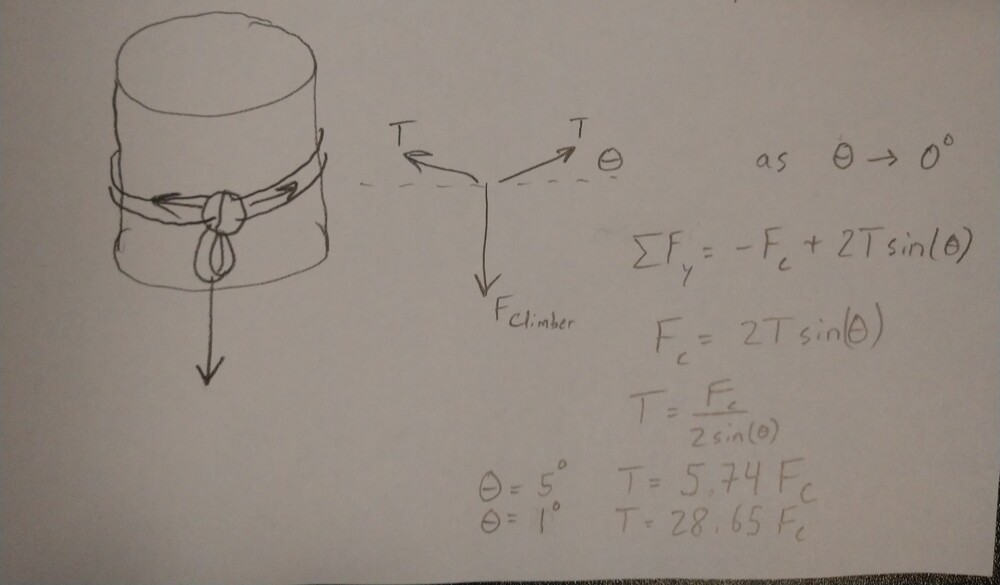
The situation I was describing was considering the force on the cord used to wrap the tree itself in a single point anchor (especially in cases of a fall onto the anchor). In other words, with a big tree (or boulder) and a tight wrap (eg: a square boulder with a reasonably tight webbing anchor), the angle between the two 'sides' of the webbing as it meets your carabiner get close to 180. If that slung object were a mid-route anchor and you fell direct onto it at the start of the next pitch you'd be in trouble (or not, hence why I asked and all the responses saying 'no' - there's plenty of other 'textbook' risks that don't matter in practice - the slackline comparison is the best analogy so far to explain why this isn't a real-world risk). 

Daniel Cowan · · Unknown Hometown · Joined Jun 2018 · Points: 257

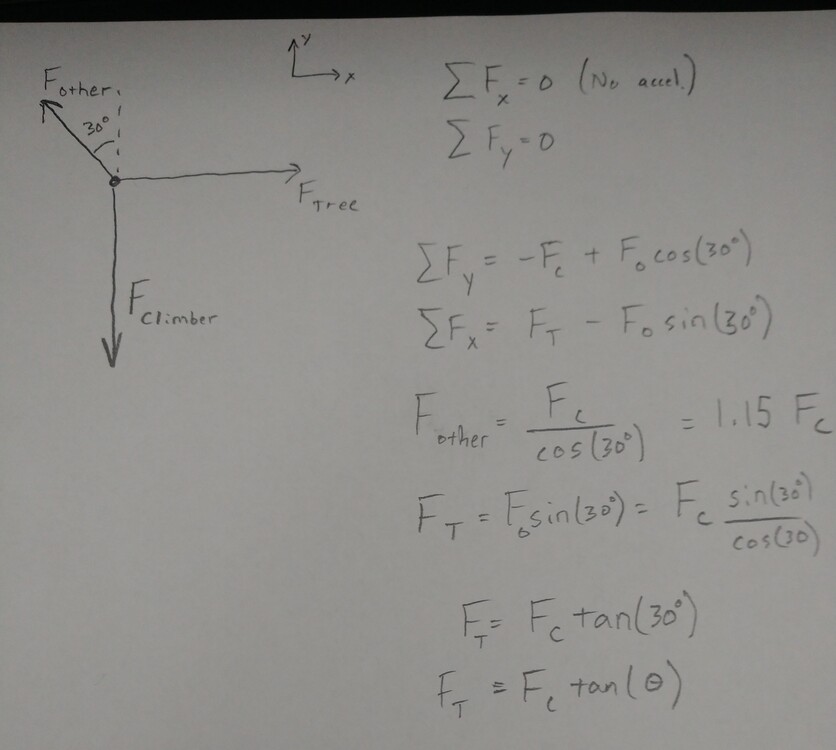
Is this more what you had in mind? I would take from this that having things slightly loose makes it all become a non-factor. 10 degrees or more and a 3kn fall is less than 10kn tension in the lines. 

Guideline #1: Don't be a jerk.

General Climbing
Post a Reply to "Slung trees and Anchor Angles"

Log In to Reply
Welcome

Join the Community! It's FREE

Already have an account? Login to close this notice.