Continue with onX Maps
 Sign in with Facebook






What did you wish you knew when you started climbing?


|
|
Don’t buy the tight ass shoes for your first pair. After that, also just continue to buy comfortable shoes because you’re not good enough for the geisha fit to really make a difference anyway. |
|
|
I wish I knew how to build and patent the Camalot in the 1960’s |
|
|
that guy named sebwrote: Not to de-rail this this thread too much, but these types of graphs are totally made up. The actual findings of that study are way more modest (see actual graph below), and even that is probably just mostly a statistical artifact. 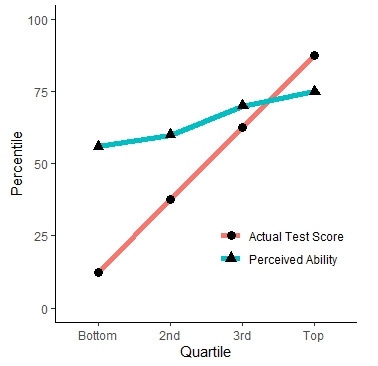 |
|
|
90% of people on MP have no idea what they are talking about |

|
Austin Donisanwrote: I disagree. The graph aligns closely with my observations and anecdotal evidence, and I feel extremely confident in my knowledge of this subject area. |
|
|
Don't be too hard on yourself. Unless you want to! As I became aware of and started to learn to climb, of course I became exposed to some of the top tier climbers of my day (doesn't matter what day we're talking about). As a noob I'd see the pictures of their feats, see the scale of their climbs, see the exposure they endured, and would think, "there is zero chance I will ever do that!" Now, many years in, decades really - I am struck with just how right I was about that assessment. I never did those things! I could not wrap my head around what it meant, or means, to be a top tier climber. But what I learned, is so frickin what! I'm not an F1 or NASCAR driver either. I did not become a movie star. I do not run a fortune 500 company. But despite my self-actualized limitations, I have done, for me, utterly amazing things climbing, the list now this many years in is both long as it is unimpressive. But sprinkled in there are big walls and wilderness wall first ascents, thousands of pitches, hundreds upon hundreds of climbs, days, weeks, months of my life in the company of best friends pursuing the folly of climbing. I've loved every minute of it. My most crushing defeats are nothing more than a mellow afterglow at this point. The ones that got away don't matter any more than the ones I succeeded on. It's all good. All you have to do is continue to climb, day over day, week over week, year after year.... and your reward will be more climbing, and pretty much nothing more. So don't be so hard on yourself. Unless you want to! |
|
|
How addicting it would be. 30 years later, I am like a junkie looking for their next fix If I in don't have a partner lined up. It has consumed my life. No regrets |
|
|
I probably fall into the 90% category that doesn’t know what they’re talking about, but I’ll … say something anyways cause I can’t resist. I’m weak. Most real climbers I know don’t log their climbs or care about doing so on MP (I do it as a form of journaling) and people on MP’s say some absurd things - you do you, generally speaking Do routes that look fun to YOU climbing is more about skill than it is about strength, at least it probably is at your and my level project routes that are a bit out of your league Different shoes have different purposes (instantly climbed way higher graded routes when I made this discovery) so don’t stay in your beginner shoes forever (like I did) Climbing’s supposed to be fun, but to get better you’ll need to try hard, and trying hard is a developed skill finding a good partner that actually wants to get out and gets out is harder than it sounds so be on the lookout for people you consistently see at the gym/crag and try to make friends Better to be safe than sorry, so risk feeling stupid and make sure you and your partner are on the same page fiddle with your gear at home or on your own time. if you want to climb trad start keeping an eye out for trad gear and picking it up slowly (saves $$) Don’t always climb to failure - often go home with some fuel left in the tank to avoid injury Injuries suck so warm the hell up and don’t jump straight into a project Work on shoulder strength and mobility closed chain ab workouts are for climbers, open chain is more for show than anything |
|
|
Austin Donisanwrote: im not so sure. by the authors own admissions, there were significant limitations to that study (sec. 4.3) and its likely the DK effect may exist for some skills... |
|
|
Hey Bill, which area are you from? We may have some advice that's more specific to where you climb. |
|
|
curt86irocwrote: Does that mean 90% of mp that gave you a thumbs up are wrong? |
|
|
Greg Dwrote: is that a...question?? |
|
|
The better you get, the less partners available... When they say they lead 5.12a sport, but only 5.9 Trad in the bio... stay away!!! |
|
|
Just climb with resoled shoes for the first few years, really. Until you get into harder stuff (like 5.12, or maybe super technical face/slab 5.11), the impact of the shoes quality on your climbing gets lost in the noise. If you can't redpoint a 5.10, it's not your shoes that's holding you back. If you can redpoint a 5.10, you can do it in MadRock Drifters, or any resoled shoes. |

|
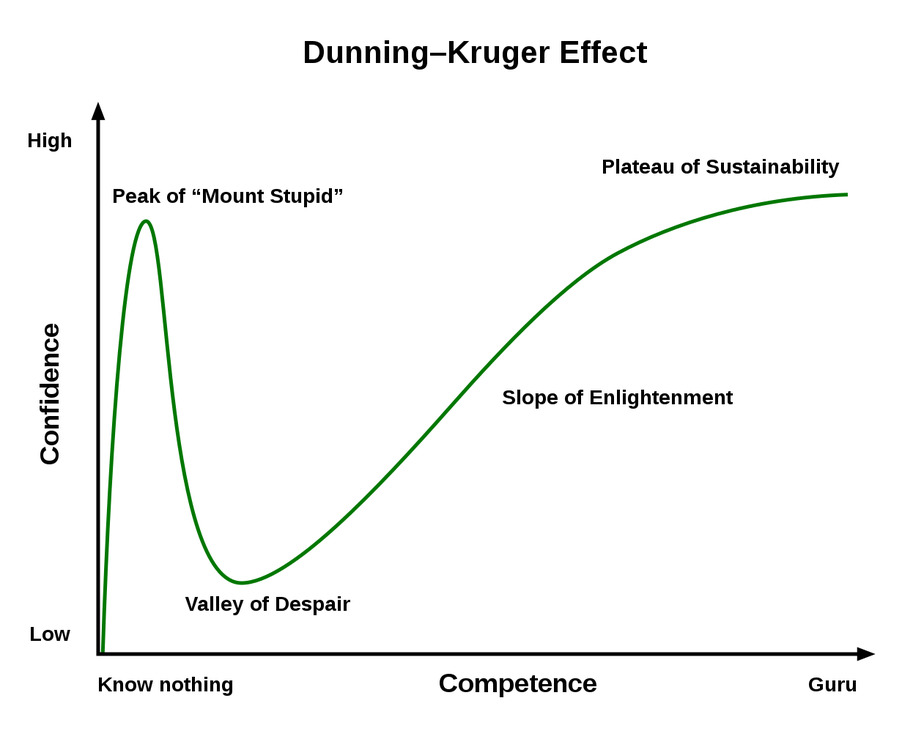
Austin Donisanwrote: I say the Dunning-Kruger effect, and that graph, are real for many climbers but not all. And it's not incompatible with the other, linear graph. The first graph shows the progression of many climbers while the second shows a division of people into 4 quartiles by test score where some of those those people in the first 3 quartiles continue to progress into a higher quartile, but not all--some of them are largely plateaued where they are. And then a lot of the people at the far left end of the Dunning-Kruger graph (from know nothing to "peak of mount stupid" to "valley of dispair" would all fall into the first two quartiles of the second graph, so to see the full pattern, you'd have to replot the 2nd graph using 10ths (deciles?) instead of quartiles. For those starting out, the D-K effect says that they don't know enough to judge their own level of competence, but how much their perceived ability exceeds actual ability varies a lot. Some people are naturally optimists and egotistical, overestimating their abilities no matter how good or bad they are in reality. Others lack confidence or are humble, and typically underestimate their actual competence. The D-K graph says that often people starting out in a new skill are likely to far overestimate their competence, then as they get better, they know enough to figure out what they don't know and then underestimate their competence. As they mature, they learn to make fairly accurate self-assessments about how good they are and what else they still need to improve. They may also watch or climb with more experienced climbers and thus realize where they stand on a relative basis. As you get more experience, both the egotistical optimists and the humble pessimists tend to bring their perception close to their reality. Separately you may have the gap between a climber's perceived competence and how good they say they are. Should add a 3rd line to the graphs showing claimed ability! Now my post proves that I have no idea how much I don't know about psychology and sociology! |
|
|
It’s supposed to be hard |
|
|
You can do things that you wouldn’t have even thought imaginable if you put in enough practice and time. Also just remember to have fun and actually enjoy being out in nature and spending time with the people around you |
|
|
I wish i had put more effort into getting proficient at laybacking when i was younger. Most if the folks i know viewed it as cheating. I should have looked at it as being another handy tool. |
|
|
What did you wish you knew when you started climbing? That climbing is just a great hobby that you are lucky to have found. |
|
|
climber patwrote: This! To think about how strong an engine you could build if you started in your early 20s... |