
 Continue with onX Maps
 Sign in with Facebook






New and Experienced Climbers Over 50 #19


|
|
Ward Smith wrote: Hope you and Steve have a gret trip altho so sorry that your friend is no longer with us. |


|
Great post, Rich! I can honestly say, I have no qualms about letting people know I will be slow. For every bit of it. If they don't wanna accommodate that, don't spend time with me, cuz that's the package, like it or not. Further? If someone isn't willing to do that, and leaves me behind, I consider it a safety issue. A good leader takes care of the team, which means the slowest/weakest person has to be included in the process. I've chewed people out, now and then, too, lol! In a party of more than two, but when we're all climbing together, just one lead climber with his rack? I have no qualms handing my rope bag off to the "kid" in the group. That's been literal, a few times. A partner that my partner and I climb with was a dad and his teenager! Great kid, and super fun to be out with him, watching him climb at 16, and as he added on a few more years. Otherwise, my partner and I? He has the rack, I've got the rope, plus about half a rack, oodles of draws, the miscellaneous crap we don't use when we take it....but wish we had it when we don't. Still getting both the pack and my harness dialed, 6 years in, lol! So, watch your pack weight and size, and get that nailed. Even how it fits, and what's stowed where, or outside of the pack. Oddly? Sometimes, the rope on my shoulders before the pack goes on, works better. Or, the rope inside, and wearing the harness. It just varies, depending on how far we're walking and if it's scrambly. I partly bring this up because yes, as a climbing partner you wanna be carrying your weight, but, if the others are a decade or two younger, it's definitely something to negotiate. It shouldn't be expected, but if someone asks, well, that's what partners do for each other. Sort out who does what. Remember, trekking poles have been brought up before, as has how much you pack! Poles (or just a single pole, or a stick clip) can help with scrambling, too. As can a partner who will offer a shoulder or something. There's one particular approach at City, that I (sometimes) end up on my partner's shoulders to negotiate a single bit. We've found that to be the simplest, and fastest way to get me down, on the way back out. Drilling Fields/Lost World, if anyone is curious. Bouldering, same sort of deal. Partners have to give an actual catch, plus, we need to work out just how to get me off the thing. It's simply what it is. I was thinking about Rich's comments on capacity, too. Mine, at COR, is walking. Not any faster, not briskly, but steady. My fitbit usually hits 15ish thousand steps a day there, and way past that, now and then. It's off, once we are where we are climbing, so that's an undercount. Oh, and when it's both steep and elevation? Get somebody to teach you how to breathe. That helps, too. COR's 6500' isn't enough to matter, but the 7500'+ at Hyalite sure was! That was snow, too, with particular ways to place your feet, also. Very very slow, for me. Best, Helen EDIT to add, Ward, so glad you going! Sorry about your friend. That just sucks. The senseless, unexpected, deaths are hard. Getting out sure helped me, especially when the other friend who was his partner was able to come climb with me. We went to where I knew our friend had been. Pretty special. Hugs from afar, eh? |
|
|
rgold wrote: As usual, spot on. |
|
|
S. Neoh wrote: Yes, I agree with this. I feel that I do have a "normal" exertion base level, but that can translate into different paces depending of course on the trail conditions but also the off-trail things that S. Neoh mentions. I think that getting a handle on what's "normal" is a task for solo hiking, as I said. Agreed that doing this in "real wilderness" isn't a good idea, but I've violated this principle on quite a few occasions...not recommending this mind you. |
|
|
Put those kids to work! A reply to BAd's post below, since the MP posting police locked me out for oversharing. BAd, you might look into acetazolamide (diamox) webmd.com/drugs/2/drug-6753… . Taken 1-2 days before going high(er), it can mitigate the effects of altitude sickness. Most people have no side effects, but you can read about the possibilities at the link above. You do need a prescription. |
|
|
Good comments about altitude. As I close in hard on 60--a couple of weeks--I have found the last couple of years that I develop MONSTER altitude headaches, like lunge out of the tent and vomit headaches, that I have never experienced before. I live at 4,000 and regularly hike and climb up to 10k or so, but spending the night now seems to lead to the head splitters. I think the key is going to be prophylactic ibuprofen. Once that stuff kicks in, I seem to be ok. Weird though, definitely something new |
|
|
rgold wrote: Thank you, rgold, for taking the time to share your thoughts on this. I'm trying to learn limits and strategies for improvement, while also hoping for big accomplishments. What I didn't mention was that on the day I hiked with my daughter I had an unusually high blood sugar when we were ready to launch, which I knew would impact my energy greatly. I was literally panting within the first dozen yards. But there we were, meeting in the parking lot, with no real options to cancel or postpone for another day, which seems to happen all the time in climbing. If I feel alone with having limiting issues, probably I am not... BAd gets headaches, you get altitude issues, we all have something. It's a decision I've made to just push through and do my best given whatever circumstances, including bad weather, bad blood sugars etc. I REALLY like your suggestions about gauging steady state and capacity with solo outings. This is something I can easily do. Also, I believe if I will remember my breathing and pace it it will help a lot. But how is this measured... just by feel? If I hike a steep trail today, and then tomorrow, is there some way of knowing whether I'm improving? There's a little bit of ego in this, I must admit. My daughter is in Search and Rescue, and we talk on the phone so much about fitness, outdoor activities, my climbing, her mountaineering... and there I was on our first outing in several years clearly struggling. She was fine with it, I was not. My daughter also mentioned something that you just stated--that it is better to slow down than to completely stop on a trail when trying to develop aerobic capacity. She was advised that a slower pace was better than constant rests, partly because as you said muscles stiffen and aerobic state has to be restarted. Well... I have to return to a familiar mantra here, that is my total admiration for this group, for the effort and problem-solving that allows everyone to continue on 'past our expiration date'. I'm open to significant feats of accomplishment from any of us (not just 'you're good for your age'). I think we're contributing to new knowledge about aging. We are putting our collective heads and experiences together to forge new paths. My new resolution is to stop expecting the other shoe to drop. |
|
|
I just wanted to add a separate post here only of interest to a few people. HGH is making a huge difference in my life right now.... physically, emotionally..I didn't expect this level of change. My energy and mood have improved greatly. I'm losing weight. I don't recall whether Phylp was instrumental in this discovery, or only involved in general hormone manufacture bitd... but I want to thank her for the effort. Not everyone needs this... as a diabetic I probably am more at risk for other endocrine problems. But wow... I'm so grateful. Here is a basic theory that we stand in divided camps over--Horst stated in his podcast that 'we don't want to go down the road of testosterone and HGH replacement' but instead to work hard with what you have. It makes no sense to me. We weren't built to last longer than 40 years or so. All hormones decline, measurably, starting in late 20's early 30's. By the time we are 'old', some vital chemicals/hormones are non-existent in our bodies. (My T levels were nearly undetectable 15 years ago). Those are the human substances responsible for anabolic processes, building muscle, maintaining skin, hair, for mood, for energy, repair. They are biological requirements. Why struggle on without them? (Why drive a car with nearly empty tank or bad gasoline?) I know a few women who had no problem with menopause. (well, actually I don't, but I've heard there are some). I endured 10 years without any estrogen, because I believed in aging 'naturally'. By that time I had lost 1/3 of my bone, my heart was enlarged, my mood was chronically depressed, my skin and hair looked 'old', my sleep was constantly disturbed. Maybe tmi but my last gynocological exam my doctor noted that she could no longer find my ovaries because with age they shrivel, the vagina dries and atrophies. She thought that was a good thing. It was about then that it occurred to me that my body was literally starving for hormones--everything was falling apart. The challenge was to find the right ones, and the right amounts (and to bow out of the scoldings and debates by my Kaiser docs and just go elsewhere)--no super doses, but no starvation, either. Almost from Day 1 everything felt better, and has continued so to this day. More than ever, now that I'm asking a lot of myself with climbing... I want to make sure that the bare essentials are there. I have now followed Tony down this same path... a macho dude who just accepted a dramatic decline in his T status for 20 years, as did his doctors... but eventually he realized he was drifting into that good-night in every way. I'm surprised at the reticence and reluctance of Tony's primary to prescribe T, even though his labs were at near empty. (Also... this damned 'range'. If the range is 70-700 and you are 70, you are still 'normal'.) It took 5 repeat lab tests and finally a Urologist to concur that a physiologically appropriate addition of testosterone was indicated, especially now that he is trying to rebuild bone in his spine. Lastly (probably not ) when I was researching my newly-diagnosed osteoporosis (15 years ago) my then doctor said "Hey, I just spent the last week at a medical conference on Testosterone, and the studies on bone strength and building are impressive." It was his view that while estrogen was important for not losing bone, it was testosterone that was responsible for building bone. Men tend to get osteoporosis and break bones after 50 when their T levels decline. Why are we fighting this? |
|
|
Well, I'm fighting this because last August I was invited to a wedding of the grandson of the owners of the last and by far the best team I raced for. I had not seen any of these people in 30+ years. Of all the rides that were there, my training partner & I were the only two people that did not take anything at all except painkillers after bad crashes. My worst crash was in 1976 - dislocated left knee & hip, fractured L5-L4-L3. I can't count how many times I came to laying on the ground not sure what just happened. Jeff, my training partner crashed at Ontario motor speedway in a Porsche - Multiple fractures of both feet, multiple fractures of left & right tibia & fibula, broken left wrist. We were the only two that could dance much less walk unassisted. Eat well, eat a wide range of food, multiple colors. Enjoy your decline it's probable less painful than mine & I mostly ignore it. But whatever you do ENJOY IT! |
|
|
Lori Milas wrote: There is some evidence--I don't know how conclusive--that testosterone therapy for men raises the chance of prostate cancer. See for example https://news.cancerconnect.com/prostate-cancer/prostate-cancer-risk-and-testosterone-supplements. This illustrates that supplements aimed at one thing might have effects in an entirely different area. |
|
|
TRT is also implicated in congestive heart failure, which is a particularly ugly way to leave the planet. |
|
|
PTR wrote: Reasonably easy to avoid with some strenous exercise. If you start taking T it helps a LOT more if you actually strain those muscles, otherwise you are wasting it and it will be used to do other things instead. |
|
|
I suspect dosage is key, as with female hormone replacement. If you don't measure your testosterone levels in your youth, there is no way to know what to replace as an old guy. This inevitably leads to some people getting too little, and some too much, with adverse reactions to be expected.
|
|
|
I just went out for a long hike, and was wishing I hadn't posted the above... it can only be cause of division. It's very hard to convey thoughts on a subject this large, and I have no skin in this game. I totally respect any decisions anyone makes. My concern was Horst mentioning several times to avoid T and HGH. I don't know how we can expect to have Maserati performance in an aging Buick. No one questions 'what to do with' a hormone like testosterone when you are young--it's not there to do extraordinary things. It's just there, feeding every vital system in the body (both male and female). It touches virtually everything, and we just take it for granted as a part of normal human biology. But If a young man in his 20's had extremely low or negligible testosterone, and if he was thin and frail, and had bones breaking down, high voice, and no libido... we would consider it a problem that needed some medication. (This was a big discovery in my world, having a young family member and some young friends chronically using opiates and to discover that their testosterone was driven down drastically by this class of drugs and T replacement was warranted to reverse the big bone/tooth and muscle loss.). But when an older male, or female, is found to have negligible testosterone levels (easily discoverable through labs), we accept it--along with the decay, muscle wasting, loss of sexual desire, mood etc that goes with it. The doses that cause heart failure and cancer are extraordinarily high... for instance, bodybuilders who self medicate, and stack, hormones and peptides far beyond normal levels. The addition of a small physiologically appropriate amount of transdermal testosterone in an older male or female is not for any purpose other than to continue functioning normally... to keep bones, balance, mood, libido, strength where they always were. (From Mayo Clinic: " While previous studies suggested a link between testosterone therapy and heart disease, the connection isn't clear. However, more recent studies show no increase in heart disease in men taking testosterone therapy. Some research even shows a lower risk of death in men receiving testosterone therapy compared with those not receiving therapy. A large 2016 study following more than 1,000 men for three years found that testosterone therapy did not increase the risk of cardiovascular events.") As for women, we make 2 molecules of testosterone to every 1 of estrogen... a little known fact, but doctors ONLY want to replace estrogen, if that. So we also have problems when only one hormone (estrogen) is brought back to a youthful value and testosterone is not also replaced. But whereas a man may require 25-50 mg of testosterone daily, I require 1. But that 1 makes a whopping big difference in my life. I shouldn't have had to plead for it. (neither should Tony)
|
|
|
I've recently been listening to Horst, and he actually does say that he would consider testosterone when he got older, but didnt feel that he needed it yet. I'm in the same boat, and try to raise my testosterone with diet, exercise and supplements. At some point I would definitely take it if felt it was needed, but I'm not there yet at 61. Everyone's mileage will vary. |
|
|
Lori Milas wrote: I don't think it was me, I don't think I've ever researched hGH replacement in aging adults. But as always I'm glad if you are seeing positive effects. From an evolutionary standpoint, for the most part, after humans have passed their child-bearing years, there's not a genetic selection mechanism to keep you disease-free, healthy and robust. I suppose you could argue that healthier seniors provide some evolutionary advantage to their child-bearing young through being there in some kind of protective sense. But that's a stretch. So nature doesn't care if we thrive or fall apart as we get older. Lori, as far as hiking uphill, there is a lot of truth in the old adage "you are what you train". My husband is on the road bike about 5000 miles a year and his aerobic capacity is hugely better than mine. But because he's on the bike so much he doesn't hike nearly as much as I do. And when we do hike together, the night and day after we go hiking on mountainous trails, he's more tired out than I am and his legs and lower back have aches and pains, while I feel good. And even though if you measured his upper body strength, he'd certainly far outperform me, if he spends a day climbing with me, he's exhausted far sooner than I am. I climb 10X as much as he does. We are planning on hiking in the Eiger region this summer, and I'm already starting a program to get to altitude to hike at least once a week. Doing it is the only way to be able to do it. Fortunately I have some 8-10K peaks in my backyard, so I don't have to travel much to do my training. 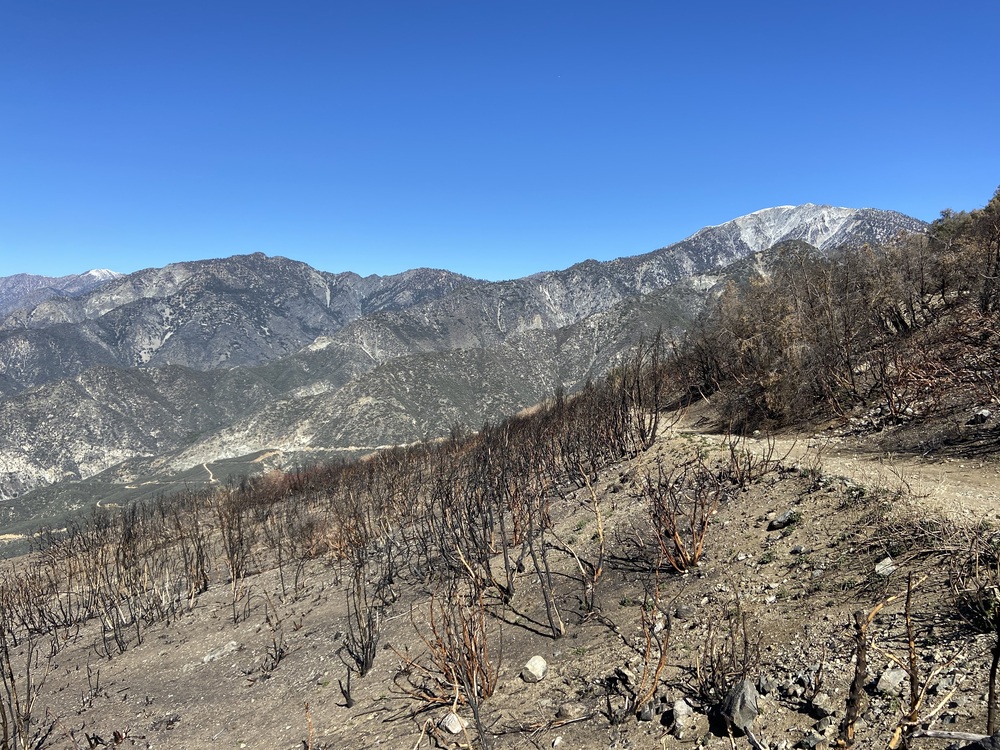 View from the trail on Saturday at 5500 ft, Mt Baldy in the distance across the way. |
|
|
Lol, Lori, I don't see any disagreements here, just opinions and the sharing of thoughts and information. Always a plus, imo. Besides, it's just medical type shit, not vitally important stuff like gates in or gates out! Bumped the rendezvous thread today! :-) |
|
|
Ward Smith wrote: I do not feel I need it at this time either. |
|
|
phylp phylp wrote: Good idea. It's really embarrassing when the 80 year old Swiss go roaring by, as they did to me about 20 years ago when I was 1/2 their age. |
|
|
Gotta watch out for old Swiss hikers. |


