
 Continue with onX Maps
 Sign in with Facebook






Rappelling without extension


|
|
Yukon Cornelius wrote: Dude, this is really the way. I do this a lot, but with no extension, and I hold onto both strands while my partner raps on the gri. I don't see the point in just holding one and it removes a faff point of "Oh which strand are you on? Ok, I'll grab the other one." Also I don't ask my partner to give me a firemans because he/she has already made it to the anchor and untangled any rope clusters on the way down so it's a pretty straightforward rap for me (assuming I'm going 2nd here). |
|
|
Nick Goldsmith wrote: Same here. I usually use an extension (because it changes how you hang and makes for a more comfortable rappel) but also go directly to belay loop some times, both with auto block on leg loop. A number of years ago when hearing it could be an issue I tested it out. I hung a couple feet above a bouldering pad with a leg loop autoblock and tried with both extended and non extended belay device. There was no way I could get it to interfere. I tried everything, being inverted and lifting my leg as close as I could, etc. as much as I actively tried to get it to release there was no way it would. So maybe when this was an issue it was someone with a different kind of harness, different body geometry, not enough wraps on the autoblock, or most likely too long a prussik cord on the leg loop (which could be an issue with any third hand setup). But for me and my setup I have no worries about it at all. |

|
I did a similar test and found the autoblock on the leg loop failed to grab in 1 out of 3 times in an inverted (I flipped upside down) scenario. That being said, the autoblock on the leg loop is the method I use most often. For those interested in a more comprehensive discussion, I wrote a book, titled Rappelling (available at amazon), that discusses rappel extensions in depth. This year I also coauthored a book with John Long titled Rock Climb: The Art of Safe Ascent that has a comprehensive chapter on rappelling that includes state-of-the-art extension methods and pros and cons of extended vs. non-extended. I think it's important to note that the number one rappelling accident, by far, is simply rappelling off the end of the rope. |
|
|
I have heard it said that one shouldn't use an extension with a Munter hitch. True? If so what backups might one use? |
|
|
Okay I think I get it now. So after reviewing this thread, I'm pretty this is my best option: 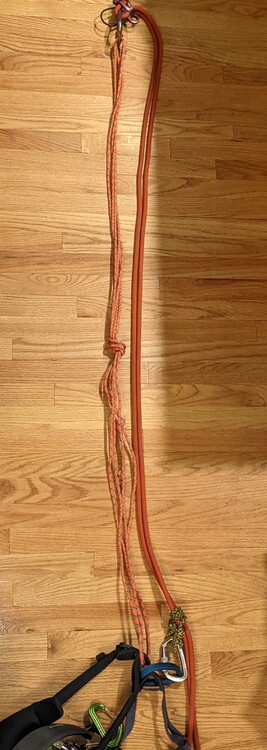 That may seem a little long. You may be wondering how it's used. Well it's simple, you actually first munter down the tether line (passing the knot in the middle) until you get to full extension. Then it's smooth sailing. Some people call it the Cadillac of rappel extension. |
|
|
Bob I have never had my autoblock fail to catch when monkeying around upside down. that may be because I use one more wrap than most people? if you keep it loose it might grab and its easier to rappel . keep it tight and it will grab but its not as hassle free of a rappel. |
|
|
After some backyard testing quite awhile ago, I decided that an auto lock (French prusik) below was too sensitive to number of wraps, diameters of cord and rope, length of cord loop, how proximate the loop ends are in attachment to the harness, and maybe etc.. … too sensitive for my pea brain to reliably keep track and mitigate in all circumstances. Granted, there are ways to address some of the issues (e.g., Sterling Hollowblock). So I don’t mean to rehash the various mitigations …. Just to emphasize Nick’s last comment.
|
|
|
Bill, This is why I use a rabbit style cord instead of a loop. Making a french prusik with a single strand is the bomb, and you can use ring overhand loops so the tails don't interfere with the hitch. No more faff with knots/stitching getting in the middle of the hitch. Nick, I'd love to see your setup, because it seems to me that the leg loop will always fail under the right conditions. It's interesting that they're making harnesses with this feature; it seems they would fail under the right conditions too. What is it exactly about some harnesses that is supposed to prevent this failure mode? |
|
|
Nick Goldsmith wrote: A couple more factors why my leg loop third hand may be farther from the belay device than some folks':
With my setup (on my body, with my harness YMMV) there's no way the third hand can be interfered with by the belay device on the belay loop. It doesn't matter if inverted, leg is lifted up, etc. It physically cannot reach it. I didn't initially setup my third hand this way to prevent interference. I've always done it that way. I probably read decades ago prussik cords should be 20", and I girth hitched the cord to my leg loop to keep the fisherman's knot out of the way. Those things just happen to have the added bonus of being safer in this situation. |
|
|
Same thing with my duct tape special. |
|
|
Glowering wrote: I have to see this to believe it. Here's my harness with the minimum possible extension on the backup and it still make contact easily with the belay device. 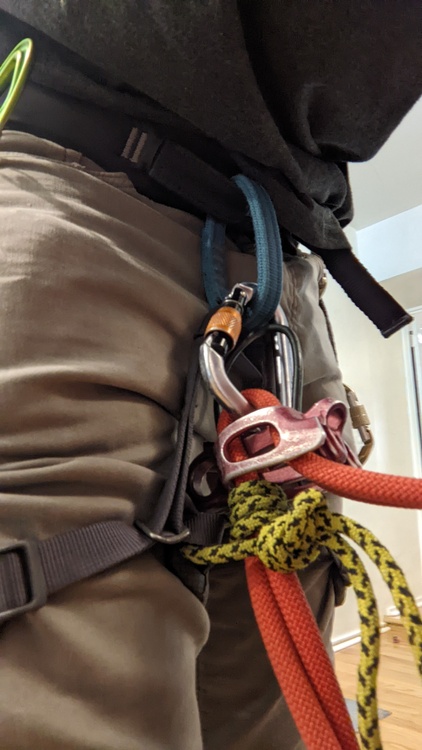 |
|
|
Dave Olsen wrote: Since the break position of a standard munter is up, rather than down, it would be rather awkward to properly break with the device extended at or above your head. I bet you could use a super-munter instead (see, for example, here: youtu.be/BshgXXn4UEk?t=511) and have a more standard setup with an extension and backup (although I have never tested this myself). Likely the "best" solution for rappelling without a belay device though is to make a biner break. To backup a standard munter rappel, you can place the prussic above the hitch on the loaded strand (with some extra extension cord, like an extra sling probably). It is definitely awkward though since you kinda need two hands to successfully break and move the prussic around to descend. EDIT: More discussion is here: mountainproject.com/forum/t… |
|
|
Eric Moss wrote: I stand corrected. It's been a few years since I did this test and I remembered incorrectly. I just repeated it. The friction hitch couldn't reach the belay device in an upright position, but it could if I was inverted. However the only way I could get the belay device to interfere with the friction hitch was if I was inverted AND I extended my leg straight up towards the sky. If you were passed out your leg would hang down. So I still didn't find a situation where the rappel wouldn't be arrested even if was unconscious and inverted. Also I have my friction hitch on the outside of the leg loop's buckle, not the inside where it's directly under the belay loop. |
|
|
just keep your wrapps tight enough and it always catches no matter what. i am not trying to rappel fast. just smooth and steady... |
|
|
Rasputin NLN wrote:  Copy that, will see you up on the beach someday Andy. It might be a while, I am an institutional man now. : -) |

|
I hope you have tiny hands. |
|
|
Eric Moss wrote: Those are all good features, Eric. Those are good points. Still, I’m not convinced they cover all the bases. But this does not matter. What does matter to me is this: A rig that seeks the Goldilocks result - guaranteed surprise catch without undue effort when just rappelling - needs to be carefully engineered. It needs to address all the variables and eliminate the unaddressed variables. The advocates of using existing brake assisted rap devices are closest IMHO. But even so, there seem to be a number of them that failed to arrive at the Goldilocks result. And so, to Nick’s approach, it may otherwise be best to compromise the “undue effort when just rappelling” and make the rig a little more “trigger happy” than not. In other words, endure a little more effort at simply rappelling so that the rig is that much more likely to catch in a surprise loss of control. |
|
|
Ben Horowitz wrote: no twist munter from alpine savvy 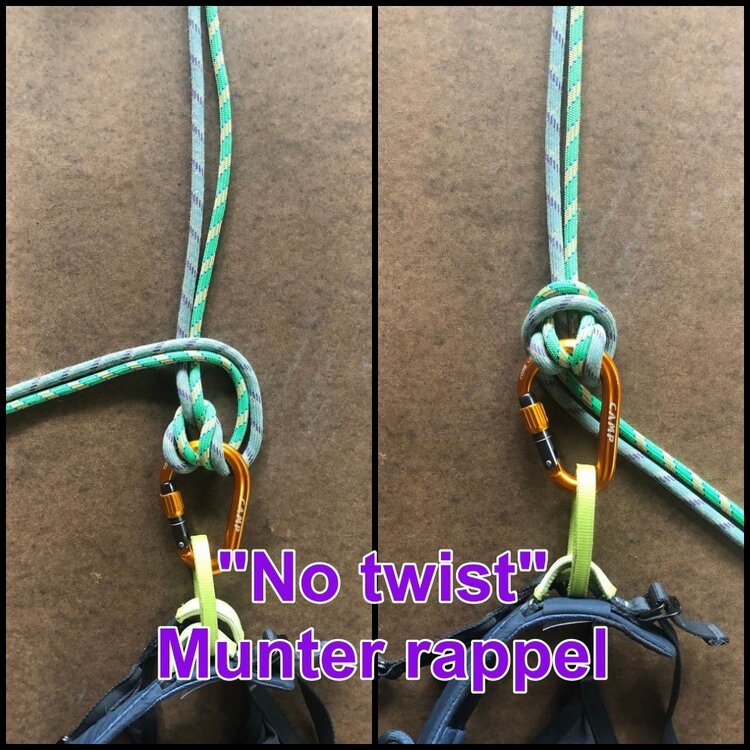 |
|
|
That looks almost like the super munter, but without passing the break strands through the carabiner again. Looks quite useful for double rope rappels. |
|
|
Ben Horowitz wrote: That's exactly what it is. If you pass the bight through the carabiner and tie it off with half hitches, it's also an effective alternative to the mule knot for tying off a munter. |


