
 Continue with onX Maps
 Sign in with Facebook






Dedicated PAS or sling?


|
|
I find a Dynema PAS is more resistant to chewing when tying up my avalanche wolverine. |
|
|
Pete Swrote: The PAS doesn't offer any speed advantage over a sling and I wasn't discounting the usefulness of a tether when rappelling. And I specifically mentioned that a PAS is only useful for rappels. If anything, saving weight by not bringing a PAS on a 15 pitch climb and other single-use pieces of gear will contribute somewhat to getting you up and down much quicker. If you like your PAS by all means keep using it! I love that in climbing we all get to do our own thing and can have pieces of gear that we love using. But my question stands, can anyone find a pic of a pro climber or guide who's not aid climbing using a PAS or purpose built tether for anything but rappelling or a staged photo shoot?? Learn to use a clove for the up and a double length sling on the way down. While some folks will like their PAS, from what I've seen, it only truly serves to limit people's ability to learn to use the gear they already have. |
|
|
Diego Bwrote: Diego, Tons of people use slings as a PAS in sport climbing. And tons of people learn how to clean routes while using the rope as protection the whole time - making using a quickdraw or 2 good enough. To your question, as others have mentioned, overhands to weaken the sling. But as long as you keep the sling weighted, then the strength reduction won't matter. IMO: the best online resource I've come across for cleaning single pitch anchors is from the AAC: https://americanalpineclub.org/resources-blog/2016/3/15/5ipkouk0id07cgc3dqks4fljnsgnx6 As they demonstrate, you can clean any sport anchor scenario safely with nothing more than 1 draw and 1 locking biner. The key is to stay attached to the rope the entire time. |
|
|
Kyle Tarrywrote: A quickdraw is nothing more than a sling and 2 carabiners. And there are a lot of anchors where this is way more of a PITA than just tethering in with a long sling. And if you follow it to a T, it does require a specialized piece of equipment you don't want to forget: a locking carabiner. This method has a lot going for it, but I guess I'm saying it doesn't make tethers obsolete. To the OP: the PAS is a convenience, not essential. Lots of people find them convenient and use them. If you don't have one, I would suggest that you don't spend the money, since you won't know what you're missing and you'll learn other methods. |
|
|
PAS vs Sling vs Petzl Connect is a matter of personal preference. |
|
|
Jeremy Baumanwrote: Do you really think that regular tether users would not know what to do if they arrived at an anchor and didn't have the tether? Like "oh shit, what do I do now... all I have is a bunch of slings, biners, and a rope... but not my PAS!" I continue to be amazed by what a PAS can do. It can even cause cognitive impairment! |
|
|
Jeremy Baumanwrote: I kinda like my PAS thong, it makes my butt pop |


|
I apologize in advance for "having to always be correct" (as my partner puts it), but technically, though definitely not practically, additional knots will potentially reduce the strength of the string. Really, the breaking strength will be a non-increasing function on the number of knots. Due to minute differences in how the knots are tied and manufacturing inconsistencies, each knot will be slightly different in breaking strength. If a new knot is stronger than the current weakest knot, the overall strength of the knotted sling will remain the same. If a new knot is weaker, the overall strength will be equal to that of this new knot. Obviously, this is irrelevant in practice, as I'd imagine the variance to be pretty minimal. |
|
|
Whoa man.... |
|
|
Jeremy Baumanwrote: I doubt it. In fact, at this year's Arcteryx Climbing Academy in Squamish I overheard not just one, but multiple pro climbers / guides refer to it as a "POS". The general consensus was "get rid of that thing, it's just clutter and serves no purpose". People will feel personally attacked about this because no one likes having their own methods questioned, but the reality is that the PAS has been rendered obsolete by modern technique and equipment. 10 years from now your PAS is going to be at the bottom of your gear bin with alongside your hexes and tri-cams. My advice is to sell that shit now to some gumby who doesn't know any better, and buy yourself a micro-traxion. |
|
|
johndricowrote: @johndrico, what is the proper technique they suggested? Always stoked to learn. Also, I understand elite climbers play by different rules… however the OP is referring to newbs and the rest of us non-pro climbers/trad dads, who love 5.6-5.10s. Help me understand… |
|
|
Diego Bwrote: I have in the past. I actually prefer a sling because I can fine-tune the knot positions. But it probably wears out quicker. Diego Bwrote: I'd worry more about length than strength. |
|
|
Pete Swrote: Literally any time you're tied into the rope, using that rope to clove hitch in is the better option for attaching yourself to the anchor. The rope is strong, dynamic, easily adjustable, it adds zero extra clutter to your harness, and unlike the PAS thong it doesn't risk getting caught on a quickdraw causing you FF2 your pelvis onto a chain of static loops. And if you're not tied to the rope (like when rappelling), it's fast and easy to just girth hitch a sling to your tie-in points to make a tether. There are plenty of easy ways to extend your rappel device on this sling as well, e.g., clove hitch or overhand on a bight set midway along the tether. If you're rapping a multi-pitch climb, you only actually need to do this once. You climb up, install your tether, rap down, and go home. So how much time does a pre-installed dedicated PAS actually save you? Especially considering that you're either digging it out from under your rack, digging for your pro if its over your rack, or fishing it up between your legs if you've worn it like a thong? And for those who say it adds convenience on long rappels, I'll point out that long routes (especially in an alpine or mountaineering context) is exactly where cutting weight and streamlining your systems becomes the most important. As someone else pointed out earlier, scroll through the Instagram of any high level alpinist and see if they're using a PAS. The answer is almost certainly "no". As I mentioned earlier in this thread, I do in fact own and use a Petzl Connect Adjust, so you can't just call me a dogmatic PAS hater. But the only time I use it is when I'm in the very specific circumstances where an adjustable and dynamic tether adds a degree of safety, e.g., when I'm working at the top of a cliff to set a top rope anchor or move a top rope anchor from one route to another. This often involves weird shenanigans like working above the anchor (often bolted on the face below a ledge) or moving between anchors at the top of the cliff. In this case, the Connect Adjust comes out of my pack, gets used for this very specific purpose that is essentially more like rope access than it is like actual climbing, and then returned to the pack when I'm done. |
|
|
johndricowrote: I think if you spend more time looking on instragram you'll discover that you are misinformed. |
|
|
soft cruxwrote: Ah, check mate. Hats off to you, sir, for your stunning rebuttal. |
|
|
Used a sling for decades but was given a petzl connect a few years ago and love it. It makes a good adjustable daisy and actually bullet proof unlike the metelious adjustable daisy. |
|
|
I really like my Petzl Connect for lending to beginners when I take them out. Other than that, I use the rope for almost everything. On the rare occasion of leading every pitch or cleaning an anchor where I have to rappel, I either use a sling or quick draws. I’m gonna die |
|
|
johndricowrote: I use the industrial version to aid climb out an I beam at work. Can’t get a boom lift in, so I get to traverse the walls. Due to needing three beam clamps to pass an obstacle (two connection points at all time), using tethers cleans up the system a lot more than using ropes, RIG’s, and an asap. Plus the bag to hold rope, and the bag for tools. It’s a hoot. |
|
|
johndricowrote: Just to counter this argument that you will never see a pro using one. PAS do in fact get used in non photo shoot environments as well as in the alpine. Are they standard, no, but they get used when appropriate. That being said, I don’t know any pros that use them sport climbing or cragging. Draws or a sling are adequate. Zoom in and you will see a metolius adjustable daisy. 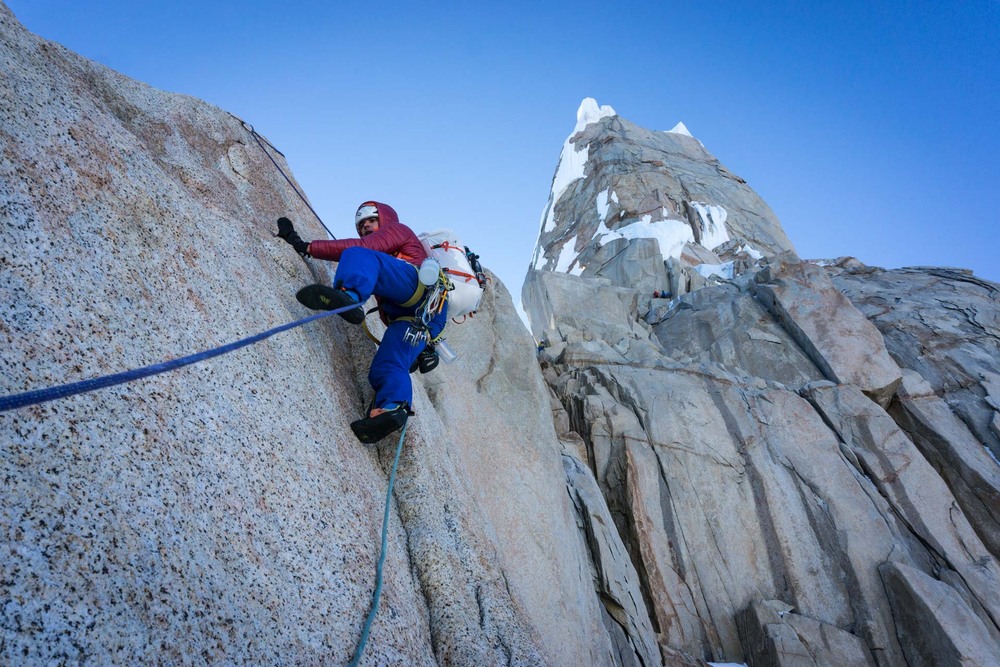 |
|
|
Both work its not that deep end of discussion |


