
 Continue with onX Maps
 Sign in with Facebook






Why Not Top Belay/Retrievable Rappel off a Beckett (actually a Blackwall) Hitch?


|
|
Just tried the setup in the OP picture... Hilariously unsafe. If the rope moves slightly, it pops right off. I can't believe anyone ever thought this was a safe idea |

|
Eric, don’t listen to all the hate. I’d be happy to go climbing with you- I’ll carry the ropes. |

|
Eric's belaying video is actually demonstrating an accepted belay technique (hand-over-hand), at least an accepted technique before everyone learned everything they need to know about climbing from a gym. His technique is a variation of the hand-over-hand method described on the AAC how to belay web page https://americanalpineclub.org/resources-blog/2020/4/2/belaying Eric's technique is not the SSS technique which I suspect is the technique tradiban was referring to that has be the source of accidents. There is no pinching of the rope with one hand while the other moves up. PBUS was standardized by the gym climbing industry because it works equally well with tuber and grr-gri devices, is reliable, and they needed only one method to simplify training new climbers but more importantly training of staff. PBUS has its problems too, especially if you take a long pull and cannot easily get you other hand below the belay hand. The hand-over-hand method also always has at least one brake hand on the rope, sometimes two. The real problem with the hand-over-hand method, especially as demonstrated by Eric, is that it will not work well with a gri-gri because the gri-gri is a right handed device, not an ambidextrous device. I suspect this is the real reason it was not selected as the climbing gym industry standard. PBUS is relatively new and is not mentioned in many climbing text. It is not in the 8th edition of Mountaineering, Freedom of the Hill published in 2010. Surely we could climb safely before then. |
|
|
Tradibanwrote: This is my preferred method for TR belaying someone. It works for slow climbers, works for fast climbers. Engages both shoulders equally, is very efficient, less hand movement reduces probability of any mistakes. Works really well for climbers who want a tight belay, works equally well for climbers who want to have a bit of slack while on TR. I would posit this is safer than PBUS - because the brake hand is always in the position of comfortable lock-off instead of being criss-crossed and sliding up. Edit - I don't wish to pollute this thread, hence the edit. When was the last time anyone saw a belayer with ABD using PBUS to take up extra slack when lead belaying? - This question is not applicable to Tradiban who always lead belays with GriGri standing in front of a mirror. |
|
|
climber patwrote: He's not doing hand over hand, he slides his hand off the climber side over the atc to the brake side. This technique leads to fumbles and is no good for lead. The climber not ever releasing their brake hand from the brake side of the rope is the best way to insure the brake side is 100% covered at all times.
I see the long pull problem with new belayors, a few reminders for short pulls and it ceases to be a problem.
Sure, things were "safe" then but times have changed the PBUS has proven to be best for the gym climber generation. Going to hand over hand just sets up people poorly to learn how to lead belay, learn PBUS at the start and stick with it.
It's ok for TR but like I said it does beginners a disservice when they learn to lead belay. No belay method or device is perfect but it's smart to learn one method and stick with it, the muscle memory pays dividends. |
|
|
Greg Rwrote: Thanks Greg! I'm glad we're getting to have a conversation about belay technique and dispelling some myths there. BTW, I got that belay technique from the AMGA Single Pitch manual. Here's another crazy Retrievable Rappel idea I just had 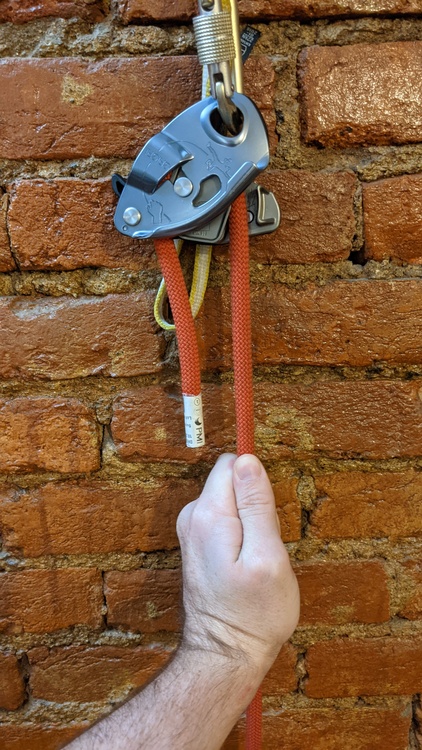 We trust a cam or a grigri because someone did the math and figured out the critical angles. The same engineering could be applied to a biner-hitch interface. I won't go that far, but I'll keep testing different combinations of hitch-biner-rope out of curiosity. |
|
|
Eric Mosswrote: Great idea, now you only need 1 rope and a dozen grigris to rap royal arches. Also I call dibs on rapping royal arches immediately following the OP |
|
|
Matt Robinsonwrote: 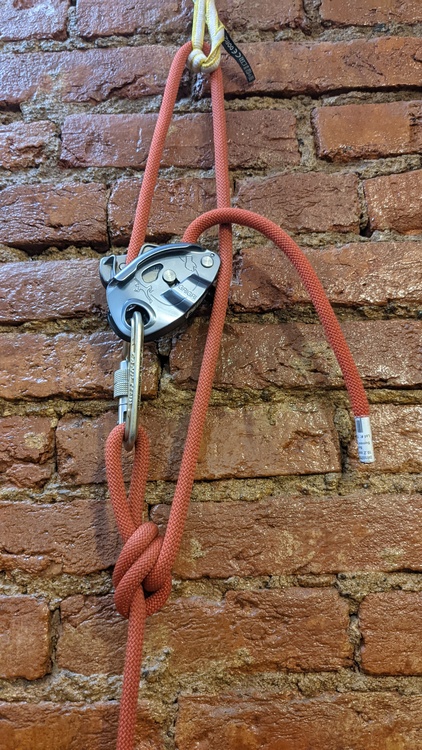 ROCK! |
|
|
Eric Mosswrote: Hard pass, dropping a grigri on my foot from waist level is bad enough Edit to add: congrats on "inventing" a more dangerous, heavy, and expensive escaper |
|
|
Matt Robinsonwrote: You still need a second GriGri to rap the contraption. Eric out of curiosity, what are your thoughts on flat earth theory. |
|
|
rocknice2, best question yet! |
|
|
rocknice2wrote: Nah, at that point I would rap on a munter to see just how much of a kinked, twisted clusterf*ck I could turn the whole situation into |
|
|
I think Eric has an Acetaminophen addiction. |
|
|
Superman capes or Pillowcase parachute?lol |
|
|
Aaron Kolb wrote: And then you have a KNIFE hurtling at you from 60m up? NO THANKS! And for that reason...I'm out. |
|
|
Matt Robinsonwrote: What have you ever invented? |
|
|
T Legowrote: Superglue bruh, what don't you get? I prefer just using a clove hitch with exactly 1/2" of tail, a gentle rap and 20 minutes of hard pulling. Works almost every time. |
|
|
Eric Mosswrote: Just looking at this gave my grigri microfractures . (Btw, why is it hanging off a sling now? Do you only own the one locker?) |
|
|
Aaron Kolb wrote: I'm sensing the next Climbing Hack. |
|
|
Eric have you ever played with the elastic fifi trick? Just get a fifi hook and add a robust and short loop (shorter than the fifis sling) of elastic cord to the eye, then attach your single strand of rope through the fifi loop and the elastic loop. Hook the fifi onto a bolt hanger…. When you weight it, the elastic stretches and your weights rests on the fifi sling, when you unweight it the elastic will contract and the fifi rockets up and unhooks itself from the bolt hanger. Presto! —please don't actually do this— |


