
 Continue with onX Maps
 Sign in with Facebook






Why Not Top Belay/Retrievable Rappel off a Beckett (actually a Blackwall) Hitch?


|
|
When I first saw this post a week ago I thought it was ludacris. Didn't try it, just assumed it was, from what I was seeing. Today I thought that maybe I was jumping the gun along with everyone else. So I decided to try it out. It's fucking worst than I originally thought. The slightest shift in the rope and it completely falls apart without warning. The second biners kinda helped but still managed to completely fail at times. Eric you need to take this idea behind the barn and shoot it. Your jumping sharks at this point. |
|
|
rocknice2 wrote:  I should have mentioned that the angle at the crook of the biner matters a great deal. Lesser angle is more stable. |
|
|
It's funny how people without imagination, when confronted with novel concepts, think they are being trolled. Such is the case throughout history, Socrates comes to mind. It may be because they are so committed to orthodoxy and herd mentality that they hate anything different. Anyway here's some data to consider (TLDR, simple Blackwall and stunner hitch failed, slipped Blackwall held and released, n=1): I'll retry the stunner hitch after rearranging the wraps around the biner, something like this (rearranged double stunner hitch pictured) 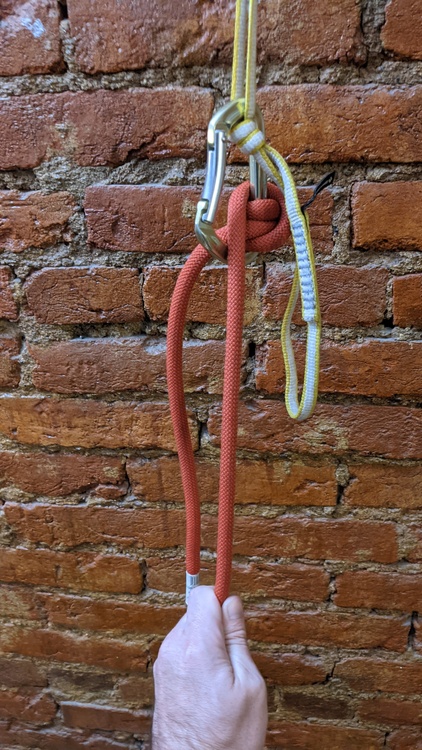 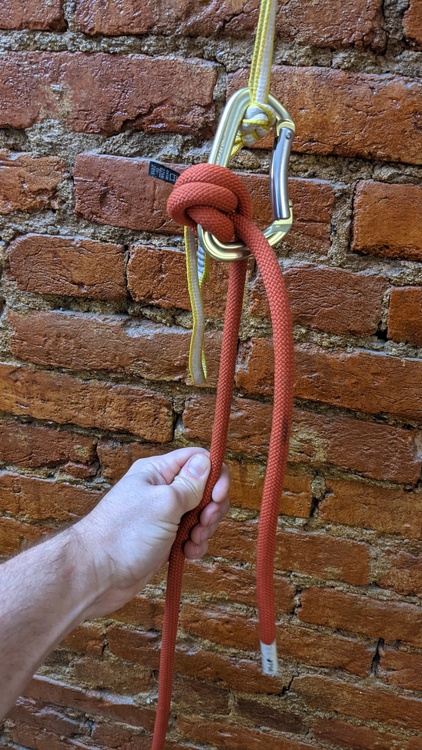 Clear your mind and imagine an apple. What does it look like on the scale below?  |
|
|
Eric, I think you're getting a lot of pushback, not because you're like Socrates, but because this suggestion violates a whole bunch of universal best practices and principles. The most obvious one is that you are trusting your life to a hitch which you have specifically selected for its ability to easily completely release and drop the rope. Nobody would choose to do that in any other climbing scenario, so it's really difficult for many of us to understand why you'd want to do this here, or how it could possibly be justified. We specifically choose to set up rappel systems in ways where small disturbances to the system (bouncing, rubbing, etc.) WON'T cause the entire system to fail, and us to plummet to our deaths. We use knots that have been tested and proven not to untie or roll with huge safety factors, we use locking carabiners on connection points, and we use rappel devices with a separate backup just to make sure that even one point of failure won't kill us. You're un-doing all of that and creating a point in the system specifically designed to release. 2 tests on a very short clean rappel are not very meaningful. A system like this needs to be 99.99%+ reliable, over a wide range of circumstances. People do hundreds (or thousands) of rappels over a climbing career, something that fails 1 time out of 100 is a horrific risk, so 2 tests under ideal circumstances isn't even scratching the surface. On top of that, this whole system appears to "solve" a problem that isn't even really an issue. We have a variety of reasonable ways to safely rappel various lengths, and none of them involve taking this kind of risk. Even the most sketchy (by far), something like a Beal Escaper, is WAY more robust than this system. I tried to watch your videos, but it was hard to figure out the conclusion of them given the long length and huge mess of belay and backup systems. One method appeared to hold one rappel, and then barely be able to release even with a completely clean free-hanging rappel and aggressive tugging. Putting all of the (massive) safety concerns aside, it's not clear that this hitch even does what you claim, which is be releasable from the bottom of a realistic rappel (a 30' rappel at Livezey doesn't really count). I think the mere existence of this post is dangerous, in the situation where somebody reads it and decides to try it without knowing better. |
|
|
Kyle Tarry wrote: Yeah, except people use a Beal Escaper, so... |


|
I tried this in my room where I play with new hardware and techniques. Every time I play with it the hitch inverts and looses all friction. If I had my weight on it I would fall to the ground and likely die. I cannot say more without violating rule #1. |
|
|
Eric Moss wrote: The beal escaper has been around for a few years and I have not heard of a single failure. I have one and use it occasionally. The biggest risk seems like it might not release. Sometimes I have to pull on it more than I expect (want) to get it to release. Even though it seems sketchy it is not. It is a very good product made by a reputable company. |
|
|
climber pat wrote: Exactly my point. I could not have said it better. People are spending so much time criticizing what they don't begin to understand. Menu To help maintain a good conversation, we limit the number of replies from one person within a short amount of time to a given topic. You are over the limit for this topic right now, but you can reply again later today or tomorrow. You can view the details here . In case you want to copy/save your text, this is what you were going to post:
You said there's no need for it, but that same need is filled by the Escaper. You're contradicting yourself.
Yes, you did say that. Perhaps not what you meant, but obviously rappelling a full rope length with retrieval is an age-old problem with solutions perhaps to be discovered, perhaps here.
You should check out the DAV manuals, it'll blow your mind https://www.mountainproject.com/forum/topic/118805298/i-translated-two-dav-manuals-links-provided-and-i-have-some-questions  |
|
|
Eric Moss wrote: A few points below. I suspect a discussion about this will not be productive, so I am going to step out at this point. 1. You have completely neglected to address any of my other points. The mere existence of the Escaper doesn't make them all moot. 2. The Escaper is a SIGNIFICANTLY more robust system than your proposal. Nudging the rope slightly on the Escaper will not cause total system failure, while you have acknowledged that your system will fail if the rope gets slightly moved in the carabiner (as it might, due to bouncing, or bumping on the rock, or whatever). This is a massive difference in the risk of the two systems. 3. Many people would say that the Escaper is already well outside their personal risk tolerance, for reasons I already mentioned. So, there is no surprised that a less tested, less robust, more dangerous system, which may not even release as well, makes people uncomfortable. 4. You have a history of proposing unorthodox solutions for scenarios that already have robust community consensus solutions in place, and your solutions usually are not based on significant testing or significant experience. That doesn't, by itself, mean your solutions won't work, but it's a pretty shaky foundation to start from.
No Eric, I didn't say that. I said "We have a variety of reasonable ways to safely rappel various lengths, and none of them involve taking this kind of risk." Don't create a straw man. |
|
|
I hope your climbing partner realizes your incompetence to asses risk, before it's too late. Your comparing yourself to Socrates. You are the rock climbing equivalent of Solar Roadways |
|
|
Eric Moss wrote: Just to be clear, I am saying the beal escaper is not sketchy. Your method is very sketchy and dangerous. |
|
|
Eric Moss wrote: Except for the fact that your proposed idea seems sketchy and actually is, by a huge margin. Now your just trolling or being an idiot. You choose. |
|
|
The doors of perception have been cleansed. There was no climbing and there were no climbers before the TopBelay/Retrievable Rappel Off a Beckett! We're being shown The Way. Do you have the courage to believe? NB: but obviously rappelling a full rope length with retrieval is an age-old problem. Absolutely! Why didn't we all see this? |
|
|
Aaron Kolb wrote: Why? He is following all the basic rules, he's just faster. This is how you lose people... demonizing and hating on something that is perfectly fine. |
|
|
Aaron Kolb wrote: I wouldn't let anyone belay me with an atc. So, yes, id let him work his magic with an ABD while i whip, all day. |
|
|
Matthew Jaggers wrote: Why? He is following all the basic rules, he's just faster. This is how you lose people... demonizing and hating on something that is perfectly fine. I wouldn't let anyone belay me with an atc. Ummm, ok? |
|
|
Matthew Jaggers wrote: Accidents have occurred with his belay method. It's okay until it isn't. While making the switch from left hand to right hand there is a moment where a hand is not on the brake side completely, if someone falls at that moment the belayer can lose control and once the rope starts moving it's not going to stop. It looks okay in a video, a controlled situation, but in reality introduces unnecessary risk. Climbing is not something to be "hacked". If you're a beginner climber reading all this please, please, please use tried and true methods and do not learn techniques from YouTube hacks. "It only takes once to die." -Tradiban |
|
|
Mountain Project needs to delete this non sense. How can they leave this insanity for a lesser experienced person to find. Allowing this stupidity to remain available is dangerous. |
|
|
Calm down. Anyone reading this thread who has the takeaway of “ thanks for the great new belay or rappel techniques!” is not long for this world regardless. |
|
|
Tradiban wrote: And another thing, this "hack" wouldn't work for lead belay. Plus, would only be helpful if your climber was climbing at running speed. I PBUS like a good boy all the time with some damn fine climbers on the other end who climb pretty fast. It works, use it. As for the hitch rap thing, I do appreciate outside the box thinking and I wouldn't dismiss anything without a review, but this thing is all splat on the rotten meter. |


