Continue with onX Maps
 Sign in with Facebook






Making Eldorado Canyon Climbing "Safer"


|
|
If it’s a pin protecting a crux/bad fall, replace it w a bolt. Fixed hardware might as well be reliable and easily assessed by those who use it. Using ancient pins as pro is my least favorite part of eldo. |
|
|
Nick Awrote: Happy to answer that and I'm assuming you are familiar with the area. Otherwise, you may want to leave this to people with the local knowledge. The bolts you mention (Bastille and Calypso) are at the top of the first pitch of multi pitch routes. They are rap anchors. Walk off is not an option (unless you free solo). People often do just the first pitch of these routes. They not only serve as a way down for these routes, but also for routes nearby. There are no bolts further up on these routes. As you go higher you must build natural anchors. Washington Irving is similar, but these anchors serve as the path of least resistance for descent for the climbs above. It is a rap. The location in question on Wind Ridge is far too high for a rap with a single rope, not to mention there is a large ledge with an easy walk off that serves as a better option to prevent clogging up the route while rapping down. Furthermore, adding bolted anchors certainly dumbs down the route and the area. This may entice more climbers without the needed experience to lead the route. We've all seen the threads where the op is asking for trad routes with bolted anchors. Why? They lack the knowledge or experience to build natural anchors. Well, I assert, if you are not competent at building anchors, you aren't qualified to lead a trad route, especially in Eldo. Slinging a tree is one of the most basic anchors taught to beginners. Slinging a boulder is not much different, which is one of the many options for a natural anchor on the second pitch of Wind Ridge. I believe Eldo's reputation is one if its best assets protecting against many more accidents. Adding bolted anchors would just entice many more climbers not properly trained leading to more accidents. Imagine how many more inexperienced climbers would show up if they knew Eldo had mostly bolted anchors. |

|
WF WF51 wrote: I think the difference in thinking is the availability heuristic: taking up climbing is now seen as a commonplace choice like taking up golf, whereas it was a reckless/fringe activity a few decades ago that few would attempt without a mentor.
I know that you are wrong on this score. The climbing community may be loosely connected and highly individualistic, but it is a community. Carry on, |
|
|
It is funny people seems to default to BOLTS when referencing his thread. I agree with Steve Levin that the real problem isn’t how “safe” the climbs are but the competency of the average climber. As a climber of many years I can say that overall the level of skill is very poor. I see sketchy behavior nearly every visit to the crag. I get the sense that the gym raised climber is a bit naive with regards to danger. I’ve considered guiding again myself just to help educate newer climbers. It frustrates greatly to see people out climbing knowing their skills are not up to task and they are likely to get hurt. I’d be happy to offer my knowledge to help educate or mentor young/new climbers. There is a lot to learn. Especially if you want to to stay safe in a place like Eldo. But I’m not currently certified. But it seems like some kind of education system would help prevent accidents like the most recent one. |
|
|
Will Cohenwrote: My route comments stand on their own, even if you disagree. Once again, for you, Will Cohen, and all you folks that want to bolt up Eldo belay stations like your neighborhood climbing gyms, either approach ACE with your requests, or learn climbing and traditional protection and anchoring skills appropriate for the routes there, or both. There's probably more climbing accidents in Eldorado Canyon because there's more climbers there than most anywhere else in Boulder...Statistics can be misleading. |
|
|
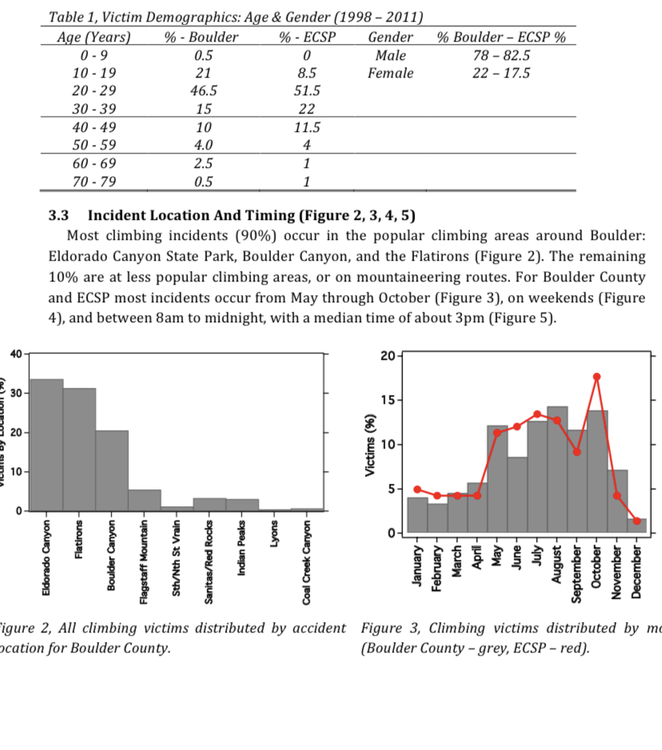
Peter Thomaswrote: A quick look at this document, mostly the charts, makes me think that the majority of accidents parallel that of avalanche victims, males in their 20s-30s with enough experience to get in trouble and not enough to know or say when they are in over their heads. It's not bolts that are needed, it's a fully developed prefrontal cortex. Evolution values risk takers, up to a point. |
|
|
Steve Levinwrote: Steve: Thanks for all you do for Eldo. My only two cents are about thought processes. I've found it pretty helpful to approach climbs with fresh eyes as much as possible. In the case of Wind Ridge, I'm pretty happy building a hanging belay 10-15' below the nasty red ledge. Solid gear, lets me see my second as they ascend p2, and lets the belayer see the leader as they ascend p3. And maybe next time I'll try going up p2 and clambering around the funny overhang on p3 before setting a hanging belay. I don't think anybody has gathered data about climbing accidents per capita at different front range areas. My hunch is that accidents at Eldorado frequently have more severe consequences than those at other front range crags. That tends to go into the mental hopper at the beginning of the day; hubris is a dangerous emotion here. I think it is possible to safely push one's grade here by consulting with more experienced climbers. There are some great 10 and 11 routes that can make safe leads for people breaking into those grades, and there are some 5.6 and 5.7s that are best approached with years of successful eldo climbing under one's belt. I suspect willingness to learn and seek advice is antithetical to hubris. |
|
|
chummerwrote: There is a lot of "gym-to-crag" education and guiding instruction happening these days, but it's obviously not enough. How can we get this education out there to more novice climbers? (My intent for this thread is to brainstorm ideas for reducing risk, so perhaps novice climbers may gain some insight reading this thread.) |

|
Steve Levinwrote: Steve, annually(?) Colorado Matters speaks about avalanche accidents with CAIC, CMC and others. Maybe you're the individual to make that an annual conversation on cpr. Bigger picture, if it were simply educating people, then smoking would not exist. |
|
|
Steve Levinwrote: Not much of an answer, I know, but like everyone does I adjust to what's there, and I try and climb sensibly. Nothing radically different, really. El Dorado does have challenges that are distinct. |
|
|
Greg Dwrote: Thanks Greg, great post and very helpful. I never considered that the bolts would lure people to get in over their heads. Very interesting point. Also..., I guess I was aware that the bolts on bastille and calypso and the like are rap stations.... I suppose I was reaching for examples of bolted belay stations and precedent. Thanks for the great info. I changed my mind. I love eldo because I love how wild it is. Learning non obvious anchor building, placing tons of gear and following a lot of pitches was definitely an experience I wouldn't want any new climber to miss. |
|
|
With so many climbers it’s difficult to even let all the folks who need more instruction know they have an option to improve their skills. I don’t know how. It seems like “herding cats.” But i would love to help educate. |
|
|
thegreer Machine wrote: I appreciate being considered a hard man for doing well protected 5.6 routes on Wind Tower, that certainly does inflate my ego. You should see me sew up the East Face of the Third Flatiron. |
|
|
thegreer Machine wrote: The dumb "hardman" days are over. Peoples lives matter more than your fragile ego. If the rock is choss and pro is sparse, add a bolt. Isn't "dumbing down" a route that has been successfully climbed 10,000 times a reaction from a fragile ego not accepting the lack of ability to follow in those 10,000 footsteps with style and grace? |
|
|
Dave Hurstwrote: Try doing it on the second and you’ll earn a gold star. That thing was way easier to solo than it was to bring my wife up it |
|
|
Steve Levinwrote: Steve - I just want to thank you for putting in such a monumental effort to provide a safety rating for every climb in your guidebook. I think that specific action has likely prevented more injuries and accidents than can be counted. |
|
|
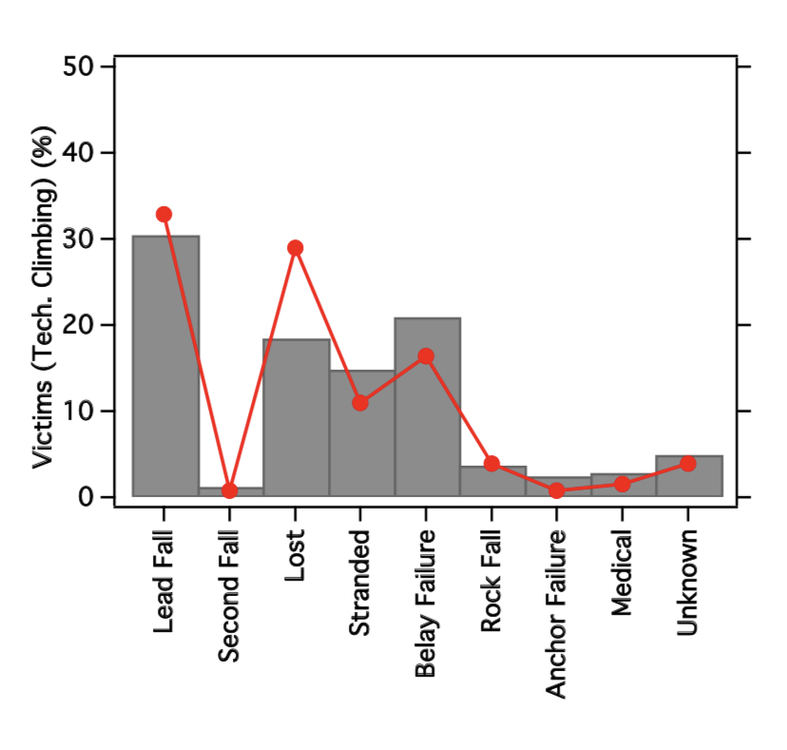
thegreer Machine wrote: I'd like to see a citation for that statement. Of the one data set published, it is 34% and35% of those by the stats are lost/stranded, which isn't something that is super likely at a single pitch sport cliff in Bocan. |
|
|
Peter Thomaswrote: Yep. I'm not sure how RMR can track accidents where they are not called and don't show up, IE: someone breaks arm on a single pitch climb and lower and gets taken to a clinic for Xrays and a cast. But when it is 3 pitches up, they are more likely to get called, especially when park staff can see what is going on and 1/2 the canyon can hear it and has cell reception. All unlike in Bocan. |
|
|
Steve Levinwrote: I am an old school trad climber. I think it is helpful to have a checklist/system of fundamental principles and rules that apply to every climb. A system of solid habitual practices reduces risk exposure even when things are stressful, casual, or distracting. For example:
|
|
|
There's the Know Before you Go avalanche education program and that has been widely shared and promoted by mountain towns and skier related organizations. With annual deaths roughly the same should we be advocating for something similar for the climbing community? We've always been somewhat self regulating and insular but with the growth of the sport I don't think it's a bad thing to have a state sponsored program at least communicating that climbing is dangerous and there's life and death consequences. A program wouldn't prevent every injury or death but at the very least it could communicate that some climbing areas are heads up and you better have your stuff together. It sounds corny but get Jimmy Chin on the video and have him talk about how great climbing in Eldo is but also that it can be more demanding and complex. If I'm a newbie and watched that it would give me pause and I'd at least consider whether I had the skill set or not. |