
 Continue with onX Maps
 Sign in with Facebook






Making Eldorado Canyon Climbing "Safer"


|
Steve Levinwrote: For me, I approach every route in Eldo with a lot of humility and respect. This equates to choosing routes that are well within or below my usual grade (if I am leading), studying topos (descents for sure, bail options, try to minimize route finding clusters), and pretty picky about my climbing partners - probably would not climb with a new to me partner in Eldo as a 1st outing. I try to avoid getting tunnel vision for gear placements - I think it can be really helpful to have a wide focus as good options are not always super obvious. Unless I am spending a LOT of time in Eldo, it feels pretty insecure with tricky gear and complex route finding/descents. It requires a different head game than most of the other places I climb.
|
|
|
Will Cohenwrote: Wind Ridge is not any less safe than other Eldo routes. Youth and ignorance are no excuse ; for those inexperienced folks, more professional rock climbing instruction is available now than ever before. If we bolt the belay, why not a bolt ladder up the whole dang route, or like the man said, why not convert it to a via ferrata? After all, why make rock climbing an adventure sport in any way? I mean, if we have to start bolting 5.6 trade routes, what's next? |

|
Eldo is safe as is every area in existence. You know why? Because it is the climbers choice to hop on a route. This argument is equivalent of pouting about being a “green” run skier and wanting to ski “blacks.” “I wish they would make them easier because they look so fun.” That is the wrong train of thought and is playing the victim. If a route looks too hard, scary, licheny, choss, whatever…choose not to do it. Climbing, as I would imagine most outdoors sports, are loved for the adventure. Some people like it tough, some people like it easy, some bloody, some Instagramy, some scared as fuck. Do whatever you want and only blame yourself for putting you in that situation. We all take on risk whenever we go climb so learn to analyze risk better if that bothers you. On a side note, and I say this in no relation to recent events, in my opinion none of the stuff I do would be fun if people weren’t getting hurt or dying. That’s what makes it exciting. This rant isn’t directed at the OP I just hate when it always comes back to the whole “how can we tame nature” thing. Nature is wild and I want to keep it that way. PS: I also want to add a brief story that summarizes this concept. I had a bad BASE accident a few years ago and could have easily died but instead broke a bunch of stuff. Did I blame BASE jumping, the cliff, my canopy opening the wrong way, the gravitational pull of the moon…no. I know what I signed up for the day I started jumping and I am solely to blame for my accident. If you cant legitimately accept the risk you are taking then you shouldn’t be doing it. If you are too inexperienced or jumping hoops too fast to not even know the risk you are taking then that is also your own fault. |
|
|
Cool you went from adding a belay to turning the wind tower into a via ferrata... You're not arguing constructively here. Kids didn't she'll out for guides when you learned to climb they won't now either. The mentor system is dead, and we need to adapt. Your only comments on routes on mountain project are complaining how it's not like the good old days. Rocky mountain rescue group statistics show >half of climbing rescues are in eldo. It becomes not only a community issue but a land manager issue as well when these types of incidents happen. The NO BOLTS EVER approach doesn't keep access and doesn't keep these incidents out of the press and Don't save volunteer or tax payer dollars |
|
|
Nick Awrote: I think it comes down to the same reason we don’t want a bolt at the multi-death cruxes of nearby Calypso (5.6) and Bastille Crack (5.7). Steve, for Eldo, I think reminders to beginners that 5.6-5.7 in Eldo is not beginner lead climbing would be a good addition to the effort. |
|
|
Jim Twrote: Both of which you can sew up |
|
|
Will Cohenwrote: What incredible and complete nonsense. So Will, an anonymous committee is going to take responsibility for YOU. We're gonna tell you what you can climb, when and with whom. We're gonna tell you that you need to take this massive 20lbs rack, two ropes, a helmet and a cup to climb Wind Tower and you gotta place a piece every two feet so that it won't be unsafe for the people who will be climbing. Oh, did I forget to mention the tests? And if you want to appeal, you gotta submit it in writing two weeks ahead of time. You'd just love that, right?
So what, and who cares? Bolted anchors do not replace of competency, and it's competency that beginners lack (by definition). |
|
|
Will Cohenwrote: Speaking of not arguing constructively... nobody ever said "no bolts ever." |
|
|
Tony Bwrote: I'd expect that a multi-pitch accident is more likely to result in a rescue than singe pitch climbing, but I'm wondering where you get your stats for how >1/2 of climbing rescues are in Eldo? If it’s what I think it was, the claimed number is a little skewed, and a little misleading, and as usual, very few are from anchor failure. 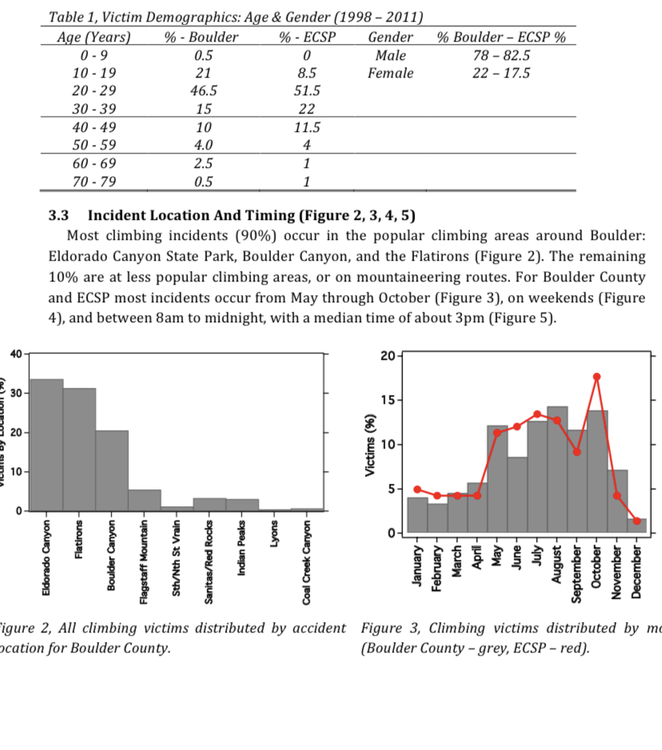 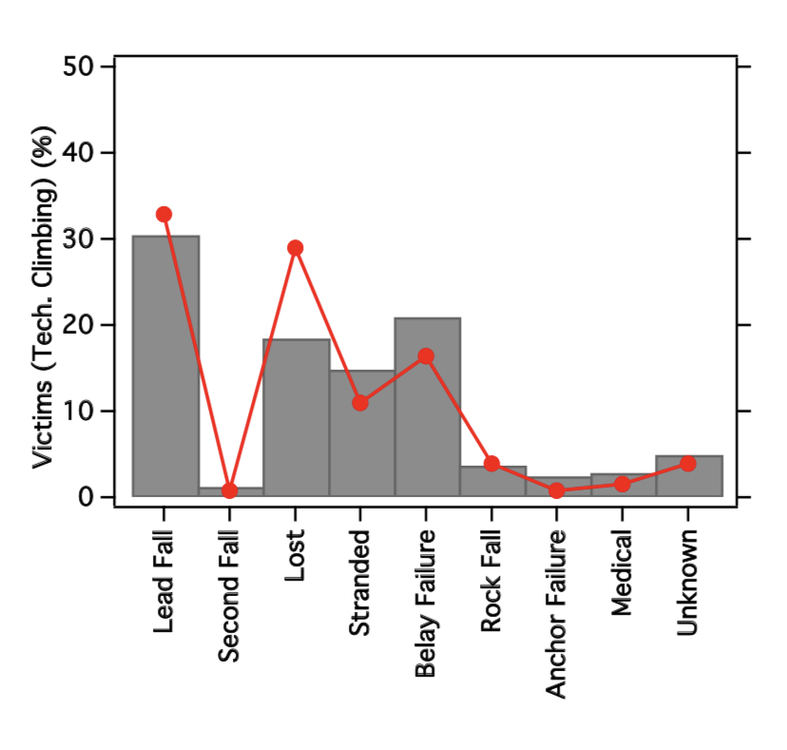 |
|
|
First off: Who the hell belays directly below the hueco? Link the pitches so if you fall you have the whole rack you left behind in the finger crack that you were slab campusing up. Anyways, it sucks that these people died. But, climbing isn’t fucking safe. I had an absolute meltdown on a 5.10 there this past week. I’ve done some R stuff in eldo, climb 5.12 on bolts. It happens to be that the mind is often the weakest part of everybody’s rack. Not knowing what you don’t know can get you in a world of trouble. More importantly, knowing what you can manage can help keep you out of trouble. To Steve’s question: Honestly, one thing that helped me eons ago was Topher Donahue’s advanced rock climbing book. That plus any of John Long’s anchor books should be right next to the shitter for when your legs go numb. If you can build good anchors, you can place good gear. Put down Instagram and read a book. Lastly, Eldo is a place reminiscent of the ethics of previous generations. The values of adventure, self reliance, and gracefully skirting danger were not unknown to the post war generations. What we can’t do is to allow one of the few microcosms of true self exploration to have “the corners padded” just because someone gets injured after they bit off more they could chew. |
|
|
Alexander Blumwrote: This is a repeated theme that often causes some level of blindness, getting/climbing oneself into trouble. Judgement reigns supreme! We're constantly judging; grip, gear, rock, partner, fall/injury potential, weather, etc. Continuous, critical judgement is commonly deficient. Yet we look outward, rather than inward, for what we feel is the expedient solution in the form of bolts. The byproduct is complacency. We become great bolt-clippers at the expense of judgement and proficiency. Ryan Marsterswrote: 'I've never really cared for the thinking that I should risk cracking my head...' Nobody but you telling you to risk anything. Honest, internal dialogue fuels self-preservation. Embracing deadly accidents for ancient pride? The norm has been to embrace personal responsibility, history and tradition, without which we have a progressively lower bar, predictability and eventual vapidity. Again, more outward thinking about what 'you/community' can/should do for 'me' to make me 'safer' vs. inward responsibility. That is more dangerous (complacency) than sinking bolts. Re: grade pushing, Eldorado Canyon may not be conducive to pushing numbers for some but others, across all levels of difficulty, seek to hone their head and numbers game. On that quality, Eldo is superlative. Will Cohenwrote: '...where people who don't know any better... there's a certain amount of responsibility the community needs to take for avoidable problems.' Why don't they know any better? Because there wasn't a shiny piece of steel to clip? Not much to learn clipping a bolt. Much to learn when looking at a boulder as a potential anchor. We can only do so much to protect people from themselves as 'protections' (incl rules/regs) invariably encroach on the competent. Waning personal responsibility is a problem. Stop demanding minimum competence and watch it disappear. |
|
|
Some software communities have functionality where a user can add feature requests that are then voted on by the community members to prioritize future development. Maybe we can figure out something similar that works for specific climb areas? Consensus bolting? No one wants bolts everywhere but I’d guess there are certain spots where the consensus would reveal that bolts would help to ensure everyone goes home safely at the end of the day. Climbing accidents that involve rescue personnel put a ton of people |
|
|
"Climbing accidents that involve rescue personnel put a ton of non-climbers at risk." Why are non-climbers involved in a climbing rescue? Also all the volunteer SAR people I know want to go on rescues and would take responsibility for their own safety. --- I don't remember that climb being hard to build anchors for, (maybe I was clueless those years ago) but if it is too mysterious for new leaders, it should get an R rating and a heads up in the guides about how to mitigate the hazard. Those that want more adventure can skip reading the guide. I am a fan of solid, obvious anchors for descent routes in high use areas. Weather and other objective hazards etc. |
|
|
Jim Twrote: I definitely remember a bolted belay station at P1 on Bastille. And also on Calypso.... I feel like the question is whether or to add bolts at the belay stations... these are pretty prime examples of classic eldo climbs where that was done. |
|
|
Gregger Manwrote: |
|
|
Great idea Greg. If online is the new go to source then a few instructive images may help. Adding bolts kicks the can down the road. Are we going to put fixed anchors on every pitch? People need to learn the skills and decision making that apply to any crag. If the original leaders put bolts at the end of every pitch, we would all still be climbing with 50 m ropes having never learned to build our own anchors. |
|
|
Nick Awrote: Have you read the whole thread? I think the pros and cons of bolting trad lines are well articulated. The consensus appears to be that adequate anchors exist on Wind Ridge and newbies guiding newbies was definitely not recommended. Individuals have mentioned online sources for learning and recommended practicing skill before your life depends on them, aka know before you go. Relying on others to solve problems for you or taking the risk out of everything has never been a plan for success. |
|
|
Will Cohenwrote: There is plenty of gear available at the P2 Wind Ridge belay besides the boulder. I've placed a .5 tricam and nuts. And if you are so inexperienced that you don't consider upward forces you are an accident waiting to happen. Hell, I ALWAYS place a piece for upward pull. For instance, I went to West Crack on Whale's Tale a few months back, and you can better believe I placed for upward pull. |
|
|
Steve Levin wrote: Steve, I think that your original point, what do individuals do to manage risk, in Eldo or any challenging environment, is a worthy discussion for climbers of all abilities. I would be interested in hearing more about how experienced individuals identify and manage risk. A few suggestions have been made such as not climbing above one's ability or rock craft skills, partnering with a more experienced climber, and so on. Eldo provides a challenging environment in which to learn and the lessons learned transfer well to many other climbing areas.
|
|
|
mountain trollwrote: Yeah i have been reading the thread. Still curious why bolted anchors at the belay on Wind Ridge would be a bad thing? There are a lot of bolted anchors in Eldo. Especially on these types of routes, calypso, bastille crack, washington irving.. a lot more i'm sure. Obviously bolted anchors are sometimes cool, so why is it not cool for Wind Ridge at this belay station? |


