
 Continue with onX Maps
 Sign in with Facebook






Best Practice: Extended Rappel vs Belay Loop Rappel?


|
|
slim wrote: Golly, you're one crusty climber! Anyways, I was doing some side reading and came about this on an AAC article:
Source: publications.americanalpine… |

|
I extend my rappel for better control. I used to clip my third hand to my leg loop but then a buddy who has some AMGA certs asked me this question “if your rappel device were to fail, would you want your third hand to be clipped to you leg loop or your belay loop?” I’d prefer not to hang from my leg loop. |
|
|
Irreverent Bastard wrote: If your belay loop were to fail wouldn't you prefer to be saved by your leg loop? |
|
|
Jim Titt wrote: Yes, I would. I’d prefer not to fall to my death. Although, hanging from a single leg loop sounds unpleasant. Edit: I don’t let my harness get tattered. |

|
The system Mikey describes is great. My only dislike with it is that with both ends clipped to the person rappelling, there's far less opportunity to relax the twists out of the rope than there is with the rope ends left free hanging. This can be annoying with many rappels. If rappelling on two ropes and it's not too windy, I'll only clip one knot to me, the one opposite the joining knot at the rappel anchor. This closes the system, especially if the rappels are pre-rigged. The other rope gets clipped to the harness with a draw or carabiner; this doesn't retain the rope end, but it does prevent the rope from swinging away on a traversing rappel. With either system, having the knot clipped to you also prevents accidentally forgetting to untie the knot(s) before pulling the rope. It's not possible to pull the rope if the end is clipped to you, so you can't forget it. (If it's windy or there's other risk of the rope getting stuck, I just clip both ends to me and deal.) |
|
|
Agreed on what Derek said about clipping the ends to you, I'll only do it if necessary, twists in the rope can be horrible by the end of the rap if they are not dangling free. No extension for me, leg loop or nothing. |
|
|
Irreverent Bastard wrote: In other words because someone with some AMGA certs posed a hypothetical scenario you changed to a less safe system? |
|
|
Drew Alldredge wrote: As had the belay device so its failure is also excluded. |
|
|
Jim Titt wrote: Well, a good friend and long time climbing partner who also has multiple AMGA certs critiqued my set up. I just mentioned his certs since it is more credible on here than "my climbing buddy". So yes, I listened to his advice. I understand the lack of redundancy in hanging solely from the belay loop, however I view the strength of the belay loop to negate that issue. If you don't trust your belay loop then you shouldn't be rappelling (or climbing for that matter). I see myself botching threading the rope through my device more possible than my belay loop failing. Without any data to back me up, I'm fairly confident that more accidents are due to failure to rig rappel systems correctly than belay loop failure. Seems safe to me! |
|
|
I don't think anyone has mentioned this, but another advantage to an extended rappel is that you can quickly and easily convert an ATC guide to an ascender by clipping the guide hole directly to your belay loop. |
|
|
Irreverent Bastard wrote: Hanging from a belay loop is redundant, it's 2 independent loops connected to 2 leg loops. Don't worry about, it's fine what you are doing. |
|
|
Irreverent Bastard wrote: Are you hitching your extension to your belay loop instead of your tie-in points? I was told that was the "wrong" way to do it, at least partially for the reason you're mentioning. But your buddy said it's better hitching to the belay loop? |
|
|
JonasMR wrote: if it's good enough for a helicopter ride, it's good enough for rapping on...(though i would not recommend leaving a sling permanently attached to your belay loop) 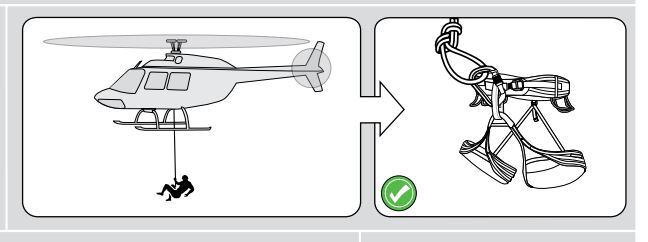 |
|
|
curt86iroc wrote: Absolutely good enough. But the point of wiring a way to do things is to make it even better at no/low additional cost, no? |
|
|
Irreverent Bastard wrote: For me, there are a couple disadvantages with girth hitching off the belay loop:
The wear-out is easily guarded against through regular inspection of gear and assuring even wear of gear (for the belay loop, it'd be rotating it every once in a while). Ultimately, we do what we're comfortable with but should have sense of the risks we're accepting and the measures to properly guard against or mitigate them. [1] https://www.rockandice.com/climbing-accidents/todd-skinner-killed-on-leaning-tower-rappel/ |
|
|
James Jen wrote: This is only an issue if your rappel extension is permanently attached to the belay loop. If you are only attaching your extension for a series of rappels and then it will come off until the next time you do multiple rappels, this is moot. Also, note that it's not really the sling rubbing that is a problem. A tightly hitched sling isn't really rubbing on anything. The hazard is the rubbing on other points of the belay loop, when climbing and walking, which might not get distributed since the belay loop could become stuck or fixed by the tether. A subtle difference, but important if you're trying to inspect a harness. Of course, if you're talking about the permanent attachment of a PAS, follow manufacturer's instructions, but that's not really the same scenario.
Does it? Doesn't the extension girth hitched to the 2 tie-in points just squeeze them together and effectively put the load into the exact same point on the harness as the belay loop? I don't really know for sure because I don't usually use my tie-in points for this, but it doesn't seem intuitively better. |
|
|
Hmmm.... Since YMMV, for everyone, I'm thinking it's time to rig up close to the ground, and go inverted on rappel! I've been meaning to tweak that righing, anyway, keep improving efficiency up at the anchors. I rarely rappel these days, there is hardware for lowering going in most places I climb now, single pitch, anyway. Thanks, ASCA! But, there's still lots of multipitch out there I've not been on, and single pitch topouts with a separate rappel station for the whole rock, are common, too. I've only flipped upside down in climbing mode, on purpose, to see what my harness does to me. Closest I've come outside, was a minor pendulum fall on top rope. Ended up fully horizontal that time. Thanks to all of the expertise, and back and forth, here! Best, Helen |
|
|
Jim Titt wrote: Normally I track your logic pretty readily, but I'm missing something here. I absolutely understand the issue with the appeal to authority. Could you explain what makes a friction hitch back up on the belay loop used in conjunction with an extended rappel less safe than a rappel on the belay loop and a friction hitch on the leg loop? (Or I've misunderstood what the two things being compared are.) Depending on what factors are considered, I could see arguments in both directions. . |
|
|
Big Red wrote: Extension as commonly taught is way too long. For the normal everyday benefit of extension (removing the friction hitch's dependence on an upright climber position), the extension only needs to be 3-5 inches longer than the belay loop - that's enough to allow a friction hitch to work on the belay loop (if the friction hitch is just the right length), and 3-5 inches has a negligible effect on one's ability to weight the system. Alas, some popular PAS products don't allow such a short extension. I use a nylon sling with knots for PAS, so I can position the knots where I need them. |
|
|
june m wrote: And carrying a knife on your harness (that you can operate with one hand if you don't use third-hand) |


