Mountain Project Logo

Best Practice: Extended Rappel vs Belay Loop Rappel?

Simon Thompson · · New Paltz, NY · Joined Apr 2011 · Points: 900

In the scenario where I want my friction hitch to engage as my brake hand, I want to know without a doubt that it’s going to do its job. For that reason I always extend and use a back up if I think there’s a chance I will want it. This can take less than a minute to set up with common materials if you practice just a bit. The extra control of having a better braking angle is an added bonus. On some short raps with almost all the variables known, I may choose to rap directly off my belay loop with no back up. 

Connor Dobson · · Louisville, CO · Joined Dec 2017 · Points: 269
Danny Herrerawrote:


https://www.youtube.com/watch?v=4A8-jsLAZV4

Ugh seems like a bunch of gumbies ripped the brake handle open. 

Mikey Schaefer · · Reno, NV · Joined Jun 2014 · Points: 233
Samuel Parkerwrote:

https://youtu.be/NkbX3-H7pLk

Great Vid from Roddy's channel about best practices for rappelling as a team.


A couple of things I definitely do differently or would point out in that video.  If you notice he takes his belay device off the rope after reaching the lower anchor and before his partner comes down.  It is hard to see and he doesn’t mention it but he keeps his prusik (or autoblock) on the rope.  This keeps the “loop closed.”  This protects against a couple things, firstly if your partner isn’t pre rigged and then fails to correctly attach their belay device, the lower rappelers prusik adds some security.  Also, it is always a good idea to maintain control of the rope from the lower anchor in case something happens to the upper climber or the wind picks up and blows the ropes away.  I believe this should be standard practice in rappelling but the only people I know that regularly do it are guides.


secondly, why are people going through the work of tying knots and tossing them when they could just clip the knots to their harness.  This does two things, it keeps the loop properly closed and the knots aren’t gonna get caught by the wind and fly around some corner and get stuck on something.  Also, when you get to the lower anchor you already have an end of the rope to start feeding through the anchor, instead of having to possibly pull up a bunch of rope.  This is standard procedure for me.  A long time ago while rappelling Washington Column, I rappelled first, un clipped the ropes and let them go.  Wind picked up, blew the ropes away, knot got stuck and I was sitting there at a hanging belay with no partner and no rope.  Sorta made me question why I ever let go of the rope…

And more directly to the OP’s original question.  It depends?  95% of the time I use a prusik on my leg loop and don’t extend.  If I’m rapping with a heavy load or an injured partner I extend my device and put the third hand on my belay loop device.  Regardless of what method you normally use, get comfortable with both.

slim · · Unknown Hometown · Joined Dec 2004 · Points: 1,093
JCMwrote:

Correlation or causation? 

In other words, is this because extended raps inherently create a bunch of faff (causality) or because there is a high correlation between climbers who extend raps and climbers who are slow bumblies? I'm not sure what the answer is. Agree with your general observation though.

-----

My experience is that extending the rap is fairly quick and convenient if your are already using a PAS or other such tether in your harness. If you don't use one of these, it is a much greater hassle. I don't use a PAS for regular climbing outings - I don't like the harness clutter of climbing with a PAS rigged up. And I don't want to faff with setting up some sling tether just to rap. So, I do not extend the device.

I think it's probably both. A couple examples. 

A), i was at jtree a while back and watched a young woman try to rappel for at least 15 minutes. She had kind of a clusterfuck and couldn't figure out what she should unclip or reclip. She kept unclipping stuff and then freaking out abd reclipping it to something else 

B) one of my friends was climbing with another very experienced partner who had recently switched over to the extended setup. They were up a ways and getting pounded by a thunderstorm, so they started rapping. The woman he was with kept having a hard time at each rap.  It's too long, it's too short, it's too this, it's too that. He was getting prettt pissed because she was really slowing things down with all the fadfing around.

People are always telling me it's just as fast and so much better, but when i watch them it looks like it sucks. Take for example those cases where you are doing the belly-slither-offa-tower-down-onto-that-anchor. That turns into a lot bigger drop when your belay device is extended.

No thanks...

Kyle Tarry · · Portland, OR · Joined Mar 2015 · Points: 448
jdejacewrote:

First person to go down raps the Grigri on 1 strand, second raps both strands with an ATC and fireman belay. No extension/autoblock shenanigans necessary. 

If you have to do a lot of rappelling, it is really nice to have the first person working on setting up the next rappel, as opposed to standing there holding onto the ropes for the duration of the second rappel.  I do agree that the fireman works great in a lot of other scenarios though.

slim wrote:

I think it's probably both. A couple examples. 

A), i was at jtree a while back and watched a young woman try to rappel for at least 15 minutes. She had kind of a clusterfuck and couldn't figure out what she should unclip or reclip. She kept unclipping stuff and then freaking out abd reclipping it to something else 

Come on.  It took 15 minutes to start the rappel, and you're seriously trying to blame that on her belay device being 10 inches further from her belay loop?  That makes about as much sense as blaming it on the color of her shirt.

Samuel Parker · · Stockton, CA · Joined Apr 2019 · Points: 15
Kyle Tarrywrote:

If you have to do a lot of rappelling, it is really nice to have the first person working on setting up the next rappel, as opposed to standing there holding onto the ropes for the duration of the second rappel.  I do agree that the fireman works great in a lot of other scenarios though.

Totally agree with that. I think a Fireman's is warranted in poor conditions or if the rap is not the most straightforward. But if it's pretty standard and your second doesn't need the back up, it's much better to start feeding the rope through and setting up the next rap

Samuel Parker · · Stockton, CA · Joined Apr 2019 · Points: 15
Mikey Schaeferwrote:

This does two things, it keeps the loop properly closed and the knots aren’t gonna get caught by the wind and fly around some corner and get stuck on something.  Also, when you get to the lower anchor you already have an end of the rope to start feeding through the anchor, instead of having to possibly pull up a bunch of rope.  This is standard procedure for me.

Gonna steal this from ya Mikey! Seems like a really useful technique for multiple raps (or when there happen to be trees you're trying to avoid - I somehow always throw em into branches...) Does bringing em with ya change how you throw/flake your ropes? Or do you just saddle bag them?

Chris C · · Seattle, WA · Joined Mar 2016 · Points: 407

Extending takes a whole of, maybe, 15 seconds more to set up. A few reasons I personally prefer it quite a bit more:

  • More ergonomic for the break strand to be in front of me rather than by my hips
  • Easier to pre-rig raps, which means more eyes to visually verify each individual’s setup
  • Serves as an easy anchor to the rap station (sometimes)
Sam Cook · · phoenix · Joined Jun 2018 · Points: 40

I've been using a Petzl dual connect adjust for an extended rap/pas, which looks like the picture below and its super comfortable. This picture doesn't display a real world situation where the anchor and the atc would be at chest height. but its close enough. 
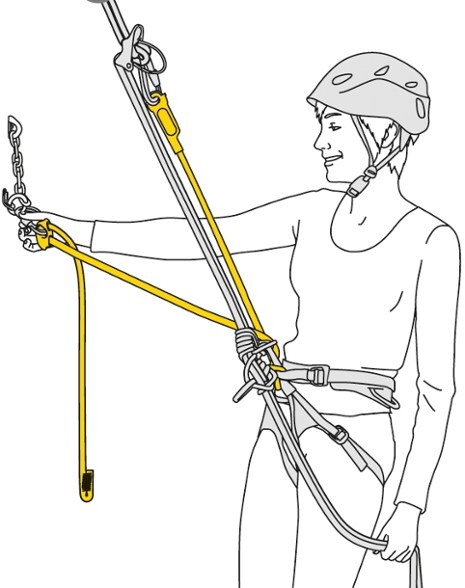
this is a big step up from using a 120 cm sling with a knot in the middle for the atc and the end loop for my pas biner. 

Rob D · · Queens, NY · Joined May 2011 · Points: 30

gri gri all day and night. 

june m · · elmore, vt · Joined Jun 2011 · Points: 124

Extending the rappel device is mandatory if you have long hair.

Connor Dobson · · Louisville, CO · Joined Dec 2017 · Points: 269
june mwrote:

Extending the rappel device is mandatory if you have long hair.

Wouldn't it be the opposite of this? You would want it far away from your face

Nathan Bilthuis · · Demotte IN · Joined Sep 2019 · Points: 35

I’ll say I almost always extend my rappel. The only valid, thought out reason as to why. It gets it above my beard. I’ve gotta to the bottom of too many rappels with a fist full of hair lodged in my atc or just gone completely. 

june m · · elmore, vt · Joined Jun 2011 · Points: 124
Nathan Bilthuiswrote:

I’ll say I almost always extend my rappel. The only valid, thought out reason as to why. It gets it above my beard. I’ve gotta to the bottom of too many rappels with a fist full of hair lodged in my atc or just gone completely. 

Exactly,  its above my hair, braid comes down past my waist

JCM · · Unknown Hometown · Joined Jun 2008 · Points: 115
june mwrote:

Extending the rappel device is mandatory if you have long hair.

Don't want this to happen: m.youtube.com/watch?v=Mj83X…

slim · · Unknown Hometown · Joined Dec 2004 · Points: 1,093
Kyle Tarrywrote:

If you have to do a lot of rappelling, it is really nice to have the first person working on setting up the next rappel, as opposed to standing there holding onto the ropes for the duration of the second rappel.  I do agree that the fireman works great in a lot of other scenarios though.

Come on.  It took 15 minutes to start the rappel, and you're seriously trying to blame that on her belay device being 10 inches further from her belay loop?  That makes about as much sense as blaming it on the color of her shirt.

No, it wasn't the distance (i dont think anyway, i could be wrong though). It seemed like she was just confused about which thingy was keeping her from falling to her death.

slim · · Unknown Hometown · Joined Dec 2004 · Points: 1,093
june mwrote:

Extending the rappel device is mandatory if you have long hair.

Extending the rappel device is even more moronic if you have long hair. Spoiler alert, the device is a lot closer to your hair...

Kyle Tarry · · Portland, OR · Joined Mar 2015 · Points: 448

slim wrote:

No, it wasn't the distance (i dont think anyway, i could be wrong though). It seemed like she was just confused about which thingy was keeping her from falling to her death.

Extending your belay device doesn't make one lick of difference about which "thingy" is connecting you to the anchor, so why would you even bring it up?

slimwrote:

Extending the rappel device is even more moronic if you have long hair. Spoiler alert, the device is a lot closer to your hair...

It seems really wild that you are telling a women who has long hair and has tested both techniques that her assessment is "moronic."  How long is your hair, Slim?

S Saunders · · Oakdale, CA · Joined Sep 2007 · Points: 45

My first partner/mentor 30 years ago, a German mountaineer and physicist, taught me things (rightly or wrongly) that remain almost hard-coded in my approach to climbing.

One of those things was: minimize links in the chain and therefore potential points of failure. Every time I see an extended rappel setup, I just see an added link/point of failure. Yeah, I know there’s a backup, but there’s still another link.

We all have our justifications for doing what we do…that one is mine, and why I don’t extend. Plus, I haven’t found an overwhelming problem I’ve needed to solve in rappelling methods over 3 decades - so, if it ain’t broke…

Old lady H · · Boise, ID · Joined Aug 2015 · Points: 1,375
slimwrote:

Extending the rappel device is even more moronic if you have long hair. Spoiler alert, the device is a lot closer to your hair...

Maybe it's closer to your hair....maybe not.

Belay loops, belay devices, slings, biners, etc are all pretty much a fixed size. The bodies they are rigged on vary. A lot.

For starters, women wear harnesses differently than men. Waist is higher. Women are usually shorter. This means, a rappel on my 4'11" height is probably way different with where the device is than it is for you. Extending the rappel gets it up above my head, still easily in reach, and out of range of....well, everything between my waist and farther north, okay?

YMMV, but just because something is so for you, doesn't make it so for everyone.

At least no one is bitchin at you for bring cranky and an admin, lol! 

:-)

Guideline #1: Don't be a jerk.

General Climbing
Post a Reply to "Best Practice: Extended Rappel vs Belay Loop Ra…"

Log In to Reply
Welcome

Join the Community! It's FREE

Already have an account? Login to close this notice.


