Mountain Project Logo

The quad is the [best/worst]!

Gunkiemike · · Unknown Hometown · Joined Jul 2009 · Points: 3,732
Jim Tittwrote:

The belayer applies a force of 4kN through the belay device (through a stretchy rope) to stop the faller, ergo the faller applies a force of 4kN on the belayer. When the piece fails this force is still there so accelerates the belayer downwards, you in effect have built a huge catapult to hurl the belayer downwards/sideways/wherever. The belayer doesn't fall, they are thrown.

It can go either way. If the belayer is hanging on the anchor but belaying directly off it, then the belayer merely falls at 1g (assuming their tether to the anchor is longer than the extension-of-failure). If OTOH they are belaying off their harness, then yes, they go down at Xg.

Connor Dobson · · Louisville, CO · Joined Dec 2017 · Points: 269
Jim Tittwrote:

The belayer applies a force of 4kN through the belay device (through a stretchy rope) to stop the faller, ergo the faller applies a force of 4kN on the belayer. When the piece fails this force is still there so accelerates the belayer downwards, you in effect have built a huge catapult to hurl the belayer downwards/sideways/wherever. The belayer doesn't fall, they are thrown.

I think force is the wrong metric to use in that case and you would want to measure momentum in the form of an impulse. The falling climber only has so much momentum to give. There is only so much energy to spread around, with some of it being absorbed in a piece pulling and the rope stretching before the piece pulls. 

Also 20g is incredibly severe in terms of impulse, I find it suspect that accelerations like that are being achieved. 

JonasMR · · Unknown Hometown · Joined Feb 2016 · Points: 6
Mark Pilatewrote:

Here’s what we ALL agree on and there is no argument.  

  • Use good judgment 

Isn't that the one that everyone does not agree on? Is "good judgement" sufficient? Because of the low probability/high consequence errors. I feel like there was a decent argument against good judgement in the penultimate section of the attached doc, but haven't heard a lot that actually addresses that argument.

M Appelquist wrote:

How is momentum and impulse different than force?

What's important to remember is that momentum and energy are v. different.

Kyle Tarry · · Portland, OR · Joined Mar 2015 · Points: 448
Connor Dobsonwrote:

I don't buy this, how are you creating this 20g of acceleration?

It's 20g of DECELERATION that is loading the anchor.  Note that you can create extremely high deceleration without having a high speed or a high acceleration, because its purely a function of how quickly you slow something down.  For an extreme example of this, see the (often misleading) DMM sling tests; they accelerate a steel weight down at 1g, but then when the tether comes tight is decelerates at many times that (resulting in very large forces).  In more realistic scenarios the forces are probably not as high as that test, but nonetheless a moving belayer coming to a very quick halt can generate high forces.

In these scenarios, not having slack in the system is the best remedy, because without slack the belay can't "get going" so to speak.

John Sigmon · · Unknown Hometown · Joined Nov 2019 · Points: 83

Clarifying some physics here…


force is mass times acceleration

(f = m*a)


momentum is mass times velocity

(p = m*v)


impulse is the change in momentum of an object

There is no such thing as deceleration technically. Acceleration is a vector quantity, so “deceleration” is commonly used to refer to a “negative” acceleration, or an acceleration pointed in a direction such that it decreases velocity.


Hope that helps, carry on :)

John Sigmon · · Unknown Hometown · Joined Nov 2019 · Points: 83

Also- A brief refresher. Calculus is helpful but not required.


http://spiff.rit.edu/classes/phys311.old/lectures/impulse/impulse.html

Serge S · · Seattle, WA · Joined Oct 2015 · Points: 683
Derek DeBruinwrote:

For the 12kN edge case, see: https://staff.weber.edu/derekdebruin/fixedpointbelay/Comparison%20of%20Fixed%20Length%20and%20Sliding%20Anchor%20Rigging%20for%20Recreational%20Climbing%20Systems.pdf

Thanks for the link - I missed this when it came out in 2019.

The negligible "force on the remaining piece" difference between 10cm and 19cm extension (Table 3) gives me the impression that extension up to "a few inches" basically doesn't matter. At least under the favorable conditions of this test (belayer tied in with a rope, as opposed to dyneema), and with the pre-condition that we have the force of FF2 as the base line.

But it occurs to me FF2 is only half the story. Though FF2 gives much higher forces, FF2 is rare. Are we justified in ignoring the possibility of pieces failing just from the weight of 3 people hanging on the anchor ? I bet the "force on the remaining piece" is much more sensitive to extension (even under 10cm) in this latter case.

Derek DeBruin · · Unknown Hometown · Joined Jul 2010 · Points: 1,129
Serge Swrote:

Thanks for the link - I missed this when it came out in 2019.

The negligible "force on the remaining piece" difference between 10cm and 19cm extension (Table 3) gives me the impression that extension up to "a few inches" basically doesn't matter. At least under the favorable conditions of this test (belayer tied in with a rope, as opposed to dyneema), and with the pre-condition that we have the force of FF2 as the base line.

You are correct that the forces resulting from small amounts of extension are less likely to be consequential. However, it's worth reviewing Jim's post upthread as there are certain cases where this may matter.

But it occurs to me FF2 is only half the story. Though FF2 gives much higher forces, FF2 is rare. Are we justified in ignoring the possibility of pieces failing just from the weight of 3 people hanging on the anchor ? 

Three people simply hanging on the anchor should not cause an anchor to fail. A useful rule of thumb for a hanging mass is to think of one person as approximately 1kN (again, hanging, not falling), so in this case three people might mean 3kN of force, which is not so different than slingshot top roping. I'd argue if the anchor failed under this load you don't really have an anchor.

I bet the "force on the remaining piece" is much more sensitive to extension (even under 10cm) in this latter case.

Indeed, the force on the remaining piece is greater after extension if there are 2 or 3 people hanging on the anchor instead of just one. Jim discusses this a bit as well. The punchline is that when a piece fails, the belayer is not just falling with the acceleration of gravity, but is also getting pulled down by the climber, and then stopped very suddenly (assuming a belay off the harness). This is a strong effect with even one person at the anchor that becomes greater with additional people. 

Jim Titt · · Germany · Joined Nov 2009 · Points: 490
Connor Dobsonwrote:

I think force is the wrong metric to use in that case and you would want to measure momentum in the form of an impulse. The falling climber only has so much momentum to give. There is only so much energy to spread around, with some of it being absorbed in a piece pulling and the rope stretching before the piece pulls. 

Also 20g is incredibly severe in terms of impulse, I find it suspect that accelerations like that are being achieved. 

No, you measure the forces. The energy dissapated in the rope is negligable and to cause failure of the piece may tend to zero. They both are insignificant.

Mark Pilate · · MN · Joined Jun 2013 · Points: 25

Well, I used to use work-energy equations via matrix mechanics to feed into a Fourier transform to extract the eigenvector from the wave function of the total climber-belay system in an inertial frame…..But as Jim said, it’s much easier to just measure the forces involved experimentally as all the other bullshit is proportional and the comparative results don’t change, and it eliminates fucked up math mistakes. 

Mark Pilate · · MN · Joined Jun 2013 · Points: 25
JonasMRwrote:

Isn't that the one that everyone does not agree on? Is "good judgement" sufficient? Because of the low probability/high consequence errors. I feel like there was a decent argument against good judgement in the penultimate section of the attached doc, but haven't heard a lot that actually addresses that argument.

Well, I meant in the context of nobody deliberately uses bad judgment.  They are always using the best judgment available to them.   Experience and knowledge support good judgment, and this thread is to help increase better knowledge.   You can lead a horse to water….

What's important to remember is that momentum and energy are v. different.

Not sure how important it is.  No matter what you want to calculate or estimate, it’s all proportional for these systems and the conclusions are the same.  
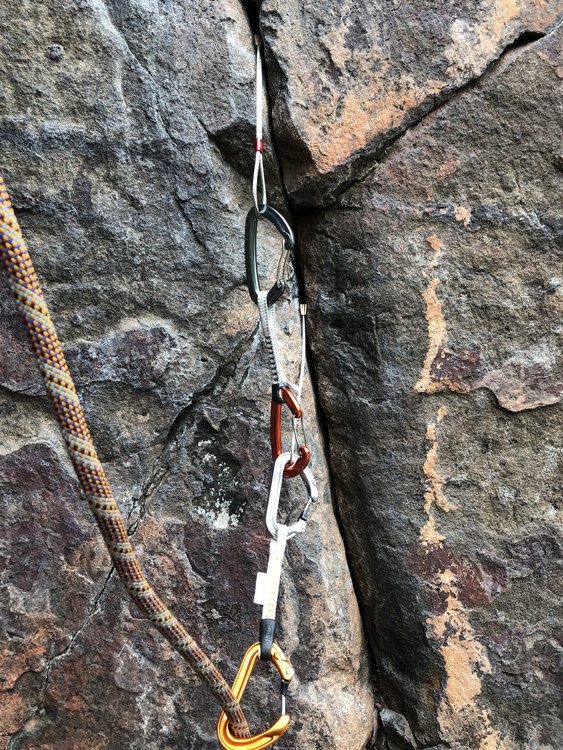

So, we’ve beaten the marginal anchor to death with high FF’s, and there is little fresh soil to till there, but let’s cross threads and bring the discussion into a leading scenario where we’re at an FF of say .7 to 1.3 (~5-6 ish kN) which is much more common.   Had this scenario yesterday…


two smaller Astronuts in basalt with a fair runout above. 

Would you:

1.  Do the same/similar as shown?

2.  Clip them separately?

3.  Other?

JonasMR · · Unknown Hometown · Joined Feb 2016 · Points: 6
Mark Pilatewrote:

Well, I meant in the context of nobody deliberately uses bad judgment.  They are always using the best judgment available to them.   Experience and knowledge support good judgment, and this thread is to help increase better knowledge.   You can lead a horse to water….

When you read the paper's penultimate section, what do you take away from it? Again, the question isn't to use good or bad judgement. It's "can experience based judgement keep you safe from low probability/high consequence problems?" I'm not clear if folks didn't read that part, or just don't want to address it, or what the deal is exactly.  

Not sure how important it is.  No matter what you want to calculate or estimate, it’s all proportional for these systems and the conclusions are the same.  

Bruh, if I explain the joke it gets way worse... (Does the "v" stand for "very" or "velocity"?)

Help us out with more info on your placements. Are they marginal and walking is a huge problem, or bomber and it's just about the nut not blowing up?

Mark Pilate · · MN · Joined Jun 2013 · Points: 25
JonasMRwrote:

Bruh, if I explain the joke it gets way worse... (Does the "v" stand for "very" or "velocity"?)

My bad.  Got it now.  6.5/10   (Standards are low for Newtonian humor)

Help us out with more info on your placements. Are they marginal and walking is a huge problem, or bomber and it's just about the nut not blowing up?

These are pretty decent placements for what they are (small offset bronze nuts that fit better than similar sized stoppers or DMM offsets that I had).

I’d say any small nut in rock can be a spin of the roulette wheel.  You can never be entirely sure of total contact area or strength of the rock.   Therefore I’d say reasonable expectations could be anywhere from 2-6 kN whether you think it’s bomber or not.   Does anyone know of empirical data for small nut pull tests in various rock types?  (Was planning some for myself in July) 

John Sigmon · · Unknown Hometown · Joined Nov 2019 · Points: 83
Not Hobo Greg wrote:

For us mathematically challenged folks, what’s the take away? I would only use a quad on bolts, that seems to be ok? From a guide perspective I want to use em so my guests have an easier time breaking down and racking the anchor, and will speed up the day throughout the belay changeovers.

My takeaway was that its fine if there’s little chance of a fall factor greater than 1. The danger comes from shock loading via extension if FF > 1. (As Jim noted extension only occurs when a piece fails)

Jim Titt · · Germany · Joined Nov 2009 · Points: 490
John Sigmonwrote:

My takeaway was that its fine if there’s little chance of a fall factor greater than 1. The danger comes from shock loading via extension if FF > 1. (As Jim noted extension only occurs when a piece fails)

FF is not relevant. Only force and extension are.

John Sigmon · · Unknown Hometown · Joined Nov 2019 · Points: 83

Thanks Jim. Technically force is all that matters. As I am sure you are aware, fall factor is a common way for climbers to estimate the amount of force generated:


https://https//m.petzl.com/US/en/Sport/Fall-factor-and-impact-force---theory?ActivityName=rock-climbing.com/US/en/Sport/Fall-factor-and-impact-force---theory?ActivityName=rock-climbing


Hence my response in terms of fall factor. Let’s try to minimize the pedantic nitpicking, shall we?

Kyle Tarry · · Portland, OR · Joined Mar 2015 · Points: 448
John Sigmonwrote:

Let’s try to minimize the pedantic nitpicking, shall we?

John Sigmonwrote:

There is no such thing as deceleration technically.

Bruh.

Connor Dobson · · Louisville, CO · Joined Dec 2017 · Points: 269
Jim Tittwrote:

No, you measure the forces. The energy dissapated in the rope is negligable and to cause failure of the piece may tend to zero. They both are insignificant.

What I was trying to get at is the 4KN of force is not consistently applied, the belayer + rope + climber can all be thought of as a single entity. 

Why is the gear so shit pieces are pulling with 0 energy absorbed, I think saying this energy being negligible is a huge oversimplification.

John Sigmon · · Unknown Hometown · Joined Nov 2019 · Points: 83
Kyle Tarrywrote:

Bruh.

this was in response to your pedantic correction of someone else.


just gonna bow out of this whole thread at this point.


thanks for the article Derek!

Jim Titt · · Germany · Joined Nov 2009 · Points: 490
John Sigmonwrote:

Thanks Jim. Technically force is all that matters. As I am sure you are aware, fall factor is a common way for climbers to estimate the amount of force generated:


https://https//m.petzl.com/US/en/Sport/Fall-factor-and-impact-force---theory?ActivityName=rock-climbing.com/US/en/Sport/Fall-factor-and-impact-force---theory?ActivityName=rock-climbing


Hence my response in terms of fall factor. Let’s try to minimize the pedantic nitpicking, shall we?

There are plenty of scenarios where FF far lower than 1 can impose high enough for forces, more than one climber on the belay is the most obvious. Using fall factors as a measure of safety is a failure.

Guideline #1: Don't be a jerk.

General Climbing
Post a Reply to "The quad is the [best/worst]!"

Log In to Reply
Welcome

Join the Community! It's FREE

Already have an account? Login to close this notice.


