
 Continue with onX Maps
 Sign in with Facebook






The quad is the [best/worst]!



|
A few recent threads have restarted the conversation about extension, shock loading, etc. I've collected some of my thoughts and comments from those threads and put them in this explainer to shed some light on the risks associated with sliding rigging systems (i.e. quad, sliding x, etc.). My hope is to provide a bit more comprehensive reference on the topic instead of the pieces of the conversation that regularly appear here. For those who like citations, I even included some of those for further reading/watching. Also, yer gonna die. https://staff.weber.edu/derekdebruin/fixedpointbelay/The%20Quad.pdf |
|
|
Thanks for posting this, Derek. Wonderfully clear. |
|
|
Seems to me that there is lots of bias going on in that paper. Basically saying that 1 in a million scenarios will cause a quad to fail, but fail to acknowledge that there are plenty of 1 in a million scenarios that cause any other anchor to fail as well. Overall, use your best judgement in creating an anchor and different scenarios will call for different anchors. |

|
Andrew Bierman wrote: Andrew, everyone always uses their best judgment in creating anchors. The problem is when that judgment is based on misunderstanding all the facts. This isn’t like “use your best judgment in voting”. There IS a right answer here, not opinion. You can do the testing at home, and I encourage you to do so. I think the belief that different scenarios will call for different anchors is one key misunderstanding. Unless you mean that in some situations it really doesn’t matter what anchor you select (I would agree) when all points are “bomber”. But in situations on the margin, when you have to “guesstimate” it can matter, and it’s best to select the option that provides overall best performance in worst case scenarios. And that is simply to eliminate points of potential extension in your anchor. The small added benefit in equalization (delta1 in graph) doesn’t make up for the added risk if that fails (delta 2 after failure of a piece). 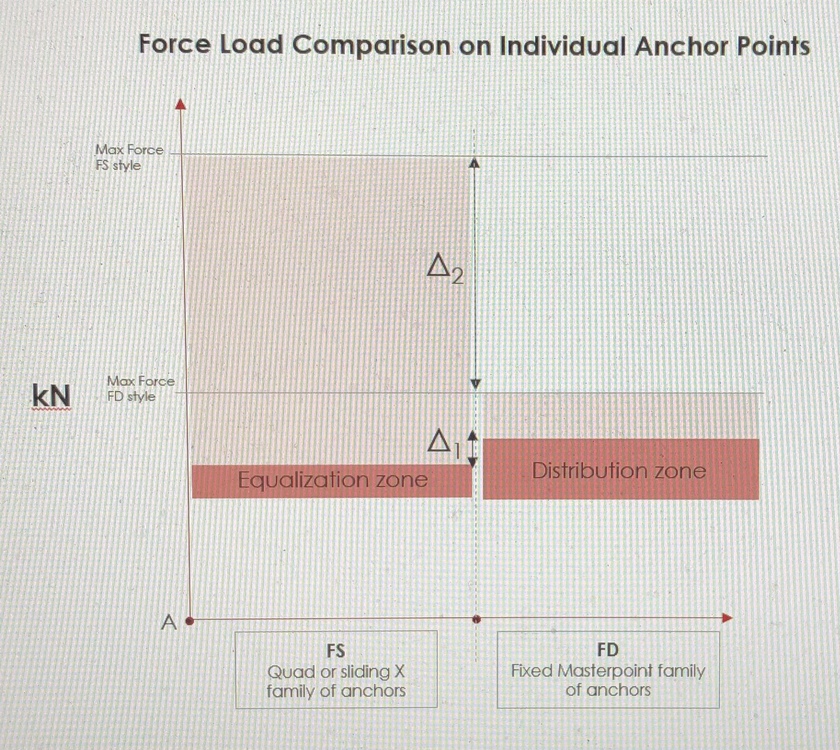 |
|
|
Andrew Bierman wrote: Since my intent was persuasion, in a sense the bias is inherent. However, I'm mostly biased toward: 1) the current evidence surrounding anchor rigging of which I'm aware and 2) the current understanding of human cognition as understood by neurology and behavioral psychology. I put some effort into citing a decent chunk of the evidence that supports the logical arguments that result in the end conclusion. I also cited the most commonly sourced counter arguments in my experience. However, if there is something that you perceive as specifically biased, I'd be happy to discuss it and adjust the position accordingly. Similarly, if there's other studies or relevant information I'm missing, I'd be happy to hear about it and adjust accordingly. I aspire to strong opinions weakly held.
Indeed. Based on currently available evidence, the rate of recorded catastrophic anchor failure in the U.S. appears to be about one incident per 5 years. This is largely because climbers don't fall before placing the first piece of protection very often, but it's certainly important to consider this possibility since it's the one that could get you killed.
I specifically mentioned rockfall as another low-probability catastrophic anchor failure case worth consideration. What additional scenarios would you propose? More importantly, is there a difference in survivability of the anchor/party between rigging systems with those other scenarios? There is in the cause of extension (but not a likely difference for rock fall, for example).
The problem with using best judgment is that the scenario that might get you killed is the one where judgment is least likely to be correct (owing to the relative rarity of the event). This is a fundamental problem in a human factors approach to risk management as even expert recognition primed decision making (aka intuition) often fails when the hazardous event is rare or the context changes. |
|
|
Thanks Derek. The tldr I am getting here is:
Would you agree?
|
|
|
"There is a lower bound to how close the knots can be on a quad before they are useless, and the limit is farther than many climbers appreciate. This is because the offset of the pull angle between an aluminum carabiner and a UHMW PE sling needs to be about 15 degrees before the static friction between the carabiner and sling is overcome and causes the carabiner to slide. Consequently, to fulfill its proposed use case, a quad needs to have at least 30 degrees of travel in its pocket." |
|
|
You mention a girth hits master point as an alternative for the quad. I agree and disagree. It fall issue to a different issue , the girth hitch refuses strength by fifty percent last time I read literature on that (earlier 2021) and as such it is 10-12 kn I strength on each leg of it. If you were to apply that 12 kn of load you use you would break the webbing possibly and also since a ghmp slips at 10 kn the hitch itself would fail. I don’t know if my logic is right but I do think that a banchée belay is a better alternative |
|
|
John Sigmon wrote: Extension matters if a piece fails. |
|
|
Put some pieces in, tie off, and you're done. Finito. |
|
|
@John S: Yes. Tests show that as you approach FF1 and greater, forces at the anchor or top piece of pro start to go above 6 kN which can definitely be significant on small trad gear. @Serge S: How many scenarios involve net vector angles beyond 15 degrees? This would mean a wandering Z route with greater than 30 degree angles between pro. The “adjustment” of equalization schemes under sudden fall loads is minimal since the friction forces are proportional to the normal load. Also, commonly in practice the belayer is opposite side of the anchor (say to the left side) if the climber is climbing off to the right. When the climber falls, the offsets and pulley effect make the net max force vector essentially net downwards or within about 10 degrees. Therefore, regardless of minimal extension even with close knots, it’s hard to find any trad scenario where a quad makes better sense. @Eliot H: a couple clarifications
|
|
|
WF WF51 wrote: I agree with this 100% ! Good pro: put some pieces in, tie off, and you’re done. Finito Bad pro: consider nothing. Put some pieces in, tie off, and you’re done. Finito …. Just perhaps in a different context. ;) |
|
|
Thanks so much for posting this. I had slowly gotten away from thinking extension matters based on the tests you mentioned and it just intuitively made sense with a dynamic rope in the system. You’re explanation for high fall factors makes perfect sense. I’ve always preferred fixed leg anchors anyway so it’s mostly academic to me but it’s good to know. |
|
|
Mark and Jim already covered a fair amount of these, but I'll add a few points. John Sigmon wrote: As Jim notes, extension matters when a piece fails. At FF<1, forces are probably not consequential. At FF>=1, I'm definitely paying attention. So, top roping is generally fine; multipitch is a much greater concern.
My particular bit of testing was a limited number of cases owing to constraints on facility time and materials; they mostly replicate in English what has been established in Europe for some time. For the 12kN edge case, see: https://staff.weber.edu/derekdebruin/fixedpointbelay/Comparison%20of%20Fixed%20Length%20and%20Sliding%20Anchor%20Rigging%20for%20Recreational%20Climbing%20Systems.pdf
Sounds about right (without checking your math). Things grow more complex when 3rd and 4th anchor pieces are added (which many folks would do with a gear anchor as opposed to bolts). See this thread for a post from Jim that explores this in more detail and subsequent discussion:
Mark pretty much covered this. The 12kN happens after a point fails and extension has already occurred. A banshee or the girth hitch prevent the extension in the first place, so the load never reaches 12kN.
The dynamic rope solves the problem in most cases; but if it's already fully stretched due to previous load (in this case the failure that caused the extension) then you run into problems. Glad you found it helpful. |
|
|
Eliot Hack wrote: The gear that the ends of the GHMP anchor are connected to (ice screws, cams, nuts) also will break around 10-12 kN; as such, it doesn’t make a lot of sense to worry about having an anchor way stronger than than, since you’re going to have failure of the protection at that same force anyway… |
|
|
I mean this all seems pretty academic which is great if you are looking for a more comprehensive academic resource but for recreational climbing, the anchor type largely doesn't matter if you aren't taking FF2 whips all the time. And if you are concerned about it in a specific pitch, just lower down the belayer and have more rope out. |
|
|
One additional point for consideration: Derek asserts (and I agree) that the one place that the extension-force risk of a quad is probably acceptable is on a bolted anchor; by extension, this is the one place that you could justify the use of a quad anchor, in this context. However, note that an anchor with 2 unquestionably strong anchor pieces is the exact scenario where you don't need equalization! So, the one time it might be safe to use a quad, is the main time you don't need one purported benefit of a quad (the equalization). So, when you remove this scenario, it leaves you with effectively zero situations where a quad is superior to other anchor choices (with regard to forces, equalization, and safety). Edit: Note that this is only with regard to anchor behavior and loading. There are plenty of other reasons to use a quad on a bolted anchor, like simplicity and convenience, and lots of people use them in this context for this reason. This is a totally reasonable use, but it's best if people understand that the "equalization" isn't really beneficial and carries pros and cons. |
|
|
Kyle Tarry wrote: I disagree, if you have two super pieces, but it is in rolling and varied terrain with a larger party having a “self “ equalizing anchor can be instrumental |
|
|
Eliot Hack wrote: Why? If the two pieces are "super," why do you need the anchor to "self equalize"? |
|
|
Mike Soucy wrote: Agree. Quad is the sum of a lot of little things: two obvious shelves to separate your mission-critical clips from your other stuff, generally orients the load in a nice way for the pieces without you having to really think about it, exceptionally easy to move around and accommodate more gear, easy to organize, everything is loadbearing, it's about the right length, it packs down small, it's easy to expand to four pieces or more with some slings or draws, you can use it on the way down as an instant equalized anchor for you and your partner on two rappel bolts... Like, listen, I'm taking twenty feet of cordelette, and I know how to build an anchor with the rope. But the quad is pretty dang slick, my dudes |
|
|
Kyle Tarry wrote: Well what if they are three or four feet apart and there is one let’s say 3 which is 14 kn and a .5 which is 10 kn. Let’s say in this situation they are off to he side in space and there isn’t a established direction of pull then you want self equalization |


