
 Continue with onX Maps
 Sign in with Facebook






New and Experienced Climbers Over 50 #16



|
I used to do a lot of physiologic testing of athletes. Heart rate, VO2max, body fat, power outputs etc...Lots of things affect HR. Heat, hydration, fatigue, rest/recovery, diet, weight, body fat. Sleep, medications...the list is pretty extensive. HR also varies wildly across the population The 220-age thing is really just a very broad guideline. Muscle mass and composition (fast vs. slow twitch) also affect how high it climbs during aerobic vs anaerobic activity. For some people, anaerobic activity like climbing will raise respiration, but not HR, but for others it raises HR too. It’s all about what is rate limiting for oxygen delivery for you physiology. For some (myself) HR drops when fatigued, for others it goes up. My point is that a lot of this is very individual and you’ll learn to recognize your own patterns, and that trying to figure out what is “right” from other people is difficult, outside of extremes that might be legitimate medical concerns. i wouldn’t be overly concerned with your “high” HR during activity in the heat, it just doesn’t sound alarming unless it is causing/accompanies other distress, pain, dizziness etc.if you had that HR at rest or just walking up the stairs, you should be concerned. |
|
|
Csproul, thank you so much for this. I am so sorry to say that I didn’t know any of this, and I’m sure you have lots more. I had only the faintest recollection of that Max Heart Rate formula but never used it. But when I started wearing a band while climbing it was a real eye-opener to see a heart rate that high, and apparently no big deal. Steep learning curve. But now that I’m paying close attention and gathering personal data I’m finding some items correlating well with recovery and energy: HRV (Heart rate variability) whatever the HECK that is but most closely correlates to how I feel in the morning, # of hours of sleep and Deep Sleep, hydration and diet, most especially protein consumption. How all of this converges with diabetes management is God’s mystery. All I want to know is what’s it take to wake up in the morning feeling recovered and ready to climb. Should be easy but at this age it’s not. |
|
|
No, for the average person or non-competitive athlete, knowing your VO2max would probably not be at all useful. It is mostly useful for aerobic/endurance sports, and even then knowing it will be of limited use little except to tell you a little about your genetic potential and if your training is helping to improve it. This requires targeted training (typically of large aerobic muscle groups) and repeated testing. I doubt it has any real benefit for rock climbing or for general health assessment. |
|
|
Lori Milaswrote: Hi Lori. I've read many of your posts, but not all, so forgive me if I've missed something. I have a pacemaker because I have "sick sinus syndrome." It paces my heart about 5% of the time because my heart goes into bradycardia while I'm sleeping. My pacemaker is monitored remotely and their are triggers where the cardiac center is notified immediately. One of these is fast heart rate (tachycardia). The first call I got from the cardiac center was when I was leading a poorly protected 5.10a crack. After a few more calls about tachycardia, they realized they were all climbing related and stopped calling about them! The tachycardia was from being scared while leading. I've noticed that the other time my heart goes into tachycardia is because I'm holding my breath. I do this mostly on overhanging routes or really hard moves. My climbing partners know this and constantly remind me to "breathe" when I'm on an overhanging route or notice me holding my breath. It happens a few other times, too. What has worked for me is to regularly check that I'm not holding my breath. I also watch the pace that I'm climbing and slow down or rest to keep the heart rate down. I also try to be aware of being scared and to relax and "center" myself which helps to bring my heart rate down.
Before Covid, I coached the "Boomers Club" at a local gym for climbers over 50. I told them to "listen to your body". Our bodies are more susceptible to injury and take longer to recover. But we all want to climb more than our bodies can tolerate. It's hard, but we must have the discipline to take a day off or have an easier day climbing. After a really hard day climbing I have to take two or three days off to fully recover. If you don't feel rested, but can't resist the urge to climb, do easy climbs and work on having immaculate technique! |
|
|
Arlo You mentioned tachycardia in the above post. This reminded me of the time Jean and I did Tachycardia in Maple Canyon years ago. It is a 3 pitch 5.7 sport route. The 2nd pitch is somewhat similar to climbing in the Gunks as you sort of pull a move and then you are exposed except it is a sport route. We finished the climb, sat at the top and looked over the beautiful landscape. When we were ready to go leave, we could not find the rap station. After a long time, I decided that Jean would down climb the 3rd pitch and clip the draws. I had her on belay the entire time. I then also down climbed and pulled the draws. the problem was that I could not get to the last draw since I was away from the wall. I had to try to swing over to Jean below the last draw. Also at the time there was a nest of bees between the 2nd belay station and the 1st draw. Every time that I tried to get to the belay station by swinging, Jean would get pulled away from the belay station. I had at that time about 60 pounds over her. After a lot of trial and effort, I finally got to the belay station. We rapped from the 2nd belay station to the gulley on the left and then took the slope down to out packs at the start of the climb. Someone now has moved the top rap station because other people had similar experiences of having a hard time to find the top rap anchor. If you get a chance to get to Maple Canyon, you should tryTachycardia as it is a lot of fun. https://www.mountainproject.com/route/107669530/tachycardia John |
|
|
When can we do 40-50 anecdotes about resting heart rate? |
|
|
I'm happy I decided the other day to start trying harder routes in the gym. I got on the grade 24 I tried for the first time Thursday night and got further before my first fall. This is me on an easy grade 19. I didn't like this route the first time I tried it but it's actually a nice route and you certainly need to think about the beta. |
|
|
Nice Carl. |
|
|
Geez, after John’s post about tachycardia I was braced for an onslaught of bad heart attack jokes. You guys are off your game. Mother’s Day maybe? |
|
|
Talking about hearts, I have quite a slow resting heart rate, less than 60 beats a minute (Brachycardia). This can cause problems (light headedness) esp if I get up too quickly. I try not to think about my heart. I've always been a bit of a hypochondriac and I hate the fact that I can literally see my heart beating in my chest, even at rest... |
|
|
Carl Schneiderwrote: Less than 60 bpm resting heart rate is not at all unusual in athletic people. Mine is 54 and I'm not even an aerobic athlete. |
|
|
Yeah, I was at the doc getting a physical last year and when they finished the cardio test my doctor looked at me and asked why I thought my heart rate was in the 50s (I'm 69) and when I told him it might have to do with those 20 mile hiking weekends with 3,000+ feet of elevation gain he gave me that 'LOOK' and quit worrying about it. That and the bone density scan where it was declared that I had the bones of a young man was pretty damn gratifying and really helps keep one motivated to continue training hard. After all, the whole goal is to stay fit enough to go in one big bang and not slowly rot. |
|
|
Eric Engbergwrote: I think we are there Eric! I believe the standard defined parameter for bradycardia is < 60 bpm, but it isn't necessarily a medical problem at rest - if your heart can't respond to demands by speeding up, that is a problem. Technically, tachycardia is defined as over 100 bpm, and we should all have tachycardia when exercising - but at rest, that could be a problem. My resting HR is 48. I think it is low from the combination of many years as an endurance athlete and doing a fair bit of yoga and meditation. If I am overtrained or fatigued it is higher and that is a good indicator for me that I need to rest. A few of you mentioned breathing - Some of the mindful breathing approaches such as 'box' breathing (breathe in for a count of 4, hold for 4, breathe out 4, hold for 4, repeat) and 4-7-8 breathing (breathe in for 4, hold for 7, breathe out for 8), or even just lengthening your exhale by 1 count over your inhale can be really useful for settling down. Exhaling activates your parasympathetic nervous system, so lengthening the exhale can be very calming when feeling scared/anxious/desperate when climbing. I find it also helps if I am working hard running or cycling - helps keep me from detonating. |
|
|
phylp phylpwrote: Yeah I know, but I wouldn't really call myself an athletic person. Other than climbing for two hours four to five times a week I'm very idle... I tried my grade 24 project again tonight and got even further. Worked out some beta for the crux and found the top third is easier than the bottom two thirds (I'd not tried the top before). Also tried a grade 25 I tried a few weeks ago and made good progress on that too. Feeling quite strong for some reason... I bet if I tried bouldering right now I'd be 'bouldering weak" though... |
|
|
Jan Mcwrote: Helen (and a few others) knows this story, but it's one I'm so grateful for. Maybe 10 years ago a counselor gave me this book (Younger Next Year) and with eye-rolls and lots of moaning I went ahead and read it. It was a permanent life changer. Maybe it was because of the sad shape I was in at the time... and watching everyone in my circle in steep decline. I just decided to throw a Hail Mary and start seriously exercising. On one page of the book there were two little graphs... (the difference between doing nothing, and becoming active) 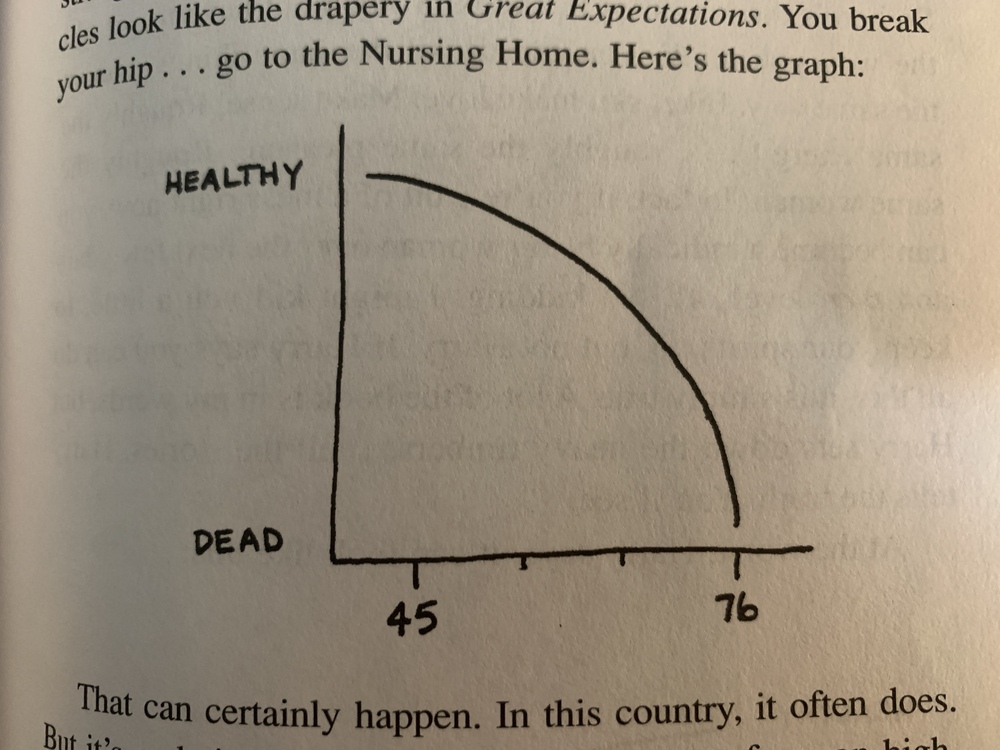 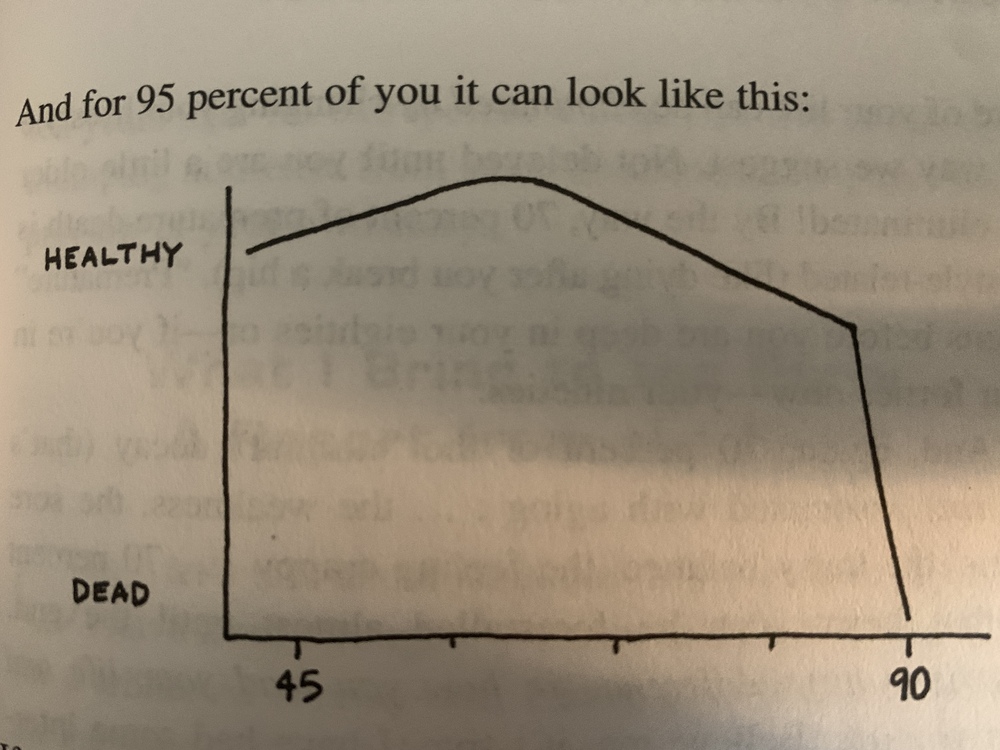 "If you haven't been there you cannot imagine how important the difference is between these two curves, because you probably can't imagine what "normal aging" is in this country. Take it on faith for a minute: normal aging is pretty grim, and the difference between curves is profound. We are begging you to get off the slippery slope. It will make a fundamental change in how you look at aging and how you feel and who you are in the Next Third of your life." "You Do Have to Age, but You Don't Have To Rot." |
|
|
Beautiful morning in JT today. A large bobcat went through the backyard at 5:30 with two annoyed, squawking ravens following closely. I had a small glass of OJ, a slice of dry whole grain toast, and an instant mocha for breakfast. I'm barefoot. |
|
|
Jay - put some butter on that toast and get some shoes on! |
|
|
Lori, In my late 30s I was climbing hard 5.12. Then everything went to hell. My body would no longer heal fast enough and climbing became too painful to continue with. It took almost 10 years before they finally figured out what was wrong with me but 'oh my god' what a gift that resurgence was. I went at it so hard all thru my 50s, climbing with my partner who was in his 20s and early 30s, bouldering almost as well as anyone at Stoney Point, and just being the best animal I could be. I was so grateful for that feeling of vitality back! Then of course the years of abuse started to kick in and age started to take a toll and I had to start to throttle back some. But I understand that graph perfectly and agree with it 100%. |
|
|
Shoes are way over rated. So is adulthood, for that matter. And now for something completely different.... Anyone have any input on Bluetooth headsets, for a phone, and climbing? I'll be getting something soon, to use for earth to Helen communication while climbing. Before you have a field day with that, and not to rain on that parade, have fun anyway, but it's for the gym, and getting some coaching. I need heaps of "go arounds" to make climbing work, with various parts, well, not always cooperating. I have an Android phone. The other twist, is I am close to totally deaf, left ear, from birth. Right is quite good, so I often don't wear my hearing aid climbing. Obviously, whatever I get needs to stay put, or be rigged with a tether or something. Thanks! If this doesn't net anything, I'll head out to MP at large for a general roasting, and maybe a bit of useful info. Best, Helen |
|
|
I'm too fat for butter, or margarine. Desirable morning chore accomplished. Interestingly, resting HR declined while breath held during efforts to promote expulsion. A transient effect that would reverse with longer duration? |


