Continue with onX Maps
 Sign in with Facebook






The Devils Lake top rope cluster Fu&k thread... (2nd Edition)



|
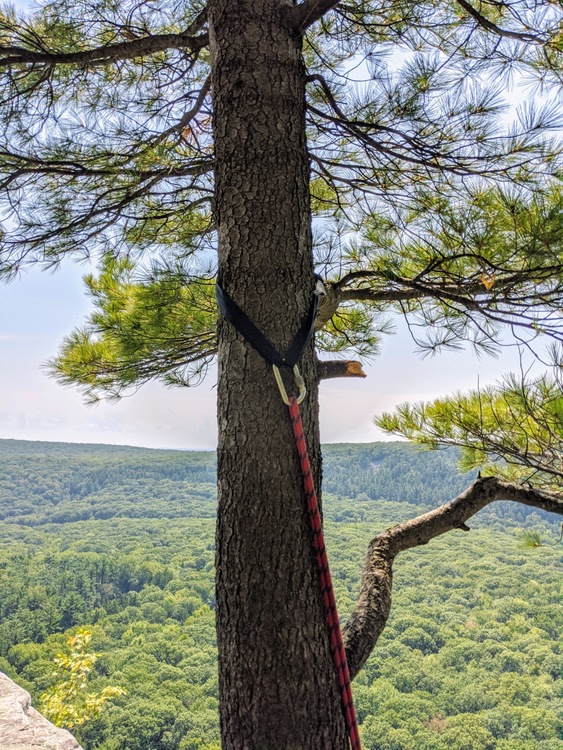
Dave Olsen wrote: Didn't say anything about the strength of the sling (though I have no way of judging its wear from the picture) or the biner. I actually have no real concerns on either of those fronts.
The climber is also not redundant, but without the climber, there'd be no climbing. The point is that it's completely trivial to introduce redundancy in the most likely failure mode in this case. And that two opposing biners is essentially the standard practice for a bottom-managed top anchor. Having multiple people hold the rope behind the belayer is not. Besides, who knows if there was or wasn't redundancy with the belayer? Maybe there were multiple adults at the bottom minding the belay. Maybe they were using a gri-gri. I don't know what redundancies they had in place there. Do you?
I think it's trivial to add a second opposing biner at the top, and it's standard practice at no real time expense. Especially given the gate is pressed up against the tree (as opposed to hanging free without contact) and the rope wrapping around the tree means the biner gets some sideways motion every time slack is taken in. (As a bonus, adding a second biner is also a little gentler on the rope and biners and reduces wear over time. So is moving the masterpoint below the lip.) |
|
|
This image is from the AMGA SPI instructor manual. It's a 2-leg anchor using the Joshua Tree method which is what the anchors in question on this thread are using. There are, of course, a few differences to the anchors we are criticizing when compared to this image I'm sharing. They are obvious, namely materials (sling and static rope vs only static rope), and the use of sliding x vs bunny ears. Also obvious is the type of rock material and edge sharpness/angles are different. Devil's Lake does have many sharp edges, which is why it makes sense to always look for softer spots when possible and pad sharp edges when that's all you've got. Perhaps the best method, as James points out I believe, is to use just the static rope with bunny ears like the image I'm posting shows. Static rope of appropriate thickness I'd argue/agree holds up better than slings in the sliding x formation, but I use the sliding x very often and was taught this by PCGI. If we're looking just at the discussion of 2-leg vs 3-leg anchors, AMGA and PCGI most certainly teach that 2-leg anchors are appropriate and safe. 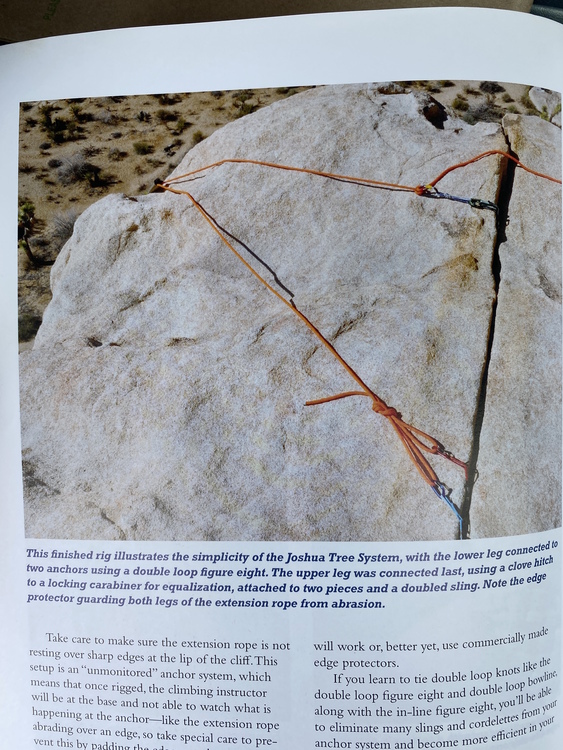 |
|
|
Not a DL climber but if you are TRing on a anchor might as well as throw in a 3rd leg? Yeah I would climb on all of these and have def used sketchier looking anchors to belay from on multi pitch. But for TR you are in no hurry and you will be weighting it probably multiple times, why not just throw the extra piece in? |
|
|
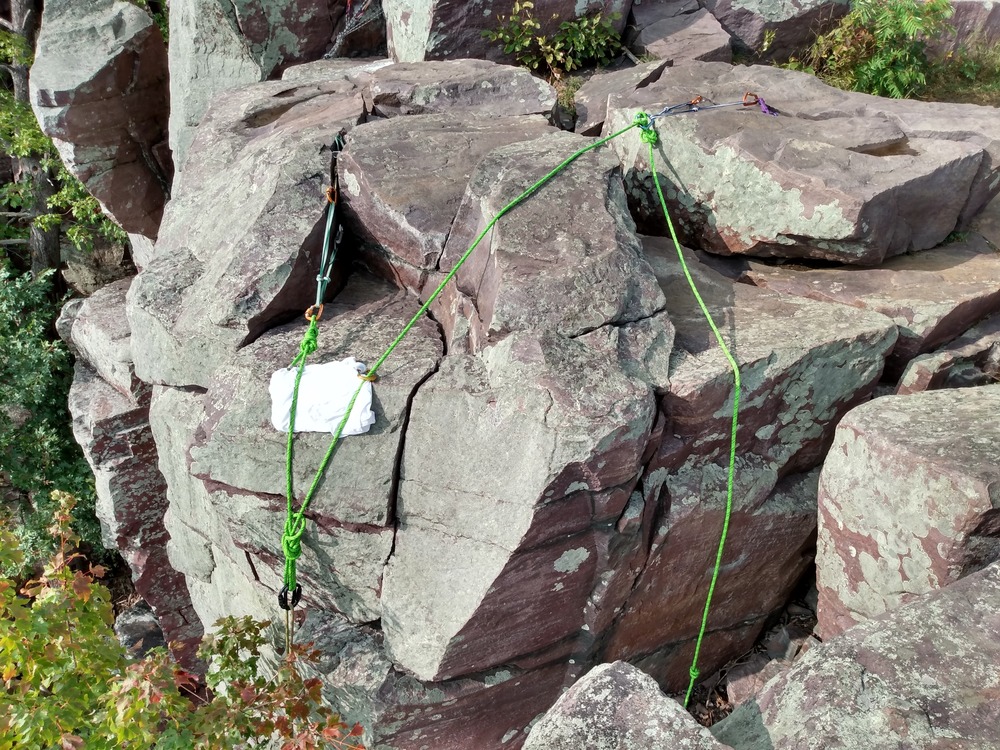
These two leg anchors are all three “piece” anchors. Maybe just semantics but what you’re suggesting would be a 4 piece anchor, Jon? Or do you mean piece as in an extra leg? Each one of these photos is a 3 piece anchor. |
|
|
I'm going to throw this out there: |
|
|
M P wrote: Jill's critical thinking question for this illustration would be: what situations is this anchor appropriate for (and what situations is it not appropriate for)? |
|
|
Doug Hemken wrote: Like James, I never pad anchors. In this example, as long as the anchor remains intact it is very stable and there will be no appreciable abrasion on the static lines. If one leg of this anchor fails, the other leg will immediately slide off the padding - it's irrelevant. That's a small matter in this specific example, but I hope you can see past the specifics to the general idea. The point of redundancy is to mitigate human errors. |
|
|
Gokul G wrote: Just felt compelled to edit that. He almost said it! |
|
|
Question: When I set up top-ropes at the lake I typically wrap a long piece of webbing around a giant ass block that is not going anywhere, even if the hulk took a 60 foot whipper on it. Then I either wrap another huge block with a separate piece of webbing or place some gear, and then equalize the anchor. Am I going to end up on here for a jive-ass two point anchor? |
|
|
Doug Hemken wrote: Any three-leg anchor just automatically have lateral stability? That's just not true. This three-leg anchor is not laterally stable if the right leg goes. 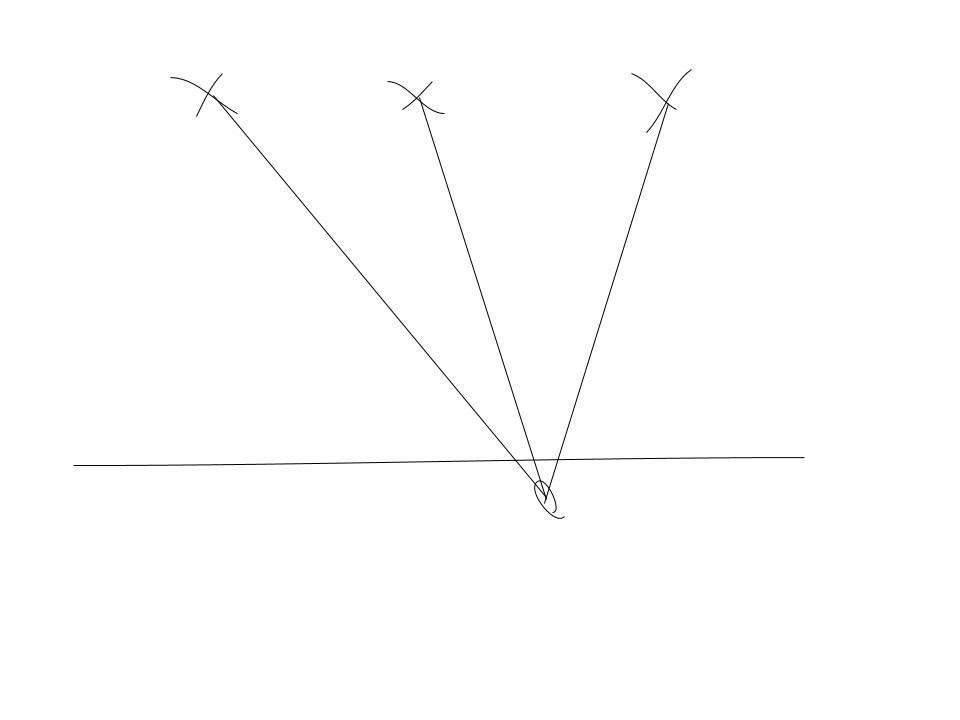 |
|
|
Brian James wrote: Sounds bomber to me. Same as two bolts |
|
|
Brian James wrote: Apparently, yes. Due to lateral instability when one leg fails. YGD. |
|
|
Jill Griffis wrote: I probably wouldn't belay my kids on this anchor if I was on the ground. I have belayed them on a single piece (tree) anchor before -- a top belay with my wife on the ground with the kids. |
|
|
HUGE Tradifan wrote: Distance, the distance is the difference. |
|
|
M P wrote: I am blind and my screen is tiny is my excuse! I thought they were 2 piece anchors... I will back slowly out of this convo. |
|
|
Gokul G wrote: A single locking biner is standard practice too. Having a rope handler/backup belayer is used when teaching new climbers as well. I would put a second biner on that anchor, as you say it take no extra time. |
|
|
No bolts. I think I would like DL! |
|
|
aikibujin wrote: I completely agree with you: nothing is automatic. |
|
|
Double J wrote: distance and also repetition of use. You lead a route and you clean on your way down or your partner cleans on their way up on TR. A TR will likely be used over and over, loading and unloading multiple times, while most likely any single piece you placed while leading won't ever be loaded, or at most once or twice. Plus you'd be dumb to whip on gear and not re-inspect it to make sure all the lobes are still engaged or whatever as you climb past it the second time. |
|
|
Plus TR anchors are often loaded at multiple angles - if the route wanders from side to side, or if the rope is used on multiple routes. You have different angles of pull to consider with lead gear. |