
 Continue with onX Maps
 Sign in with Facebook






The Devils Lake top rope cluster Fu&k thread... (2nd Edition)



|
Not the place for this discussion. |
|
|
You guys must have missed our recent accident. |
|
|
I think there are too many variables to make broad generalities, I use this tactic a lot. Also would not call this a clusterfuck. I would be more concerned about using two pieces on a small (as maybe shown in this pic?) detached block (I am not even sure about that tho?) than nickle and diming a 2-leg, 3-point anchor. If setting properly, you shouldn't be seeing big shifts in a TR. Padding an edge is a definite viable option, which this person looks to have done. Checking an anchor mid day for any red flags is a good idea. And using cord instead of webbing is ideal because of the shape, construction, rating, and tendencies. |
|
|
Doug Hemken wrote: Maybe I'm missing the point, but these anchors looks legit to me. |
|
|
I agree with Jill. In general, two legs (each built from multiple quality pieces or an infallible single piece), when made from static rope (not cord or webbing, mind you) is a modern standard. Since I can't evaluate the individual placements from the photos, I'm assuming they're fine. From what I can see (and assuming the placements are fine), not only would I climb on all of these anchors, I would happily guide clients on them, use them in any AMGA course or exam, and under the scrutiny of any guiding accreditation program. These anchors are properly rigged. Edited to add: "webbing" |
|
|
James Schroeder wrote: agree with all of these! |
|
|
Consider anchor #4 (the top of Vacillation). What happens if the western (climber's left) piece fails? If the rope remains intact, it ends up hanging down The Grotto. |
|
|
Doug Hemken wrote: It appears that the leg in question is would require the failure of two pieces to create the scenario you're describing. I can't see the other piece, but I'm assuming that's why the dyneema quad is there. |
|
|
I would climb on all of these, and have definitely built similar anchors myself, but I think all of Doug's points are valid. Especially in a longer-term TR scenario (meaning it'll be up for a couple hours or more), spending a few extra minutes to build a really bombproof anchor is a worthy trade-off in time spent. Since SERENE and ERNEST are falling out of favor, I'm judging these by the AAC's "Triple S" method: https://americanalpineclub.org/resources-blog/2017/7/31/anchors The important part from there, I think, is:
If an anchor leg failing could cause the masterpoint to shift 8ft and potentially rub its remaining leg on an edge, are we passing it for "avoid edge-case failure scenarios" and "anything unexpected happens"? If the masterpoint stays intact I suppose you could argue that it passes, but if my climber swung 8ft into a gully because one of my anchor legs failed, I'd fail my whole anchor without question. |
|
|
Sorry Doug, I'm with the mob on this one; these anchors check out in my book (assuming the individual pieces are good). There's a few things to get nit-picky about, but why be that guy. |
|
|
Not too gang up too hard, but ya all those anchors look bomber. The last one is a little weird though. Two leg anchors are pretty common for me especially if using burly static cord. That looks to be 9mm so pretty darn good, better than the single climbing rope. I would be nervous if that green rope was like 6-7mm cord for sure. Also agreed though that you do have to worry about potential swing if one leg were to fail. So just make sure they arent set super wide apart. It looks like on some of those they actually have 2 pieces on each leg for a total of 4. And they don't look super wide. |
|
|
Yeah I was taught (from a well qualified guide who specialized in the Lake) to set a fixed anchor, tie a BFK masterpoint and weight it, then equalize the second leg; I’d imagine this is how many of these anchors are set, using a single large line of static rope. Presuming you’re not using floss and pad the edges well I am comfortable with two independent, redundant main legs that are composed of either bomber anchors like trees OR groups of removable pro. This is faster, simpler, and also safer than trying to equalize a 3 leg cordellette using the “hang over the edge” technique or running completely independent lines of webbing and tying them off to equalize, as you don’t end up spending as much time at the cliff edge and can tether to your fixed line. |
|
|
James Schroeder wrote: If the top piece of the left strand fails under load (someone’s on the rope), that leg of the anchor slides 4”-8” over the edge (again, under load), until the limiter in the quad catches the cloved locker. Could several inches of sawing over that edge damage the static line? Dunno, but I wouldn’t rule out the possibility. Moreover at this point, the right leg of the anchor is no longer taut over the edge and is likely dangling over the side, unweighted and with slack in it. Have I built anchors with only 2 legs? Plenty of times. Would I call that last anchor “bomber”? I wouldn’t. Have I built anchors that are not bomber? Almost certainly. Would I climb on that anchor? Maybe after inspecting the pieces (but if I’m going to that trouble, I’d probably see if I can fix the anchor). Would I use that to teach others how to build a good anchor? Nope!
|
|
|
The anchor in question does not have "grace". |
|
|
If this is the new AMGA standard, then I now understand why I saw so many anchors with this geometry. They are being built from all materials, not just static line. Sorry the only examples I took photos of are static line - the neatness of execution with the static line makes it easiest to see the geometry.. On review I'll give the Berkeley anchor a C+, because both legs have two pieces of gear and they are equally tensioned. |
|
|
The AMGA and PCIA courses are great. I've taken both and would encourage anyone wanting to know more to check either out. I've also had lots of friends take the PCGI courses. They also have a nice book with lots of colorful pictures where they talk a lot about best practices. It is great! The standards are based around learning about how to make decisions and manage risk. There are defined standards, but most of the courses and teachings are about critical thinking, taking information in, and synthesizing it into the best "thing" that you can come up with out of the situation. You continuously talk through areas of improvement and WHY you make a choice. If you can justify your thoughts, it means you have a good understanding of the concepts and standards. You aren't always given the lemons and the sugar. I can see some feedback points on each of this anchors, as stated, But a clusterfuck is some kind of almost gross negligence, IMO, and these are not. Per my original post - it is better to check your anchors mid day, pad edges, understand what the trade-offs of your decisions are. I've also seen people comment on here saying "I'd climb that" on things that are messed up and truly risky. Maybe we should talk about that instead. How about we turn our attention to this... a present from a friend. The most simple clusterfuck that maybe ever lived. A one-point anchor with the master above the edge and the worst way to possible use a carabiner. So their kids could climb... 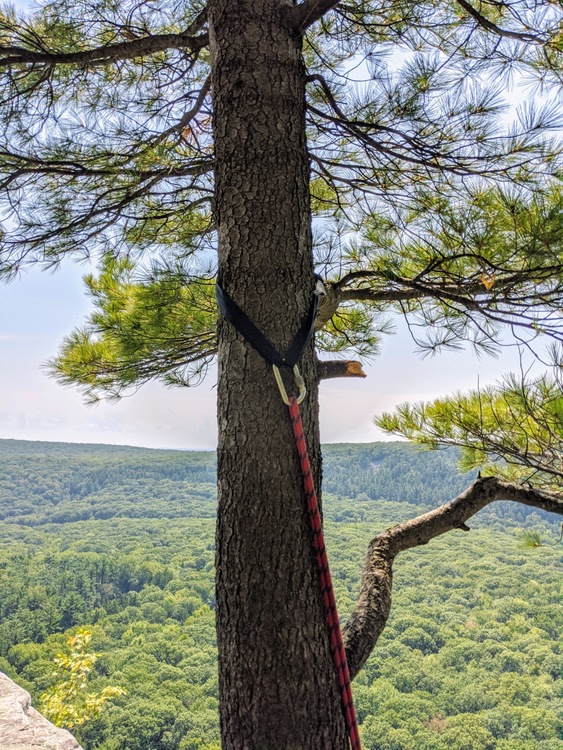 |
|
|
simple clusterfuck Oxymoron |
|
|
Doug Hemken wrote:
"On review I'll give the Berkeley anchor a C+, because both legs have two pieces of gear and they are equally tensioned." A C+? Fuck it, that's above average. I'll take it. I mean, I got through my first degree with lower scores than that. |
|
|
Doug, I took some time to look more closely at each of the pictures you presented, and I'll give you the feedback I'd give clients in an anchor course for each of them (based solely on what I can see and assuming what I can't see is fine).
I guess the general theme I'd press for is more straightforward, more elegant anchors. In the end, the only one with anything close to a "safety issue" is the anchor on Vacillation, and that's pretty minor, assuming the pieces in the left (background) leg are adequate. I've probably built thousands of anchors at the Lake. I rarely pad edges (gasp!), and I've never had an abrasion issue. I've also never had so much as a single piece in an anchor fail, let alone a multiple or complete failure. I've used similar rigging to each of the pictures (minus the quads) for thousands of pitches of professional and recreational climbing at the Lake (and elsewhere); I've never had close to an issue. I'm confused by various anchoring opinions/stories I've heard from you over the years, Doug. I can remember a time at Jackson Falls where I built a rappel anchor with one piece of webbing joining two trees. I made the masterpoint redundant by tying a separate overhand in each leg. Even though you weren't rappelling on the anchor (only I was), you questioned it and thought I shouldn't have bothered with the redundant master point and should have only tied a single overhand leaving one strand of webbing at the master point. I always questioned that thought, and it seems at direct odds with your concerns here. I know the situations are a bit different, but not altogether that different. I know my 23-years of experience in this sport pales in comparison to your tenure, but I've never had an anchor fail. Maybe I'm just lucky, perhaps I haven't been around long enough, and maybe my time is coming, but I'd put my record up against anyone. Anyway, in the end, I stand by my original comment about the situations in which I'd use these anchors. |
|
|
Is this a local guide service? Looks to be similar anchor material and technique. |


