|
|
Cosmiccragsman AKA Dwain
·
Jul 10, 2020
·
Las Vegas, Nevada and Apple…
· Joined Apr 2010
· Points: 146
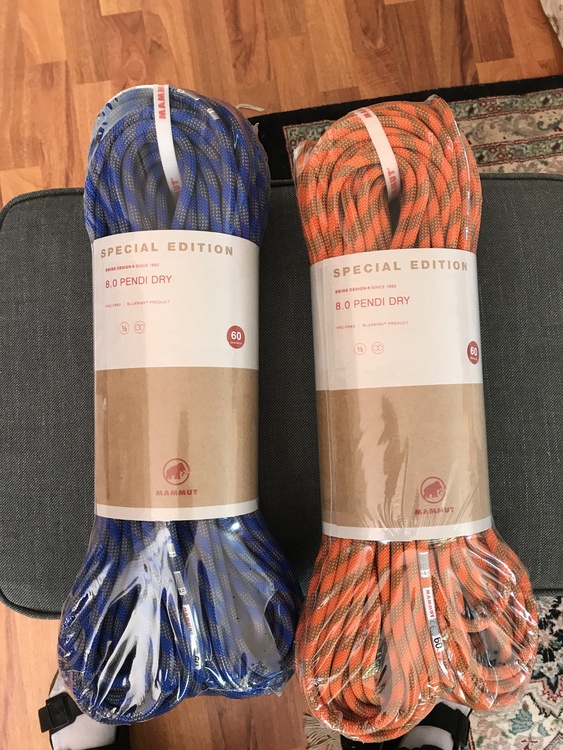
Get up at 4:00 in the morning and you can see this.
|
|
|
Buck Rogers
·
Jul 11, 2020
·
West Point, NY
· Joined Nov 2018
· Points: 240
|
|
|
Buck Rogers
·
Jul 11, 2020
·
West Point, NY
· Joined Nov 2018
· Points: 240
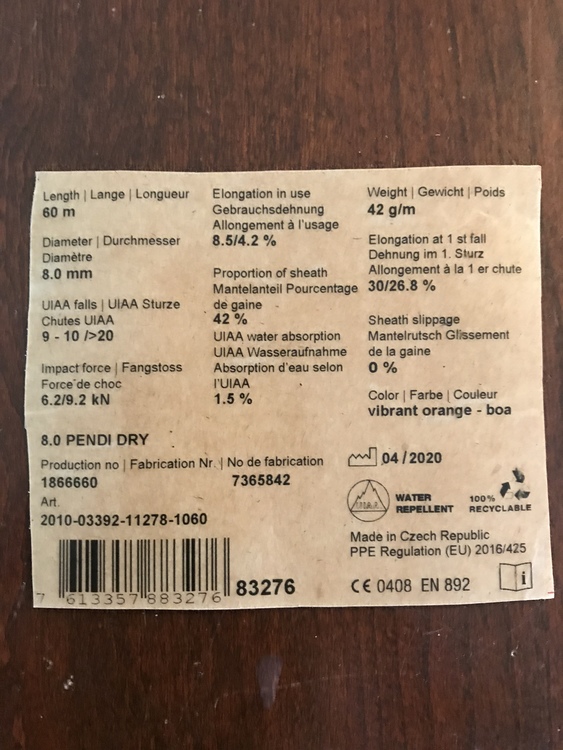
Out of the package they feel great. I'm on-call this weekend so no outside climbing but next weekend will be their maiden voyage!
|
|
|
june m
·
Jul 11, 2020
·
elmore, vt
· Joined Jun 2011
· Points: 124
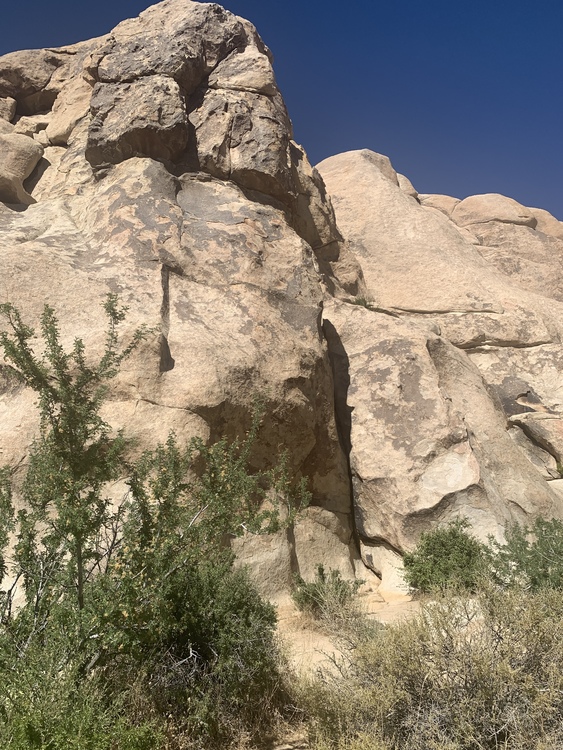
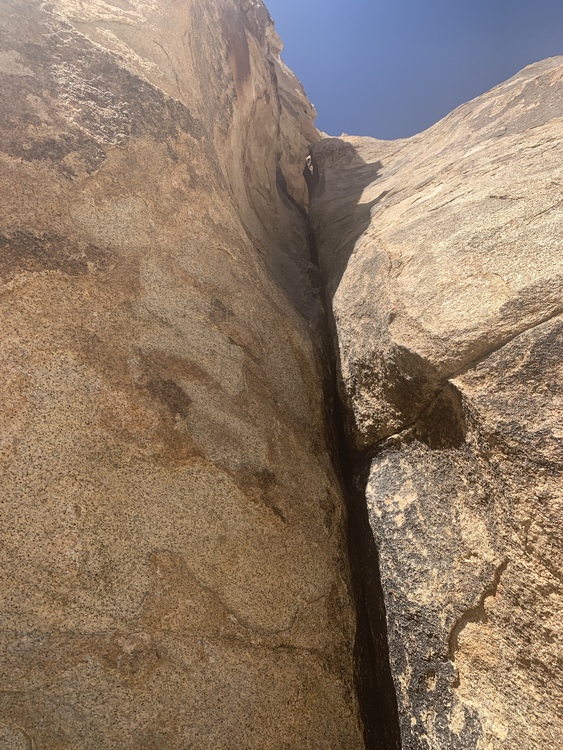
Lori Milaswrote: The route where the rope got stuck... that long crack and little protrusion 2/3 up. The main problem for me would be muscling up and over the overhanging first part... once into the crack the rest would go easier.
So back in the day when we climbed a lot more with hexes than with cams it was pretty common practice when you had a crack where a rope could potentially get stuck to stuff a hex or a nut into the top of the crack so that the Rope could not get stuck in it when it went over the Bulge
|
|
|
Lori Milas
·
Jul 11, 2020
·
Joshua Tree, CA
· Joined Apr 2017
· Points: 250
Buck Rogerswrote: Doubles have arrived! I'm so curious what this is about. I hope you will take pictures. Double ropes, half ropes, is not something I have yet learned about. But it sounds like a really fun adventure for you!
|
|
|
Lori Milas
·
Jul 11, 2020
·
Joshua Tree, CA
· Joined Apr 2017
· Points: 250
june mwrote: So back in the day when we climbed a lot more with hexes than with cams it was pretty common practice when you had a crack where a rope could potentially get stuck to stuff a hex or a nut into the top of the crack so that the Rope could not get stuck in it when it went over the Bulge Hey June, thank you for this! The job of a guide or friend who takes responsibility for an outing is kind of mind-boggling to me. There aren't enough books to cover all the what-ifs, and when someone else takes the lead it does not force learning. Like my kids, I seem to learn by experience the best... for instance, I won't forget this particular incident! But initially this route was just a last-minute thought on my way home. It wasn't in my book. I thought it was an interesting crack, in the shade, and there was already a top rope that could be redirected from the adjacent route. So, why not try it out?
I don't know how anyone lives through this. All I see is danger, everywhere, and more lessons to learn fast. How did the good climbers here ever learn and survive all their stupid early mistakes? Every time I'm out I see another possible way to die or get injured.
Another lesson learned this week (I hope)... I keep hearing about bees swarming. Apparently, you will hear the swarm first, and see a black cloud... as a hive is flying right at you. But, the key is to duck and wait it out... they aren't attacking... they are just moving their nest. One person I know had to throw his partner down and cover her with his body while the swarm flew by. Maybe that wasn't necessary? Glad to have this advance warning before we encounter a swarm.
It's hard not to swat at single bees when they land on a leg or arm, while you are climbing. I believe that, being diabetic, they especially like me.
|
|
|
rgold
·
Jul 11, 2020
·
Poughkeepsie, NY
· Joined Feb 2008
· Points: 526
Lori Milaswrote: The job of a guide or friend who takes responsibility for an outing is kind of mind-boggling to me. There aren't enough books to cover all the what-ifs, and when someone else takes the lead it does not force learning. Like my kids, I seem to learn by experience the best... for instance, I won't forget this particular incident! But initially this route was just a last-minute thought on my way home. It wasn't in my book. I thought it was an interesting crack, in the shade, and there was already a top rope that could be redirected from the adjacent route. So, why not try it out?
I don't know how anyone lives through this. All I see is danger, everywhere, and more lessons to learn fast. How did the good climbers here ever learn and survive all their stupid early mistakes? Every time I'm out I see another possible way to die or get injured.
The old saw about good judgement coming from experience and experience coming from bad judgement applies. You do have to hope and pray that none of your bad judgements are fatally bad, and then experience is only effective if you don't make the same mistake twice. When it comes to anchors (and protection more generally), the buttress against fatal errors is redundancy. Experienced climbers can and do construct two-point gear anchors, but that is cutting the margin thin and there should be a reason why more pieces aren't being used (there are plenty of such reasons, but the decision should be a conscious balancing of risks and rewards). I've got a lot of experience and I would never set up a top-rope gear anchor with only two pieces, for example, even though I'm as capable as anyone of judging the solidity of the two-piece configuration, and use such configurations in certain climbing situations periodically.
Avoiding jammed ropes is one of those things you tend to learn by getting your ropes jammed. Placing directionals to keep the rope from dropping into constrictions is one solution, and moving the position of the top-rope anchor, if possible, is another solution. Inspecting where the ropes might go as you rap down should at least give clues about directionals. If multiple people are top-roping, each one has to remember to reclip the directional after they pass it.
At the end of the day, "experience" can never be just some extensive list of what to avoid. "Covering all the what-if's" isn't possible and isn't the point. The idea is to (1) anticipate problems and (2) make decisions about what actions if any, to take based on the circumstances. If you "see danger everywhere," that's actually a good first step. I think a lot of people get killed by dangers they never saw coming. But "dangers everywhere" could be a paralyzing perception, inducing frustrating and possibly dangerous slowness and even total inaction, so the perception has to be filtered through some sense of how likely those dangers are to happen, what the cost in time, gear, and personal skills will be to mitigate those dangers, and how that cost fits in to the enterprise at hand. The decisions you make in a Patagonian storm are going to be different from ones made on top of a sunny rock at JT, even if the details to be resolved are identical.
I think that one of the difficulties in achieving some level of expertise is that the teaching and learning process tends to provide soup-to-nuts solutions to specific problems, which it is tempting to learn by a rote process that actually quarantines all the knowledge away from all the situations that don't fully resemble the practice example. You can end up knowing a lot of stuff you can't use because of the way it was learned. Something like the Munter Mule is a good example, It is often taught as a component of a self-rescue procedure. But its function is as a releasable hitch. Any time you have to attach something that is going to be hanging from the attachment, there is going to be a problem undoing it if it can't be unweighted. The Munter Mule is the solution to that generic problem. Understanding it that way is different and more effective than memorizing it as step 7 of some self-rescue procedure, and makes it available as a tool when a "what-if" you never contemplated while learning suddenly arises. This is how a certain finite amount of learning manages to cover an infinite amount of what-ifs.
So then the $64,000 question is how to you learn (and, how do you teach) in a way that makes your knowledge available in unanticipated circumstances? If I could answer that I'd probably be very rich and have prizes of various sorts. But the first step, at the learning end, is to think about all the components of the processes you've been taught, trying to identify in some general way what each component really does, so that the component becomes available even under completely different circumstances.
All this requires some metacognition, which is to say thinking about how you learn stuff, not just learning it. An example, that I hope you won't take as too much of a criticism Lori, is why didn't you think about a prusik for protection on the rope once it had jammed? You knew how to tie a prusik, right? And you knew that they slide up the rope but not down right? So what is it in the learning process that blocked your access to that knowledge when you might have needed it? And how, going forward, can you reduce the potential for blocking knowledge you've actually got? If you can manage this, you go from "WTF do I do now?" to "I know a ton of shit---what can I use here?"
|
|
|
Old lady H
·
Jul 11, 2020
·
Boise, ID
· Joined Aug 2015
· Points: 1,375
rgoldwrote: The old saw about good judgement coming from experience and experience coming from bad judgement applies. You do have to hope and pray that none of your bad judgements are fatally bad, and then experience is only effective if you don't make the same mistake twice. When it comes to anchors (and protection more generally), the buttress against fatal errors is redundancy. Experienced climbers can and do construct two-point gear anchors, but that is cutting the margin thin and there should be a reason why more pieces aren't being used (there are plenty of such reasons, but the decision should be a conscious balancing of risks and rewards). I've got a lot of experience and I would never set up a top-rope gear anchor with only two pieces, for example, even though I'm as capable as anyone of judging the solidity of the two-piece configuration, and use such configurations in certain climbing situations periodically.
Avoiding jammed ropes is one of those things you tend to learn by getting your ropes jammed. Placing directionals to keep the rope from dropping into constrictions is one solution, and moving the position of the top-rope anchor, if possible, is another solution. Inspecting where the ropes might go as you rap down should at least give clues about directionals. If multiple people are top-roping, each one has to remember to reclip the directional after they pass it.
At the end of the day, "experience" can never be just some extensive list of what to avoid. "Covering all the what-if's" isn't possible and isn't the point. The idea is to (1) anticipate problems and (2) make decisions about what actions if any, to take based on the circumstances. If you "see danger everywhere," that's actually a good first step. I think a lot of people get killed by dangers they never saw coming. But "dangers everywhere" could be a paralyzing perception, inducing frustrating and possibly dangerous slowness and even total inaction, so the perception has to be filtered through some sense of how likely those dangers are to happen, what the cost in time, gear, and personal skills will be to mitigate those dangers, and how that cost fits in to the enterprise at hand. The decisions you make in a Patagonian storm are going to be different from ones made on top of a sunny rock at JT, even if the details to be resolved are identical.
I think that one of the difficulties in achieving some level of expertise is that the teaching and learning process tends to provide soup-to-nuts solutions to specific problems, which it is tempting to learn by a rote process that actually quarantines all the knowledge away from all the situations that don't fully resemble the practice example. You can end up knowing a lot of stuff you can't use because of the way it was learned. Something like the Munter Mule is a good example, It is often taught as a component of a self-rescue procedure. But its function is as a releasable hitch. Any time you have to attach something that is going to be hanging from the attachment, there is going to be a problem undoing it if it can't be unweighted. The Munter Mule is the solution to that generic problem. Understanding it that way is different and more effective than memorizing it as step 7 of some self-rescue procedure, and makes it available as a tool when a "what-if" you never contemplated while learning suddenly arises. This is how a certain finite amount of learning manages to cover an infinite amount of what-ifs.
So then the $64,000 question is how to you learn (and, how do you teach) in a way that makes your knowledge available in unanticipated circumstances? If I could answer that I'd probably be very rich and have prizes of various sorts. But the first step, at the learning end, is to think about all the components of the processes you've been taught, trying to identify in some general way what each component really does, so that the component becomes available even under completely different circumstances.
All this requires some metacognition, which is to say thinking about how you learn stuff, not just learning it. An example, that I hope you won't take as too much of a criticism Lori, is why didn't you think about a prusik for protection on the rope once it had jammed? You knew how to tie a prusik, right? And you knew that they slide up the rope but not down right? So what is it in the learning process that blocked your access to that knowledge when you might have needed it? And how, going forward, can you reduce the potential for blocking knowledge you've actually got? If you can manage this, you go from "WTF do I do now?" to "I know a ton of shit---what can I use here?" TLDR? A truly great teacher guides us in learning how to question and learn, in our own way. We are so fortunate with you on here, sir!!! I realized a long time ago that I don't track linearly, and later, that many climbers are very linear in their thinking. For me, I will see all sorts of possibilities, including with totally stupid stuff. Rich will testify to that, eh? But, it has been really beneficial for me. If I understand how something works, then that's applied all over the place, as Rich said.
I have to say, yet again?
That one simple hitch, doing an amazing, astonishing, thing on a rope, so elegantly, instantly hooked me with it's beauty. And I discovered I was a climber before I ever climbed rock.
You, Lori, know far more "things" than I do, probably far more than most, and likely more than enough. Let the creative side of your mind play with those concepts. Play with this stuff for real (safely), see what you can get it to do. How else can you solve the problem? What other problem can this solution be applied to?
I've done this on these forums for years now. Usually not with real stuff, mostly in theory. But I have loaded up a bag of gear and tried out things both outside and at the gym. Usually only a basic idea of what I was doing, with most of what I learned being "mistakes".
For starters, it's simply fun! But lacking the skill of "seeing", however you do that? Fatal. You can get there with whatever sort of mind you have, we're all different.
Best, Helen
|
|
|
Andrew Rice
·
Jul 11, 2020
·
Los Angeles, CA
· Joined Jan 2016
· Points: 11
Buck Rogerswrote: Doubles have arrived! Mammut ropes are great.
|
|
|
Andrew Rice
·
Jul 11, 2020
·
Los Angeles, CA
· Joined Jan 2016
· Points: 11
rgoldwrote:
I think that one of the difficulties in achieving some level of expertise is that the teaching and learning process tends to provide soup-to-nuts solutions to specific problems, which it is tempting to learn by a rote process that actually quarantines all the knowledge away from all the situations that don't fully resemble the practice example. You can end up knowing a lot of stuff you can't use because of the way it was learned. Something like the Munter Mule is a good example, It is often taught as a component of a self-rescue procedure. But its function is as a releasable hitch. Any time you have to attach something that is going to be hanging from the attachment, there is going to be a problem undoing it if it can't be unweighted. The Munter Mule is the solution to that generic problem. Understanding it that way is different and more effective than memorizing it as step 7 of some self-rescue procedure, and makes it available as a tool when a "what-if" you never contemplated while learning suddenly arises. This is how a certain finite amount of learning manages to cover an infinite amount of what-ifs. This ^.
I'm so grateful that I grew up exposed to the outdoors. Backpacking, boating, hiking, riding horses, etc. A LOT of the skills and critical thinking that I use as a climber were pre-loaded into my brain from those activities ages ago. Need to hang food from a bear? Rope skills. Need to moor a boat so it stays tied up but simultaneously doesn't bang on the dock? Skills. Need to develop a sense of what's dangerous (for me) and what's not. That's where the 10,000 hours thing comes in.
|
|
|
Old lady H
·
Jul 11, 2020
·
Boise, ID
· Joined Aug 2015
· Points: 1,375
Lori Milaswrote: I'm so curious what this is about. I hope you will take pictures. Double ropes, half ropes, is not something I have yet learned about. But it sounds like a really fun adventure for you! Lori, someone who knows what they're doing with two ropes in hand, is how you can do those traverses you seem drawn to a little more safely! Multipitch!, with you sandwiched between two leaders and tied in to two ropes.
And honkin bigass rappels! Best, Helen
|
|
|
FrankPS
·
Jul 11, 2020
·
Atascadero, CA
· Joined Nov 2009
· Points: 276
Old lady Hwrote: Multipitch!, with you sandwiched between two leaders and tied in to two ropes.
Haven't heard of this technique, Helen. How does it work?
|
|
|
Bob Gaines
·
Jul 11, 2020
·
Joshua Tree, CA
· Joined Dec 2001
· Points: 8,685
Well said rgold.
I'm working on a new book with John Long and we have a chapter about managing risk. Here's a little excerpt:
Longtime YOSAR (Yosemite Search and Rescue) officer, John Dill, studied the most serious climbing accidents that occurred in Yosemite Valley over a two decade period (during which fifty-one climbers died). Dill estimates that 80 percent of those accidents were “easily preventable.” Many survivors told Dill that they lost their good judgment just long enough to get hurt. It’s a complex subject.
Nevertheless, Dill found at least three states of mind that frequently contribute to the majority of outdoor climbing accidents: ignorance, casualness, and distraction.
Ignorance is being unaware of potential danger. Casualness is not taking things seriously enough—complacency reinforced by repeatedly getting away with poor safety habits. Distraction is when our mind wanders away from a critical task while we’re doing it.
“Gravity Never Sleeps.” Neither can we. Accident reports overwhelmingly show that the danger is largely within, and that eternal vigilance is the one quality most likely to bring us safely home.
One thing I always teach is not to engage in conversation when performing critical tasks, like making transitions (eg. toproping to rappelling, etc.)
|
|
|
Old lady H
·
Jul 11, 2020
·
Boise, ID
· Joined Aug 2015
· Points: 1,375
FrankPSwrote: Haven't heard of this technique, Helen. How does it work? An experienced climber leads, belayed by an experienced climber. The noob is tied in to the leaders rope, and climbs, also tied in and trailing the rope for the other experienced climber. They unclip and reclip the draw to each of the ropes as they go up past each draw. Once up, the noob is simply clipped in to the anchor, and the leader brings up the other experienced climber. The noob isn't belaying, cleaning anchors, just climbing when it's their turn. It's rather a nice way to get out, with people who are willing.
Best, Helen
|
|
|
FrankPS
·
Jul 11, 2020
·
Atascadero, CA
· Joined Nov 2009
· Points: 276
Old lady Hwrote: An experienced climber leads, belayed by an experienced climber. The noob is tied in to the leaders rope, and climbs, also tied in and trailing the rope for the other experienced climber. They unclip and reclip the draw to each of the ropes as they go up past each draw. Once up, the noob is simply clipped in to the anchor, and the leader brings up the other experienced climber. The noob isn't belaying, cleaning anchors, just climbing when it's their turn. It's rather a nice way to get out, with people who are willing.
Best, Helen Sounds like you're talking about "caterpillar" style climbing. Where there's really only one leader at a time. Could be either experienced climber, but there's only one leader on each pitch. Edit: Your reference to "two leaders" threw me off!
|
|
|
Old lady H
·
Jul 11, 2020
·
Boise, ID
· Joined Aug 2015
· Points: 1,375
FrankPSwrote: Sounds like you're talking about "caterpillar" style climbing. Where there's really only one leader at a time. Could be either experienced climber, but there's only one leader on each pitch. Lucky for us it isn't millipede, eh? That'd be crowded. Sadly, sir, the OP has blocked me from the OLH thread. No limericks.
Best, Helen (please note, no "." You missed that detail)
EDIT to add, but I did reply, Frank! ;-)
|
|
|
Lori Milas
·
Jul 11, 2020
·
Joshua Tree, CA
· Joined Apr 2017
· Points: 250
rgoldwrote: The old saw about good judgement coming from experience and experience coming from bad judgement applies. You do have to hope and pray that none of your bad judgements are fatally bad, and then experience is only effective if you don't make the same mistake twice. "Covering all the what-if's" isn't possible and isn't the point. The idea is to (1) anticipate problems and (2) make decisions about what actions if any, to take based on the circumstances. If you "see danger everywhere," that's actually a good first step.
All this requires some metacognition, which is to say thinking about how you learn stuff, not just learning it. An example, that I hope you won't take as too much of a criticism Lori, is why didn't you think about a prusik for protection on the rope once it had jammed? You knew how to tie a prusik, right? And you knew that they slide up the rope but not down right? So what is it in the learning process that blocked your access to that knowledge when you might have needed it? And how, going forward, can you reduce the potential for blocking knowledge you've actually got? If you can manage this, you go from "WTF do I do now?" to "I know a ton of shit---what can I use here?" Rich... as always, thank you. Perhaps I think as a mom of 4 little ones, watching them careen around corners, my son Timothy who loved to ride his tricycle on 2 wheels, down the middle of the street until I could run out and swoop him up. I see danger everywhere... but it is not paralyzing. I think it's just common sense. No criticism taken about the prussik... you are EXACTLY right. Maybe given enough time, cool weather, plenty of ground support, eventually I would have had the bright idea to save myself with the prussik. More than likely I would have really floundered and probably tried to walk, scoot, fall down.
I believe I'm learning a lot--so happy to report a new comfort level out there. Over time, some of this is becoming familiar and useable in many ways. Suddenly, setting up an anchor, placing a cam, seeing the end product is becoming easy. "Systems, not steps" is helpful advice for me.
-----------------------
Bob. What a treasure you are! You mentioned distractions, and I don't know how many times you have had to remind me to keep my hands free when lowering (I like to hold my glasses)... and to CONCENTRATE on movements. Not chatter. The day you said to me that if you trip or stumble on a route, you will spend the rest of the day asking yourself how that happened. There have been times you reminded me not to be sloppy or casual in my footwork when I was just schlepping along. Or not to use my knees on a mantle. Or pat the wall searching for a hold. Something I noticed about Jeremy S as well... how very precise he is in his foot and hand placement when climbing tough routes. I look back at some of these pictures of magnificent climbs and think how very fortunate I am for the times we have been out.
Question for you J Tree climbers: what about Watergate Wall? I wish Todd G would stop posting daily pictures of these beautiful routes. And he also posted a pic of a slightly diagonal crack climb in Indian Cove that I believe I've been eyeing for a year-campfire girl. He should stop.
|
|
|
Tim Schafstall
·
Jul 11, 2020
·
Newark, DE
· Joined Nov 2007
· Points: 1,358
Bob Gaineswrote:
Well said rgold.
I'm working on a new book with John Long and we have a chapter about managing risk. Here's a little excerpt:
Longtime YOSAR (Yosemite Search and Rescue) officer, John Dill, studied the most serious climbing accidents that occurred in Yosemite Valley over a two decade period (during which fifty-one climbers died). Dill estimates that 80 percent of those accidents were “easily preventable.” Many survivors told Dill that they lost their good judgment just long enough to get hurt. It’s a complex subject.
Nevertheless, Dill found at least three states of mind that frequently contribute to the majority of outdoor climbing accidents: ignorance, casualness, and distraction.
Ignorance is being unaware of potential danger. Casualness is not taking things seriously enough—complacency reinforced by repeatedly getting away with poor safety habits. Distraction is when our mind wanders away from a critical task while we’re doing it.
“Gravity Never Sleeps.” Neither can we. Accident reports overwhelmingly show that the danger is largely within, and that eternal vigilance is the one quality most likely to bring us safely home.
One thing I always teach is not to engage in conversation when performing critical tasks, like making transitions (eg. toproping to rappelling, etc.)
Bingo. Also, if I'm leading, my belayer best not be chatting it up with someone.
|
|
|
phylp phylp
·
Jul 11, 2020
·
Upland
· Joined May 2015
· Points: 1,142
Bob Gaineswrote:
Dill estimates that 80 percent of those accidents were “easily preventable.” Reading, Accidents in North American Climbing" every year, I come to the same conclusion.
Nevertheless, Dill found at least three states of mind that frequently contribute to the majority of outdoor climbing accidents: ignorance, casualness, and distraction.
It's worth noting that distraction can be other than a momentary careless habit. It can be a "state of being" arising from stressful situations going on in your life. One of the worst climbing accidents I ever had occurred the year following my Mother's death. That was a year of constant grief. Looking back on it, I doubt I was ever really fully present that year.
Now it's a habit of mine, just before leaving the ground to say to myself, "Be here now", "time to focus", "be fully present". Sometimes I say it out loud. That can be just the moment you realize you are about to start up a route without the rack ;-)!
|
|
|
ErikaNW
·
Jul 11, 2020
·
Golden, CO
· Joined Sep 2010
· Points: 410
phylp phylpwrote: Reading, Accidents in North American Climbing" every year, I come to the same conclusion.
It's worth noting that distraction can be other than a momentary careless habit. It can be a "state of being" arising from stressful situations going on in your life. One of the worst climbing accidents I ever had occurred the year following my Mother's death. That was a year of constant grief. Looking back on it, I doubt I was ever really fully present that year.
Now it's a habit of mine, just before leaving the ground to say to myself, "Be here now", "time to focus", "be fully present". Sometimes I say it out loud. That can be just the moment you realize you are about to start up a route without the rack ;-)!
Thank you so much for this. So much truth here. When I was relatively new to the sport I spent a lot of emotional and mental energy on things/tasks that are routine now (including managing fear) - and I did not have any extra bandwidth for even small life stresses. There were plenty of times when I 'didn't feel it that day' and would not climb or bail during particularly stressful periods. Now climbing can be a welcome escape, I don't have to actively think about a lot of tasks (although that does not mean I don't attend to them and double check everything) and the threshold for stress interfering with climbing in that way is higher. Years of mindfulness practice has also helped as I have trained my brain to redirect to what I am doing and being present - I use a lot of the phrases you mentioned Phylp, and often out loud (on the ground, but also while climbing if I feel I am thinking about other things). Another phrase is 'later' - meaning after climbing I can think about whatever it is. Doesn't always work though, a few weeks ago my partner asked me if I actually wanted to take the draws with me as I was starting off up the route! She and I had a good laugh - but glad she noticed before I got too far! I've been under some extreme stress recently and I'm sure that played a big role in my distraction that day.
|

 Continue with onX Maps
 Sign in with Facebook