Mountain Project Logo

New and Experienced Climbers Over 50 #12

rgold · · Poughkeepsie, NY · Joined Feb 2008 · Points: 526
wendy weisswrote:

Rich, Does Bob Williams live in Texas and look like Willie Nelson? Or would that be too much of a coincidence? 

That's probably my friend Bob; he was a professor at University of Austin for many years and still has an email address there.  He now lives in Princeton, NJ (because of the proximity of the Institute for Advanced Study) and has some kind of summer home in Montana.

rgold · · Poughkeepsie, NY · Joined Feb 2008 · Points: 526
Buck Rogerswrote:

Rich, if I could pick your brain I was wondering what you would suggest for half ropes for a week long trip to Switzerland I'm planning for late August.

We'll be doing multiple 8-15 pitch climbs from 5.8 to 5.10 with many requiring raps to get back down.  Slabs, chimneys and general face climbing.  

Amazingly the routes are well bolted and have double bolted belay and rap stations throughout.

I was wondering what thickness you'd suggest for the ropes?  8.5?  9?  I remember that you used half ropes in the Gunks.  Any particular brand you like?   I love Edelrid as acompany and I can get their stuff pretty cheap here in Germany as they are a German company.

Thanks!,,

I'd recommend twin ropes rather than half ropes.  They're lighter, you clip 'em as one, and you have little or no need for the advantages of half ropes on the climbs you described.  The ropes we were using for your Gunks visit were Mammut Genesis 8.5's, which have become legendary for their endurance, but are no longer in production (why, why, why?)  A compromise that would still give you half rope capabilities would be to get a set of 8 mm half ropes.  Nowadays, many of the thin ropes are dual-certified anyway, so the choice ultimately boils down to weight vs. the desire for half-rope technique.

Edelrid makes half ropes at 7.1mm and 7.9 mm, at which point there is no point in getting a twin that isn't half-rated.  I find 7.1 a little scary---that's basically a cordelette made into a rope, but 7.9mm sounds sweet.  Two things to check are the actual weights involved and also sheath percentages.  Higher percentage sheaths translate to increased durability.  I think the Genesis was 45% sheaf, for example.

Oh, and one other thing: make sure to have a belay device that works with the diameters you get.  And this means actual testing in a safe environment as opposed to believing the manufacturer's minimum diameter ratings.  Minimum test is a free-hanging rappel.  If that's a struggle to control, the belay device isn't going to be worth anything for a high fall-factor fall.

wendy weiss · · boulder, co · Joined Mar 2006 · Points: 10
rgoldwrote:

That's probably my friend Bob; he was a professor at University of Austin for many years and still has an email address there.  He now lives in Princeton, NJ (because of the proximity of the Institute for Advanced Study) and has some kind of summer home in Montana.

I met him once a long, long time ago. His cousin, Brett, is a good friend from college. Actually, I think he's her uncle, not cousin. But not sure.

Buck Rogers · · West Point, NY · Joined Nov 2018 · Points: 240
rgoldwrote:

I'd recommend twin ropes rather than half ropes.  They're lighter, you clip 'em as one, and you have little or no need for the advantages of half ropes on the climbs you described.  The ropes we were using for your Gunks visit were Mammut Genesis 8.5's, which have become legendary for their endurance, but are no longer in production (why, why, why?)  A compromise that would still give you half rope capabilities would be to get a set of 8 mm half ropes.  Nowadays, many of the thin ropes are dual-certified anyway, so the choice ultimately boils down to weight vs. the desire for half-rope technique.

Edelrid makes half ropes at 7.1mm and 7.9 mm, at which point there is no point in getting a twin that isn't half-rated.  I find 7.1 a little scary---that's basically a cordelette made into a rope, but 7.9mm sounds sweet.  Two things to check are the actual weights involved and also sheath percentages.  Higher percentage sheaths translate to increased durability.  I think the Genesis was 45% sheaf, for example.

Oh, and one other thing: make sure to have a belay device that works with the diameters you get.  And this means actual testing in a safe environment as opposed to believing the manufacturer's minimum diameter ratings.  Minimum test is a free-hanging rappel.  If that's a struggle to control, the belay device isn't going to be worth anything for a high fall-factor fall.

Brilliant stuff!

Doing some more searching and there was a great deal on the Mammut Pendi 8.0 mm Dry half ropes (27% off) which is certified as both twin and half and is cheaper than the Edelrid one so I went ahead and bought a pair of those.

I use a DMM Pivot for belaying and rappelling and it says that it is rated from 7.3 to 11 mm but I'll double check it at the gym to make sure it works well with the 8.0 mm diameter.

Thanks Rich!  As always, awesome advice and help!

Guy Keesee · · Moorpark, CA · Joined Mar 2008 · Points: 349

Buck - good choice. Two ropes are better than one. I second the “test out your belay device” and would add this. Get a extra belay device so you can loan it out when you climb with someone who doesn’t have one. And sometimes you can put a belayer on each strand. 

Lori Milas · · Joshua Tree, CA · Joined Apr 2017 · Points: 250
Idaho Bobwrote:  Some of my favorite places to climb, hopefully I'll be climbing there again not too far off in the post-pandemic future!
 Cirque of the Towers, Wind River Range

City of Rocks

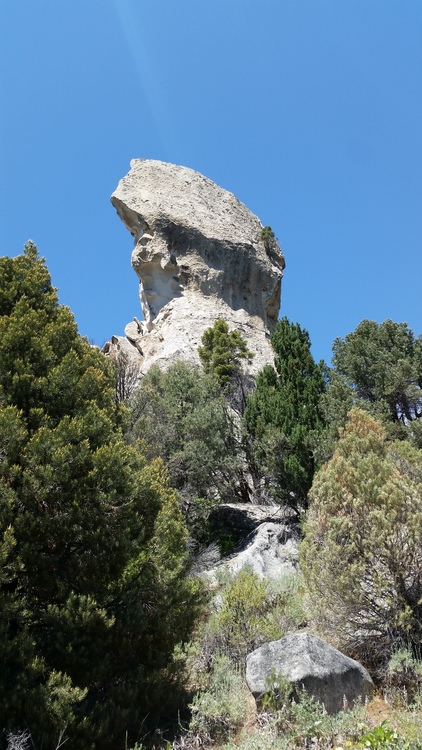
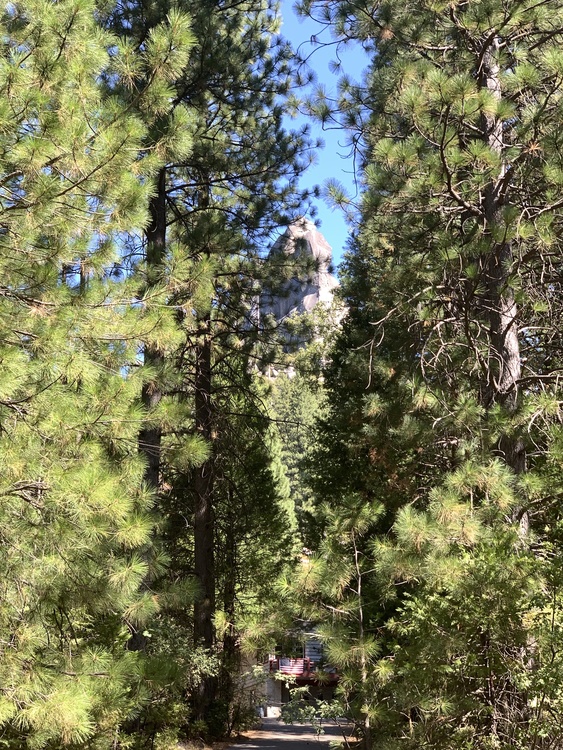
City of Rocks is surely looking fun.  This formation reminds me of one I have wanted to visit in Tahoe called Sugarloaf.  On our way to Lovers Leap last year I happened to glance off to the left of me and saw this surreal spire jutting up above the trees.  Whoa!  Let's go there!  I am advised that this isn't as wonderful as I hope it will be... there is the much greater Lovers Leap a few miles further.  And I guess the hike is a hassle.  Still, I'd like to go this year and see what it's all about.


I've been mulling over the conversations here... starting with Helen's wisdom of "Just stand up".  To the true athletes here this must sound silly, but for me it was sound advice--still ringing.  Senor is cycling 100 miles a week. Climbers here share their rigorous workout routines.  But I've been wondering where my mojo went.  I've honestly thought that maybe my season has passed... (always wondered what happens when you are finally 'old'... maybe this is it!  You just lay down and lose all interest.)
I appreciate Rich also a few pages back talking about rowing being 'terminally boring'... a lot of exercise is.  (And yet he did it and continues to workout).  But it was when he got back out on the trails that he realized what he had lost from being down for a season.  (paraphrased)

Brandt has a workout room in his garage that I really want to see.  I think a wall, or the right equipment, and some great music, would go a long way towards getting fit, especially when it's too cold/hot or otherwise.

But here's my take so far: every day since I've been here I have 'stood up' and left the house, usually into the Park, to do something, anything.  From starting heavy, sluggish, barely fitting into my shorts 6 weeks ago... out of breath and wanting to take a nap... my body is back into some recall.  Every day I feel a little stronger.  Muscle memory is coming back.  Our route the other day actually required some upper body strength, a mantle, something besides strong toes, and it was fairly easy.    So all those gym muscles didn't totally atrophy.  

I'm guessing Helen and I won't be riding 100 miles a week (yet).  High-five and big props for just standing up.  

-------------------

Also, Rich, the prussik loop caught my attention.  I also carry one, but I would have hung there and had no idea how to use it to ascend.  

I can start asking these questions when I'm out.  Last year I asked Bob to show me a pick-off, which went really well but having not repeated it, I wouldn't remember how to do it today.  It just seems like knowing this stuff would be really important...  along with a refresher course on CPR.  People seem to fall around here where there is no cell service for miles. 

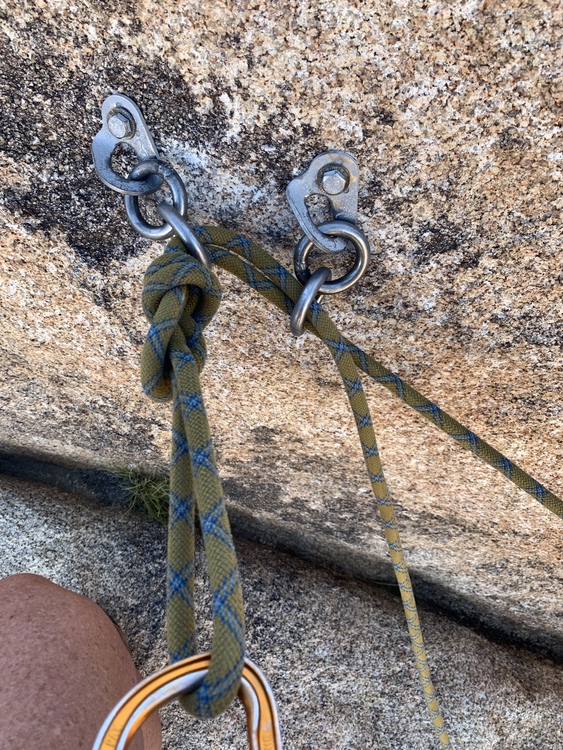
When climbing this week Matt demonstrated cleaning an anchor while still on belay, and lowering on belay.  I THOUGHT he was about to demonstrate cleaning an anchor and rapping back down. The mess of ropes had me quite confused.  Maybe I'm one of those who just needs to repeat until it's mine.


Lori Milas · · Joshua Tree, CA · Joined Apr 2017 · Points: 250
Buck Rogers · · West Point, NY · Joined Nov 2018 · Points: 240
Lori Milaswrote: 

Nice!

I'll have to remember that when my daughter makes a chocolate pudding cake at 9 pm (like she did last night) and offers me a piece!!!

Dallas R · · Traveling the USA · Joined May 2013 · Points: 191
Lori Milaswrote: When climbing this week Matt demonstrated cleaning an anchor while still on belay, and lowering on belay.  I THOUGHT he was about to demonstrate cleaning an anchor and rapping back down. The mess of ropes had me quite confused.  Maybe I'm one of those who just needs to repeat until it's mine.


Lori, I would be interested in knowing how you got the rope to look like that while on belay.  

As we travel around and climb I find the different clean and lower vs clean and rap discussion interesting.  I find areas that have a strong, well funded, climbing community favor the clean and lower scenario, it's safer. 

Here's a facebook post by Chockstone Climbing in Smith Rock.  "Another one bites the dust."  The climbing communtiy, Chockstone, Smith Rock Climbing, Smith Rock Group, all work diligently to monitor and replace hardware there.  I would suspect that there is a pretty good climbing community in Joshua Tree as well. COR?  The times we were in Castle Rocks we talked with the "Climbing Ranger".  He and some young volunteers were working on trail improvement.  Salt Lake City Climbers are pretty strong.  Friends of Enchanted Rock and Austin Climbers do good work. 

Yet sadly I also see some places where the hardware is getting pretty thin and there is no one doing the maintenance.  Strawberry in CA, Lolo in MT come to mind.  

So a great big thank you to those with bolting tools on your belts.  I do my part by cleaning and rapping and only pulling unweighted ropes. 

Buck Rogers · · West Point, NY · Joined Nov 2018 · Points: 240
Dallas Rwrote: Lori, I would be interested in knowing how you got the rope to look like that while on belay.  

As we travel around and climb I find the different clean and lower vs clean and rap discussion interesting.  I find areas that have a strong, well funded, climbing community favor the clean and lower scenario, it's safer.

Here's a facebook post by Chockstone Climbing in Smith Rock.  "Another one bites the dust."  The climbing communtiy, Chockstone, Smith Rock Climbing, Smith Rock Group, all work diligently to monitor and replace hardware there.  I would suspect that there is a pretty good climbing community in Joshua Tree as well. COR?  The times we were in Castle Rocks we talked with the "Climbing Ranger".  He and some young volunteers were working on trail improvement.  Salt Lake City Climbers are pretty strong.  Friends of Enchanted Rock and Austin Climbers do good work.

Yet sadly I also see some places where the hardware is getting pretty thin and there is no one doing the maintenance.  Strawberry in CA, Lolo in MT come to mind.  

So a great big thank you to those with bolting tools on your belts.  I do my part by cleaning and rapping and only pulling unweighted ropes.

Two types.  This one looks like the pinch technique of passing it through the anchors.

Here's a great AMGA vid that I used to review prior to heading back outside this year.

https://www.youtube.com/watch?v=WzmbTHe_ql0

Lori Milas · · Joshua Tree, CA · Joined Apr 2017 · Points: 250
Dallas Rwrote: Lori, I would be interested in knowing how you got the rope to look like that while on belay.  

I would be, too!     Fact is, I was so fixated on cleaning and rapping that it took me awhile to realize we were cleaning and lowering while on belay.  So, this one will be a do-over which I will video.  One thing about teaching this to others is to keep it real simple, and one lesson at a time.  Nelson frequently says "I don't want you to memorize steps. I want you to memorize systems.  Know where you're at and what you are trying to achieve at all times."

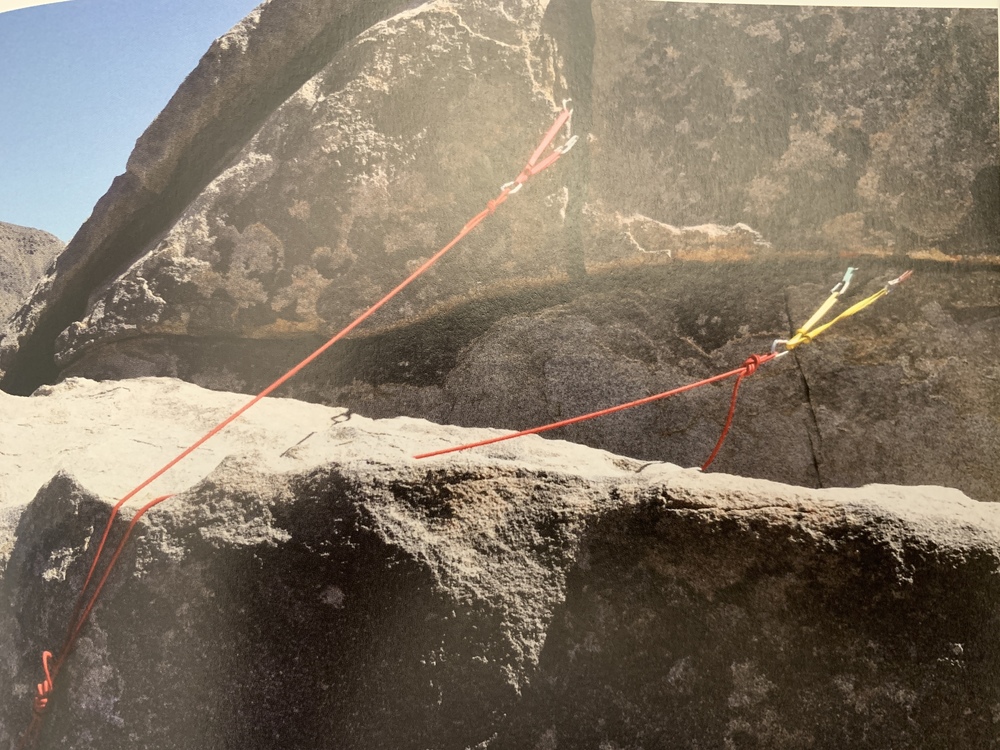
Although we have climbed many bolted routes, I understand that Joshua Tree greatly favors building anchors into rock from cams/nuts and cordalettes, which I am learning to do.  Something I didn't see much in Tahoe is bringing a short static rope for throwing around boulders, etc.  and/or creating "The Joshua Tree System".  I see this a lot.  (Anywhere else?)  Bob Gaines pic in his book Advanced Rock Climbing.
Here's where we may part ways.  I'm just trying to learn this in a way where I can guarantee no fluster, and no adrenaline while I am high on a route and trying to move up or down.  This just has to be second-nature and I need to know what to do when Plan A fails.
Andrew Rice · · Los Angeles, CA · Joined Jan 2016 · Points: 11
Lori Milaswrote:  Something I didn't see much in Tahoe is bringing a short static rope for throwing around boulders, etc.  and/or creating "The Joshua Tree System".  I see this a lot.  (Anywhere else?)  Bob Gaines pic in his book Advanced Rock Climbing.

It's a valuable system anywhere but particularly in J-tree because of the substantial number of single pitch trad routes and the fact that there's often a big boulder or a couple cracks located significantly AWAY from the edge of the top of J-tree climbs. 

Bob Gaines · · Joshua Tree, CA · Joined Dec 2001 · Points: 8,693

The Joshua Tree System also works great at toproping areas that have trees, and you can do it all with just the rigging rope.

If you have two trees to work with here are the steps:

1. Tie the end of the rigging rope around one tree with a simple bowline, backed up with half a double fisherman's

2. As you approach the edge, protect yourself with a tether. Attach a double-length nylon sling to the rigging rope with a klemheist, then clip the sling to your belay loop with a locker

3. Tie a BHK for your masterpoint over the edge

4. Tie the rigging rope to a second tree with a bowline with-a-bight

PS: At Joshua Tree there aren't many trees up on the rock, and the NPS at Joshua Tree prohibits the use of trees for anchors.

Carl Schneider · · Mount Torrens, South Australia · Joined Dec 2017 · Points: 0

Lori said '... When climbing this week Matt demonstrated cleaning an anchor while still on belay, and lowering on belay....
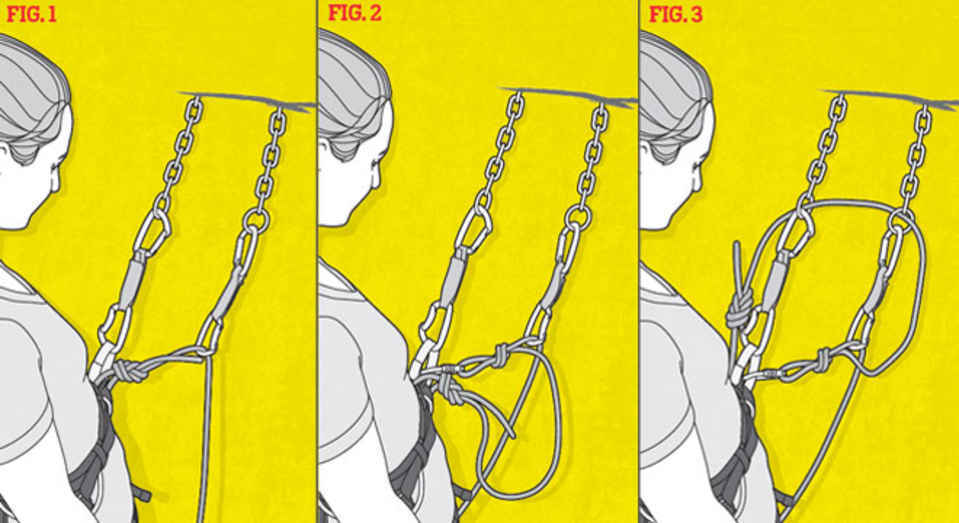
I always use that method if I can. If I'm reading the picture correctly it' s where one takes a bight of rope, threads it through the anchor ties a fig 8 on the bight, attaches that to a locking carabiner attached to your belay loop. You then untie your original fig 8, weight the rope and get lowered off. The benefit is two fold, no chance or dropping the rope and you are always on belay. One can't always do it if the rings are too small. Also, often the ethic is not to lower of the fixed gear. It's more acceptable if the anchor has locking biners or mallions that are replaceable.


EDIT, I must say if I use the other method I always attach the rope to my harness before untying my fig 8 of course. 
Lori Milas · · Joshua Tree, CA · Joined Apr 2017 · Points: 250

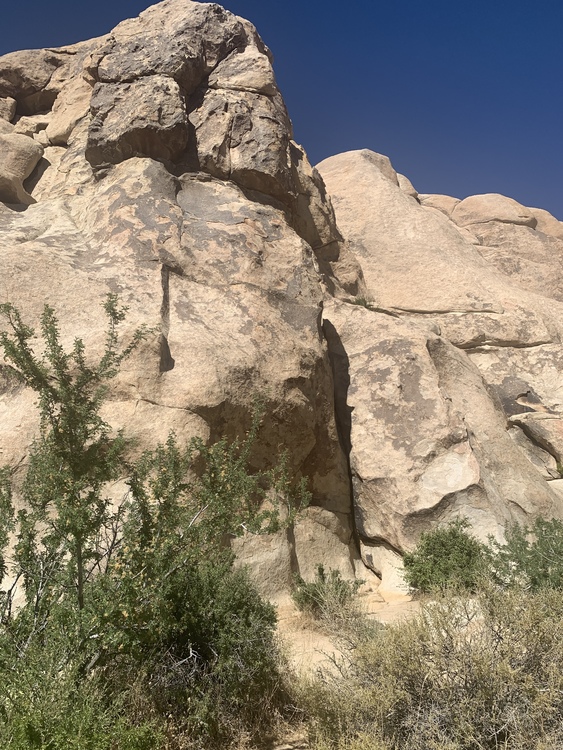
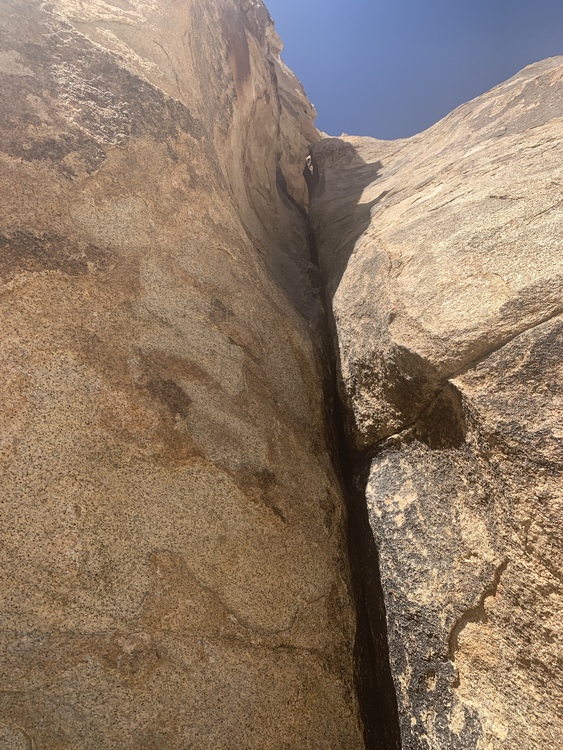
The route where the rope got stuck... that long crack and little protrusion 2/3 up.  The main problem for me would be muscling up and over the overhanging first part... once into the crack the rest would go easier. 

Andrew Rice · · Los Angeles, CA · Joined Jan 2016 · Points: 11
Lori Milaswrote: The route where the rope got stuck... that long crack and little protrusion 2/3 up.  The main problem for me would be muscling up and over the overhanging first part... once into the crack the rest would go easier.
Just so I understand, the CLIMBER'S side of the rope got stuck? 

budman · · Moab,UT · Joined Mar 2008 · Points: 11
Lori Milaswrote: The route where the rope got stuck... that long crack and little protrusion 2/3 up.  The main problem for me would be muscling up and over the overhanging first part... once into the crack the rest would go easier.

Looks like Fun Stuff area in Echo cove.  Some times when setting top ropes you need to rap down and place directionals to keep the climbers rope running free just as a lead climber does to avoid rope drag.

Lori Milas · · Joshua Tree, CA · Joined Apr 2017 · Points: 250
budmanwrote:

Looks like Fun Stuff area in Echo cove.  Some times when setting top ropes you need to rap down and place directionals to keep the climbers rope running free just as a lead climber does to avoid rope drag.

Amazing you guys can identify one rock out of thousands.    You are exactly right.  It is an interesting crack I wanted to try after climbing Fun Stuff—I do not believe it’s in the guidebook I have. 

It was a good learning experience, and I feel fortunate I was close to the ground when the rope jammed.  Directionals would have helped for sure.  

Brandt Allen · · Joshua Tree, Cal · Joined Jan 2004 · Points: 220

The name of the route is Raging Intensity. With good reason, it's not an especially popular route.

rgold · · Poughkeepsie, NY · Joined Feb 2008 · Points: 526

When it comes to elder fitness, the following quote from Shawangunk climbing pioneer and physical fitness expert Bonnie Prudden seems relevant!


So I'm thinking of putting a note on the fridge: "Did you wind the clock today?"

This topic is locked and closed to new replies.

Log In to Reply
Welcome

Join the Community! It's FREE

Already have an account? Login to close this notice.